


Lei Jun stepped into the car manufacturing circle.

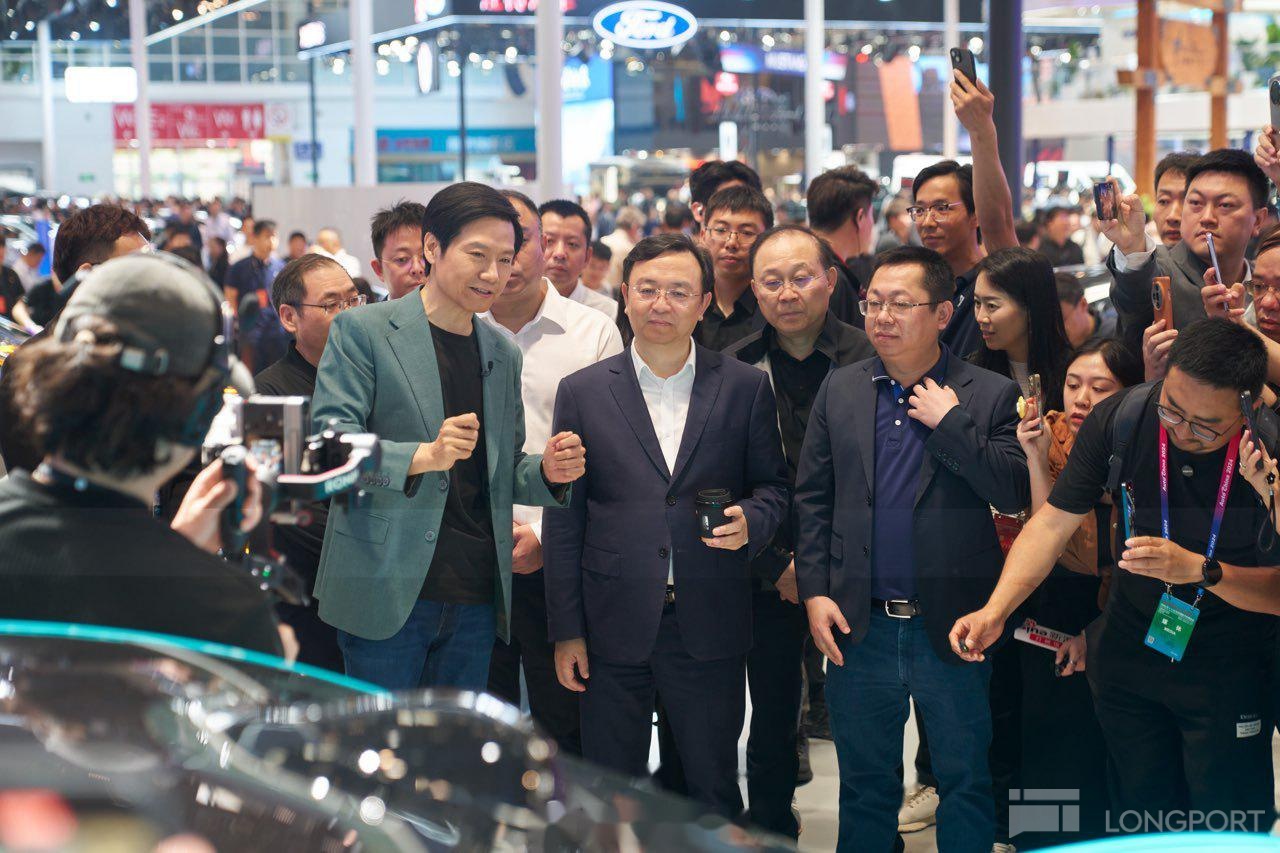
If one word could describe Xiaomi's venture into car manufacturing, "fast" would undoubtedly be the most fitting.
However, Xiaomi's speed isn't just reflected in the rapid production and delivery of their new cars, but also in how quickly Lei Jun has integrated into the automotive industry.
This can be seen from Lei Jun's frequent interactions with various players in the automotive sector during the Beijing Auto Show.
The new energy vehicle (NEV) upstarts represented by Nio, XPeng, and Li Auto are naturally part of this.
Nio's William Li even filmed a video with Lei Jun, standing shoulder to shoulder and shouting the slogan "Power up China's new energy vehicles." Similarly, Li Xiang of Li Auto frequently interacted with Lei Jun, even stating that "the Li Auto L6 isn't profitable."
If Lei Jun's interactions with Nio, XPeng, and Li Auto stem from an inherent camaraderie due to their shared industry, then his exchanges with Great Wall Motors' Wei Jianjun showcase Lei Jun's successful transition from a "tech influencer" to an "auto industry influencer."
Beyond gifting Wei Jianjun a Xiaomi SU7, Lei Jun also proposed standardizing charging interfaces across automakers during the Beijing Auto Show to reduce costs and improve consumer experience.
Lei Jun told Wei Jianjun, "I mentioned this to Li Xiang and He XPeng yesterday, and they were quite receptive. William Li also joined the discussion at noon. Could we unify the ecosystem? If we can, the possibilities would expand significantly. How about you take the lead in organizing this?"
It's safe to say that Lei Jun is no longer the man who only talked about Xiaomi smartphones—he’s now a bona fide auto industry veteran.
This aligns with Lei Jun's earlier self-positioning: in the coming period, he will focus his time and energy on car manufacturing to establish a second growth curve for Xiaomi.
Predictably, Lei Jun and the massive influence he carries will gradually shift from the tech sector to the auto industry, ushering in a new phase of development for car manufacturing.
However, just as the NEV market faces reshuffling and adjustments, Lei Jun, now stepping into the auto industry, may encounter even greater challenges.
I
As the saying goes, "The duck knows first when the river warms in spring."
Leading companies in any industry are always the first to sense profound changes.
Similarly, if one word could describe the current NEV market, "winter is coming" would be an understatement.
This is evident in Tesla's global layoffs and halted spring recruitment.
It’s also visible in the growing challenges faced by NEV players like Nio, XPeng, and Li Auto.
Whether it’s the PR storm following the launch of the Li Auto MEGA, Nio's pivot to making smartphones, or the skepticism surrounding XPeng's stock performance—all reflect this trend.
The NEV market has moved past its golden era of capital and hype. What truly tests these players now isn’t just their ability to craft concepts and market them, but their capacity to drive innovative changes in the industry.
This brings to mind Jia Yueting’s message to Lei Jun when the Xiaomi SU7 launched:
Only when a culture of innovation prevails over copycatting; only when originality is ingrained in entrepreneurs’ DNA, rather than a follower mentality being treated as gospel;
Only when great entrepreneurs and risk-takers emerge, not just successful businesspeople;
Only when industry leaders become pioneers, not shortcut-takers;
Only when global values drive market conquests, not just local profits—can we truly advance technology and lead global industrial transformation.
In short, while the auto market still brims with hype and potential, if players focus solely on marketing without delivering real innovation, Lei Jun’s once-foolproof smartphone strategies may face mounting challenges as consumers grow weary of gimmicks.
II
Lei Jun’s frequent interactions with auto giants at the Beijing Auto Show clearly position him as an industry insider. But this is superficial—rooted in hype and marketing, not the product and technological prowess that will define the industry’s future.
Admittedly, such surface-level tactics can attract attention.
But once the hype fades and competition shifts to hardcore capabilities, this approach won’t just fail to help—it could backfire.
Thus, while Lei Jun and Xiaomi have stormed into the auto market with lightning speed, this is just the beginning.
The real challenges for Xiaomi’s car venture may have only just begun.
Lei Jun’s entry into the auto industry is merely the opening act.
For Xiaomi to replicate its smartphone success in cars and build a seamless "human-car-home" ecosystem, the road ahead is long, and the learning curve steep.
This echoes Xiaomi’s "tribute" posts to established automakers. Whether these are marketing ploys or genuine humility, one thing is certain: in this new battlefield, Xiaomi has much to learn.
Take the Xiaomi SU7. While innovative and well-targeted at its consumer base, if it remains a standalone model—unlike Xiaomi’s smartphone lineup that caters to diverse needs—Xiaomi’s car venture will struggle to scale.
Unless Xiaomi’s cars form a robust ecosystem integrating with its smartphones and smart home devices, its "human-car-home" vision may remain a pipe dream.
From this perspective, Lei Jun’s auto foray is just the starting line.
Building a complete product lineup and ecosystem from here is a marathon, not a sprint.
III
Lei Jun’s move into cars marks Xiaomi’s entry into a new phase.
More precisely, it signals Xiaomi’s ambition to build a "human-car-home" ecosystem.
Lei Jun and Xiaomi are undoubtedly successful.
But as they enter this new cycle, the auto industry itself is undergoing transformation.
In this new era, what tests players isn’t just marketing, but hardcore automotive expertise.
Tesla’s dominance in the auto market goes without saying.
Tesla still controls pricing power—any price cut triggers similar moves from Chinese NEV players.
This underscores Tesla’s entrenched dominance.
Beyond Tesla, China’s NEV sector is undergoing a deep reshuffle.
The market is overcrowded and chaotic—evident in the collapse of Evergrande Auto, HiPhi’s shutdown, and the bankruptcy of Byton, once grouped with Nio, XPeng, and Li Auto as the "Four NEV Dragons."
Lei Jun’s auto debut was undeniably successful.
This is clear from the media frenzy around the Xiaomi SU7 launch and the overwhelming public interest in its pricing.
But this is just a good start.
The key to Xiaomi’s auto success lies in rapidly scaling SU7 production and delivery, and expanding its car lineup.
With Lei Jun’s experience in smartphones, entering the auto industry was easy.
But replicating Xiaomi’s smartphone success—or sparking a butterfly effect—won’t happen by simply copying past strategies.
Lei Jun’s auto venture so far reflects Xiaomi’s past successes, not groundbreaking innovation in this new field.
Perhaps this is why Jia Yueting, stranded overseas, struggles to break FF’s bottlenecks.
For Lei Jun, these are the real challenges—ones that can’t be solved with hype and marketing alone.
Epilogue
Lei Jun’s frequent auto industry interactions at the Beijing Auto Show paint him as a seasoned player.
But is this really the case?
Perhaps it only shows the continuity of Xiaomi’s past successes, not proof of automotive triumph or a fully realized "human-car-home" ecosystem.
Lei Jun’s auto entry is just the beginning.
In this new secret garden, the real puzzles for Lei Jun and Xiaomi are only starting to emerge.
And these puzzles can’t be solved with the hype and marketing tactics Xiaomi excels at.
Perhaps this is why Lei Jun, upon entering the auto world, finds it "a whole new ballgame."
And this will determine whether his auto venture succeeds. $XIAOMI-W(01810.HK)
—The End—
Author: Meng Yonghui, Senior Writer, Columnist, Industry Observer, Influencer, Digital Economy Scholar.
The copyright of this article belongs to the original author/organization.
The views expressed herein are solely those of the author and do not reflect the stance of the platform. The content is intended for investment reference purposes only and shall not be considered as investment advice. Please contact us if you have any questions or suggestions regarding the content services provided by the platform.
