


 Posts
PostsBitcoin ecosystem knowledge pyramid, test which level you are at

Written by: Jaleel, BlockBeats
With the birth of the Runes protocol and the third wave of the Bitcoin ecosystem, more and more communities are paying attention to the Bitcoin ecosystem. However, the biggest confusion for most newcomers is still "the high barrier to entry in the Bitcoin ecosystem." Therefore, BlockBeats has categorized the various terms in the Bitcoin ecosystem into five knowledge tiers, gradually unveiling the mysteries of the Bitcoin ecosystem.
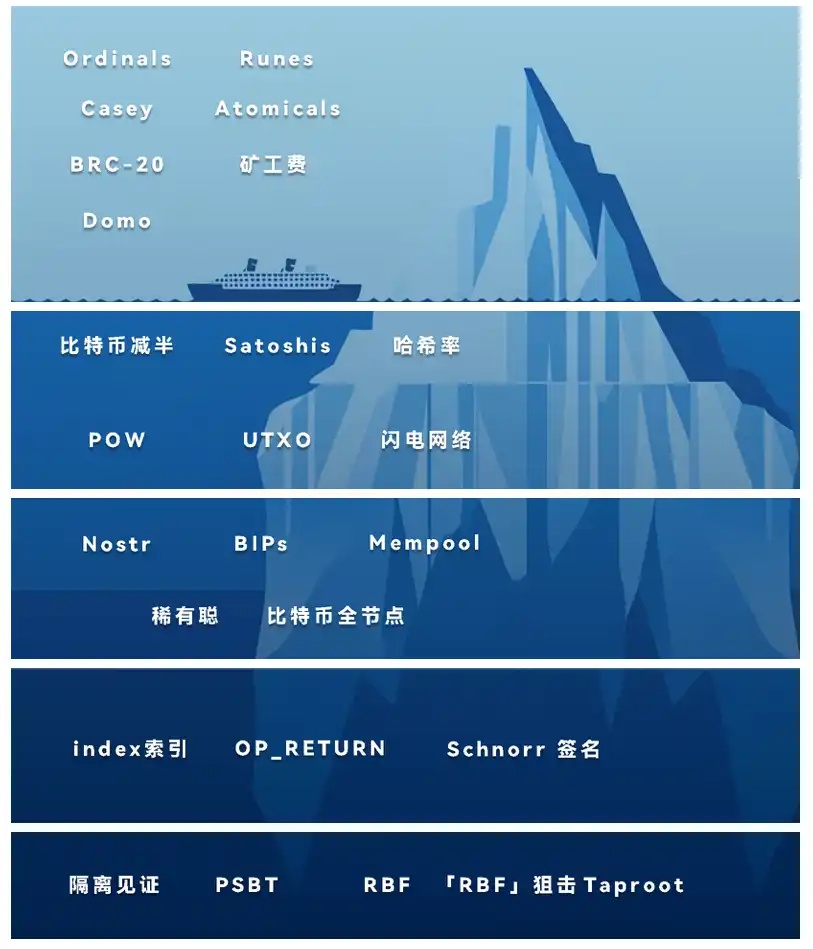
Beginner Tier: Topics Familiar to Most Bitcoin Newcomers
1. Ordinals
The Ordinals protocol focuses on minting NFTs on Bitcoin's smallest unit—the satoshi—leveraging Bitcoin's Taproot upgrade to allow each satoshi to represent a unique digital asset. By utilizing Bitcoin's inherent blockchain features, Ordinals enables each satoshi to uniquely represent a digital asset, bringing NFT-like functionality to the Bitcoin network without requiring any additional layers or tokens.
2. Casey Rodarmor
Casey Rodarmor (@rodarmor) is a programmer and Bitcoin developer, as well as the creator of the Ordinals and Runes protocols. Through the development of the Ordinals protocol, Casey introduced a new way to store and transfer non-monetary data (such as digital art) directly on the Bitcoin blockchain. It's fair to say that without Casey, the Bitcoin ecosystem wouldn't exist.

Source: Ordinals Summit 2023
3. BRC-20
BRC-20 is an experimental standard for creating and transferring fungible tokens on the Bitcoin network. It was introduced by the anonymous developer Domo in March 2023, aiming to mimic Ethereum's ERC-20 standard. Unlike ERC-20, which uses smart contracts, BRC-20 tokens are created by inscribing JSON data on Bitcoin's smallest unit, the satoshi.
4. Domo
Domo (@domodata) is the creator of the BRC-20 protocol. Since developing BRC-20, Domo has remained anonymous and has since founded the Layer 1 Foundation to assist with BRC-20 governance.

Source: Ordinals Summit 2023
5. Runes
Runes is a new Bitcoin protocol developed by Casey Rodarmor, the creator of Bitcoin Ordinals. Unlike Ordinals, which is used for issuing NFTs, Runes is designed for issuing fungible tokens on the Bitcoin network. It allows users to create, mint, and transfer tokens directly within Bitcoin's UTXO model, without relying on any centralized services or intermediaries. Runes optimizes the BRC-20 protocol by combining the minting and listing processes into a single transaction.
6. Atomicals
The Atomicals protocol enables the creation and management of digital assets called ARC-20 on the Bitcoin blockchain. These assets use the UTXO model and can store multiple files, making them suitable for more complex applications. Unlike BRC-20 and Ordinals, Atomicals' AVM is designed for greater flexibility and scalability, offering smart contract-like functionality for more sophisticated digital asset management. Compared to Casey and Domo, the author of the Atomicals protocol, Arthur, is even more anonymous, never appearing in public or at offline events and only participating in a few audio interviews.
7. Miner Fees
Fees paid by users to miners for including their transactions in a block. Miner fees are transaction fees on the Bitcoin network, ensuring economic incentives for miners to support the network's operation and security.
Second Tier: Topics Familiar to Most Bitcoin Enthusiasts
1. Bitcoin Halving
Bitcoin halving refers to the event where the mining reward is cut in half, occurring every 210,000 blocks (approximately every four years). The primary purpose of halving is to control Bitcoin's issuance, simulating the gradual reduction in the mining rate of scarce resources like gold. Halving directly impacts miners' incentives and is believed to significantly influence Bitcoin's price. The most recent halving occurred on April 20, 2024, and the next is expected around February 2028 at block height 1,050,000.
2. Satoshis
Translated as "sats" in Chinese, satoshis are the smallest unit of Bitcoin, with 1 Bitcoin equaling 100,000,000 satoshis. Given Bitcoin's potentially high value, satoshis provide a smaller monetary unit, enabling microtransactions.
3. Hash Rate
Hash rate refers to the number of hash attempts per second by all mining devices in the network, typically measured in hashes per second (H/s). It is a key metric for assessing Bitcoin's network security, with higher hash rates indicating greater computational difficulty and security.
4. POW
Short for Proof of Work, POW is a cryptographic algorithm used to prevent network abuse (e.g., spam or DDoS attacks). Bitcoin's POW requires miners to solve a complex mathematical problem, with the difficulty automatically adjusted to ensure a new block is added approximately every 10 minutes. Successful miners can add new blocks to the blockchain and receive newly minted Bitcoin as a reward. This process not only protects the network from attacks but also serves as Bitcoin's monetary issuance and circulation mechanism.
5. UTXO
Short for Unspent Transaction Outputs, UTXOs represent Bitcoin amounts in the network that can be used as inputs for new transactions. Bitcoin's transaction model is based on UTXOs, where each transaction references previous transaction outputs as inputs and creates new UTXOs for future transactions.
6. Lightning Network
The Lightning Network is a "Layer 2" payment protocol built on top of the Bitcoin blockchain, designed to enable instant, high-throughput micropayments. By creating a network of payment channels, the Lightning Network reduces congestion and fees on the blockchain, making small transactions economical and fast.
Third Tier: Topics Familiar to Bitcoin OGs
1. Nostr
Nostr is a simple decentralized social networking protocol that uses key pairs to allow users to create and manage their identities and communicate through events (e.g., posts, contact info, and other social interactions). Founded by Fiatjaf (@fiatjaf), this protocol is not directly linked to Bitcoin but has garnered significant attention from Bitcoin supporters due to its decentralized and censorship-resistant nature. In April 2023, a Lightning Network "custodial solution" called Nostr Assets Protocol also adopted the Nostr name.
2. BIPs
Short for Bitcoin Improvement Proposals, BIPs are community-driven design documents proposing new features, information, or environmental improvements for the Bitcoin community to review. BIPs are a critical part of Bitcoin's development process, providing a formal pathway for network improvements.
3. Mempool
The mempool (short for "Memory Pool") is the collection of all unconfirmed transactions stored on a Bitcoin network node. When a transaction is sent to the Bitcoin network but not yet included in a block (confirmed), it resides in the mempool. Miners select transactions from the mempool to create new blocks, typically prioritizing those with higher fees.
4. Rare Satoshis
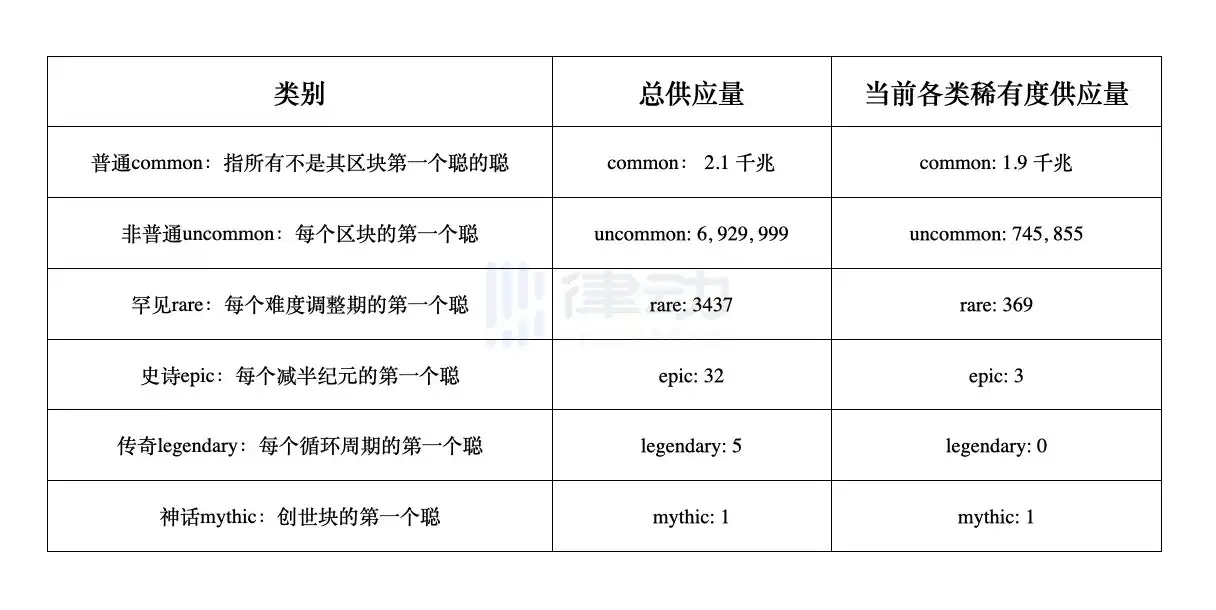
Rare satoshis are not an official Bitcoin network term but emerged after the advent of Ordinals, referring to satoshis with collectible value due to their association with specific block times. Bitcoin's smallest unit is the satoshi, with each Bitcoin consisting of 100 million satoshis. The scarcity and uniqueness of satoshis can be determined by ordinal theorists, assigning special meaning to satoshis—whether they were mined by Satoshi Nakamoto, the first satoshi in a block, or satoshis used to buy pizza. Related reading: "Rare Satoshis: The Next Wave of Hype After BRC-20, Are You Positioned?"
5. Bitcoin Full Node
A Bitcoin full node is a complete client running the Bitcoin protocol, maintaining a full copy of the blockchain. Full nodes validate all transactions and blocks, ensuring compliance with Bitcoin's rules. They are crucial for the network's health and decentralization, distributing power and preventing any single entity from controlling or altering Bitcoin's transaction history. Full nodes also enhance security, as more nodes validating transactions make it harder to manipulate the system.
Fourth Tier: Delving Deeper into the Rabbit Hole
1. Index
In the context of Bitcoin, "index" or "索引" typically refers to structures in the blockchain database used for quick data retrieval. For example, a transaction index (txindex) is an optional feature that allows nodes to create an additional database storing metadata for each transaction, including their position in the blockchain. Enabling the transaction index allows nodes to access transaction information faster, which is useful for developing applications and services that require extensive blockchain data queries.
2. OP_RETURN
OP_RETURN is an opcode in Bitcoin's scripting language that allows embedding a small amount of data (currently capped at 80 bytes) into a Bitcoin transaction. This data is unspendable and cannot be used as input. OP_RETURN is primarily used to add metadata to transactions, enabling applications like timestamping services, simple messaging, or more complex blockchain-layer solutions. Since this data is permanently recorded on the Bitcoin blockchain, it provides developers with an immutable data storage option.
3. Schnorr Signatures
Schnorr signatures are a digital signature algorithm proposed by mathematician Claus Schnorr. In Bitcoin, Schnorr signatures were introduced through the Taproot upgrade, aiming to replace or coexist with the existing ECDSA (Elliptic Curve Digital Signature Algorithm). Schnorr signatures offer several advantages, including simpler signature aggregation, enhanced privacy, and greater efficiency. Signature aggregation allows multiple signatures to be combined into one, reducing data size and lowering transaction fees. Additionally, it improves support for multi-signature transactions, making them indistinguishable from regular transactions, thereby enhancing privacy.
Fifth Tier: The Most Esoteric Bitcoin Knowledge
1. Segregated Witness (SegWit)
SegWit is a Bitcoin protocol upgrade aimed at solving transaction scalability and malleability issues. By "segregating" signature data from transaction data, SegWit increases block capacity and reduces transaction size, improving network throughput.
2. PSBT
Partially Signed Bitcoin Transactions (PSBT) is a standard format for transferring incomplete transactions between participants for signing. It enables multiple parties to collaboratively create, sign, and send transactions without exposing private keys.
3. RBF
Replace-by-Fee (RBF) is a mechanism that allows senders to replace unconfirmed transactions by increasing fees. This is commonly used to speed up confirmations or correct transactions with accidentally low fees.
4. "RBF" Sniping
RBF has spawned "RBF" attacks, a profit-making strategy where users monitor low-fee unconfirmed transactions and attempt to replace them with higher-fee versions using RBF. This is often employed by mining pools or individual miners to extract higher fees.
5. Taproot
Taproot is a major Bitcoin upgrade enhancing privacy and scalability through a combination of MAST (Merkelized Abstract Syntax Trees) and Schnorr signatures. Taproot makes complex transactions appear as regular ones on the blockchain, improving privacy. It also boosts network efficiency and scalability. Arguably, the Bitcoin ecosystem began flourishing thanks to Taproot.
The copyright of this article belongs to the original author/organization.
The views expressed herein are solely those of the author and do not reflect the stance of the platform. The content is intended for investment reference purposes only and shall not be considered as investment advice. Please contact us if you have any questions or suggestions regarding the content services provided by the platform.
