



The Japanese yen plunged again, what will happen to Buffett's investment in Japan?


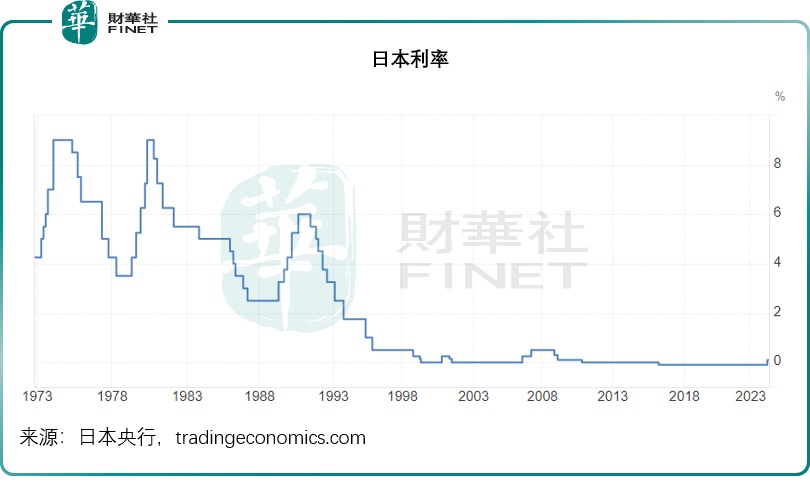
The Bank of Japan ended its negative interest rate policy in March this year, maintaining the interest rate at 0%-0.1%, marking the first rate hike since 2007, as shown in the chart below.
However, the yen's exchange rate against the US dollar did not receive a boost as a result. Instead, it continued to decline, hitting 160 in early trading on April 29, 2024. Although it later retreated below 160 due to intervention by the Bank of Japan, it remained weak, failing to break through 155, as shown in the chart below.
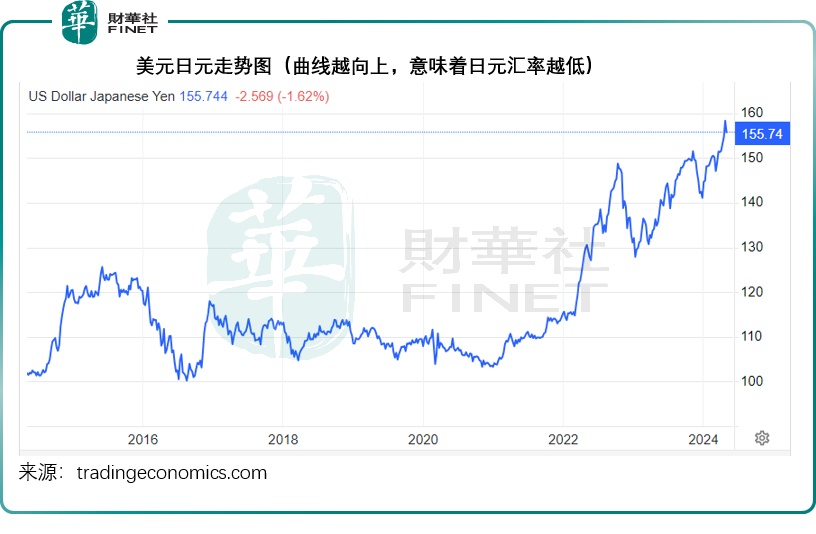
The yen entered negative interest rates in February 2016. As seen in the chart above, the yen's exchange rate against the US dollar began a sustained decline in February 2022 (the higher the value, the lower the yen's exchange rate against the dollar), highlighting the strong correlation between the two.
What is the root cause of the yen's depreciation?
The widening interest rate differential is the most straightforward explanation for this trend.
The Federal Reserve began its rate hike cycle in March 2022. According to general expectations, it is now at the peak of this dollar interest rate cycle, as the market anticipates the Fed will start cutting rates in the second half of this year.
However, recent US employment data and somewhat stubborn consumer price index figures suggest the market may have been overly optimistic about the Fed's rate cut cycle.
In other words, US interest rates could remain high for an extended period. Meanwhile, to stabilize exchange rate expectations, the Bank of Japan has indicated it will maintain loose monetary policy, meaning further rate hikes are unlikely.
This implies the interest rate differential between the US dollar and the yen will remain high for some time, creating an ideal opportunity for speculative funds to short the yen—selling yen to buy higher-yielding currencies and later repurchasing yen to close positions, profiting from both the interest rate differential and potential further yen depreciation.
As shown in the chart below, the spread between US 10-year Treasury yields and Japanese 10-year Treasury yields surged after 2022, remaining above 300 basis points since late 2022 and even exceeding 400 basis points in October 2023 when expectations of the Fed's rate hike cycle peaking were strongest.
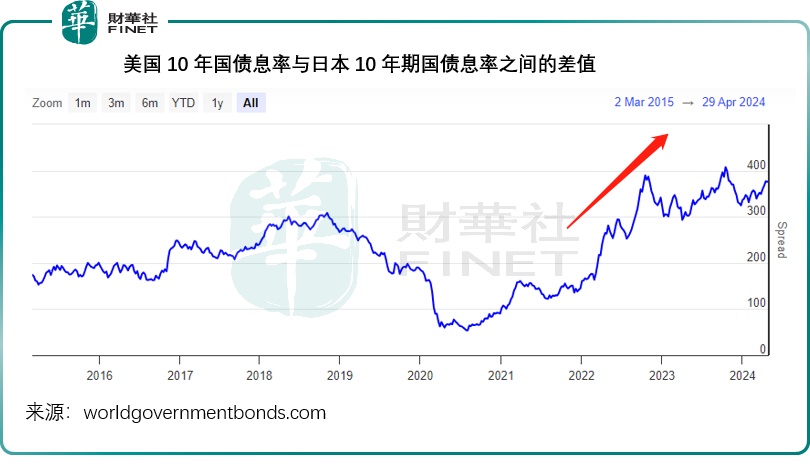
However, the chart shows the spread narrowed somewhat in late 2023. Although it has rebounded slightly recently due to speculation about a delayed Fed rate cut cycle, it has not returned to late 2023 levels. So why does the yen's decline persist?
Caijing Hong Kong believes rampant speculation is the main reason—betting the Bank of Japan will not unexpectedly intervene heavily in the forex market, coupled with Japan's lackluster economic fundamentals, prompting capital to flee Japanese assets for gold (safe haven), the US dollar (higher yields), and emerging markets (e.g., China).
Japan's latest economic data shows its Q4 2023 (September–December 2023) real GDP, calculated based on total social expenditure, was 142.64 trillion yen, up 1.20% year-over-year—the lowest growth among the four quarters of 2023, as shown below.
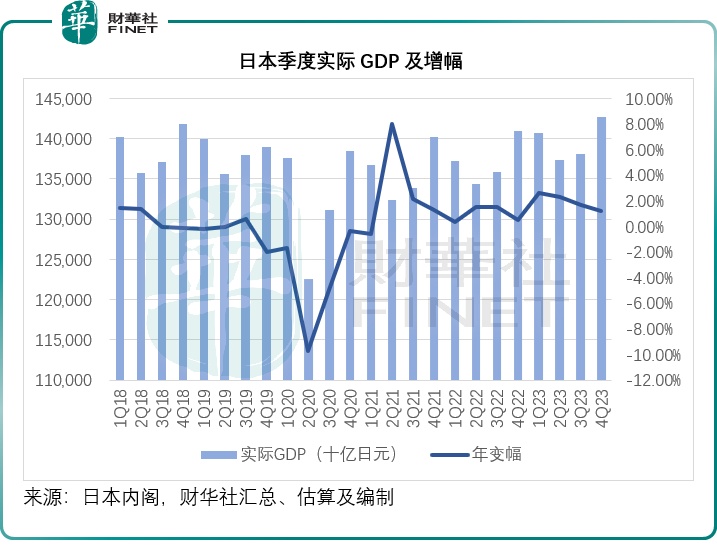
Breaking it down by sector, Caijing Hong Kong notes household consumption expenditure, the largest component of Japan's GDP, actually fell 0.52% year-over-year in Q4 2023, while government spending rose just 0.1%. The biggest driver of real GDP growth was exports, which grew 3.52% year-over-year.
As shown below, Japan's export-driven economy means export trade fluctuations significantly impact real GDP. During the peak of the pandemic in 2020, despite rising government spending, overall GDP fell due to declining exports. In 2023, export growth helped lift overall GDP growth to 1.92%, up from 0.96% the previous year, even as household consumption and government spending growth slowed.
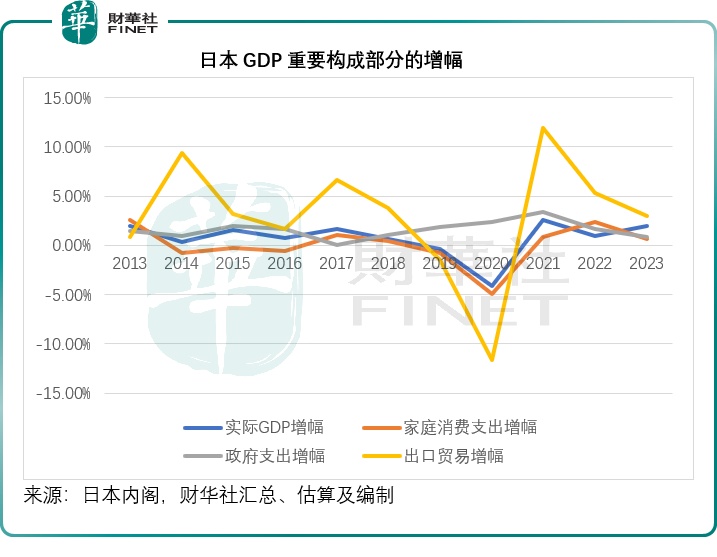
Weak household consumption growth is offset by yen depreciation encouraging tourism and shopping in Japan, boosting domestic demand. Meanwhile, a weaker yen benefits Japanese exporters—a silver lining to exchange rate pressure.
Data from Japan's Ministry of Finance shows March 2024 exports (the yen's recent decline began in early March) rose 7.32% year-over-year to 9.47 trillion yen, while imports fell 5.13% to 9.08 trillion yen, resulting in a trade surplus of 387.01 billion yen.
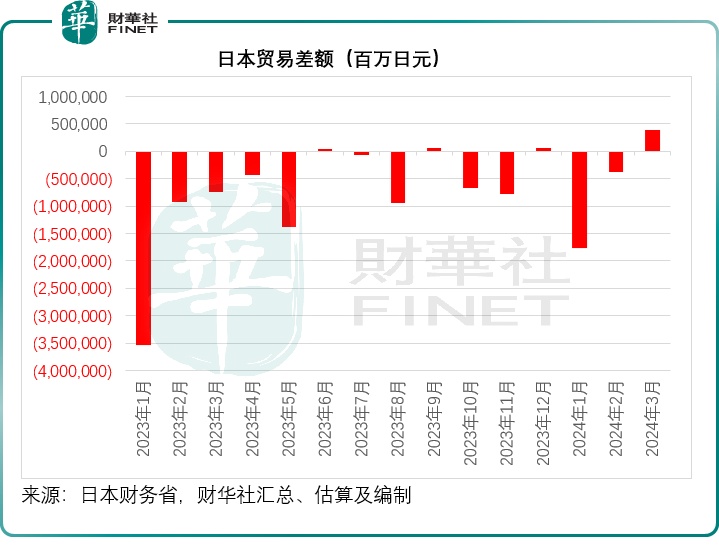
However, sustained yen depreciation has downsides. Japan is resource-scarce, relying on imports for many raw materials, minerals, and consumer goods.
In 2023, Japan's largest net import partners were Australia and the Middle East (especially Arabia and the UAE), as it imports minerals like iron ore to process into exports (e.g., steel for its auto industry—Japan's top export sector) and fuel for domestic consumption.
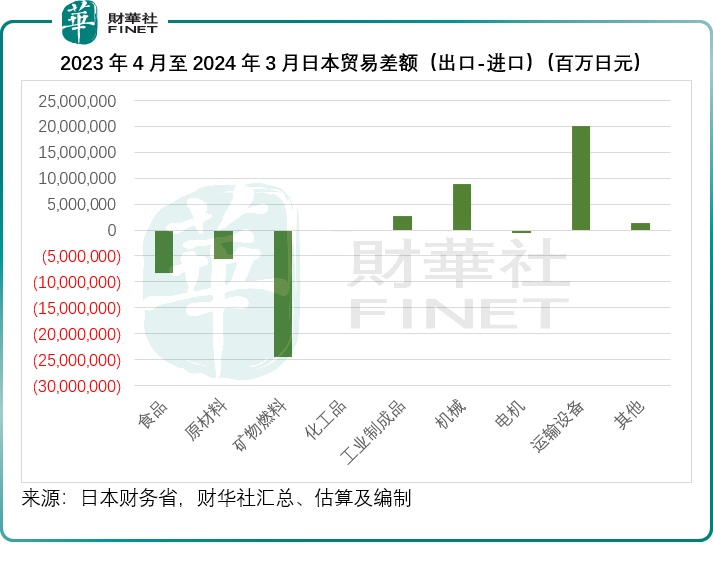
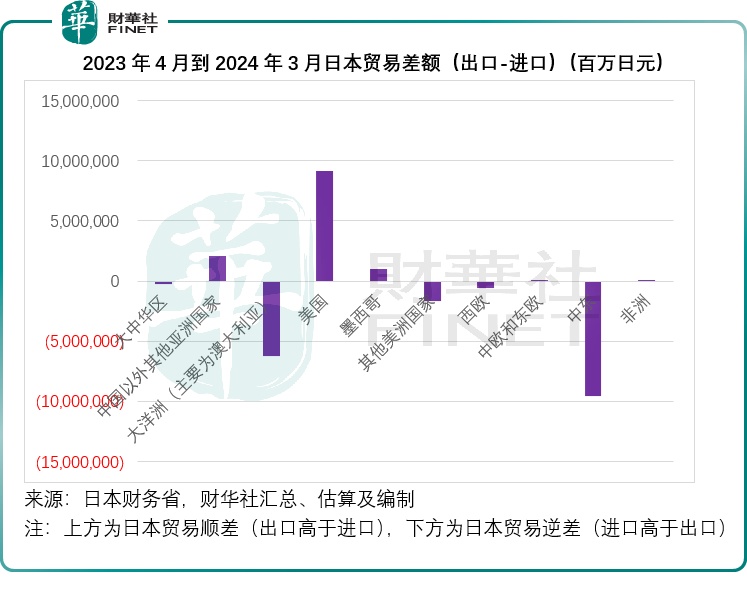
Thus, yen depreciation raises domestic production and consumer prices—imported goods become more expensive in yen terms. For example, steel mills pay more for imported ore, increasing production costs. If carmakers cannot pass these costs onto export prices, they absorb the losses. Similarly, higher gasoline prices dampen consumer spending—an unwelcome outcome for policymakers.
Moreover, IMF data shows Japan's debt-to-GDP ratio hit 261.3% in 2022, and as of April 16, 2024, it remained high at 241.64% (per commodity.com), meaning government debt far exceeds annual revenue, increasing borrowing costs and fiscal pressure.
This is why the Bank of Japan swiftly intervened when the yen hit 160.
Many may wonder: How does yen depreciation affect Warren Buffett, who has aggressively entered Japan's capital markets?
Yen Depreciation and Buffett's Trading Strategy
Buffett began investing in five Japanese trading houses in August 2020: Mitsubishi Corp. (8058.TYO), Mitsui & Co. (8031.TYO), Itochu Corp. (8001.TYO), Marubeni Corp. (8002.TYO), and Sumitomo Corp. (8053.TYO), and has continued to increase his stakes.
These are no ordinary firms—they have long histories and global operations, with mineral resources as a key revenue source. Their businesses span diverse sectors in Japan and abroad.
As noted earlier, Japan lacks mineral resources but relies heavily on them for industry (e.g., iron ore, copper, lead, nickel). Since the last century, Japan's Ministry of Economy, Trade and Industry has encouraged major firms to invest overseas in resources. Buffett's five picks have large-scale mineral investments, leveraging Japan's demand and economic opportunities. Since their resources are mostly overseas, yen depreciation has limited impact on their operations.
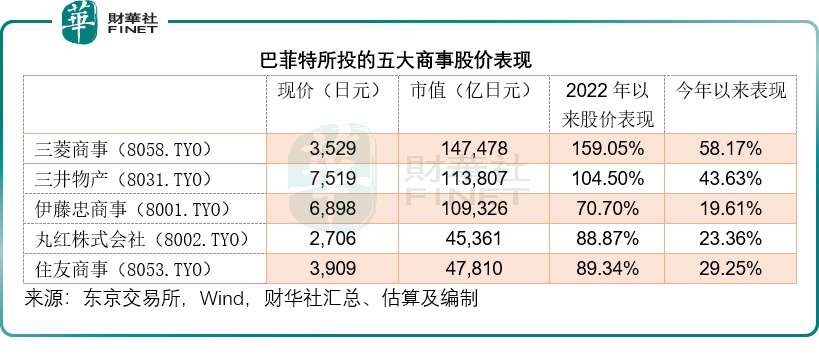
As shown below, these five firms have surged over 70% since Japan's stock market rally began in 2022, with Mitsubishi Corp. and Mitsui & Co. more than doubling. This year, they continue to post strong double-digit gains, showcasing robust capital appreciation.
More intriguingly, Buffett recently issued yen-denominated bonds for general corporate purposes. This is essentially a carry trade: borrowing cheap yen, converting it to higher-yielding currencies, investing in high-yield assets, and repaying the debt in yen at maturity.
SEC filings show$Berkshire Hathaway B(BRK.B.US) issued 283.3 billion yen ($1.819 billion) in bonds, including 169 billion yen in three-year notes at 0.974%. Caijing Hong Kong estimates total annual interest at ~3.471 billion yen ($22.29 million), averaging just 1.225%. For$Berkshire Hathaway(BRK.A.US) 's $100B+ cash pile, this cost is negligible—the key is earning returns far exceeding it. Even risk-free US Treasuries (currently yielding 5.21%) offer a 399-basis-point spread, excluding potential yen depreciation gains.
This is the "Oracle of Omaha's" investment logic.
Thus, the wisest strategy isn't chasing maximum risk-adjusted returns in turbulent times but anticipating macroeconomic shifts early to secure stable, low-risk profits—a lesson for investors at crossroads.
Author: Mao Ting
The copyright of this article belongs to the original author/organization.
The views expressed herein are solely those of the author and do not reflect the stance of the platform. The content is intended for investment reference purposes only and shall not be considered as investment advice. Please contact us if you have any questions or suggestions regarding the content services provided by the platform.
