


 Top 10 Influencers in 2025
 Likes Received
Apple's Q2 earnings report interpretation: Exceeded expectations, only because expectations were set too low, valuation is about to recover.

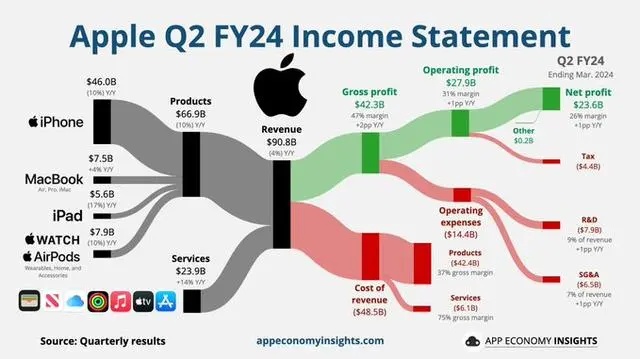
After the U.S. stock market closed on Thursday (May 2), Apple released its financial results for the second quarter of fiscal year 2024. The report showed that Apple's revenue and profit performance in the second quarter ending in March exceeded Wall Street expectations, and the decline in Greater China sales was not as severe as previously feared.
Apple's total revenue was $90.753 billion, down 4% from $94.836 billion in the same period last year, but better than the market expectation of $90.33 billion.
Net profit was $23.636 billion, down 2% from $24.160 billion in the same period last year, but also better than the market expectation of $23.17 billion.
At the same time, Apple's board of directors approved the largest stock buyback plan in history: $110 billion! This is equivalent to buying back and canceling 9 Vanke, or 5 China Tourism Group Duty Free, or 2 Xiaomi, or 1 Ping An Insurance.
---
Whether this earnings report is good or bad depends on who you compare it to.
Compared to Apple's consistently excellent performance in the past, it is definitely not good, as the growth rates of various business metrics are mediocre, and this situation has persisted for several quarters, which is the main reason for Apple's sluggish stock price during this period.
But compared to market expectations, this report is not bad. "I thought you would perform poorly, but you didn't do as badly as I expected." This is the so-called "beat expectations." Due to overly pessimistic expectations leading to an oversold stock price, the after-hours trading saw a surge of over 7%, which is a correction of overly pessimistic expectations.
It is expected that Apple's stock price will rebound significantly in the near future, but it is unlikely to reach the previous high of $199.3.
Apple did not provide formal guidance in its earnings report, but CEO Tim Cook stated in an interview that overall revenue for the third quarter is expected to achieve "low single-digit growth."
Apple's revenue in the third quarter of last year was $81.8 billion, and LSEG analysts currently expect revenue for this year's third quarter to be $83.23 billion.
In other words, the most pessimistic expectations have been revised, but the various issues Apple previously faced have not been truly resolved. Next quarter's data may still be mediocre, and even the company itself is not very confident.
---
Apple's main challenges:
1. Weak iPhone sales
This issue has three sub-issues: (1) The overall sluggishness of the smartphone market; (2) Lack of innovation in Apple's iPhones; (3) Macroeconomic downturn in the Chinese market.
Apple cannot solve (1) and (3), as they are external factors beyond its control. However, as a former industry leader, Apple has been resting on its laurels regarding (2). Apart from higher prices, recent generations of iPhones have lacked innovation, and some features have even been surpassed by high-end Android phones. This is undoubtedly Tim Cook's responsibility.
Currently, all smartphones are "overpowered" in terms of performance. How can the next-generation iPhone stand out when users no longer need more features? I believe this will be very difficult, and Apple should focus on maintaining existing customers and improving value-added services.
2. Slow progress in AI
Initially, Apple did not prioritize AI, as it was not a core business in the short term. However, as the AI trend gained momentum, Apple had to catch up. Unfortunately, its slow start has left it without any notable achievements, and it has even considered partnering with Google (the latest development is poaching Google engineers).
I am not overly pessimistic about this, as major tech giants are gradually closing the gap with OpenAI, and the method is straightforward: massive purchases of Nvidia's GPUs.
Quantity leads to quality. In the current AI industry, the barriers are not as high as imagined. With sufficient computing power, electricity, and time, anyone can produce at least a 75-point product.
Cook announced that new AI features will be launched next week. Let's wait and see.
3. Apple's ecosystem is no longer invincible
Despite weak iPhone sales, Apple's profits still exceeded expectations, largely due to its robust value-added services ecosystem. However, cracks have begun to appear this year.
Regions like the EU have repeatedly sued Apple for monopolistic practices, achieving some results, including reducing developer fees and no longer mandating AppStore downloads. These rules directly impact Apple's revenue, and further confrontations are possible.
Value-added services are a core revenue source for Apple. Balancing the interests of all parties will be a major challenge for the foreseeable future, as many believe Apple "makes too much money" in this area.
---
After discussing the challenges, let's talk about potential positives.
1. Massive buyback
With failed projects like car manufacturing winding down and no new directions worth betting on (except AI), Apple, sitting on a pile of cash, naturally opted for buybacks—a cornerstone of the U.S. stock market's long-term bull run.
Therefore, we can expect Apple's stock price to continue its upward trajectory, albeit at a slower pace than before.
2. Expectations of a rebound in the Chinese market
Apple's revenue in Greater China, its third-largest market, was $16.372 billion in the second quarter, down 8% from $17.812 billion in the same period last year but better than the market's expectation of a double-digit percentage decline. Before the earnings release, Wall Street had pessimistically predicted a 11% year-over-year drop to $15.87 billion.
Apple CFO Luca Maestri stated that concerns about the Chinese market were exaggerated. He said, "We are pleased with our performance in China. The reality may be different from what you sometimes read."
Regarding the declining iPhone sales in China, CEO Tim Cook emphasized the importance of the Chinese market and vowed not to abandon it. He even visited China personally earlier this year, believing that once China's internal issues ease, pent-up purchasing power will be released.
Finally, after analyzing this earnings report that "wasn't as bad as feared," is Apple's stock worth buying now?
Based on historical data, Apple is currently near the lower end of its reasonable valuation range. A short-term rebound is highly likely, and the long-term outlook remains bullish. It's a hold, but not an ideal target for 超额收益。$Apple(AAPL.US)
The copyright of this article belongs to the original author/organization.
The views expressed herein are solely those of the author and do not reflect the stance of the platform. The content is intended for investment reference purposes only and shall not be considered as investment advice. Please contact us if you have any questions or suggestions regarding the content services provided by the platform.
