


2024 Week 18 Weekly Report

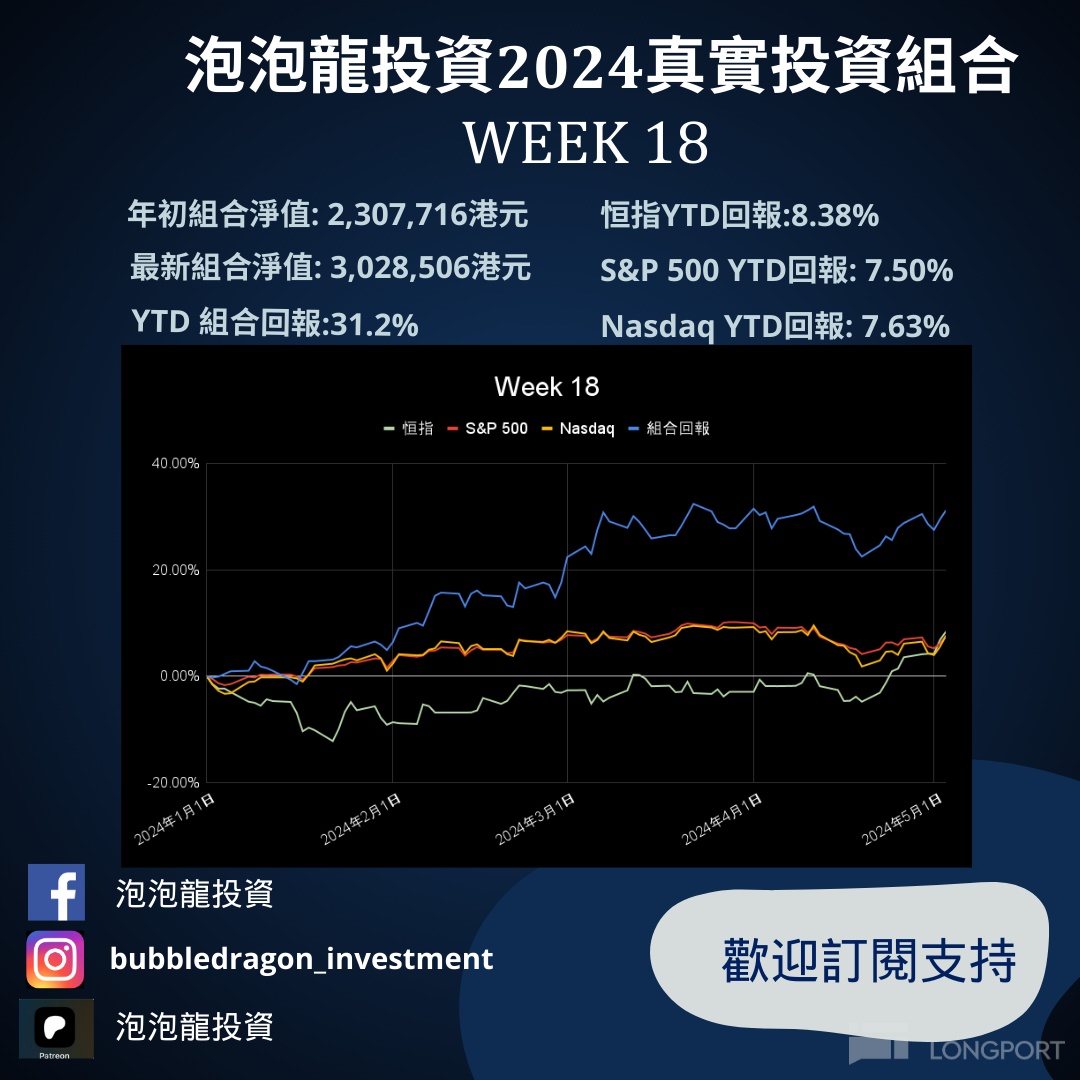
Portfolio NAV at the beginning of the year: HKD 2,307,716
Latest portfolio NAV: HKD 3,028,506
YTD return: 31.2%
Hang Seng Index YTD return: 8.38%
S&P 500 YTD return: 7.5%
Nasdaq YTD return: 7.63%
Portfolio
While updating the index returns above, I realized that the YTD return of the Hong Kong stock market's Hang Seng Index has already surpassed that of the S&P 500 and Nasdaq. Back in January this year, I remember the Hang Seng Index was down nearly 10% at its lowest point. The index has since rebounded by about 20%, and many individual stocks have doubled from their lows.
I'd like to congratulate those who stuck with Hong Kong stocks—this year, you're finally seeing returns, unlike the past few years when losses were brutal.
As for my own portfolio, the YTD return has gradually climbed back to 31.2%, once again breaking the 30% mark. Currently, my public portfolio is 100% invested in U.S. stocks. Although I've been bullish on Hong Kong stocks, I didn’t want to suddenly switch the public portfolio back to Hong Kong stocks, so it remains 100% U.S. stocks.
For Hong Kong stocks, I’ve provided members with a list of 7 core stocks, which have performed well so far, though they’ve noticeably underperformed the broader market in recent days. A detailed review will be shared in the members' section.
A detailed review of the portfolio holdings is shared in the Patreon members' area:
Hong Kong Stock Market
- This week, the Hong Kong market broke out again, with strength that feels almost exaggerated. The last time it was this strong was from October 2022 to January 2023, driven by expectations of China's economic recovery after the lifting of pandemic restrictions.
- Of course, the results were somewhat disappointing, leading to another market decline, with the index dropping as low as 15,000 points...
- This time, the rally’s core drivers are: 1. After four years of declines, many stocks are at valuations so low they’re irresistible, showing strong appeal. 2. Policy support from the government and foreign capital inflows into Hong Kong stocks.
- I also think Hong Kong stocks deserve a rally—after all, the quality of companies isn’t that bad. From a fundamental perspective, I don’t see major changes; it’s more about shifts in capital flows.
- Take January this year, for example: Hong Kong stocks were down about 10% at their worst, but fundamentals hadn’t deteriorated enough to justify such a broad market decline. It was largely due to the final wave of large-scale capital outflows. When prices fall low enough, long-term funds start buying gradually, and as this momentum builds, the market finds support and begins to rebound.
- For instance, I built significant positions in Hong Kong stocks in March and April, betting on company growth, low valuations, and high dividend yields. I knew there was a high probability of making money. As more people adopt this mindset, demand outstrips supply, and stock prices rise.
- After breaking through 18,000 points, it’s hard to say where the top is. For a stock, this would be like going from a PE of 10 to 12—is 12 high? It could go to 13, 14, or even 15. As global capital continues to flow in, valuations can gradually rise.
- I believe that once the market holds above 18,000, it has a good chance of testing 19,000 or even 20,000. However, in the medium to long term, sustained stock price growth depends on rising corporate earnings (i.e., higher EPS). I don’t yet see this as a broad trend—it’s only happening in select stocks and sectors.
U.S./Japan Stock Market
- U.S. stocks started to rebound this week!
- If you’ve been tracking market sentiment, you can clearly see capital flowing back into stocks. Combined with Friday’s weaker-than-expected non-farm payroll data, the market continued to rise.
- After the jobs report, analysts now expect the first rate cut in September, possibly before the election—fitting the narrative perfectly. I think this is highly likely.
- Just days ago, the pessimistic forecast was for the first cut in November. The shift to September has given the market another boost.
- On the individual stock front, Apple surged after earnings. The main reasons were slightly better-than-expected results (though expectations were very low) and the announcement of a historic $110 billion buyback, both fueling the rally.
- However, news just broke that Warren Buffett reduced his Apple stake by 13%, which could put some pressure on the stock Monday.
- This week, Amazon, AMD, and SMCI also reported earnings. Amazon’s results were solid, though Q2 guidance was conservative—still, the stock rose. AMD and SMCI delivered strong earnings but fell short of the high expectations baked into their share prices, leading to declines.
- That said, I can confidently say AMD and SMCI have solid fundamentals. Their earnings are growing steadily—it’s just that their stock prices ran ahead and now need to wait for earnings to catch up. What does this mean? It means these stocks won’t keep falling indefinitely; once they drop enough, buying interest will return.
- These aren’t companies with declining earnings, so the approach should differ. Investors should focus on when they’re cheap enough to buy, not on selling.
- Back to the broader market: if you read last week’s update, I called the market bottom. This week’s action aligns with that view. I expect U.S. stocks to continue grinding higher.
The above represents personal opinions and does not constitute investment advice.
$NVIDIA(NVDA.US) $Alibaba(BABA.US) $TENCENT(00700.HK) $Tesla(TSLA.US) $AMD(AMD.US) $Amazon(AMZN.US) $Apple(AAPL.US)
The copyright of this article belongs to the original author/organization.
The views expressed herein are solely those of the author and do not reflect the stance of the platform. The content is intended for investment reference purposes only and shall not be considered as investment advice. Please contact us if you have any questions or suggestions regarding the content services provided by the platform.
