


The boss of Durex doesn't want to sell milk powder anymore.


Over the past year, British consumer goods giant Reckitt Benckiser, which owns brands like Durex, Dettol, and Veet, has been under pressure from shareholders to review and sell its Mead Johnson nutrition business.
Reckitt Benckiser's stock price has fallen 25% over the past year, and shareholders are dissatisfied.
Finally, today (July 24), CEO Kris Licht announced a major business streamlining plan: the company will sell some home care brands and evaluate the struggling Mead Johnson business, "considering all strategic options."
Reckitt Benckiser's product portfolio is extremely diverse, ranging from hair removal creams to disinfectants, from cleaners to insecticides, from condoms to infant formula.
The company will sell its home care product portfolio and focus on strong brands in the future, such as throat lozenges Strepsils, disinfectant Dettol, stain remover Vanish, etc. These brands have strong growth and high profit margins, achieving a 7% annualized growth rate over the past five years.
Currently, the company is divided into three major business segments: hygiene, health, and nutrition; the 2015 structure will be adjusted to: Reckitt Benckiser (including top-performing brands like Nurofen and Gaviscon); Essential Home (including lower-growth home care brands); and Mead Johnson.
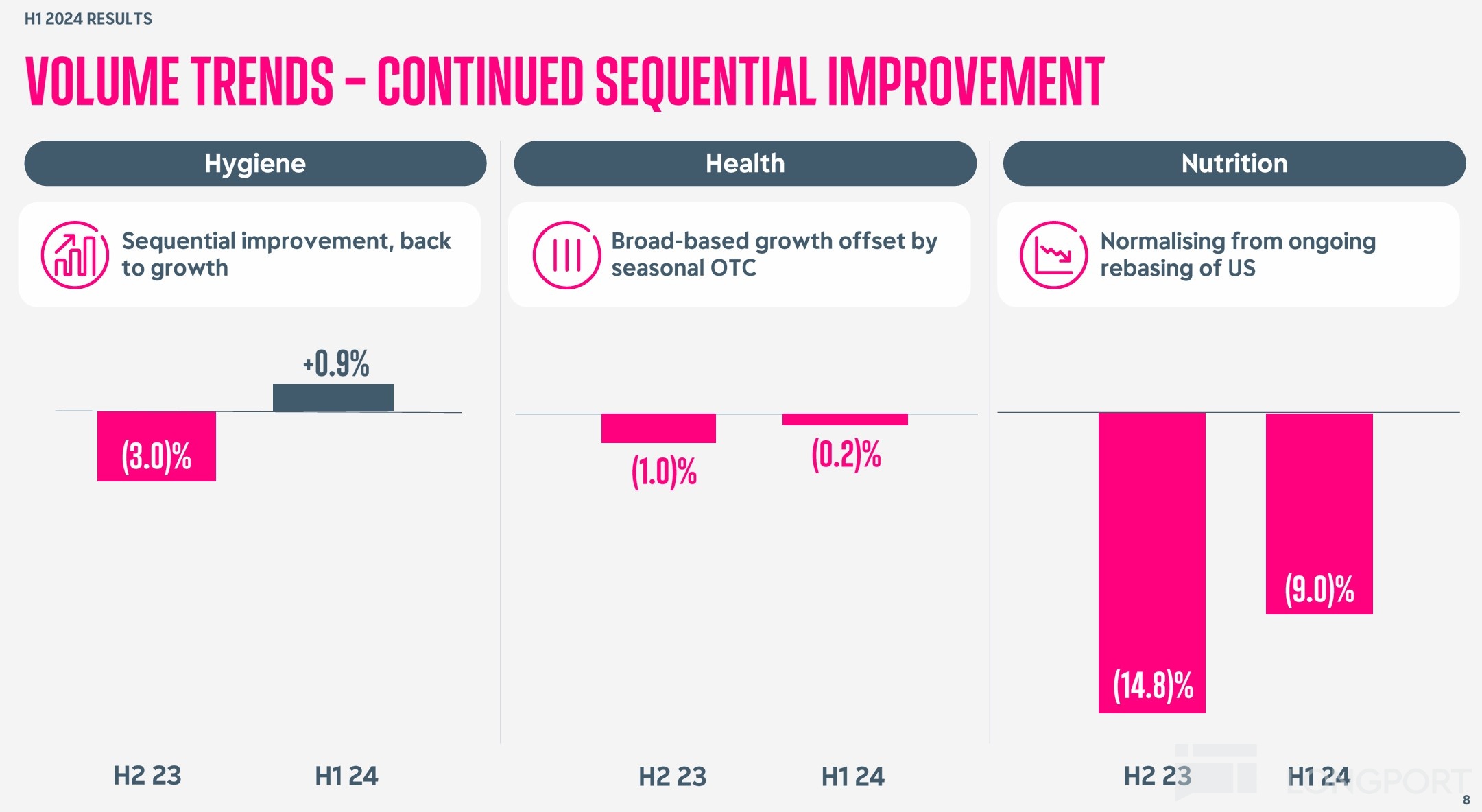
On the same day, Reckitt Benckiser announced its first-half results, with revenue of £7.2 billion, up 0.8% year-on-year; this was due to an average price increase of 2.1%, but a 1.3% decline in volume offset some of the growth; the company's underlying operating profit fell 4.9% to £1.7 billion.
Among them, the hygiene business grew by 4.5%; the health business grew by 1.3%; the nutrition business where Mead Johnson is located saw net revenue decline by 9.0% year-on-year to £1.166 billion; adjusted operating profit was £210 million, down about 30%.
A Turbulent Seven Years

Reckitt Benckiser acquired U.S. infant formula company Mead Johnson for $17.9 billion in 2017, its largest acquisition ever; but the past seven years have been bumpy, with differing views on this part of the business during management changes, and shareholders have long complained that it lacks strong strategic alignment with other businesses.
The hygiene and health business segments account for 44% and 43% respectively, far exceeding the nutrition business's 14% share.
In addition, a tornado in the U.S. this month damaged a warehouse, and Reckitt Benckiser expects the nutrition business to decline by low double digits in 2024, worse than the earlier forecast of high single-digit declines; Mead Johnson also has ongoing consumer lawsuits in the U.S.
Kris Licht is the third CEO since Mead Johnson was acquired by Reckitt Benckiser, and the nutrition business has undergone strategic changes over the seven years.
In 2017, then-CEO Rakesh Kapoor led the acquisition, and besides acquiring U.S. infant formula manufacturer Mead Johnson, he also reorganized the company into two independent divisions: health and home hygiene. Kapoor's strategy was to focus the company on higher-margin consumer health products, such as infant formula, rather than home cleaning products.
In 2019, Kapoor retired, and Pepsi executive Laxman Narasimhan succeeded him. In early 2020, he was quick to distance himself from the Mead Johnson acquisition, writing down the business by £5 billion.
Reckitt Benckiser had never seen such an acquisition write-down before. Narasimhan explained that the write-down was mainly due to slower-than-expected progress in China, a key market for infant formula manufacturers; Mead Johnson is a good company, but circumstances have changed, birth rates are declining, and local competitors are becoming stronger.
Narasimhan's approach was to focus resources on faster-growing categories like vitamins, sexual health, and specialized nutrition, shifting from a brand-led growth strategy to a category-led growth strategy, focusing on high-growth categories and extending brands to new places and spaces to support medium-term growth.
Under this approach, in 2021, the company sold most of its stake in Mead Johnson China to Primavera Capital for $2.2 billion. Mead Johnson China was once the foreign infant formula brand with the highest market share, reaching 14.3%, but the rise of domestic formula brands has led to a decline in foreign brands' market share.
Currently, Primavera Capital has maintained the independence and integrity of the Mead Johnson China brand. Reckitt Benckiser in China is primarily centered around the Durex and Dettol brands.
After selling Mead Johnson China, Reckitt Benckiser's remaining infant formula business had net assets of approximately £5.4 billion. As early as April 2022, there were reports that Reckitt Benckiser was considering selling its infant formula business, with an estimated valuation of $7-10 billion, but the pandemic clearly affected birth rates, and no deal was announced.
In September 2022, CEO Narasimhan left Reckitt Benckiser to become CEO of Starbucks in the U.S.
Priorities

Current CEO Kris Licht previously oversaw the company's star brands like Dettol and Durex. At the CAGNY conference on February 22, 2024, CEO Kris Licht, who had been in office for over six months, outlined his approach to the nutrition business:
"There is no doubt that the number of births has declined in many parts of the world, but there is also no doubt that the real way to grow this business, the appeal, lies in significant premiumization. That's why we're grounded in innovation and formulation science, and when we bring clinically supported new propositions to market, we can offer strong scientific backing.
"To be fair, I don't think nutrition will be the fastest-growing business in the portfolio, but I do think there is still good growth potential."
At today's (July 24) earnings meeting, CEO Kris Licht admitted that Reckitt Benckiser's infant formula business became large due to the Mead Johnson acquisition but did not always naturally fit into the group. "Do I think nutrition was a good choice? No, I don't. That's in the past. I don't think there's any need to say more."
Kris Licht and Reckitt Benckiser itself are under heavy pressure, facing scrutiny from activist investors.
In June this year, one of Reckitt Benckiser's shareholders, Bluebell Capital Partners, said it was in talks with management, suggesting that Reckitt Benckiser separate its hygiene division from other divisions.
From a category perspective, the nutrition business where Mead Johnson is located is the smallest of Reckitt Benckiser's three major businesses. The U.S. is Reckitt Benckiser's largest market, accounting for nearly one-third of total business. About 80% of Reckitt Benckiser's nutrition business sales come from infant formula, with the U.S. accounting for half of that.
In 2023, Reckitt Benckiser's nutrition business performed better in developed North American markets, while business in developing markets saw a mid-single-digit decline due to falling birth rates, rising breastfeeding rates, and some third-stage products being replaced by cheaper alternatives after price increases.
Compared to 2021, Reckitt Benckiser's nutrition business in developing markets saw a 17.6% decline in volume in 2023. Premiumization and growth in the adult nutrition market offset some of the decline, but if infant formula alone is considered, the decline would be even greater.
Major shareholders have repeatedly expressed dissatisfaction, and after nine months of deliberation, Reckitt Benckiser's management finally announced a new strategy to streamline the business by selling non-core brands and focusing on strong brands.
Reckitt Benckiser will exit its basic home care product portfolio by the end of 2025, including brands like Air Wick, Mortein, Calgon, and Cillit Bang, which generated £1.9 billion in revenue in 2023.
The Mead Johnson nutrition business has been classified as a "non-core business," and Reckitt Benckiser will explore all strategic options for the asset to maximize shareholder value.
The company will focus on its Powerbrands—this includes Dettol, Durex, Veet, Finish, etc.
Cost optimization is also a key part of the new strategy, with Reckitt Benckiser aiming to streamline its organizational structure, reduce management layers, and eliminate duplication. The company will transition to operating through three geographic regions: North America, Europe, and emerging markets.
The newly structured Reckitt Benckiser will debut on January 1, 2025.
The copyright of this article belongs to the original author/organization.
The views expressed herein are solely those of the author and do not reflect the stance of the platform. The content is intended for investment reference purposes only and shall not be considered as investment advice. Please contact us if you have any questions or suggestions regarding the content services provided by the platform.
