



HiPhi accelerates IPO: "Hydrogen" boat still needs to cross thousands of mountains

The "hydrogen energy" trend has been blowing in the domestic new energy vehicle market for quite some time.
According to data from Hydrogen Cloud Chain, global hydrogen vehicle sales in 2023 reached 14,642 units, a year-on-year decline of 21.4%. Among the five major hydrogen vehicle markets, only China and the U.S. achieved positive sales growth. China sold 5,805 hydrogen vehicles, a 72% year-on-year increase, accounting for 39.6% of the global market, surpassing South Korea to become the world's largest single hydrogen vehicle market in 2023.
CITIC Securities Research also released a report stating that, based on the targets of the medium- and long-term hydrogen energy development plan, the market size of the hydrogen vehicle industry chain in 2024/2025 is expected to double consecutively, with industrialization gradually approaching.
For some startups, this is also a good time to "take off."
It is reported that recently, Xiao Hydrogen Automotive (Shanghai) Co., Ltd. (hereinafter referred to as "Xiao Hydrogen Automotive") has reached a merger agreement with special purpose acquisition company Aquaron Acquisition (AQUNU) and plans to go public on the NASDAQ through a SPAC merger, with a pre-investment valuation of $1 billion.
Regarding this cooperation, Chen Weishan, founder and chairman of Xiao Hydrogen Automotive, said: "This transaction will enable us to accelerate our growth strategy, expand our market share, and enhance our ability to provide comprehensive solutions to customers in the hydrogen-powered vehicle market."
Tianyancha shows that Xiao Hydrogen Automotive was established in 2020 and is mainly engaged in the R&D and manufacturing of hydrogen fuel cell vehicles. Additionally, according to its official website, the company has developed a fuel cell light truck, the HUTURE O2, and its R&D center and Phase 1 production facility have been completed in the Dianshan Lake area of Shanghai's Qingpu District. The company hopes to leverage Shanghai's geographical advantages to recruit more global talent, conduct independent forward R&D, and provide high-quality hydrogen fuel cell vehicle products to the market.
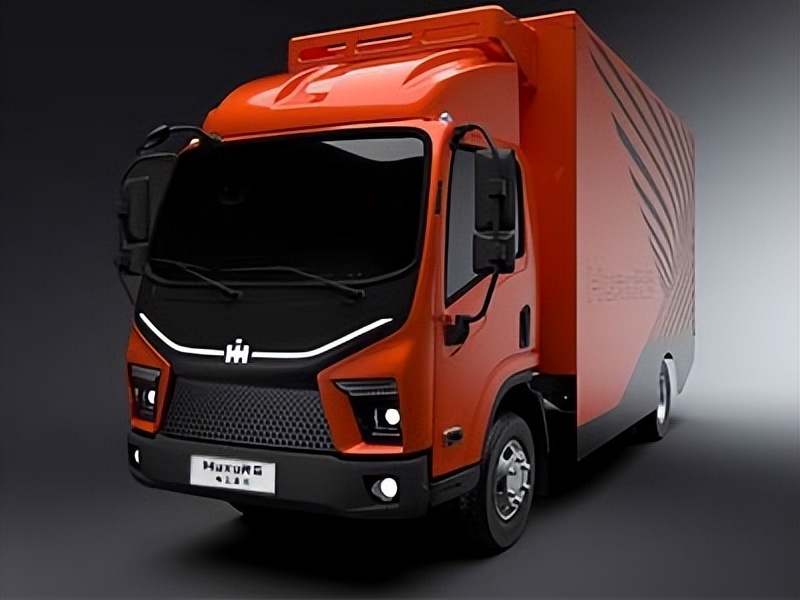
Overall, Xiao Hydrogen Automotive is still in its early stages, and what attracts market attention the most is undoubtedly the industry's prospects. Specifically, the current development of hydrogen fuel cell vehicles is mainly driven by energy advantages and the joint efforts of upstream and downstream players.
It is understood that hydrogen fuel, as an energy source, is characterized by being pollution-free, highly efficient, and recyclable, and is considered the most ideal energy source for the 21st century. Based on this, many regions have introduced policies to support the development of the hydrogen energy industry in recent years.
For example, the Guangdong Provincial Development and Reform Commission and nine other departments jointly issued the "Guangdong Province Comprehensive Implementation Plan for Clean Production (2023-2025)," proposing the orderly development of hydrogen fuel cell vehicles and the steady replacement of fuel-powered commercial and specialized vehicles with electric and hydrogen fuel vehicles.
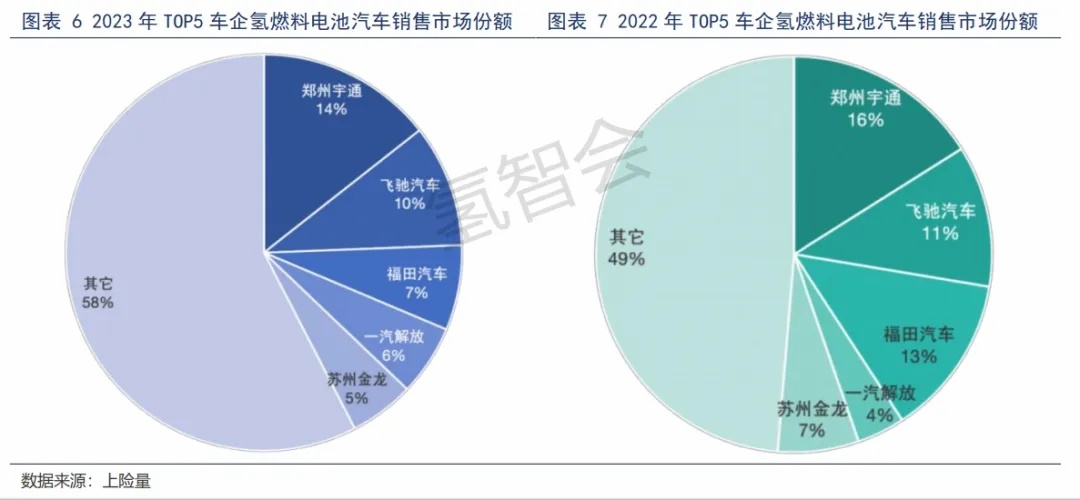
Under this trend, some companies have taken the lead in seizing the high ground by focusing on product R&D. According to a report by Hydrogen Intelligence, the top five hydrogen fuel cell vehicle companies by market share in 2023 were Zhengzhou Yutong, Feichi Auto, Foton Motor, FAW Jiefang, and Suzhou King Long.
However, as the industry is still in its early stages of development, related companies face serious challenges. For example, high costs are a major issue. According to Yi Baolian, an academician of the Chinese Academy of Engineering, the "high cost" is mainly reflected in three aspects: First, hydrogen fuel cell engines are expensive, making hydrogen fuel cell vehicles 2-3 times more expensive than fuel-powered vehicles and 1.5-2 times more expensive than lithium-ion battery vehicles. Second, the construction cost of hydrogen refueling stations is high, at approximately 12-15 million yuan. Third, the cost of hydrogen refueling is as high as 60-70 yuan per kilogram.
The existence of these problems means that many technical challenges remain to be overcome. For Xiao Hydrogen Automotive, it undoubtedly needs to prepare for greater challenges.
In this regard, Xiao Hydrogen Automotive stated that through technological innovation and market expansion, the company is committed to promoting the commercialization of hydrogen energy. "Our target markets are not limited to the logistics-rich regions of eastern China but also include hydrogen-rich regions in western China and international markets such as Europe, the Middle East, and North America."
The copyright of this article belongs to the original author/organization.
The views expressed herein are solely those of the author and do not reflect the stance of the platform. The content is intended for investment reference purposes only and shall not be considered as investment advice. Please contact us if you have any questions or suggestions regarding the content services provided by the platform.
