芝能-烟烟
2024.07.27 01:28

China's 2024 first half auto export review: Americas edition

portai
I'm PortAI, I can summarize articles.
​​

Produced by Zhineng Technology


What are the chances for China's gasoline and electric vehicles to succeed in the Americas? Overall, Chinese automakers are actively exploring opportunities in the American market. In terms of numbers, Chinese brands have made a notable impact in the automotive markets of Brazil and Mexico.


01

Overall Sales Performance


● BYD leads the pack in Brazil with sales of 32,562 units,


● Chery follows closely, selling 27,969 units in Brazil and 10,936 units in Mexico.


● Great Wall Motors sold 12,731 units in Brazil and 1,301 units in Mexico.


● SAIC and JAC also made gains in the Mexican market, selling 4,106 and 2,103 units, respectively.


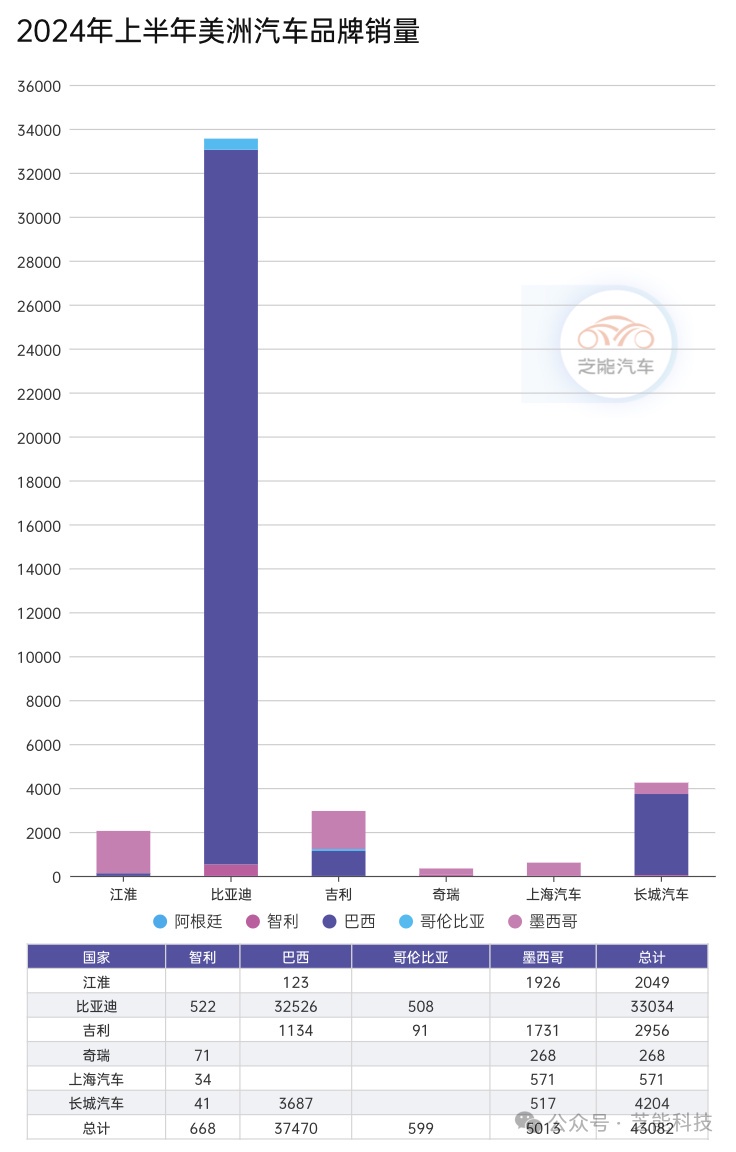
Focusing solely on electric vehicles, here are the sales figures for Chinese EV brands in South America and Mexico:


● JAC: Sold 123 units in Brazil and 1,926 units in Mexico, totaling 2,049 units.


● BYD: Sold 522 units in Chile, 32,526 units in Brazil, and 508 units in Colombia, totaling 33,034 units.


● Geely: Sold 71 units in Chile, 1,134 units in Brazil, 91 units in Colombia, and 1,731 units in Mexico, totaling 2,956 units.


● Chery: Sold 268 units in Mexico.


● SAIC: Sold 571 units in Mexico.


● Great Wall Motors: Sold 41 units in Chile, 3,687 units in Brazil, and 517 units in Mexico, totaling 4,204 units.


The data shows that BYD has the strongest performance in the Brazilian market, while Great Wall Motors also has significant sales in Brazil and Mexico. Although other brands have more scattered performances across different markets, they collectively demonstrate the overall growth of Chinese automotive brands in South America.


02

Policies in the Americas


Starting January this year, Brazil will gradually reinstate import tariffs on electric vehicles, hybrid vehicles, andplug-in hybrid vehicles purchased from overseas.


● For hybrid vehicles, the import tariff rate will be 15% starting January 2024, increasing to 25% in July. By July 2025, the rate will rise to 30%, and a year later (July 2026), it will further increase to 35%.


● For plug-in hybrid vehicles, the import tariff rates for these four time points will be 12%, 20%, 28%, and 35%, respectively.


● For electric vehicles, the tariff rates will change in the following order: 10%, 18%, 25%, and 35%. That said, Brazil's overall purchasing power for EVs isn't particularly strong.


In Mexico, due to significant pressure, there's little room for breakthroughs. Chinese electric vehicles don't have much of an opportunity in the Americas, especially given the difficulty of entering the U.S. and Canadian markets.


Summary


In the Americas, a sales strategy centered on gasoline and hybrid vehicles is more reasonable for Chinese automakers, as the development of power systems and charging infrastructure will take time.​​​​

The copyright of this article belongs to the original author/organization.

The views expressed herein are solely those of the author and do not reflect the stance of the platform. The content is intended for investment reference purposes only and shall not be considered as investment advice. Please contact us if you have any questions or suggestions regarding the content services provided by the platform.