



Super Central Bank Week, what's worth looking forward to


During the Mid-Autumn Festival holiday, the A-share market was closed, but global capital markets are eagerly awaiting this week's developments, as three of the most watched central banks in developed countries will announce their interest rate decisions.
Federal Reserve: A Major Reversal in Rate Cut Expectations
The Federal Reserve is leading the charge.
The central bank behind the world's primary settlement currency will announce its interest rate decision on September 19 (Thursday), which is likely to be the first rate cut since 2020. Since March 2022, the Fed has raised rates by a cumulative 525 basis points, bringing the current U.S. federal funds rate to a high of 5.25% to 5.50%. After the last 25-basis-point hike on July 27, 2023, the Fed has kept rates unchanged for nearly 14 months.
Dramatically, after last week's CPI inflation data, some investors expected the Fed to hold rates steady in September. However, just a day later, this view shifted significantly due to unexpectedly weak PPI (Producer Price Index) and unemployment figures, which suggested the U.S. economy was weaker than anticipated. Investors began speculating that the Fed might stimulate the economy with larger rate cuts.
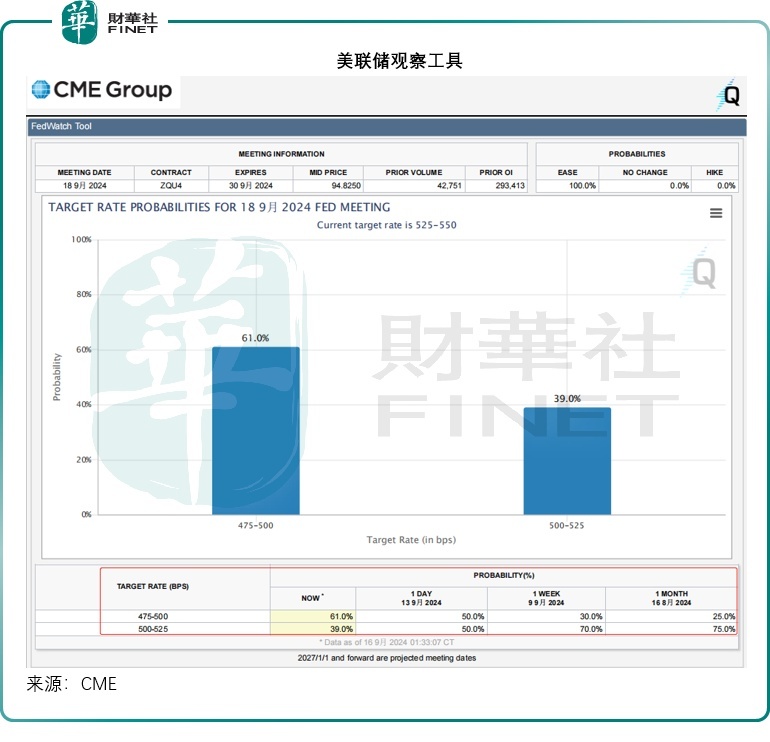
The CME FedWatch Tool shows that expectations for a 50-basis-point Fed rate cut surged from 30% a week ago to 61%, while expectations for a 25-basis-point cut dropped from 70% to just 39%.
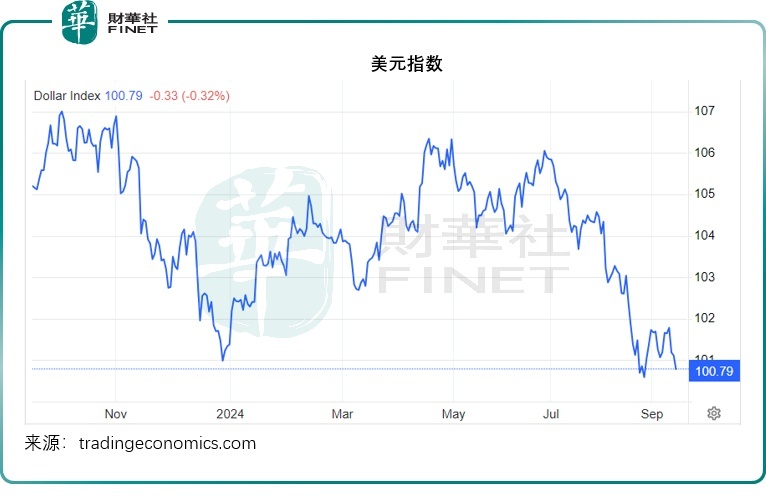
This dramatic shift has caused volatility in global asset prices. The U.S. dollar index continues to decline, now at 100.79.
Amid heightened rate-cut expectations, oil prices rebounded from earlier lows as investors bet that deeper cuts would boost demand in the world's largest energy-consuming nation. Brent crude futures, after briefly falling below $70 to around $68, quickly recovered and now stand at $71.89 per barrel. WTI crude futures also rebounded to $69 after dipping below $66.
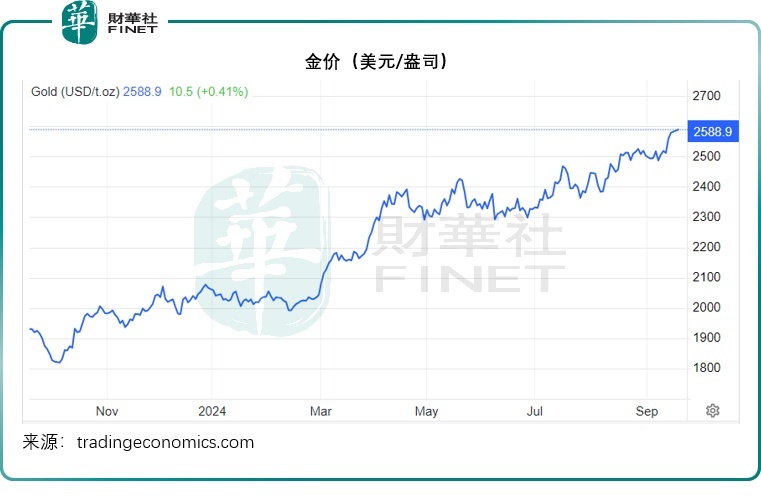
Meanwhile, gold prices hit new highs, supported not only by the Fed's expanded rate-cut expectations (which bolster dollar-denominated gold) but also by the European Central Bank's rate cut last week, signaling policymakers' growing confidence in controlling inflation. This suggests further rate cuts may follow, increasing the appeal of holding gold.
Beyond the Fed's rate decision, markets will also focus on Chair Jerome Powell's economic outlook and future policy stance.
Caijing believes the uncertainty around rate decisions may fuel speculative activity, increasing market volatility—particularly in tech stocks like the $NASDAQ Composite Index(.IXIC.US) . $NVIDIA(NVDA.US) The urgency of AI chip shortages was reaffirmed by Oracle (ORCL.US) founder Larry Ellison, who joked about begging Jensen Huang for faster deliveries. He noted that AI R&D and commercialization rely on massive capital investments, and tech giants with ample cash may see their AI bets pay off during a rate-cut cycle.
Bank of Japan: Cautious Rate Hikes Remain an Option
The Bank of Japan (BOJ) will announce its rate decision on September 20 (Friday). Markets widely expect the BOJ to hold rates steady in September but remain open to further hikes, possibly as early as October. BOJ officials have stated that short-term rates need to reach at least 1% to sustain its 2% inflation target; the current rate is 0.25%.
Driven by a weak yen and an influx of global tourists, Japan's July 2024 inflation rate hit 2.8%, with core inflation at 2.7%.
To stimulate growth, the BOJ long maintained negative rates. As the U.S. began hiking in 2022, the interest rate gap between Japan and the U.S. widened, making the USD/JPY pair—one of the most traded currency pairs—a popular carry trade, amplifying yen volatility.
As shown below, the yield spread between Japanese 10-year bonds and U.S. 10-year Treasuries has narrowed amid expectations of BOJ hikes and Fed cuts.
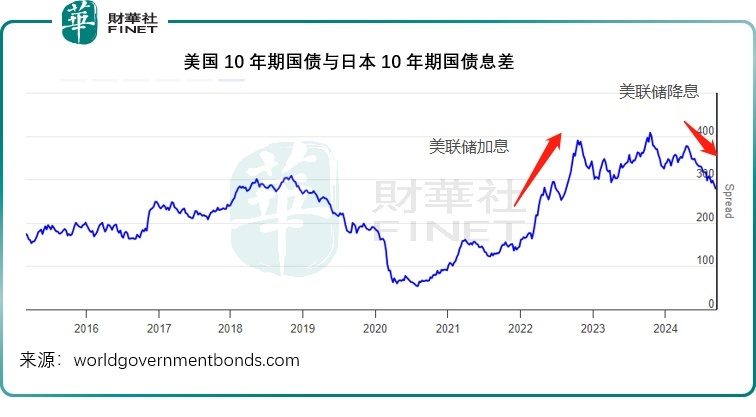
With the U.S.-Japan rate gap shrinking, the yen has strengthened against the dollar. The USD/JPY exchange rate recently broke through the psychological 140 level for the first time since July 2023, reflecting the yen's recent strength.
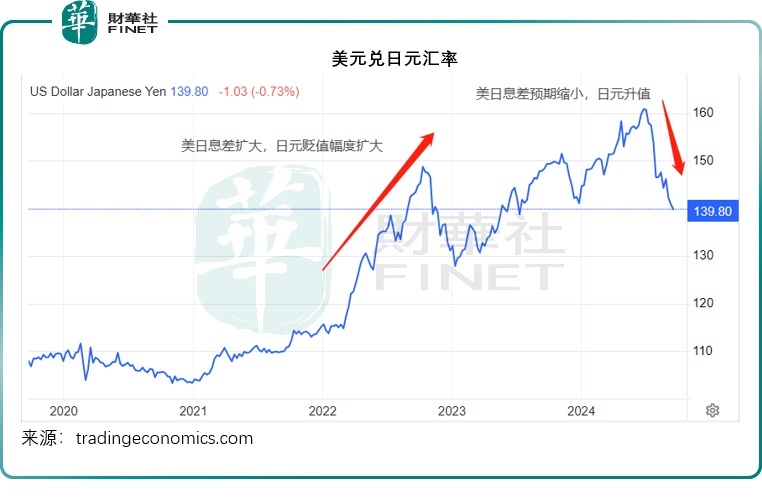
In March, the BOJ ended negative rates for the first time in years, then hiked by 25 basis points to 0.25% in July to counter yen depreciation pressures. It also reduced monthly bond purchases to normalize rates.
If the Fed cuts aggressively while the BOJ continues normalizing rates, the U.S.-Japan rate gap could shrink further, weakening the dollar against the yen and potentially ushering in a new exchange rate cycle.
Bank of England: Likely to Hold Steady
The former economic powerhouse, the U.K., will also announce its rate decision on Thursday. Markets widely expect the Bank of England (BoE), which entered a rate-cut cycle earlier, to hold rates steady after last month's 25-basis-point cut. A day before the BoE's decision, the U.K. will release inflation data, with August figures expected to remain stable at 2.2%, slightly above the 2.0% target.
Conclusion
As inflation in major Western economies is tamed by rate hikes, their central banks are entering monetary easing phases to stimulate growth—a boon for equities, as lower funding costs encourage risk-taking and boost corporate earnings.
However, "expectations" are the invisible hand that moves markets. When "unexpected" events occur, volatility spikes—this is the source of risk. Thus, the question isn't "whether" rates will be cut, but "by how much."
What’s the right amount? Perhaps not for central bankers to decide, but for markets. Cut too much, and overheating inflation could reverse the cycle, as seen in the 2022 hikes. Cut too little, and economic contraction could trigger a crisis, forcing central banks to slash rates or "flood" the economy with stimulus, as in 2019–2020.
This is how rate cycles operate and influence commodities, rates, and currencies. There’s nothing new—understanding the mechanics lets you navigate the cycle.
Author: Mao Ting
The copyright of this article belongs to the original author/organization.
The views expressed herein are solely those of the author and do not reflect the stance of the platform. The content is intended for investment reference purposes only and shall not be considered as investment advice. Please contact us if you have any questions or suggestions regarding the content services provided by the platform.
