


Weak growth in life insurance, struggling tech business, Ping An's transformation in crisis


Although a big ship can weather storms, Ping An Insurance (Group) Company of China (PINGAN) is currently facing both internal and external challenges, dealing with volatile industry policies and internal management pressures, making its transformation difficult.
@新熵 Original
Author 丨 Yan Zhao Editor 丨 Jue Ying
At the intersection of the trillion-yuan markets of comprehensive finance, healthcare, and elderly care, the future direction of Ping An has become a focal point for the market.
Two years ago, in August 2022, when Ping An released its interim report, CEO Xie Yonglin stated in an interview with Yicai that Ping An was entering its fourth decade, focusing on comprehensive finance and healthcare. At the same time, Xie Yonglin admitted that Ping An faced challenges in three areas: First, from the financial industry perspective, China's life insurance sector was undergoing deep adjustments, with agents and product models in urgent need of reform. Second, macroeconomic changes due to the pandemic impacted Ping An's performance growth. Third, internal management pressures within Ping An.
Observations show that more than two years later, these three challenges still persist and remain Ping An's primary contradictions. Amid economic downturns and even consumption downgrades, Ping An faces volatile industry policies and internal management pressures.
According to Ping An's latest 2024 interim report, while its three core businesses—life & health insurance, property & casualty insurance, and banking—drove revenue and net profit growth, its asset management and technology segments showed weakness. Notably, technology businesses represented by Lufax (LU) and Ping An Health saw significant declines in net profit attributable to shareholders, raising concerns.
Various signs indicate that Ping An's core business is not as stable as Mount Tai, with potential risks gradually emerging. Moreover, its new business value growth lags behind peers, and implementing its "comprehensive finance + healthcare" strategy will face challenges.
Core Life Insurance Growth Lags Behind Peers
As is well known, Ping An's core businesses include life & health insurance, property & casualty insurance, and banking. Among these, life & health insurance is the profit pillar for Ping An, making its performance particularly critical.
Overall, in the first half of 2024, Ping An achieved revenue of 494.966 billion yuan, up 1.26% year-on-year, and net profit attributable to shareholders of 74.619 billion yuan, up 6.84% year-on-year. In comparison, its revenue growth in the first half of 2023 was 7.65%, while net profit saw a 1.25% decline. This shows that its core performance indicators—revenue growth has slowed significantly, while net profit appears slightly optimistic.
Breaking it down, life & health insurance, property & casualty insurance, and banking achieved net profits attributable to shareholders of 50.612 billion yuan, 9.909 billion yuan, and 14.999 billion yuan, respectively, up 12.17%, 7.22%, and 1.94% year-on-year. The products under these segments—Ping An Life, Ping An Pension, and Ping An Health—all maintained positive growth.
However, it is worth noting that the growth rate of new business value (NBV) for its life insurance, a key component of its core business, lags behind major competitors.
In the insurance industry, NBV refers to the present value of future profits expected from newly sold policies, an important metric for measuring insurers' performance.
Financial reports show that in the first half of 2024, Ping An's life & health insurance NBV reached 22.320 billion yuan, up 11.0% year-on-year. In contrast, China Pacific Insurance (CPIC) and China Life Insurance reported NBV of 9.037 billion yuan (up 22.8% year-on-year) and 32.262 billion yuan (up 18.6% year-on-year), respectively.
This indicates that Ping An's life insurance NBV, including health insurance, faces intense competition in both absolute value and growth rate.
Surviving Adversity Under Policy Guidance

In recent years, the insurance industry has undergone dramatic changes under regulatory policies. A landmark event was the establishment of the National Financial Regulatory Administration (NFRA) on May 18, 2023, replacing the China Banking and Insurance Regulatory Commission (CBIRC), accelerating the formation of a "one central bank, one administration, one commission" regulatory framework. This marked another major adjustment in financial regulation since the CBIRC's formation in 2018.
Meanwhile, rapid declines in agents, capital market turbulence, falling interest rates, and the suspension of 3.5% fixed-rate products like whole life insurance triggered a wave of policy cancellations, leaving Ping An, a Fortune 500 financial giant, struggling to keep up.
Moreover, to reduce risks, the insurance industry has begun rectifying sales channels, lowering fees, and extending "compliance between filings and operations" from property insurance to life insurance. According to regulators, this means insurers cannot "say one thing and do another."
This also implies that the industry's "gray areas" will shrink, and high-margin products like high fixed-rate insurance will fade away, leaving insurers with fewer profits.
Amid these policy changes, the industry has seen a massive talent exodus. Media reports in late 2021 highlighted "nearly a million insurance professionals leaving in six months," exposing the industry's glossy facade. In subsequent years, agent attrition remained a recurring issue, and Ping An was no exception.
According to the "2024 China Insurance Development Report," by the end of 2023, the number of agents had dropped to 2.8134 million, down 69% from 9.12 million at the end of 2019. In the first half of 2024, Ping An's monthly average agent count was 308,000, down 18.7% from 379,000 at the end of 2023, indicating ongoing challenges in agent retention.
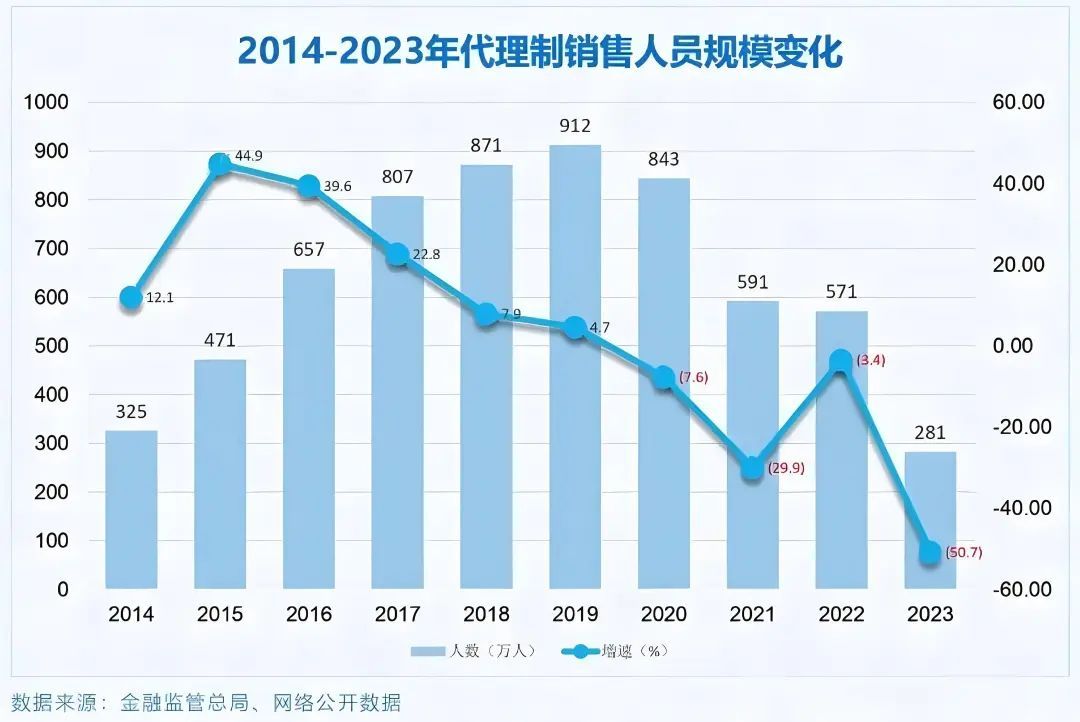
On the bright side, the impact of fewer agents is weakening, and their contribution to Ping An's performance is stabilizing. How to adapt to "fewer but better" agents has become an industry trend.
Data shows Ping An's sales network is gradually recovering, with agent-channel NBV up 10.8% and per-agent NBV up 36%. While agent numbers stabilize, their incomes continue to rise.
Ping An's interim report shows that in the first half of 2024, average monthly income per agent in life & health insurance was 12,000 yuan, up 9.9% year-on-year (compared to 9,813 yuan at the end of 2023). This suggests that "fewer but better" agents benefit both insurers and agents.
Additionally, Ping An faces uncertainty due to product restructuring. At the 2024 interim results briefing, co-CEO Guo Xiaotao said Ping An would further optimize its product mix, targeting dividend insurance to account for over 50% of sales.
However, while restructuring sounds simple, execution is challenging. In the first half of 2024, Ping An's dividend insurance premiums were only 35.420 billion yuan, just 9.13% of total premiums—far from 50%.
Clearly, Ping An's bet on dividend insurance requires training specialized sales teams, a lengthy process. It also needs to reshape consumer perceptions of its products.
Analysts attribute this shift to the NFRA's guidance to lower life insurance product rates and align them with market rates. This means Ping An's existing life insurance products are no longer profitable, necessitating restructuring.
However, as mentioned earlier, Ping An's transition to dividend insurance faces significant uncertainties and market challenges, with an uncertain outlook.
Asset Management and Tech Drag Down Performance
Amid economic downturns and weak investment markets, the insurance industry's overall investment returns have been lackluster. According to Guancha Finance, insurers' investment income collectively declined in the first half of the year. For example, in bullish markets, Ping An and China Life saw investment income in the hundreds of billions, but now it's in the tens of billions.
Among the seven listed insurers, combined investment income was 87.574 billion yuan, down 43.37% year-on-year. Ping An, one of the seven, performed particularly poorly. Its interim report shows investment income of 15.053 billion yuan in the first half of 2024, down 25.54% year-on-year.
Meanwhile, in the first half of 2024, Ping An's insurance fund investment portfolio achieved an annualized comprehensive investment return of 4.2%, up 0.1 percentage points year-on-year but below its 10-year average of 5.4%.
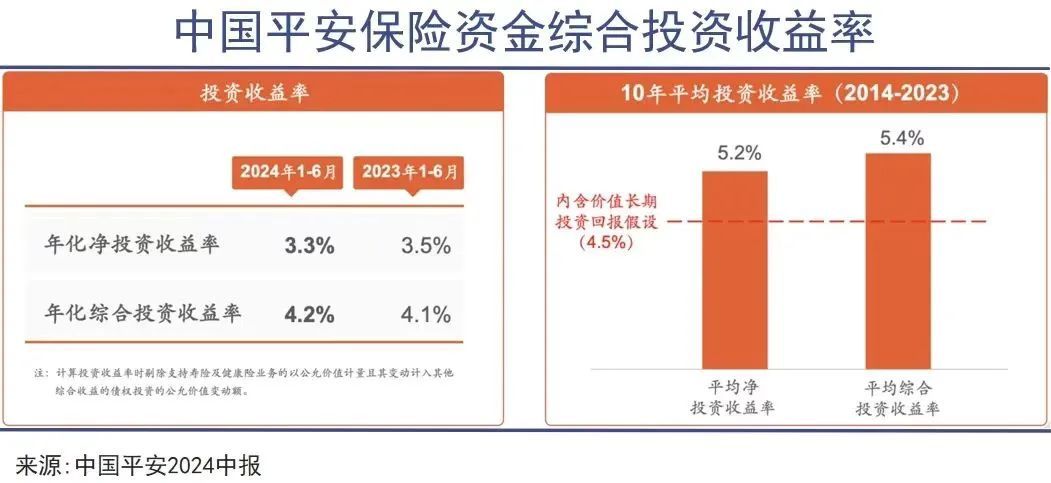
Additionally, its annualized net investment return was 3.3%, down 0.2 percentage points year-on-year due to maturing assets and lower yields on new fixed-income assets. This also falls short of its three-year average of 4.5% and 10-year average of 5.2%.
Beyond investment pressures, Ping An's asset management and tech businesses are also concerning. Both segments saw revenue declines, dragging down overall performance.
Ping An operates asset management mainly through Ping An Securities, Ping An Trust, Ping An Leasing, and Ping An Asset Management. As of June 30, 2024, assets under management exceeded 7.6 trillion yuan. However, asset management net profit was 1.685 billion yuan, down 14.7% year-on-year.
Analysts attribute this to Ping An Trust's struggles, largely tied to real estate. For example, its investments in China Fortune Land Development, Country Garden, Ronshine, Sunac, and CIFI—all major developers—have suffered due to liquidity crises or defaults.
However, at Ping An's August 2024 interim results briefing, Chief Investment Officer Deng Bin stated that with policy support, the worst for real estate is over, and the bottom has formed.
This suggests Ping An is mitigating real estate risks. However, insiders warn that real estate risks extend beyond insurance investments, potentially affecting banking, trust, and other third-party assets.
In tech, Ping An operates through subsidiaries like Lufax (LU), OneConnect (OCFT), Ping An Health, and Autohome. While these provide diverse services and synergies, profitability remains weak.
Financial reports show Ping An's tech segment operating profit plunged 61.2% year-on-year in the first half of 2024, mainly due to Lufax's profit decline.
Ping An attributed this to higher taxes from special dividends. Lufax's total revenue fell 33.1% to 12.94 billion yuan, with net losses widening by over 1.5 billion yuan. Meanwhile, Ping An increased its stake in Lufax to over 50% via "stock dividends," consolidating it into financial statements.
Although asset management and tech are small contributors, their struggles reflect inefficiencies or conflicts among Ping An's business units.
Lufax's consolidation, while strengthening Ping An's control, has raised concerns about a potential privatization.
Ping An's interim report heavily emphasized its "comprehensive finance + healthcare & elderly care" strategy. Clearly, Ping An aims to tap into three trillion-yuan markets simultaneously, but transformation and market tests await.
Ping An's grand vision includes running a financial supermarket for one-stop services, creating China's version of managed healthcare, and turning homes into elderly care centers. However, its core businesses remain unstable, and regulatory uncertainties persist.
Thus, as a comprehensive financial institution with full licenses, Ping An is like a giant ship with a clear destination. But navigating storms requires daily, yearly efforts.
This means Ping An's transformation will not be smooth sailing but fraught with unpredictable challenges. Yet, as a strong player, Ping An's resilience and experience may help it overcome obstacles and emerge stronger.
References:
1. "Ping An CEO Xie Yonglin: In Its Fourth Decade, Ping An Faces Three Challenges"
2. "Ping An's Interim Report Released!" Securities Times China
3. "Ping An Life & Health Investment Income Drops 80%, NBV Growth Lags" Global Finance
4. "Ping An: Worst for Real Estate Investments Is Over" Viewpoint Live
5. "Ping An Increases Lufax Stake to 56.82%, Consolidates Financials" Lei Di
6. "Ping An 2024 Interim Report: Breaking Through Reforms, Evolving" Blue Whale Finance
7. "Ping An at the Crossroads of Three Trillion-Yuan Markets" Big Cat Finance Pro
The copyright of this article belongs to the original author/organization.
The views expressed herein are solely those of the author and do not reflect the stance of the platform. The content is intended for investment reference purposes only and shall not be considered as investment advice. Please contact us if you have any questions or suggestions regarding the content services provided by the platform.
