


 Likes Received
 Posts
PostsThis is a real positive! Correctly interpreting the impact of the central bank's new monetary tools on the stock market!

During the National Day holiday, investors spent the most memorable golden week with smiles all around.
After all, in the Hong Kong stock market, as of the time of writing (not including today, Monday), the overall gains were quite good.
Therefore, starting tomorrow (Tuesday), market expectations are largely that the rally will continue, similar to the near-limit-up trend seen on the last trading day before the holiday.
However, just yesterday, Securities Times published an article by Xiang Songzha, Dean of the Greater Bay Area Financial Research Institute, titled "Don’t Misinterpret the Monetary Policy Tools of the People’s Bank of China."
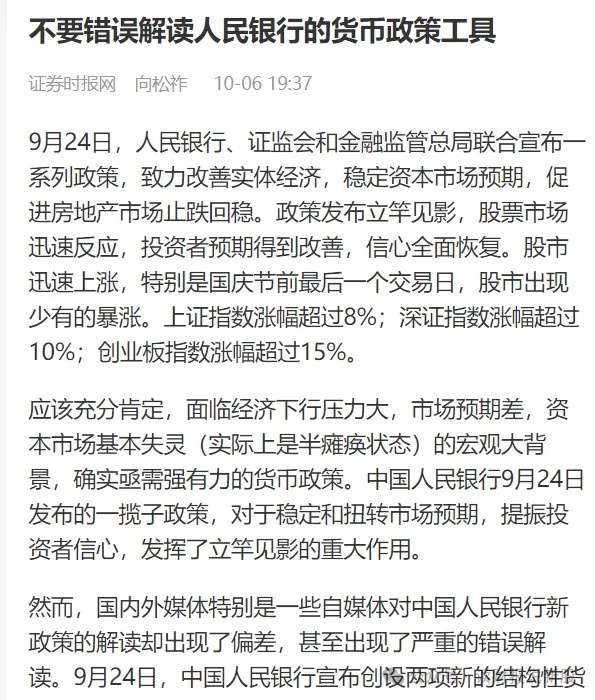
Brother Cai took a look and found the article’s points to be correct, but its intent seemed more about being right for the sake of being right, bordering on sensationalism—a common flaw among so-called 'experts' in China.
The article makes two main points:
First: Don’t mistakenly believe the central bank is directly buying stocks.
On this point, most media or bloggers don’t actually hold this view. Only a tiny fraction of sensationalist content creators deliberately push this narrative for clicks.
But Dean Xiang’s original argument suggests that many domestic media outlets have misinterpreted this.

Dean Xiang’s sweeping generalization unfairly tars most people with the same brush—this is true sensationalism.
The article’s second point: Dean Xiang’s correct interpretation of the central bank’s two new monetary tools.
His interpretation is accurate, but he only analyzes it from his 'professional' financial perspective, without mentioning its impact on the stock market—or to what extent.
It feels like 'armchair theorizing,' and he again falls into the trap of overgeneralizing.
Financial experts often love to comment on macro trends, but their insights rarely help us investors.
Because their analyses remain superficial, never delving into the stock market specifics. After all, 'armchair theorizing' carries no accountability.
Theory must be combined with practice. As a hands-on investor who’s nearly fully invested, Brother Cai will now correctly interpret how these two new monetary tools affect our stock market.
Whether you trust 'armchair theorists' or 'hands-on practitioners' is up to you!
.......
The two new monetary tools issued by the central bank are: 1) Swap Facility, and 2) Stock Buyback and Shareholding Increase Special Relending.
① First, the Swap Facility
The Swap Facility allows securities firms, funds, and insurance companies to use their holdings—such as bonds, stocks, ETFs, and CSI 300 constituent stocks—as collateral to exchange for highly liquid assets like government bonds and central bank bills from the central bank.
The essence of this tool is to help financial institutions improve their liquidity.
For example, if a financial institution holds stocks worth 1 billion yuan but can’t easily sell them, it can pledge them to the central bank. With a 70% collateral rate, it can exchange them for 700 million yuan in government bonds, which can then be sold for cash.
Notably, the central bank mandates that this 700 million yuan can only be used to buy stocks, not for other purposes. So this policy not only strengthens financial institutions’ capital but also improves market liquidity.
Additionally, financial institutions borrowing and selling bonds can help curb the soaring prices of government bonds, stabilizing long- and short-term bond yields.
Thus, the central bank’s new tool kills three birds with one stone.
Overseas markets have similar tools to the Swap Facility, but they’re typically used during special periods.
During the 2008 financial crisis, the Federal Reserve introduced the Term Securities Lending Facility, allowing primary dealers to use less liquid securities as collateral to borrow highly liquid Treasury bonds, facilitating market financing and boosting market confidence.
In 2020, when U.S. stocks experienced a meltdown that even Warren Buffett called 'unprecedented,' this tool was revived.
Looking at U.S. stocks, whether during the 2008 financial crisis or the 2020 market crash, the use of this tool directly triggered major reversals and rallies!
China’s Swap Facility has an initial scale of 500 billion yuan, but Governor Pan said that if it works well, another 500 billion—or even a third round—could follow.
Given the U.S. stock market’s performance, this is undeniably a real positive for stocks!!!
②Stock Buyback and Shareholding Increase Special Relending
Besides the Swap Facility, the central bank’s second new tool is the Buyback and Shareholding Increase Relending.
Everyone knows about buybacks and shareholding increases—one uses the company’s funds to buy back shares, the other uses shareholders’ own money.
Some listed companies feel their stocks are undervalued and want to buy back or increase holdings, but they lack the funds.
No problem—this new policy allows listed companies or major shareholders to borrow from banks specifically for buybacks or shareholding increases.
As for interest rates, the central bank offers relending to commercial banks at 1.75%, who then lend to companies or shareholders at 2.25%.
Compared to other loans, this rate is very cheap. Stock buybacks have been a key driver of the long-term bull market in U.S. stocks, as they boost EPS and market sentiment.
After the 2008 financial crisis, U.S. Treasury and corporate bond rates fell for a long time. In this low-rate environment, coupled with tax cuts, U.S. companies aggressively bought back shares.
With real capital injections, U.S. stocks repeatedly hit new highs.
The result of leveraged buybacks is that some companies’ net assets turned negative. You might not know this, but even star companies like Starbucks have negative net assets due to years of dividends and leveraged buybacks.
In A-shares, negative net assets mean delisting, but in U.S. stocks, as long as fundamentals are strong, negative-asset companies can still thrive.
③ Conclusion
From the above, it’s clear that the central bank’s two new monetary tools are, to some extent, inspired by the U.S. stock market’s past.
Looking at the charts, 2008 and 2020 were rare bear markets for U.S. stocks, especially the 2008 crash.
These two tools single-handedly lifted U.S. stocks out of bear markets.
Thus, the central bank’s two new tools are undeniably a real positive for A-shares!!!
$SMIC(00981.HK) $TENCENT(00700.HK) $Alibaba(BABA.US) $MEITUAN(03690.HK)
That’s all for today’s analysis. Did you find it helpful? I’m StockPro, an ordinary investor who loves reading financial reports, specializes in Hong Kong IPO subscriptions, and invests across Hong Kong, U.S., and A-shares with a long-term focus and short-term supplements. See you next time!
The copyright of this article belongs to the original author/organization.
The views expressed herein are solely those of the author and do not reflect the stance of the platform. The content is intended for investment reference purposes only and shall not be considered as investment advice. Please contact us if you have any questions or suggestions regarding the content services provided by the platform.
