



When autonomous driving meets National Day, leading players show their 'real skills'

Since entering the "Golden September and Silver October" period, the automotive industry has been exceptionally vibrant.
Major automakers have launched heavyweight models one after another. Statistics show that in September alone, over 30 automakers released approximately 46 new models, making it the month with the highest number of new car launches this year.
Many of these new cars share a common selling point: they are equipped with Huawei's Qiankun Intelligent Driving System.
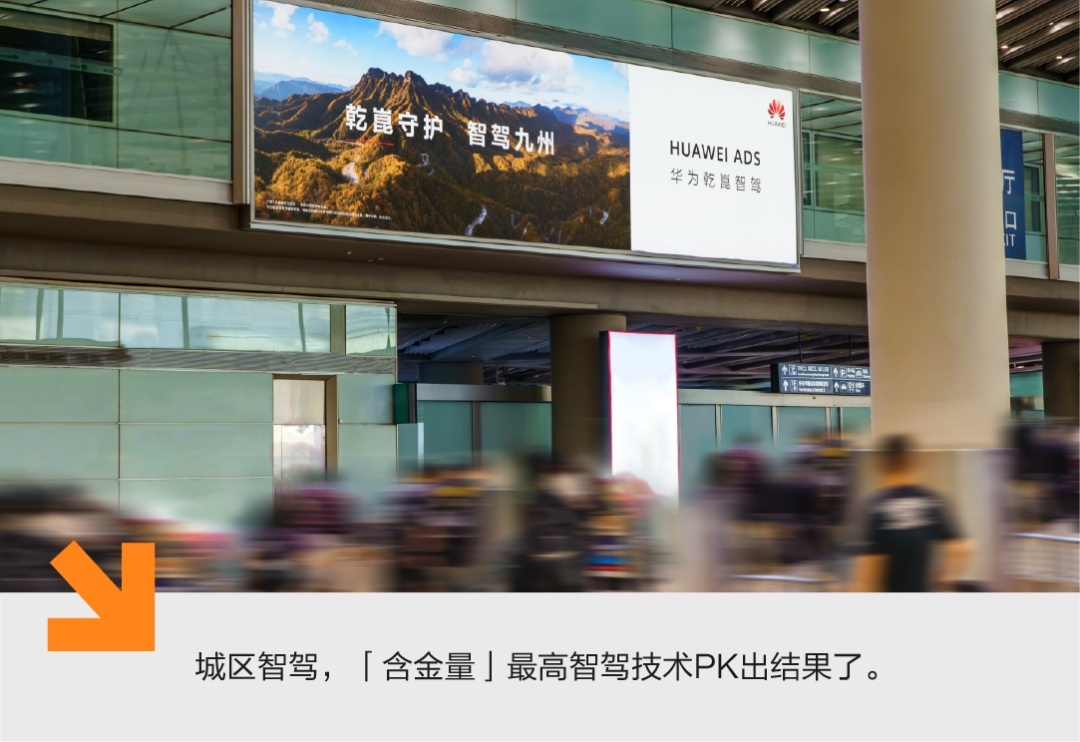
Just before the National Day holiday, many noticed that Huawei Qiankun's new billboards quietly appeared at major airports across the country, featuring a new slogan: "Qiankun Protection, Intelligent Driving Across the Land".
The eight-character slogan not only resonates with the travel scenes during the National Day holiday but also highlights Huawei Qiankun's value proposition, allowing users to enjoy intelligent driving with peace of mind and appreciate the beauty of the country.
The term "Intelligent Driving" perfectly captures the new trend in contemporary lifestyle.
According to data from the Ministry of Transport, from October 1 to 7, the total cross-regional passenger flow was estimated at 2.008 billion, with a daily average increase of 4.1% year-on-year.
In terms of road travel, the passenger flow reached approximately 1.85 billion, with a daily average increase of 3.9% year-on-year.
Among these, self-driving accounted for over 80%, becoming the absolute mainstream of National Day holiday travel.
The complex traffic scenarios during the National Day holiday provided an excellent opportunity to evaluate the real-world performance of intelligent driving products. As the performance of intelligent driving products improves, the penetration rate of advanced intelligent driving continues to rise, and "intelligent driving" is poised to become a new label for national travel.
Leading players in intelligent driving, such as Huawei Qiankun and Li Auto, have showcased their "report cards" for National Day holiday travel.
On October 9, Huawei's Intelligent Automotive Solution BU released the "2024 Huawei Qiankun Intelligent Driving National Day Travel Report" (hereinafter referred to as the "Report"), which revealed the following data:
From 00:00 on October 1 to 24:00 on October 7, the number of users of vehicles equipped with Huawei Qiankun (i.e., vehicles with non-zero intelligent driving mileage) reached 278,000, with a total intelligent driving mileage of 85.717 million kilometers. Notably, the proportion of intelligent driving mileage to total mileage for Huawei Qiankun users has exceeded 40% (41.1%).
The high proportion of "intelligent driving" among "self-driving" users has exceeded many people's expectations. The shift from "self-driving" to "intelligent driving" is driven by Chinese new energy vehicle participants known for their cutting-edge technology.
Facing the surge in traffic, the current "high ground" of intelligent driving technology—urban intelligent driving—has effectively passed a "battle test," and the results are now official.
01、Urban Intelligent Driving: The Highest-Stakes Technology Competition Yields Results
The Report shows that during the National Day holiday, Huawei Qiankun's intelligent driving partner vehicles accumulated a total mileage of 210 million kilometers, of which intelligent driving accounted for 85.717 million kilometers, representing 41.1% of the total mileage; urban intelligent driving mileage reached 13.349 million kilometers, accounting for 15.57% of the total intelligent driving mileage.
Meanwhile, data from Li Auto's National Day Holiday Travel Report shows that Li Auto's total mileage during the holiday reached 550 million kilometers, with intelligent driving accounting for 82.135 million kilometers, or approximately 14.93% of the total mileage; urban intelligent driving mileage was 7.261 million kilometers, accounting for about 8.84% of the total intelligent driving mileage.
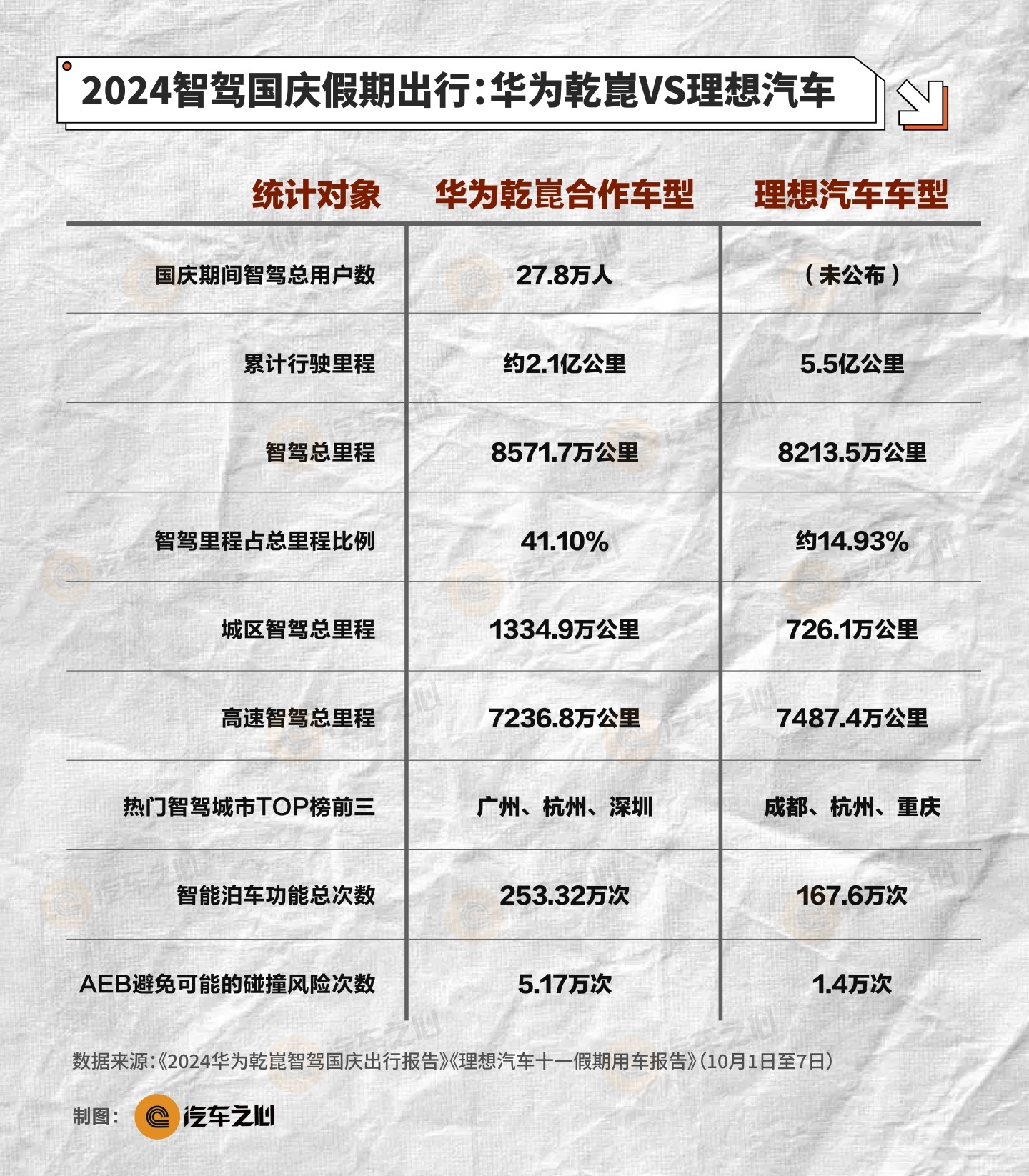
User trust is reflected in product usage rates. In comparison, although Li Auto has a larger fleet and longer total mileage, its intelligent driving mileage proportion is only 14.93%, significantly lower than Huawei Qiankun's 41.1%.
This fully demonstrates that Huawei Qiankun, with its advanced technological capabilities and exceptional maturity, has won widespread user trust, making users feel at ease, secure, and confident during use, once again highlighting its leading position in the intelligent driving field.
Urban intelligent driving is the "touchstone" for measuring the technological value of an intelligent driving product.
Compared to highway driving, urban road conditions are more complex, placing higher demands on intelligent driving technology. In this regard, Huawei Qiankun's urban intelligent driving mileage proportion of 15.57% once again leads Li Auto's 8.84%.
In fact, Huawei Qiankun's lead in this data was expected.
As the saying goes, "Intelligent Driving Across the Land," connecting north and south. As early as the ADS 2.0 stage, Huawei Qiankun's intelligent driving technology was already a generation ahead of other players.
While other manufacturers were still relying on high-precision maps and competing over the number of cities where NCA was available, Huawei Qiankun was the first to achieve nationwide operation on public roads.
Recently, with the large-scale rollout of the Qiankun Intelligent Driving ADS 3.0, it now covers multiple models, including the Aito series, Avatr series, Enjoy S9, Zhijie R7, and the new Voyah Dreamer Qiankun Edition.
Huawei Qiankun Intelligent Driving has officially evolved from "operable nationwide" to "enjoyable nationwide".
So, what can one of China's best intelligent driving products currently offer users?
Two things: improved efficiency and enhanced safety.
The improvement in user driving efficiency largely stems from the widespread application of parking functions.
In the last 100 meters of intelligent driving, Huawei Qiankun Intelligent Driving ADS 3.0 has upgraded parking capabilities, achieving breakthroughs in automatic parking space recognition, automatic parking, and valet parking, enabling "visible and parkable."
The Report further corroborates this, showing that Huawei Qiankun's intelligent parking assistance was used 2.5332 million times, far exceeding Li Auto's 1.676 million times.
Among these, APA (Automatic Parking Assistance) accounted for 73.05%; AVP (Automated Valet Parking) accounted for 5.30%; and remote parking assistance accounted for 21.65%.
Safety is the ultimate luxury. Intelligent driving products primarily ensure user driving safety through systems like collision avoidance.
The Report shows that Huawei Qiankun avoided 51,700 potential collision risks, again leading Li Auto's 14,000, further validating the slogan "Qiankun Protection".
This is attributed to Huawei Qiankun Intelligent Driving ADS 3.0's instinctive safety network, a key differentiator from the industry.
The instinctive safety network prioritizes safety in Huawei's end-to-end network, enabling rapid and timely emergency responses in complex road conditions, ensuring a safety baseline.
For users, Huawei Qiankun Intelligent Driving ADS 3.0 is not just a technology but a synonym for safety, efficiency, and convenience.
As technology continues to evolve, intelligent driving will become a mainstream travel mode, offering users increasingly efficient and safe travel experiences.
02、Huawei Qiankun's "Circle of Friends" Expands Rapidly: Who Will Join the Disruptor?
In April this year, during the Beijing Auto Show, Jin Yuzhi, CEO of Huawei's Intelligent Automotive Solution BU, mentioned in a press conference that 2024 marks the first year of large-scale commercial use of intelligent driving.
This prediction has been gradually validated with the launch of Huawei Qiankun's new brand and its subsequent explosive growth.
September 2024 can be seen as an inflection point for Huawei Qiankun's intelligent driving business.
Last month, Huawei Qiankun seemed to press the accelerator in the intelligent vehicle race, leaving competitors far behind.
From the debut of the Aito M9 five-seater version to the elegant upgrade of Qiankun Intelligent Driving ADS 3.0, and the launch of new collaborative models with major automakers, Huawei Qiankun has shone in segments like premium SUVs, MPVs, and sedans.
Huawei's Intelligent Automotive Solution BU's path to helping automakers "build better cars" is becoming clearer, and its "circle of friends" is growing.
Now, Qiankun Intelligent Driving's first batch of partners, including Dongfeng, Changan, GAC, BAIC, Seres, Chery, and JAC, have also delivered impressive results.
The "Qiankun series" models rode the wave of what the auto industry considers "the highest sales week in years" during the National Day holiday, experiencing unprecedented order surges.
On the evening of October 8, Huawei announced that the Zhijie R7 received over 9,600 orders; the Avatr 07 saw daily orders exceeding 1,000 during the holiday; and Harmony Intelligent Driving's full lineup received over 5,200 orders on National Day alone...
Over the years, Huawei has deeply rooted itself in chips, hardware, software, and cloud computing, building its comprehensive technological leadership.
Through continuous innovation and investment in the intelligent vehicle sector, more automakers have become partners of Huawei's Intelligent Automotive Solution BU, entering a phase of rapid growth.
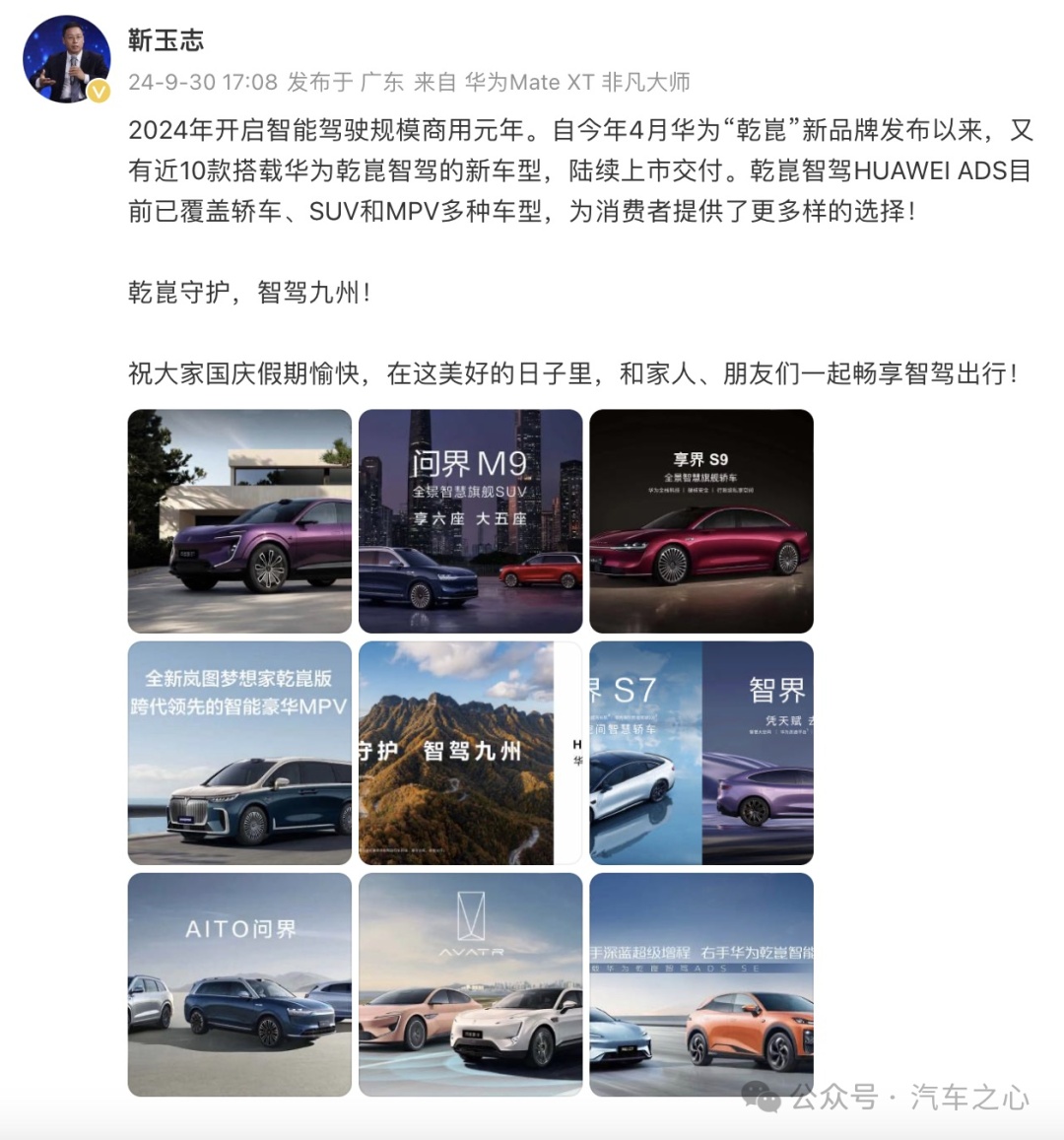
On September 30, Jin Yuzhi, CEO of Huawei's Intelligent Automotive Solution BU, reiterated on Weibo that "2024 marks the first year of large-scale commercial use of intelligent driving."
Once, intelligent driving was not at the center of China's new energy vehicle market until the breakout success of Aito.
Now, Huawei Qiankun Intelligent Driving ADS 3.0 has entered the fast lane of commercialization, evolving from Aito's "solitary bloom" to "blossoming everywhere."
Huawei's exploration in the intelligent vehicle sector is a microcosm of China's automotive industry transformation.
By empowering automakers and collaborating with the industry to build an intelligent open platform, Huawei's Intelligent Automotive Solution BU has introduced a new business model in China's auto market, redefining the relationship between automakers and partners.
With the shared goal of providing users with cutting-edge intelligent driving products, Huawei Qiankun Intelligent Driving is driving China's automotive industry toward a "blooming" future of intelligence.
$Li Auto(LI.US) $Huawei(HUAWEI.NA) $LI AUTO-W(02015.HK)
The copyright of this article belongs to the original author/organization.
The views expressed herein are solely those of the author and do not reflect the stance of the platform. The content is intended for investment reference purposes only and shall not be considered as investment advice. Please contact us if you have any questions or suggestions regarding the content services provided by the platform.
