Tesla and the US stock market observation window after the election

We have recently been focusing on researching Tesla. After the highly anticipated Robotaxi launch event, the stock price plummeted, sparking significant controversy.
First, let's summarize the pros and cons of Robotaxi:
Advantages:
Technologically, Tesla is quite aggressive, advancing the "transformer+BEV" technology significantly, shifting autonomous driving from "rule-driven" to "vision and data-driven." From a hardware perspective, they eliminated the high-cost LiDAR and high-definition maps, which is the main reason for the rapid reduction in vehicle costs.
In contrast, although this technological direction has become an industry consensus, mainstream manufacturers still retain LiDAR due to safety concerns. This gives Tesla's Robotaxi a price advantage in the short term.
Of course, under the data-driven logic, algorithms are no longer an absolute moat, and the weight of visual training has increased. Tesla does not hold an absolute advantage over domestic competitors like Baidu and XPeng.
Disadvantages:
The vehicle pricing is extremely low. Although hardware optimization is a key factor, it inevitably raises concerns: even the high-premium Tesla is now competing on price. Once price competition begins, its gross margin will be compressed, and the original valuation model will be overturned. Additionally, the overly vague timeline has caused some unease among investors.
Summary:
In terms of the Robotaxi product alone, Tesla has brought a shocking aspect to the market. Its advanced visual processing capabilities are likely about a year ahead of competitors. While the low price may require rebuilding the business model centered on gross margin, Robotaxi itself represents a new business model: shifting from vehicle sales to ride-hailing services.
With a one-year technological lead, if we disregard unpredictable risks like geopolitics, Tesla should have enough time to promote its product, and the overall outlook should be positive.
Next, let's discuss Tesla's stock price. As a high-beta company, Tesla's stock price largely depends on the broader U.S. stock market.
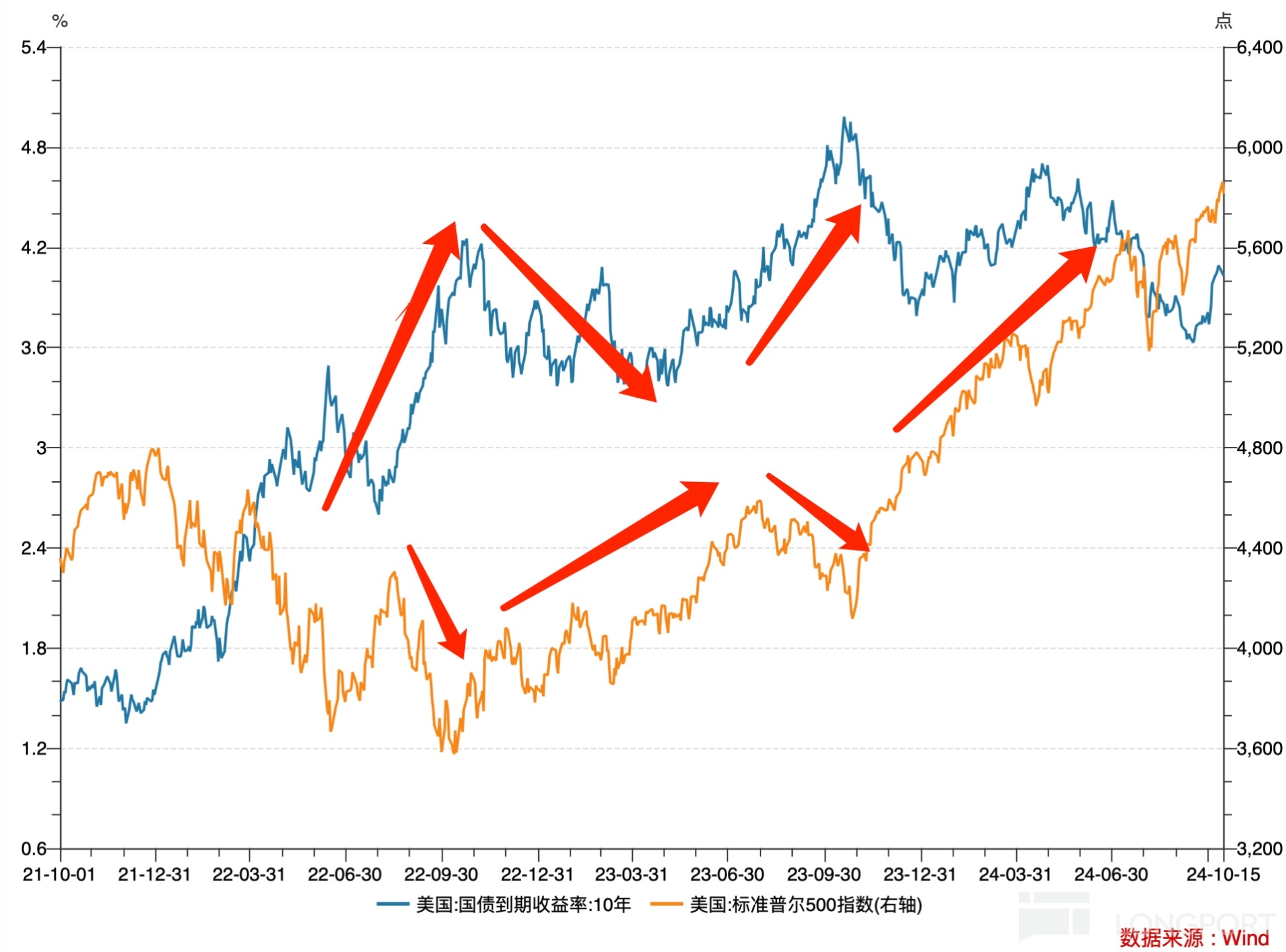
In our observation, we roughly divide the U.S. stock market since the interest rate hikes into the following phases:
Phase 1: March 2022 - October 2022. U.S. Treasury yields surged due to rate hikes, and U.S. stock liquidity suffered. Tesla's valuation also continuously declined during this period.
Phase 2: October 2022 - June 2023. U.S. Treasury yields peaked and began to decline, mainly due to the drop in the USD index, which led to dollar repatriation and eased liquidity. The U.S. stock market rebounded during this time.
Phase 3: June 2023 - Early 2024. Risk appetite in the U.S. stock market converged during this period, manifesting as redemptions in U.S. Treasuries and stocks. The USD index fell (capital flowed out of the U.S., leading to bull markets in non-U.S. economies).
Phase 4: Early 2024 - July 2024. The stock-bond hedging effect became evident during this time, with investors selling Treasuries to buy stocks. Stable economic fundamentals injected confidence into the market.
Phase 5: July 2024 - Present. The U.S. stock market has become highly sensitive to macroeconomic data, showing an increasing hedging effect between U.S. and non-U.S. economies (manifested as economic expectation gaps—declining interest rates—falling USD index—capital outflows—U.S. stock declines. If economic expectations change, this dynamic could reverse).
So, how should we judge the future?
1) Until the U.S. election (November 5), the Fed will strive to control market expectations, avoiding significant rate cuts or contractions. The reason is simple: they don’t want monetary market fluctuations to cause volatility before the election. This is also why Trump has opposed rate cuts before the election.
2) After November, if U.S. economic indicators worsen (below expectations), rate cuts could accelerate capital outflows, turning them into a negative factor.
3) If economic indicators remain strong and rate cuts are orderly, U.S. capital market risk appetite will be safeguarded (our historical review emphasizes the relationship between risk appetite and the market). In this case, even modest rate cuts would be positive.
For Tesla, we can divide it into two phases:
1) Before the election, there won’t be significant fluctuations.
2) After the election, it depends on economic fundamentals. We hope CPI remains controlled and employment data stays strong.
3) The short-term stock price has a vague relationship with Robotaxi, but in the long run, the latter will contribute significantly.
$Tesla(TSLA.US)
The copyright of this article belongs to the original author/organization.
The views expressed herein are solely those of the author and do not reflect the stance of the platform. The content is intended for investment reference purposes only and shall not be considered as investment advice. Please contact us if you have any questions or suggestions regarding the content services provided by the platform.