


 Likes Received
 Posts
PostsHenan's 'Pork King' earns 10 billion yuan.

The former "Pork Maotai" Muyuan Foods seems to be making a comeback.
Recently, Muyuan Foods disclosed its Q3 earnings forecast: it is expected to achieve a net profit of 10 billion–11 billion yuan in the first three quarters of 2024, a year-on-year increase of 642.79%–697.07%; among which, Q3 is expected to achieve a net profit of 9 billion–10 billion yuan, a year-on-year increase of 860.63%–967.36%.
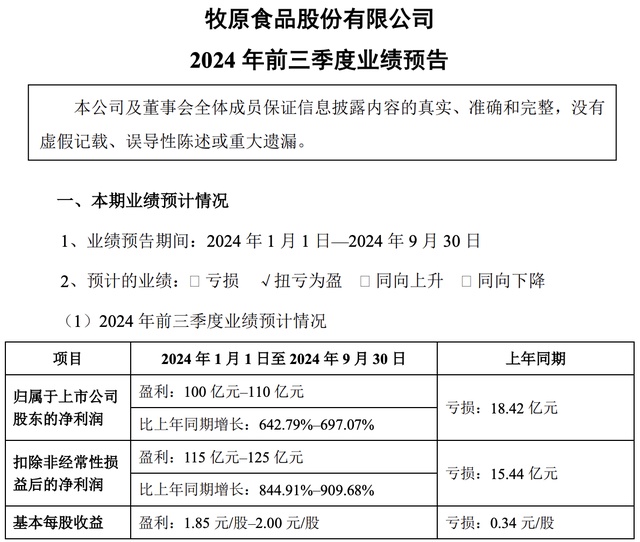
Compared with past performance, if Muyuan Foods ultimately reaches the upper limit of the 10 billion yuan profit expectation, the company will have returned to the profitability level of the "strongest pig cycle" in 2020.
For the industry, this is also an important turning point.
Of course, the reason Muyuan Foods was able to achieve a profit of over 9 billion yuan in Q3 is largely due to the recovery in pork prices. Data shows that the national average live hog price in September was 18.93 yuan/kg, down 6.93% month-on-month but up 15.64% year-on-year.
Notably, in the previous pig cycle, pork prices rose from 16 yuan/kg in mid-2018 to 56 yuan/kg by the end of 2019, a staggering increase of 250%. In comparison, the current performance of Muyuan Foods has even higher "gold content."
Over the past few years, under the influence of persistently low pork prices, the live hog farming industry has been sluggish. However, Muyuan Foods chose to expand against the trend during the industry's downturn. But now, having survived the darkest moments, Muyuan Foods' "good days" are just beginning.
The Return of "Pork Maotai"
Among the many listed pig farming companies, Muyuan Foods has always been the most profitable.
Especially during the "strongest pig cycle" in 2020, Muyuan Foods' net profit that year reached 27.45 billion yuan. For comparison, in the same year, the two other leading pig farming companies, Wens Foodstuff Group and New Hope, achieved net profits of 7.426 billion yuan and 4.944 billion yuan, respectively. Muyuan Foods' net profit was nearly 4 times that of Wens and over 5 times that of New Hope.
However, impacted by the sharp decline in pork prices, Muyuan Foods also reported losses in 2023. According to its 2023 financial report, Muyuan Foods incurred a net loss of 4.263 billion yuan in 2023.
Entering 2024, with the recovery in hog prices, Muyuan Foods quickly emerged from the "quagmire" of losses.
According to the announcement disclosed by Muyuan Foods, it is expected to achieve a net profit of 10 billion–11 billion yuan in the first three quarters of this year, a year-on-year increase of 642.79%–697.07%; among which, Q3 is expected to achieve a net profit of 9 billion–10 billion yuan, a year-on-year increase of 860.63%–967.36%.
Overall, the former "Pork Maotai" Muyuan Foods has returned, and compared to the past few years, Muyuan Foods seems even stronger.
This is because Muyuan Foods has managed to control farming costs while expanding, demonstrating exceptional cost control capabilities. According to the earnings forecast, in the first three quarters, Muyuan Foods sold a total of 50.144 million live hogs, with sales revenue of 95.35 billion yuan, both showing year-on-year growth. In terms of farming costs, Muyuan Foods' farming cost in August had dropped to around 13.7 yuan/kg, a reduction of 2 yuan/kg compared to the beginning of the year, a decline of over 10%. According to the plan, Muyuan Foods expects to further reduce costs to 13 yuan/kg by the end of the year.
It's worth noting that the live hog farming industry is different from other industries. During expansion, the industry is prone to "diseconomies of scale," especially after the "African swine fever" outbreak. Many pig farming companies face cost control issues as their production scale increases, with 5 million heads being a critical inflection point. However, Muyuan Foods has managed to achieve both "expansion and cost reduction," showcasing its strength.
Of course, Muyuan Foods' fundamentals are not perfect. According to the half-year report, the company still faces some debt pressure.
As of the first half of this year, Muyuan Foods' total liabilities stood at 118.4 billion yuan, with a debt-to-asset ratio of 61.81%. Among these, short-term loans alone amounted to 43.15 billion yuan, while notes payable and accounts payable reached 26.62 billion yuan, totaling nearly 70 billion yuan. During the same period, Muyuan Foods' cash reserves were 20.36 billion yuan, insufficient to cover short-term loans and payables, indicating significant cash flow pressure.
However, after the Q3 earnings report is released, with the substantial increase in profits, Muyuan Foods' cash flow situation will undoubtedly improve. For now, debt pressure is no longer a major issue.
The "Good Days" Have Just Begun
As one of the few pig farming companies to disclose Q3 earnings forecasts early, Muyuan Foods' performance highlights its leading position in the industry.
We believe that, based on industry trends and Muyuan Foods' aggressive expansion over the past few years, a single-quarter net profit of over 9 billion yuan is not the ceiling.
This claim is not without basis. On one hand, a new pig cycle has arrived. According to media reports, from the beginning of the year to early August, the average hog price rose by nearly 33%. Although prices have recently declined slightly, the national average live hog price in September was still 18.93 yuan/kg. Based on Muyuan Foods' latest farming cost of 13.7 yuan/kg, the company is already profitable across the board.
As long as hog prices remain stable in the future, Muyuan Foods' performance can continue to grow steadily.
According to media analysis, after the last super pig cycle, the capitalization of China's live hog farming industry has surged. From 2019 to 2023, the "big three" listed pig farming companies raised over 5.874 trillion yuan in total. Capitalization has led to a transformation in China's hog supply structure and the gradual disappearance of the pig cycle.
Currently, the live hog farming industry has entered a "new phase," where large-scale farming institutions will reduce irrational "chasing highs and selling lows" behavior. Large pig farming companies are focusing more on cost reduction and efficiency improvement, replacing simple capacity adjustments and expansions. In this context, pork prices will stabilize.
On the other hand, as mentioned earlier, despite the industry's downturn in recent years, Muyuan Foods chose to expand against the trend during the low period. According to financial reports, in the first half of this year, Muyuan Foods' fixed assets amounted to 109 billion yuan, with construction in progress at 2.094 billion yuan, totaling 111.094 billion yuan. In 2020, Muyuan Foods' fixed assets were 58.53 billion yuan, with construction in progress at 14.83 billion yuan, totaling 73.36 billion yuan. In less than four years, Muyuan Foods' "fixed assets + construction in progress" grew by approximately 38 billion yuan.
During the period of persistently declining pork prices, this capacity was once a "burden" for Muyuan Foods. But now, with pork prices rising significantly, this capacity will drive further growth in Muyuan Foods' performance.
Overall, as pork prices gradually recover, Muyuan Foods' cost and scale advantages will become increasingly evident. From an institutional holdings perspective, in the first half of the year, Muyuan Foods had 869 institutional holders, with holdings totaling 429.5 million shares, both showing significant year-on-year growth. This indicates that institutions are also optimistic about Muyuan Foods' prospects.
The copyright of this article belongs to the original author/organization.
The views expressed herein are solely those of the author and do not reflect the stance of the platform. The content is intended for investment reference purposes only and shall not be considered as investment advice. Please contact us if you have any questions or suggestions regarding the content services provided by the platform.
