


Behind the 140 million yuan financing, the media convergence process has been put on the "fast track".


According to a report by 36Kr, Communication Brain Technology (Zhejiang) Co., Ltd. recently received an investment of 140 million yuan from Zhejiang Industrial Fund. The funds will be used for technology R&D, product upgrades, project expansion, and daily operations of Communication Brain.
For a long time, digital media convergence has been a niche track for capital, with sporadic financing mainly concentrated in angel rounds and Series A, generally below tens of millions. Communication Brain's 140 million yuan financing is undoubtedly a shot in the arm for the entire industry, while also raising three questions:
1. For many, "media convergence" is a relatively unfamiliar term. What background and trends does it correspond to?
2. What role does "Communication Brain" play in the process of media convergence, and why has it attracted the attention of the capital market?
3. Behind the phenomenal 140 million yuan investment, what impact will it have on media convergence, and what chain reactions will follow?
If we can clarify the answers to these questions, we may gain a deeper understanding of the inevitable trend of media convergence and the potential opportunities within it.
01 A Decade of Exploration: "Media Convergence" Enters the Deep End
Jay Nelson once predicted in "The End of Traditional Media": "In the next five to ten years, most current media formats will die out and be replaced by integrated online media."
Back in 1998, when the internet was just beginning to spread, newspapers and TV were still the mainstream. Nelson's view was bold. The "qualitative change" occurred ten years later, with the rapid rise of social media like Weibo and WeChat, and the emergence of new formats such as news feeds, live streaming, and short videos. Amid behavioral shifts like "not reading newspapers but scrolling through WeChat Moments" and "not watching TV but playing with Weibo," media convergence was put on the agenda.
On August 18, 2014, the Central Leading Group for Comprehensively Deepening Reforms reviewed and approved the "Guiding Opinions on Promoting the Convergence of Traditional Media and Emerging Media," elevating media convergence to a national strategy. After the starting gun was fired, the discussion was no longer about "whether to converge" but "how to converge."
Over the past decade, the exploration of "media convergence" has been in full swing, with many beneficial model innovations and convergence cases emerging from the bottom up.

The first is the "county autonomy" model, which focuses on county-level units, adapting to local conditions for targeted convergence innovation. The most common example is the establishment of county-level media convergence centers. For instance, Zhejiang Wenling's "Village Communication Network" builds four scenarios—"perception and decision-making, precise communication, public feedback, and governance enhancement"—for villages and communities, bridging the "last mile" of grassroots communication and governance.
The second is the "city coordination" model, characterized by resource aggregation at the municipal level to break down information silos. A typical example is Zhengzhou's Zhengbao Media, which collaborates with 16 counties and development zones to advance media convergence center construction, exploring a smart operation model of "news + government affairs + services + e-commerce" and incorporating commercial operations into the scope of "media convergence."
The third is the "provincial coordination" model, which essentially constructs a "central kitchen" at the provincial level as the nerve center and innovation platform for media convergence content production, while also building a shared, open technical foundation in the "cloud" to provide comprehensive services such as technology, platforms, content, and talent. The most classic examples are Zhejiang's "Tianmu Cloud" and "Xinlan Cloud."
However, the old and the new are constantly intertwined. The model innovations that worked well a decade ago are gradually showing signs of "fatigue" under the wave of the new technological revolution:
Driven by large models, new formats like digital humans and virtual anchors are gaining momentum. Due to technical limitations, county-level media convergence centers can only "show off" occasionally without regular application. At the same time, talent gaps are exposed. Data from Zhejiang Media Research Institute shows that the lack of professional talent in new media content production at county-level media convergence centers is as high as 77.78%. Other hidden issues include business fragmentation, data silos, content operations, and commercial monetization.
In other words, "media convergence" has entered the deep end. Simple "puzzle-style" convergence or "reshuffle-style" organizational restructuring can no longer solve existing problems. Beyond model innovation, technological advancement is essential.
As proposed in the "Decision" of the Third Plenary Session of the 20th Central Committee: "Build a work mechanism and evaluation system adapted to omnimedia production and dissemination, and promote systemic reform of mainstream media."
02 Technology-Driven: Communication Brain "Weaves" a Network
When media convergence requires technology to break through, it means a change in the rules of the game: whoever seizes the technological trend and gains a voice in technology will take the initiative in competition.
Back in early 2023, Communication Brain Technology Company was officially established under the guidance of the Zhejiang Provincial Party Committee's Propaganda Department, jointly initiated by Zhejiang Daily Press Group, Zhejiang Radio and Television Group, Zhejiang Publishing United Group, and Zhejiang Cultural Industry Investment Group. As the name suggests, "Communication Brain" aims to be the unified technology-driven foundation for deep media convergence across the province.
Despite its clear state-owned enterprise background, Communication Brain, with its clear goals, resembles a pure technology platform, even more "aggressive" than many internet companies.
Zhang Yuyi, General Manager of Communication Brain, stated that 80% of the company's employees are technical personnel, and R&D investment has exceeded 120 million yuan from 2023 to the present.
Facing the deep-end media convergence process, how should a technology platform respond? Zhejiang's solution is to build a "one network" for media convergence at the provincial, municipal, and county levels.
Zhejiang Daily's "Tianmu Cloud" and Zhejiang Radio and Television's "Xinlan Cloud" were integrated into "Tianmu Lan Cloud." Through user, content, and operation integration, a unified technical support platform connecting media resources at the provincial, municipal, and county levels was built, providing a full-chain business solution covering "planning, collection, editing, review, distribution, management, and evaluation" to avoid internal friction caused by resource dispersion, business overlap, and interest conflicts.
After solving the problem of a unified technical foundation, Communication Brain targeted two core pain points hindering media convergence:
The first is content production and dissemination.
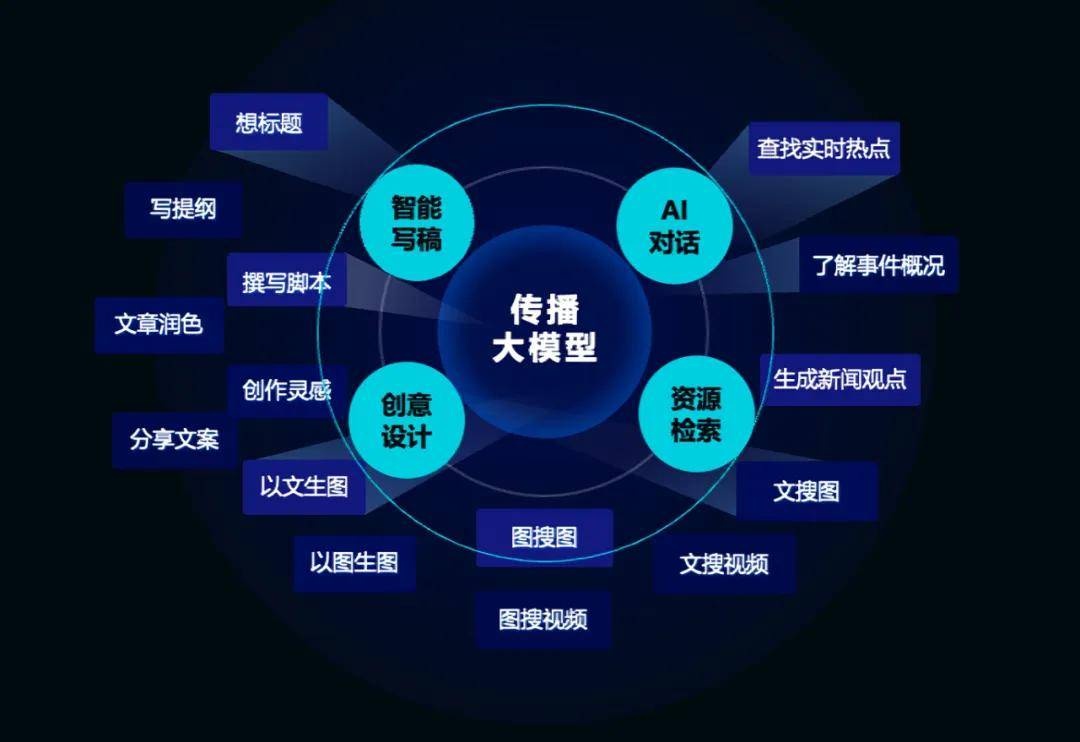
In addition to integrating propaganda resources to form a media resource library, automatic content review, and real-time linking of articles to the dissemination matrix platform as "efficiency" tools, Communication Brain continuously seeks productivity from new technologies. A direct example is the "Communication Large Model" launched in September 2023, which has introduced over 60 AIGC functions, including dialogue Q&A, intelligent creation, multimodal retrieval, creative design, and intelligent proofreading, and has been opened to "one network" users.
The second is commercial operation and monetization.
If media revenue is not diversified enough and lacks strong self-sustaining capabilities, the driving force for convergence will be absent. Technology-driven Communication Brain found two entry points: collaborating with leading commercial communication platforms on content copyright, covering refined content operation monetization and copyright protection; and in digital marketing, building the first provincial-municipal-county integrated digital marketing platform "Hongze" to enhance commercial 溢价能力 through traffic aggregation.
The logic is not hard to explain.
The 初衷 of "one network" is to use a unified technical foundation to connect various resources, enabling all media in the province to share open-source technology and 共建开放生态, shifting from 过去的单兵突进 to 整体作战. When unnecessary internal friction is eliminated, the efficiency of content production and dissemination improves, media influence grows, and commercialization avenues widen, media convergence becomes a natural outcome.
As of now, Communication Brain's "network" has served the daily content production, release, and dissemination of over 90 media outlets in the province, with one-third of Jiangsu residents becoming registered users of "one network."每天有 250 万条内容在 "one network" 上发布,初步形成了一个共建共享共融的省域媒体生态。
03 Capital Inflow: Media Convergence Presses the "Accelerator"
According to past experience, capital inflow often marks the industrialization of technology. Over the past decade, media convergence has largely been policy-driven. When the driving force shifts from policy to capital, what chemical reactions will occur?
Zhang Yuyi, General Manager of Communication Brain, stated in a media interview: "Investing in cutting-edge technologies and actively applying them to the media and cultural industry, while continuously exploring new business and market models, are the key factors for us to secure investment." The 140 million yuan investment from Zhejiang Industrial Fund will mainly be used to promote innovation in three areas:
First, increasing exploration of cutting-edge technologies. This includes strengthening and upgrading the "Communication Large Model," building a next-generation future media convergence studio, and enhancing technological exploration in cultural digital products like positive energy 态势感知 and risk control 巡检。
Second, driving product and business innovation and upgrades, continuing to optimize Communication Brain's core product "Tianmu Lan Cloud," actively promoting the iteration of key platforms "Chao News" and "Z Vision," and strengthening regional cooperation for the "Hongze" system.
Third, expanding markets within and outside the province. It is reported that Communication Brain will seek business growth points in regions like Chongqing, Jiangxi, Guangxi, Xinjiang, Hebei, Yunnan, Beijing, and Anhui.
There is not much 公开的消息, but the signals are clear: the next step will focus on two directions to "啃硬骨头"—continuing to invest in technology to 巩固创新的先发优势, and steadily advancing 生态建设 to deepen 合作的范围和力度。
Only innovators advance, only innovators are strong, only innovators prevail. Under the call for deepening media convergence, Communication Brain's goal is likely not just to be a "Zhejiang model." Zhejiang has set an example for 全国媒体融合, also securing a "ticket" for Communication Brain to a broader market.

As mentioned earlier, most provinces and cities are still in the "cloudification" stage of media convergence. This is because many media outlets have yet to move beyond the "technology workshop" model, relying mainly on 外包 for R&D, resulting in 明显的滞后 in technology application.
How can media and new technologies seamlessly converge to 迸发新质生产力? Communication Brain 某种程度上扮演了 "领航员" 和 "探索者" 的角色。
Whether it's the Communication Large Model 重塑内容生产力和创造力, the third-generation future media convergence studio integrating virtual reality, digital humans, and AIGC, or the 落地应用 of "one network" in provincial-municipal-county 三级融媒体, the challenges are not just technological. How to address 体制和机制的壁垒问题, accelerate the convergence of people, matters, systems, and 思想认识, and deepen the depth of technical cooperation in 路径, involves many common issues in the media convergence process.
Communication Brain,勇闯 "无人区," provides 参考的打法 for other provinces and cities undergoing transformation.
Evidence includes Communication Brain's 深度合作 with Jiangxi Province to empower the Jiangxi Media Brain platform technologically and 参与组建江西融媒大脑科技有限公司, marking its first "跨省旅行" beyond 地域界限. Over the past year, it has provided technical services to media outlets in Guizhou, Hebei, Yunnan, Shanxi, and Tibet. Media from Guangxi, Chongqing, Jiangxi, and other provinces have already reached 合作意向 with Communication Brain regarding the "Communication Large Model."
Following this logic, Zhejiang Industrial Fund's investment "unlocks" not just Communication Brain's innovation and market expansion capabilities but also 无形中 presses the "accelerator" for the stagnant media convergence process. More regional media convergence processes are expected to be activated by "Zhejiang experience."
04 Final Thoughts
The main theme of media is always 变革建立在技术创新上。
Over 100 years ago, newspapers ruled, then 广播和电视登上了 "王座," and the internet became the new 传播力王者 in an unforeseen way... Perhaps in another 10 years, the internet will also be buried in the 故纸堆 like newspapers,广播, and TV.
Technology is the 纽带 of 传播, the natural law of media convergence. Those who 违背市场规律 will be 淘汰 by the times.
The copyright of this article belongs to the original author/organization.
The views expressed herein are solely those of the author and do not reflect the stance of the platform. The content is intended for investment reference purposes only and shall not be considered as investment advice. Please contact us if you have any questions or suggestions regarding the content services provided by the platform.
