


 Buffett Apprentice
The semiconductor industry is still booming, you can pay attention to the performance release of equipment manufacturers.

$NVIDIA(NVDA.US) Recently, US semiconductor companies have successively created new market capitalization highs, raising concerns about the peak of the semiconductor cycle. In particular, the expected order bomb from upstream manufacturer ASML has further heightened market worries.
However, from a longer-term perspective of upstream manufacturers, the semiconductor cycle is still in a prosperous state, with no signs of major fluctuations.
Recently, ASML stated that outstanding performance from AI data centers, automotive, and industrial markets will drive sustained semiconductor growth. From recent market inflection points, the past decade was clearly driven by smartphones, PCs, and servers, while the next decade will see new inflection points.
Industry research firm TechInsights also predicts that the global semiconductor market will reach $1 to $1.3 trillion by 2030, doubling in size over 10 years.
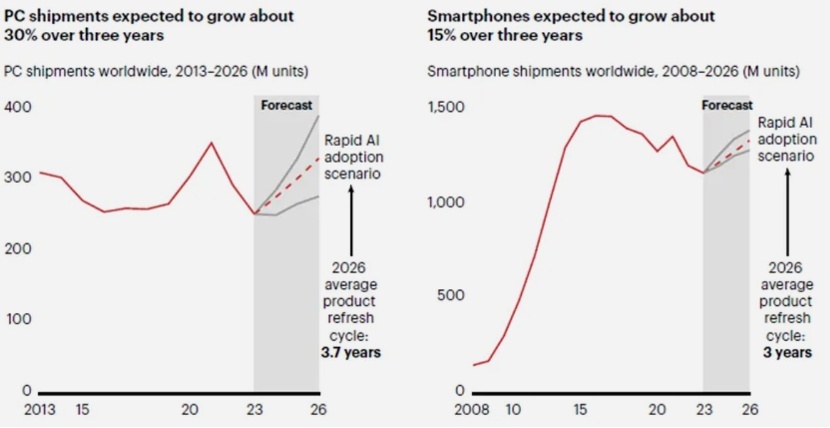
Specifically, growth in smartphones and consumer electronics has slowed, with demand for smartphones and PCs expected to grow by 6% and 3% respectively from 2024 to 2026. Meanwhile, servers, data centers, and storage are projected to achieve a 13% CAGR, and automotive a 14% CAGR over the same period.
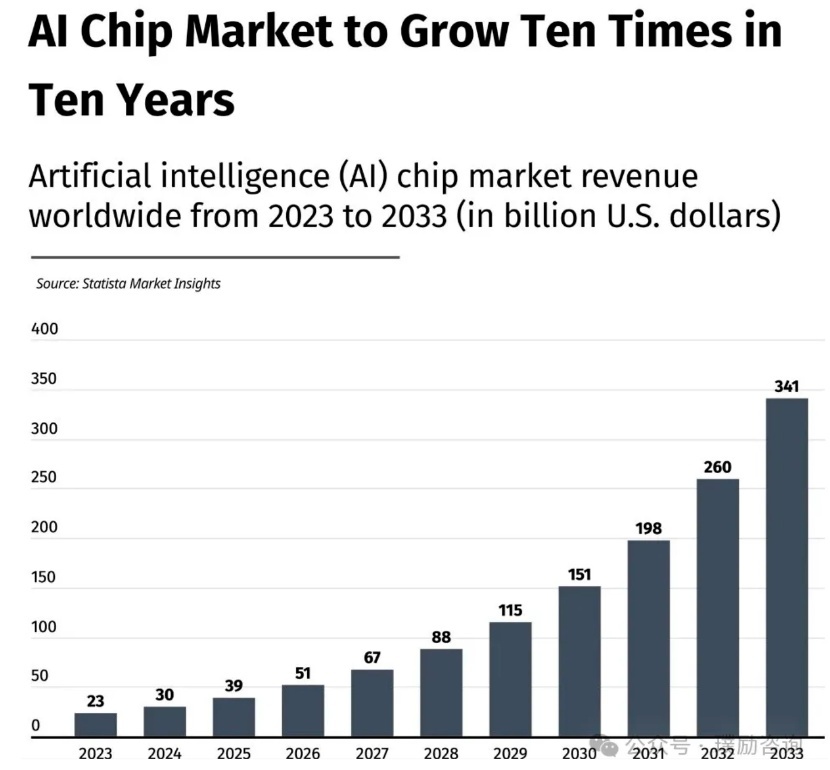
The demand for high-performance computing driven by AI chips (e.g., GPU, TPU) has made advanced processes (e.g., 7nm and below) a hot investment area. The global AI chip market is expected to grow by over 25% in 2024, boosting demand for data centers and edge computing devices.
High-performance computing-driven data centers, electrification and autonomous driving-driven automotive, and industrial automation-driven sectors will be key growth engines for the semiconductor market over the next decade. Gartner predicts semiconductor end markets will grow by 9% by 2030.
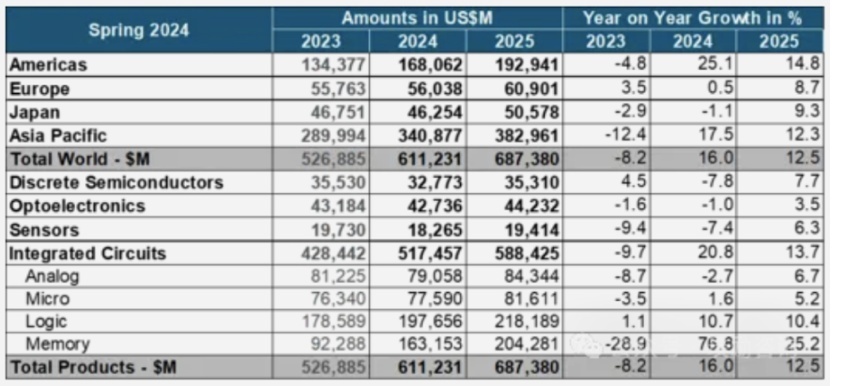
According to the latest forecast from the World Semiconductor Trade Statistics (WSTS), the global semiconductor market is expected to grow by 16% in 2024, reaching $611 billion. This growth is primarily driven by logic chips (projected to grow 10.7%) and memory chips (projected to grow 76.8%), with the US and Asia-Pacific regions as the main growth areas.
The semiconductor industry's prosperity will also drive rapid development in semiconductor equipment and materials.
TechInsights reports that the wafer fabrication equipment market will maintain a 10% CAGR from 2020 to 2028, with the market size expected to exceed $143 billion by 2028. The CMP market is projected to grow at a 12% CAGR, ion implantation equipment at 14%, and deposition and lithography equipment at 12% annually from 2020 to 2028.
SEMI's latest market forecast shows that the global semiconductor equipment market will reach $109 billion in 2024, up 3.4% YoY, hitting a record high. Driven by AI and strong demand from China, the global semiconductor market will maintain high growth. SEMI expects the semiconductor equipment market to surpass $128 billion in 2025, up 17% YoY.
Global 300mm wafer fab equipment spending is projected to reach a record $400 billion from 2025 to 2027, driven by demand for AI chips, 3D NAND, automotive, and IoT chips. South Korea, Taiwan, and the US will invest approximately $81 billion, $75 billion, and $63 billion, respectively, to expand capacity, focusing on advanced nodes and new power semiconductors.
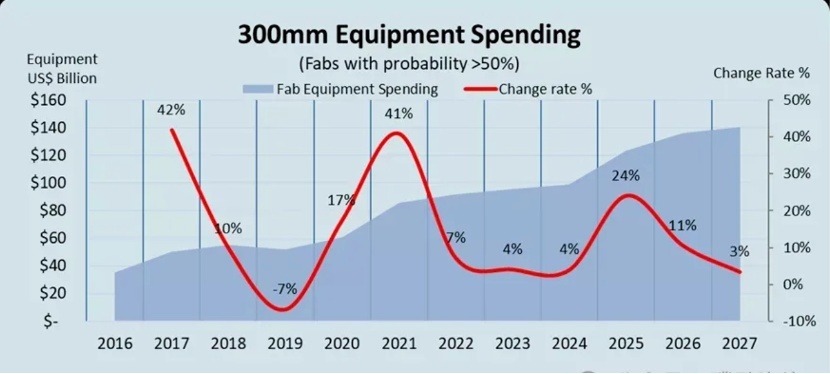
Thus, over a longer timeframe of five to ten years, the semiconductor industry remains in an upward trajectory. Semiconductor equipment companies may be the beneficiaries of this long-term bull market.
However, structural fluctuations will still occur during this bull market.
Recently, TrendForce predicted that DRAM price increases will slow significantly in Q4 2024, with conventional DRAM rising 0%-5%. However, due to increasing HBM adoption, overall DRAM prices are expected to rise 8%-13%, a noticeable slowdown from Q3. PC DRAM prices are expected to remain flat, server DRAM price increases will moderate, and LPDDR4X mobile DRAM prices may decline 5%-10% QoQ.
As DRAM is a key component in smartphones and PCs, price changes will affect production costs and gross margins. A 5%-10% decline in LPDDR4X mobile DRAM prices in Q4 could benefit smartphone manufacturers by improving gross margins.
The copyright of this article belongs to the original author/organization.
The views expressed herein are solely those of the author and do not reflect the stance of the platform. The content is intended for investment reference purposes only and shall not be considered as investment advice. Please contact us if you have any questions or suggestions regarding the content services provided by the platform.
