


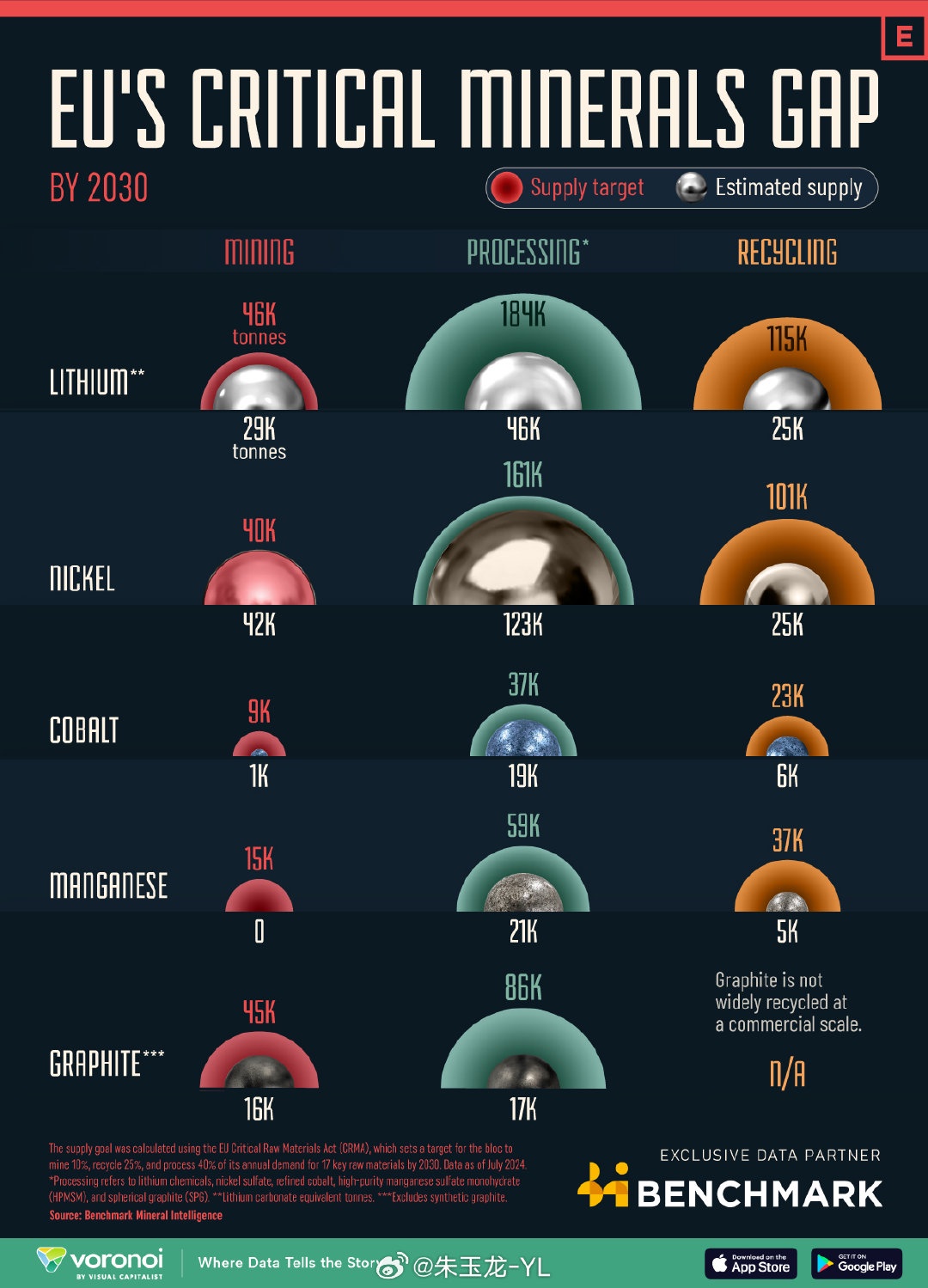
The EU's game on tariffs actually involves many things. The EU has introduced the "Critical Raw Materials Act" with ambitious goals to enhance the resilience of critical mineral supply chains. Specifically, it aims to meet 10% of the EU's critical mineral demand from domestic mining, 40% from processing within the bloc, and 25% from recycling. But the reality is, it's simply not achievable!
First, let's look at mining. Apart from nickel mining, which shows some promise, the EU's mining capacity for other battery minerals is far from satisfactory. Take graphite, for example—it's a major component in batteries, but the EU lacks supplies of manganese ore and coke (a precursor for synthetic graphite). By 2030, the EU is expected to mine only 16,000 tons of flake graphite, far short of the 45,000-ton target. Lithium is another issue, with projected production of 29,000 tons of LCE (lithium carbonate equivalent), while the 10% target requires 46,000 tons. This means the EU faces a significant gap in the upstream supply of critical minerals.
Processing isn't much better. The EU is expected to process only 25% of its lithium demand, 76% of nickel, 51% of cobalt, 36% of manganese, and 20% of flake graphite—still far from the 40% target. This means many critical minerals will likely rely on external processing, increasing supply chain instability.
Recycling also has its problems. The EU is projected to recycle only 22% of its lithium demand, 25% of nickel, 26% of cobalt, and 14% of manganese. Graphite isn't yet widely recycled on a commercial scale. This makes it difficult to meet the 25% recycling target through waste recovery.
This situation has serious implications for the EU. With booming industries like new energy vehicles and electronics, insufficient critical mineral supplies could slow their growth. European companies may face raw material shortages and rising costs, affecting the EU's global competitiveness. Over-reliance on external supplies also brings geopolitical risks—if international tensions escalate, critical mineral supplies could be cut off, threatening the EU's economic security.
If the EU wants to achieve self-sufficiency and sustainable supply of critical minerals, it needs to step up its efforts. Relaxing some environmental regulations, increasing investment in domestic mining, improving extraction technologies, and exploring new mineral resources could help. It should also focus on enhancing processing and recycling efficiency and strengthen cooperation with other countries and regions to jointly develop critical mineral resources and ensure supply chain stability.
The copyright of this article belongs to the original author/organization.
The views expressed herein are solely those of the author and do not reflect the stance of the platform. The content is intended for investment reference purposes only and shall not be considered as investment advice. Please contact us if you have any questions or suggestions regarding the content services provided by the platform.
