



Luxury goods are cooling down, but can Prada still outperform its peers?


As is well known, due to a sharp cooling in demand, the luxury goods industry has encountered a severe "winter" in 2024, which is also reflected in the performance of luxury giants.
However, despite the industry downturn, some brands have still managed to stand out.
While the industry faces a "winter," these brands shine
On July 23, French luxury giant LVMH$Louis Vuitton(LVMUY.US) released its mid-year 2024 financial results. The data shows that in the first half of the year, LVMH Group's revenue fell 1% year-on-year to €41.7 billion, achieving 2% organic growth; net profit attributable to shareholders dropped 14% year-on-year to €7.3 billion.
By region (on an organic basis), revenue in Japan rose 44% year-on-year; Asia (excluding Japan) revenue declined 10% year-on-year; revenue in the U.S. and Europe grew 2% and 3% year-on-year, respectively.
Another luxury giant, Gucci's parent company $Kering(PPRUY.US), also reported a revenue decline of 11% year-on-year to €9 billion in the first half of the year, with net profit attributable to shareholders plummeting 51% year-on-year to €900 million.
Similarly, by region, retail sales in the Asia-Pacific region (excluding Japan) fell 22% year-on-year to €2.9 billion in the first half of the year.
Notably, several luxury giants that have released mid-year results mentioned weak demand for high-end consumption in China, which aligns with the regional performance data.
Amid the decline in performance, luxury giants like LVMH have also seen their stock prices fall.
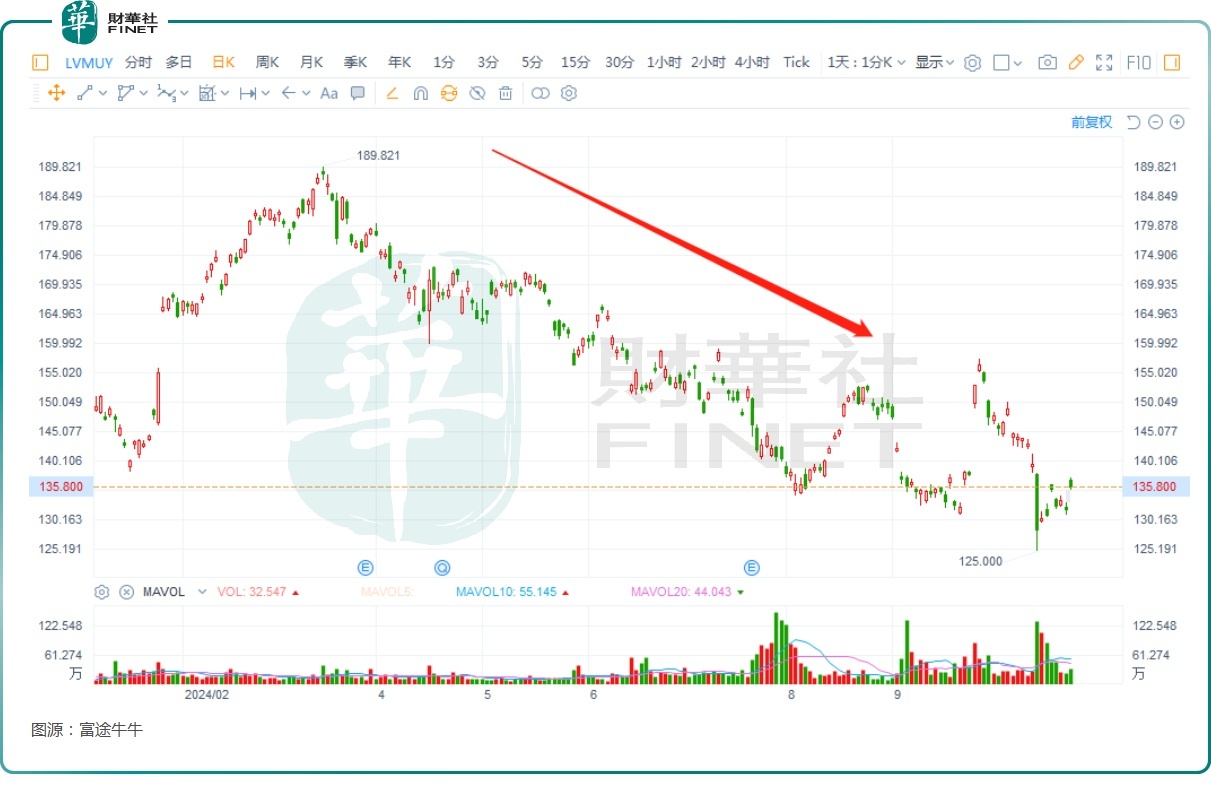
However, against the backdrop of an overall industry downturn, some brands have significantly outperformed their peers.
Among them, Hermès reported revenue of €7.5 billion in the first half of the year, up 15% year-on-year at constant exchange rates (or 12% at current exchange rates); net profit attributable to shareholders reached nearly €2.4 billion, also showing growth.
By region, Asia (excluding Japan) revenue grew 10% year-on-year; revenue in Japan rose 22% year-on-year, benefiting from strong local customer loyalty; revenue in the Americas increased 13% year-on-year; Europe (excluding France) grew 18% year-on-year; and France saw a 15% year-on-year increase.
Additionally, Prada reported revenue of €2.55 billion in the first half of the year, up 14% year-on-year; net profit attributable to shareholders surged 26% year-on-year to nearly €400 million, demonstrating strong performance.
By region, Prada's retail sales in the Asia-Pacific region grew 12% year-on-year in the first half; Europe rose 18% year-on-year; the Americas increased 7% year-on-year; and Japan soared 55% year-on-year.
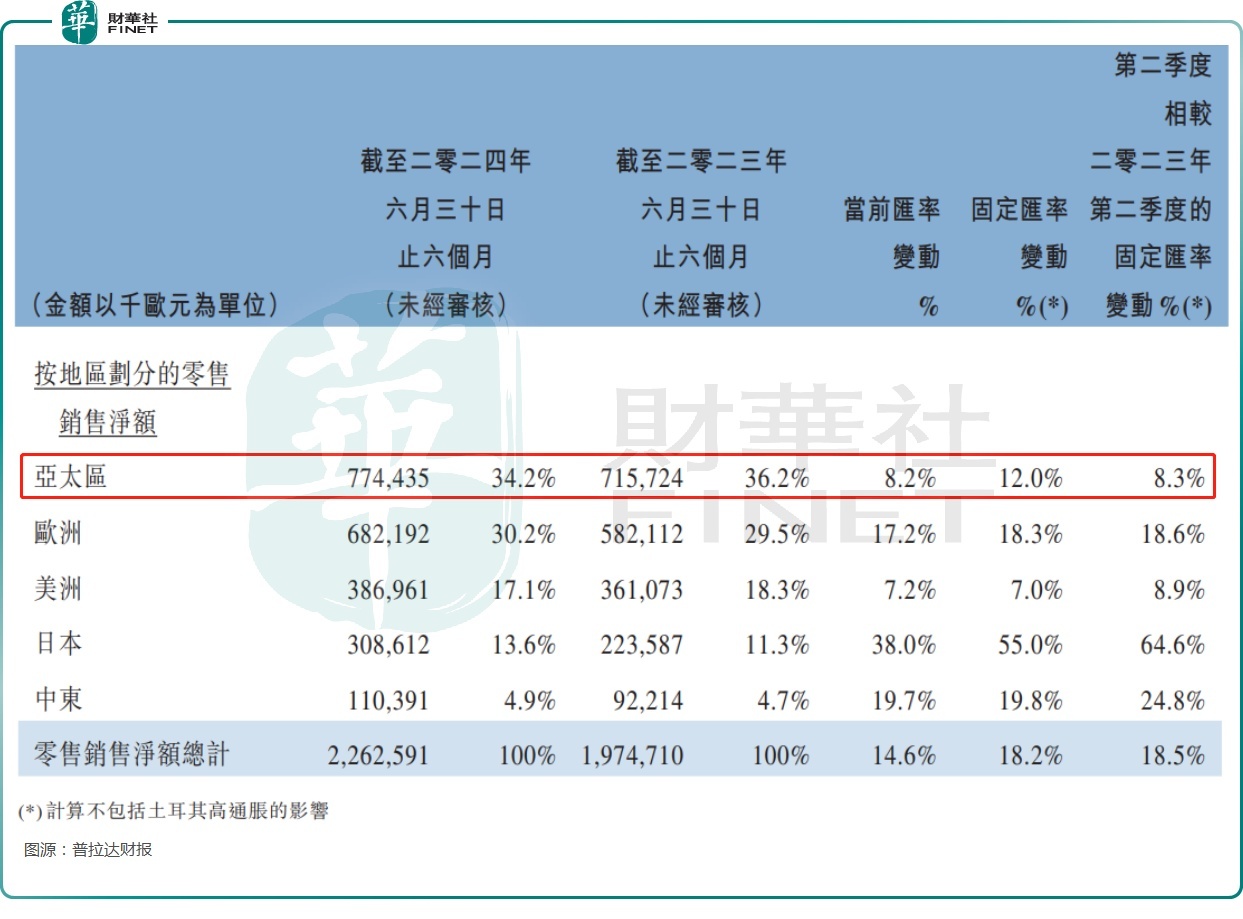
It is reported that Hermès' sustained growth is mainly due to favorable supply-demand dynamics, while Prada's strong performance in the first half was driven by its high-growth brand Miu Miu. Data shows that Miu Miu's retail sales surged 92.7% year-on-year, demonstrating excellent performance across all categories and regions.
Hermès shines in Q3 results—can Prada sustain its momentum?
It is worth noting that some luxury brands have already released preliminary Q3 results.
LVMH's Q3 report showed that all major divisions missed expectations, with quarterly revenue down 3% year-on-year—the first decline since the pandemic—and core division sales "falling for the first time in four years." Gucci, under Kering Group, saw Q3 sales drop 25% year-on-year, and Kering expects the group's full-year 2024 profit to decline by over 45%.
However, on October 24, Hermès announced that Q3 revenue reached €3.7 billion, with sales growing 11% at constant exchange rates, slightly above expectations.
Hermès' latest results are a breath of fresh air in the luxury industry, offering a slight boost to investor confidence.
As for Prada, China International Capital Corporation (CICC) recently released a research report predicting that Prada's Q3 retail revenue will grow 14% year-on-year at constant exchange rates (CER), or 13% year-on-year in reported terms to €1.133 billion, with a 1-percentage-point negative impact from currency fluctuations. The slowdown in retail revenue growth compared to Q2 2024 is mainly due to weaker performance in Asia, as Greater China faces weakened consumer confidence, while Japan's sales growth has slowed due to reduced price attractiveness caused by the yen's appreciation.
Nevertheless, CICC analysts believe that Prada is well-positioned in the luxury industry and is expected to outperform its peers in 2024.
Prada is set to release its quarterly performance update on October 30, which is worth tracking.
Conclusion
As one of the leading players in the luxury industry, Prada has been repeatedly included in the "Top 100 Hong Kong Stocks" list and achieved strong rankings.
According to the Top 100 Hong Kong Stocks official website, the 2024 Hong Kong Listed Companies Development Summit Forum and the 11th "Top 100 Hong Kong Stocks" Awards Ceremony, hosted by the Top 100 Hong Kong Stocks Research Center and co-organized by Caijinghua and Futu AnYi, with support from media institutions such as Hong Kong Ta Kung Wen Wei Media Group, will be held on the afternoon of November 11, 2024, at the Hong Kong Convention and Exhibition Centre. The event will delve into discussions on further consolidating Hong Kong's position as a global wealth management hub and capital market fundraising center, as well as enriching the fintech ecosystem in the new era.
Against the backdrop of a cooling luxury industry, will Prada make it onto the latest "Top 100 Hong Kong Stocks" list again? Let's wait and see!
Author: Yan Shisi
The copyright of this article belongs to the original author/organization.
The views expressed herein are solely those of the author and do not reflect the stance of the platform. The content is intended for investment reference purposes only and shall not be considered as investment advice. Please contact us if you have any questions or suggestions regarding the content services provided by the platform.
