


The transition between old and new businesses is not smooth: Baidu should consider spinning off ERNIE Bot.

The market often exhibits counterintuitive phenomena. Especially when following trends, some companies are clearly part of certain hot concept stocks, and analysts may conduct serious analyses, but the reality often falls short of expectations, leading to frustration. This shifts from studying and mastering the market to questioning it.
Baidu is a typical example of this. Holding two of the hottest concepts—autonomous driving and AI—whenever there's industry buzz, opinions suggest that the optimistic external environment should reflect on Baidu's market value. However, the outcome is often disappointing. As of writing, Baidu's TTM P/E ratio is less than 11x, compared to Tencent's 23x and Alibaba's 25x.
Why is Baidu's valuation capability so low? Why is the boost from new concepts and paths so weak? This is the focus of our discussion.
Key points of this article:
First, before reaching the critical point of Scaling Law, expanding capital expenditure is the main theme for global cloud computing companies. Baidu has been relatively restrained in this regard, and the poor handover between old and new businesses has left the company constrained in budgeting.
Second, Baidu's low valuation capability is mainly due to the pressure on the group's overall growth. Simply put, new businesses cannot stand alone yet, while the core advertising business is showing signs of fatigue, leading to a decline in Baidu's overall performance.
Third, spinning off new businesses like ERNIE Bot is one of Baidu's few options. A spin-off would benefit the valuation premium of innovative businesses, and management should seriously consider it.
Difficulty in Balancing Old and New Businesses: Impact on Baidu's Valuation Capability
In previous analyses of Baidu, we developed the following framework:
Traditional advertising contributes profits, while emerging innovative businesses (cloud computing, large models, Apollo Go, etc.) represent glory and dreams.
Ideally, advertising revenue provides sufficient profit and cash flow for the latter, which in turn continuously delivers "high expectations" to the group. Living in the present while gazing at the stars coexists, and the market responds positively, steadily increasing the company's market value.
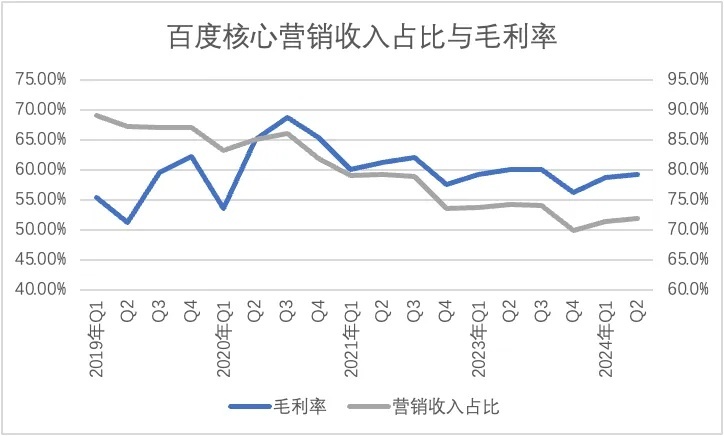
In the chart above, we can clearly see that Baidu's core gross margin is closely related to the proportion of marketing revenue. The two lines almost move in sync, highlighting the obvious value of the former to the group.
Under the dual pressures of the macro environment and new competitors, Baidu's core advertising revenue is increasingly showing signs of decline. In Q2 2024, the business fell by 2% YoY, revealing the fragility of the ideal framework mentioned earlier.
Baidu is well aware of this challenge. In recent quarters, it has undertaken a series of cost optimization measures, including but not limited to workforce adjustments, technology route selection (e.g., focusing on closed-source large models due to low costs and predictable effects), and cost control (with significant reductions in period expenses). The goal is to maintain the effectiveness of the above framework through cost-cutting and efficiency improvements.
These reforms have not been smooth in the short term. Compared to the common internet business model of gaining users through massive subsidies to achieve scale effects and then profits, Baidu's bets on innovative businesses are all high-investment, long-term battles. For example, the recent focus on large models is a field requiring sustained high costs.
Due to space constraints, we will only demonstrate the costs of the large model sector.
To date, Scaling Law remains a key driver of industry development. Its basic principle is that a model's final performance is mainly related to computational power, model parameters, and data size. When not constrained by the other two factors, model performance exhibits a power-law relationship with each factor. Therefore, to improve model performance, model parameters and data size must be scaled up simultaneously.
The academic consensus is that Scaling Law is still far from its critical point. Improving large model performance inevitably requires the simultaneous growth of model parameters and data size, which in turn demands higher computing power. In other words, improving large model performance comes with massive capital expenditure.
For example, Southwest Securities derived the GPU requirements for large model training based on relevant papers, as shown in the chart below.
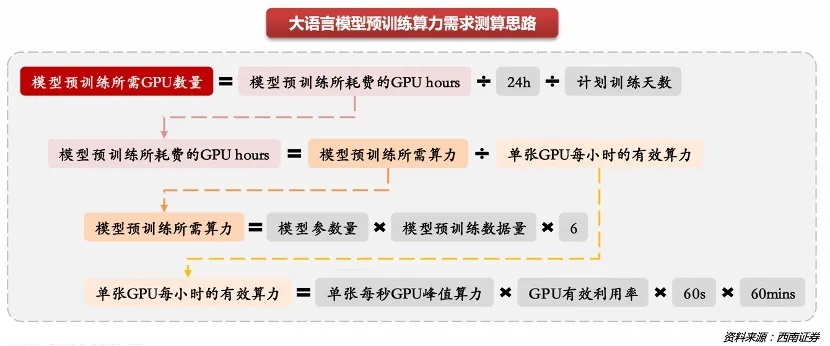
In a sense, competition among large model companies is not just about technology but also a money-burning arms race. The above only covers GPU requirements, not to mention data centers, storage, memory, and infrastructure needs. Measured by Nvidia's Hopper/Blackwell/next-gen GPU FP16 computing power, China Fortune Securities estimates global text large model AI training GPU demand for 2024-2026 at 2.71/5.92/12.44 million units.
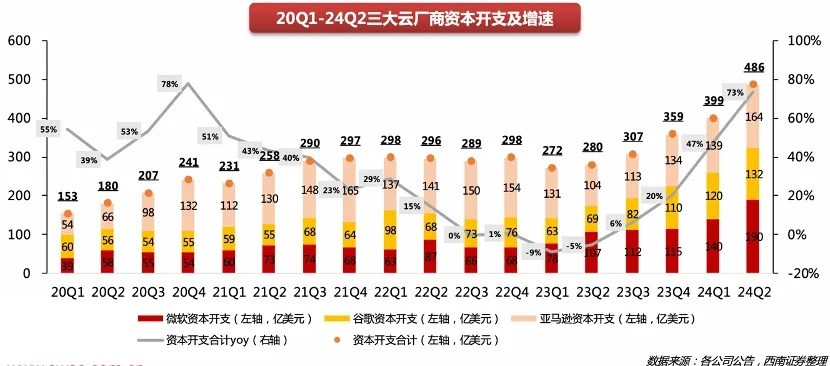
After the rise of large models in 2023, global cloud computing companies have increased capital expenditures to meet growing computing demands.
For example, Baidu's U.S. counterpart Google's capital expenditures are primarily driven by infrastructure, with servers being the largest component, followed by data centers. Cloud providers' GPU orders account for about 45% of Nvidia's Q2 FY25 data center revenue, indicating that cloud providers' capital expenditures are mainly for cloud computing infrastructure.
The same applies to domestic internet companies. For instance, Alibaba's capital expenditure in Q2 2024 reached RMB 12.1 billion, up from RMB 6.9 billion YoY, with part of the increase likely due to Alibaba Cloud's computing needs.
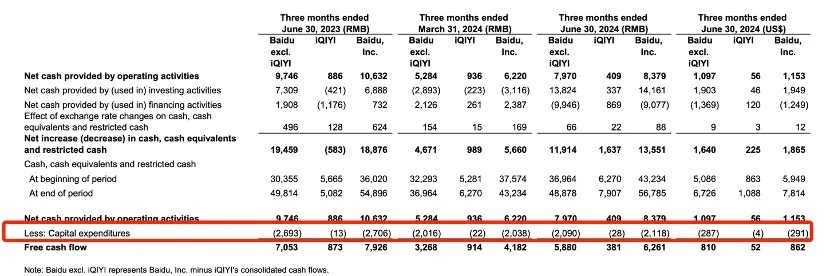
In contrast, Baidu's capital expenditures are much more moderate. After a significant YoY increase in Q1 2024, Q2 saw a return to conservatism.
Theoretically, Baidu has bet on the large model sector, which, as we analyzed earlier, is one of the most capital-intensive areas. Yet, Baidu's conservative approach to capital expenditures differs from both domestic and international peers. Why?
Due to space constraints, we will skip the analysis and present the conclusion:
With the core business's growth faltering, it has clearly affected Baidu's "ship's" propulsion system. To maintain stability, the company needs to shed redundant burdens to lighten the load, which can also reserve more energy for innovative businesses.
In the chart above, we only see Baidu's conservatism in capital expenditures but overlook the subtext: AI-related capital expenditures are likely still expanding, while other (especially peripheral) businesses' capital expenditures are being significantly cut. Sacrificing the pawn to save the king has become the recent operational focus.
At this point, we have a clear understanding of the main reasons for Baidu's low valuation capability.
According to the formula P/E = 1/(r - g) (where r is the discount rate and g is the profit growth rate), the current discount rate remains high due to the Fed's rate hikes. If g remains sluggish, the denominator increases, inevitably affecting the company's overall valuation level.
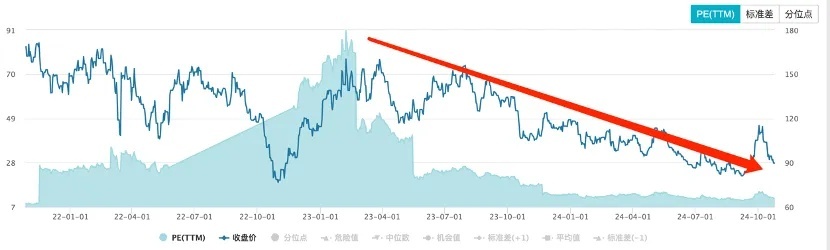
In other words, although Baidu holds many hot concept businesses, the "ship's" g faces severe downward pressure. Until a solution for growth is found, Baidu will struggle to achieve a high premium in the market.
Spinning Off ERNIE Bot Offers Many Benefits
Earlier, we gained a clear understanding of Baidu's current businesses, capital expenditures, and valuation capability. Does the company have any tricks left?
There is still an opportunity: spinning off the large model business.
Baidu's old and new businesses are intertwined, which not only pressures the marketing business (capital expenditure cuts and period expense reductions hinder innovation in traditional businesses) but also makes it difficult to uncover the potential of new businesses in the overall valuation model. The novelty, opportunities, and potential of new businesses are hard to quantify.
In the medium term, the large model sector is a highly capital-intensive business. Performance improvements ultimately rely on computing power, requiring sustainable financing capabilities to support capital expenditures (cost-cutting alone is unsustainable).
At its current valuation level, Baidu has largely lost its ability to raise capital in the market (it even repurchases shares annually to reward investors). Relying solely on "savings" and cash flow from the advertising business is unsustainable for the future.
In this case, spinning off the business to highlight financing capabilities is a viable alternative.
Now, the question is whether Baidu can achieve a higher valuation after spinning off ERNIE Bot.
Returning to the formula P/E = 1/(r - g), spinning off the new business isolates its growth potential g, shrinking the denominator. This will boost the P/E multiple, ultimately reflecting in the valuation through a multiplier effect and transforming into financing capabilities, injecting new cash sources for development.
More importantly, as the Fed enters a rate-cutting cycle, capital market liquidity will improve further. The market will favor high-growth-potential companies, and this shift in market sentiment will benefit the spun-off ERNIE Bot.
Recently, emerging companies like Horizon Robotics and Pony.ai have begun their IPO processes. The former's market cap in Hong Kong once exceeded HKD 60 billion (nearly 1/4 of Baidu's market cap), with a P/S ratio exceeding 20x. Just as the market favored internet companies 20 years ago, today's capital market is giving very positive evaluations to such high-growth-potential companies.
If the spin-off proceeds smoothly, it will be particularly important and beneficial for Baidu in the current capital market environment. Management now faces two paths:
The conservative route: Maintain the balance between old and new businesses as much as possible, with the CFO's primary mission being budget balancing. If the core business cannot continue to support innovation, the group may fall into a quagmire where old and new businesses cannot connect.
The proactive route: Spin off the business, allowing high-growth businesses to operate independently. With high premium capabilities, the company can raise capital from the market, improving its chances in the arms race. Before the Scaling Law inflection point arrives, sufficient financial support for capital expenditures can pave a long-term path, making Baidu the ultimate winner in the large model industry.
Which path will Baidu's management choose? We cannot know for sure, but we hope the company does not miss the window of opportunity to avoid future regrets.
$Baidu(BIDU.US)
The copyright of this article belongs to the original author/organization.
The views expressed herein are solely those of the author and do not reflect the stance of the platform. The content is intended for investment reference purposes only and shall not be considered as investment advice. Please contact us if you have any questions or suggestions regarding the content services provided by the platform.
