ZhiNeng Auto Market Weekly Report | Japanese brands in China Week 46: Toyota, Honda, Nissan and Mazda

Produced by Zhineng Technology
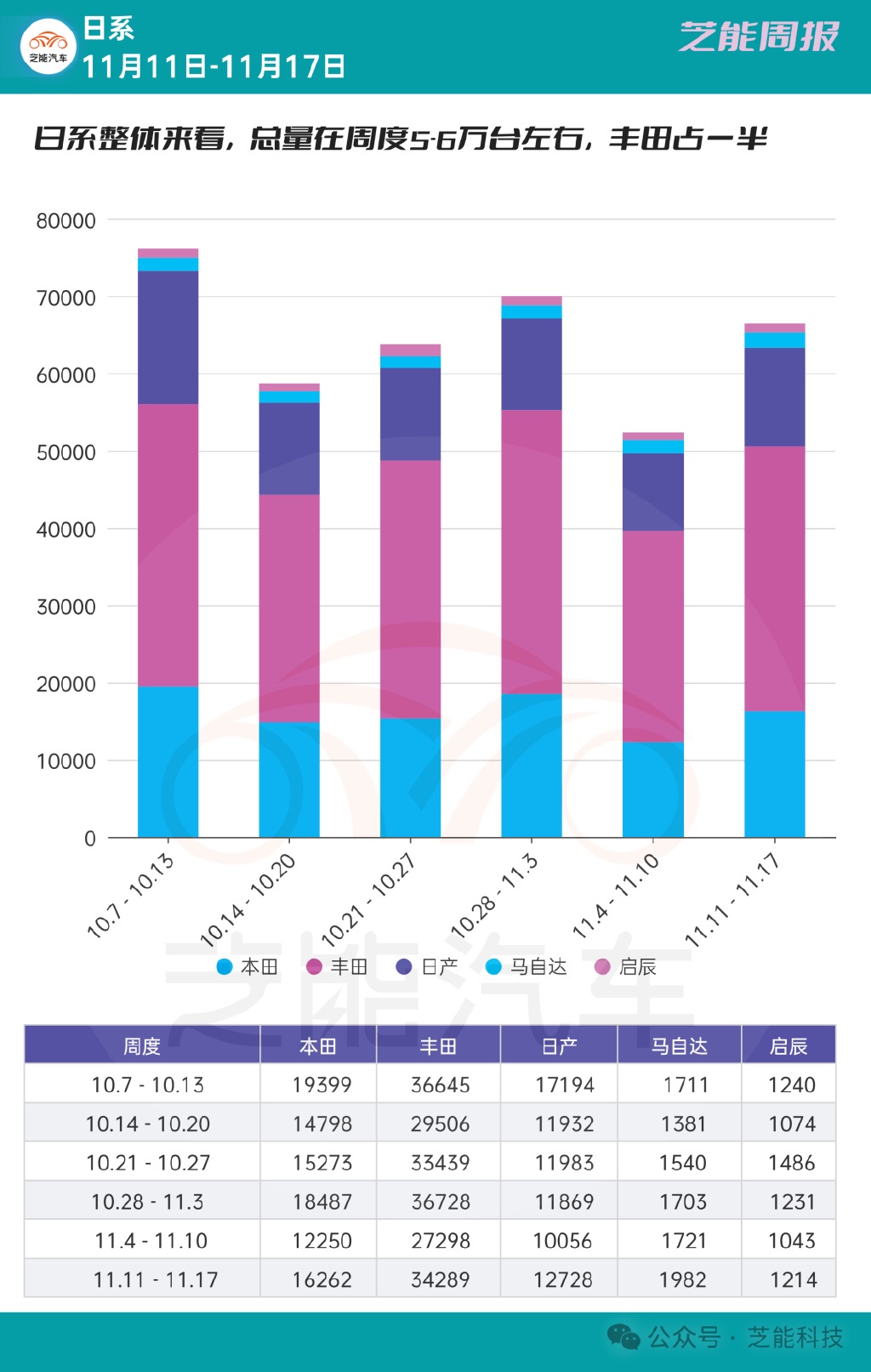
The Japanese car market showed a polarized trend in Week 46. Toyota continued to lead with steady sales and high year-on-year growth, while Honda and Nissan faced challenges with declining sales.
Key models like Toyota's Corolla and RAV4 performed stably, but Honda's CR-V and Accord showed weakness. Some brands are pushing new energy models, but market response has yet to show significant advantages.
We delve into the current market situation and future direction of Japanese cars through core brand data and model reviews.
01
Core Brand Data:
Toyota Dominates,
Honda and Nissan Under Pressure
This week's sales data reveals stark differences in the performance of Japanese brands in the Chinese market.
● Toyota sold 34,289 units this week, up 11.79% year-on-year, demonstrating strong market resilience. As the leader among Japanese brands, Toyota's hybrid series benefits from the shift toward hybrid technology, especially with the upcoming resumption of purchase taxes.
● Honda sold 16,262 units, down 34.51% year-on-year, making it the weakest-performing Japanese brand. Core models like the CR-V and Accord still provide some support but lack strong performance.
● Nissan sold 12,728 units, down 21.23% year-on-year. The Corolla series maintained high sales, but other models showed weakened competitiveness.
● Mazda saw slight growth, selling 1,982 units, up 12.49% year-on-year, maintaining a niche market share.
● Venucia showed a bright spot, selling 1,214 units, up 43.50% year-on-year, but its overall market size remains small.
The data clearly shows Toyota as this week's biggest winner, with its extensive model lineup and hybrid technology providing strong market support.
● Japanese brands show divergent performance in the Chinese market:
◎ Toyota maintains its market dominance with a stable lineup of fuel and hybrid vehicles;
◎ Honda and Nissan face dual challenges of weak product strength and lagging new energy transition.
With the rapid rise of new energy, competition from domestic brands and new forces makes it urgent for Japanese cars to offer more competitive electrified products.
● To maintain their market position, Japanese brands should focus on the following:
◎ Accelerate localization of new energy models: Introduce affordable, high-performance pure electric models tailored to Chinese consumers.
◎ Enhance competitiveness in premium models: Further develop mid-to-large cars and luxury MPVs.
◎ Leverage local supply chains to upgrade technology and brand image: Use Chinese supply chains to enhance smart features (cabin + autonomous driving) and technological upgrades to revitalize brand appeal.
02
Model Reviews:
Classic Fuel Cars vs. New Energy Models
A closer look at specific models reveals clearer market performance and product strategies.
● Fuel Cars: The Stable Foundation
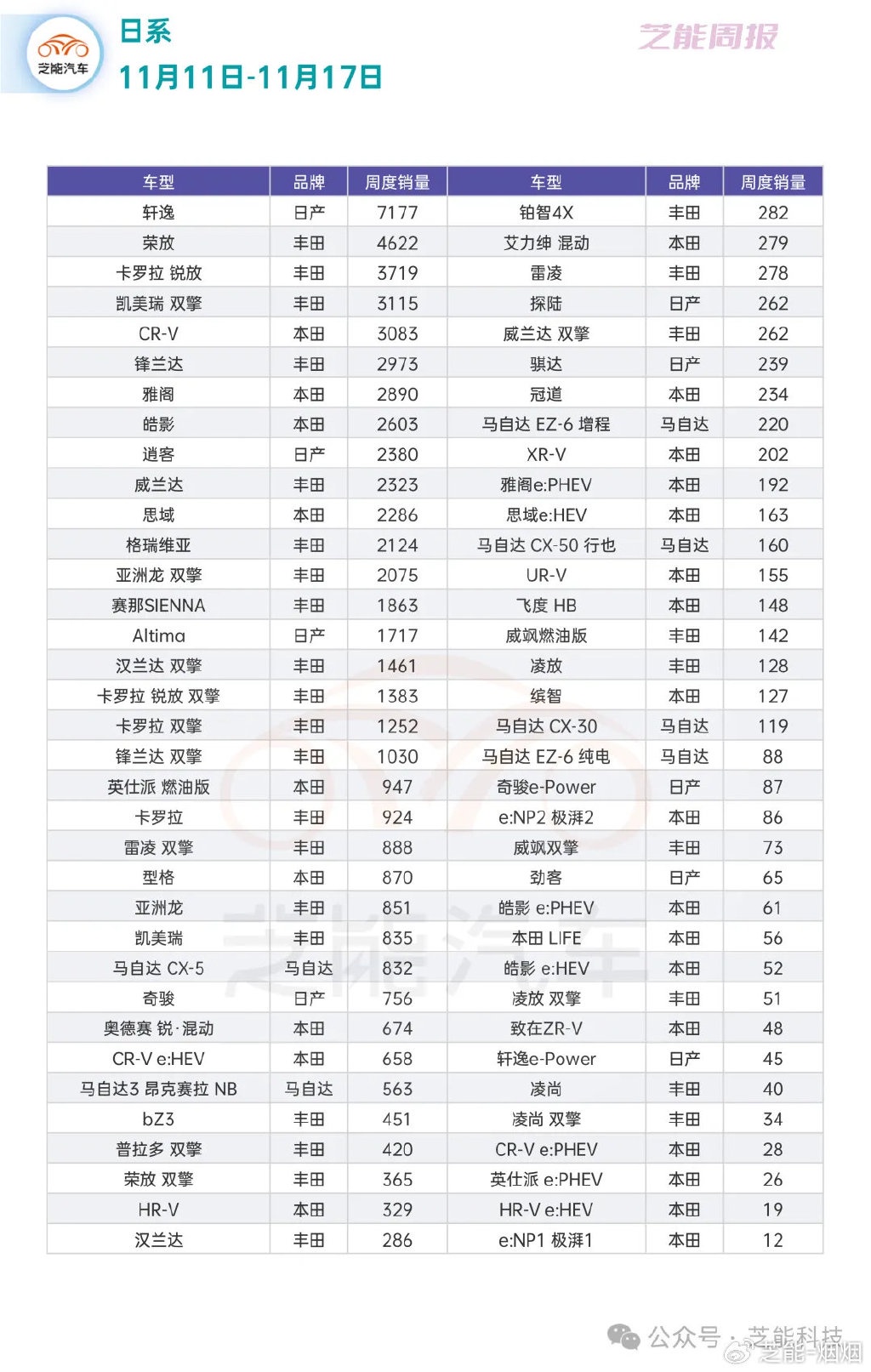
◎ The Corolla (7,177 units) remains Nissan's sales pillar, maintaining its mainstream position in the A-segment with its cost-performance and brand recognition.
◎ The RAV4 (4,622 units) and Corolla Cross (3,719 units) contribute significantly to Toyota's sales, reflecting its balanced SUV and sedan lineup.
◎ The Accord (2,890 units), as Honda's flagship mid-size sedan, retains some market influence but faces pressure from luxury brands like BBA and rising domestic competitors.
● Hybrid Products
◎ Toyota's hybrid models, like the Camry Hybrid (3,115 units) and Avalon Hybrid (2,075 units), show steady performance, reflecting consumer acceptance of hybrids. However, pure electric models like the bZ3 (451 units) underperform and need stronger competitiveness.
◎ Honda's hybrids, like the CR-V e:HEV (658 units) and Accord e:PHEV (192 units), are weak and fail to reverse its overall sales decline.
◎ Nissan's hybrid efforts, like the Corolla e-Power (45 units), are lackluster and struggle against domestic new energy models.
● Niche and Premium Models: Limited Highlights
◎ Toyota's premium MPV, the Sienna (1,863 units), enjoys good market reputation, but supply and pricing limit further expansion.
◎ Mazda's CX-5 (832 units) maintains some appeal with its unique design and driving experience, but overall sales remain small.
Summary
Japanese cars face challenges in China, but brands like Toyota and Honda still have a profit base. Scaling back gradually and using China as an export hub could be a viable strategy.
The copyright of this article belongs to the original author/organization.
The views expressed herein are solely those of the author and do not reflect the stance of the platform. The content is intended for investment reference purposes only and shall not be considered as investment advice. Please contact us if you have any questions or suggestions regarding the content services provided by the platform.