


The sense of crisis is overwhelming! Zhifei Biological has suffered losses for three consecutive quarters, relying solely on the agency model is indeed not working anymore.

In the face of cold hard data, even the vaccine industry leader has to admit that the era of 'easy money' is over.
Recently, Zhifei Biological, a top player in the vaccine industry, released its latest financial report, revealing a clear chill: In 2024, the company's operating revenue was 26.07 billion yuan, down 50.74% year-on-year; net profit attributable to shareholders was 2.018 billion yuan, down 74.99% year-on-year; and adjusted net profit was 1.991 billion yuan, down 74.84% year-on-year.
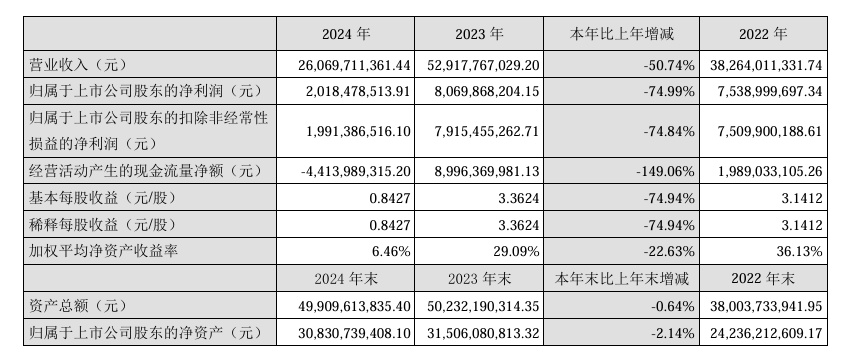
In the first quarter of this year, Zhifei Biological still couldn't find its 'spring,' instead feeling an even harsher winter wind: revenue of 2.374 billion yuan, down 79.16% year-on-year, with net profit turning to a loss of 305 million yuan. Reports indicate that Zhifei Biological has recorded net losses for three consecutive quarters since Q3 2024.
As the company's operational decline becomes increasingly evident, the investment market has also lost confidence. Currently, Zhifei Biological's stock price hovers around 20 yuan, with a market cap below 50 billion yuan—far from its peak of over 150 yuan per share and a market cap exceeding 300 billion yuan.
With declining performance and investors fleeing, Zhifei Biological is clearly in survival mode.
HPV Vaccine Supply-Demand Imbalance: Zhifei Biological and Peers Exit the Golden Age
In fact, focusing on Zhifei Biological's core HPV vaccine business, it's clear the company isn't alone in its struggles—it has plenty of 'brothers in hardship.'
Take Walvax Biotechnology and Wantai Biological, for example. According to their financial reports, in 2024, Walvax's revenue was 2.821 billion yuan, down 31.41% year-on-year; net profit was 142 million yuan, down 66.10% year-on-year; and adjusted net profit was 108 million yuan, down 81.10% year-on-year.
During the same period, Wantai Biological reported revenue of 2.245 billion yuan, down 59.25% year-on-year; net profit of 106 million yuan, down 91.49% year-on-year; and an adjusted net loss of 186 million yuan, down 117.29% year-on-year.
These bleak financial reports signal to the investment market that the HPV vaccine industry is exiting its golden cycle.
Few expected the industry to cool so rapidly. Just a few years ago, Merck's quadrivalent and nonavalent HPV vaccines sparked a vaccination frenzy in mainland China, with doses in short supply. Thanks to its exclusive distribution deal with Merck, Zhifei Biological raked in massive profits, with annual revenue once exceeding 10 billion yuan.
Compared to those days, Zhifei Biological now faces a 'heaven-and-earth' gap. So, what caused this performance chasm?
The answer lies in the profound impact of supply-demand dynamics.
On the supply side, companies like Wantai Biological have disrupted foreign monopolies by introducing affordable, widely applicable domestic bivalent HPV vaccines. As competition intensified and demand shifted, Merck expanded its nonavalent vaccine's target age range to 9-45 years to boost sales.
With more market choices, competition has grown fierce.
Government procurement programs have further fueled price wars, with domestic bivalent HPV vaccines slashing prices from hundreds to just tens of yuan per dose.
Even Merck's premium-priced HPV vaccines couldn't escape the impact, especially as demand proved weaker than expected, forcing strategic adjustments.
In an October 30, 2024 investor briefing, Zhifei Biological estimated that since HPV vaccines debuted in China, the vaccination rate has reached only about 21%, leaving roughly 250 million women unvaccinated—with particularly low rates among girls aged 9-15.
Despite increased supply and lower prices, low market penetration reflects widespread 'vaccine hesitancy.'
This supply-demand imbalance has derailed vaccine companies, with Zhifei Biological particularly vulnerable due to its reliance on distribution deals. Any major shift in Merck's supply strategy destabilizes its operations, as seen in its 2024 financials.
The report shows Merck's quadrivalent HPV vaccine shipments plummeted 95.49% year-on-year to 466,000 doses in 2024, while nonavalent shipments fell 14.8% to 31.1408 million doses—directly impacting Zhifei Biological's performance.
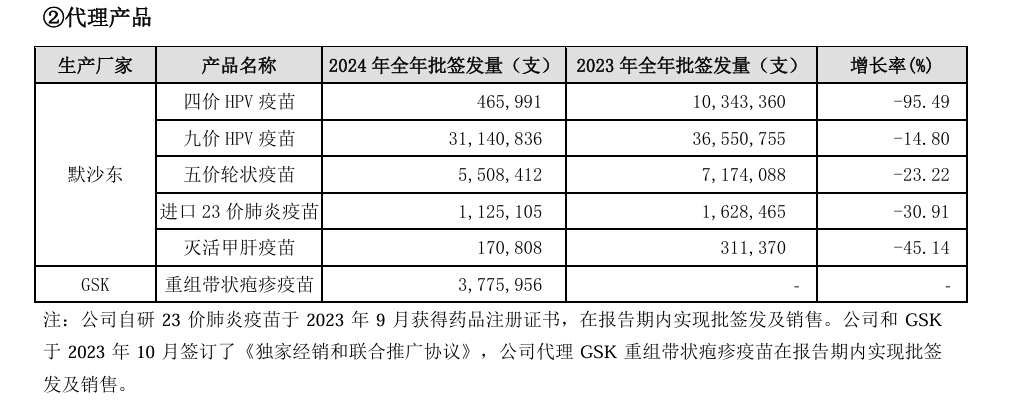
'Rise and fall by the same factor.' Zhifei Biological's transformation is now imperative.
Dual Strategy of 'Distribution + R&D': What Are the Odds of Success?
At this critical juncture, Zhifei Biological is pivoting to a 'distribution + R&D' model.
On the distribution front, it's expanding partnerships while strengthening existing ties. For instance, on December 4, 2024, the company signed a supplementary agreement with GSK to jointly promote recombinant shingles vaccines and explore a 10-year commercialization deal for RSV vaccines in mainland China.
Zhifei Biological also noted that with Merck's HPV vaccines approved for males in 2025, it will collaborate on 'gender-neutral prevention' to build herd immunity.
On the R&D front, it's boosting investment and talent, with 1.391 billion yuan spent in 2024 and 1,072 researchers. Over five years, cumulative R&D expenditure exceeded 5.1 billion yuan.
As of the report date, the company had 34 self-developed projects (excluding COVID-related ones), with breakthroughs in pneumonia, meningitis, enteric, and adult vaccine portfolios.
It's also pursuing M&A, like acquiring a controlling stake in Chenan Biological in March 2025 to expand into GLP-1 and insulin analogs.
Despite these moves, success remains uncertain for three reasons:
First, both distribution and R&D face cutthroat competition. In shingles vaccines, domestic players like Changchun BCHT already offer cheaper alternatives to GSK's product. Similarly, flu and rabies vaccines—key R&D focuses—are crowded markets.
Second, vaccine R&D is inherently high-risk, with long cycles and heavy costs. For Zhifei Biological, long reliant on distribution, this shift feels like 'biting off more than it can chew.'
Finally, and most critically, the company faces severe inventory pressure. Year-end 2024 inventory surged 147.25% to 22.218 billion yuan, now comprising 44.52% of total assets.
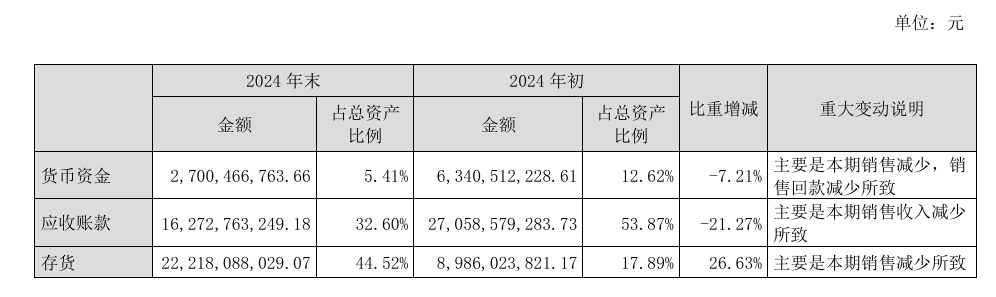
Clearly, Zhifei Biological's transformation is anything but light-footed—shedding this baggage won't be easy.
Conclusion
The HPV vaccine market's supply-demand upheaval may mark the start of structural reforms in China's vaccine industry.
When price wars can't sustain growth, competition will return to fundamentals: Companies that redefine vaccine value chains through breakthrough technologies—balancing public health needs with profitability—will dominate the reshaped landscape. This transition is ultimately a stress test for Chinese vaccine firms evolving from market expanders to technology innovators.
Source: Pharmaceutical Research Society
The copyright of this article belongs to the original author/organization.
The views expressed herein are solely those of the author and do not reflect the stance of the platform. The content is intended for investment reference purposes only and shall not be considered as investment advice. Please contact us if you have any questions or suggestions regarding the content services provided by the platform.
