AutoNavi and Baidu Maps compete in the second half of autonomous driving

As autonomous driving enters the second half of user rationality, what can map service providers, who play an infrastructure role, do?
Original © New Entropy · Automotive & Mobility Team
Author 丨 Jiang Li Editor 丨 Sakura Editor-in-Chief 丨 Jiuli
Recent accidents involving new energy vehicles have intensified debates over the safety of autonomous driving, ultimately prompting regulatory intervention to "cool down" marketing hype around autonomous driving.
On April 16, the Ministry of Industry and Information Technology held a meeting to advance the management of intelligent connected vehicle product access and software over-the-air updates. The meeting emphasized that automakers must "avoid exaggerated and false advertising and strictly fulfill their obligation to inform."
The regulatory tightening on autonomous driving marketing is fundamentally aimed at preventing misleading promotions that could lead users to over-trust autonomous driving and trigger safety incidents.
As autonomous driving enters the second half of user rationality, map services, which have long played a foundational role, are now stepping into the spotlight.
As key players in the autonomous driving ecosystem, Amap and Baidu Maps have launched new rounds of competition focused on enhancing driving safety and user experience.
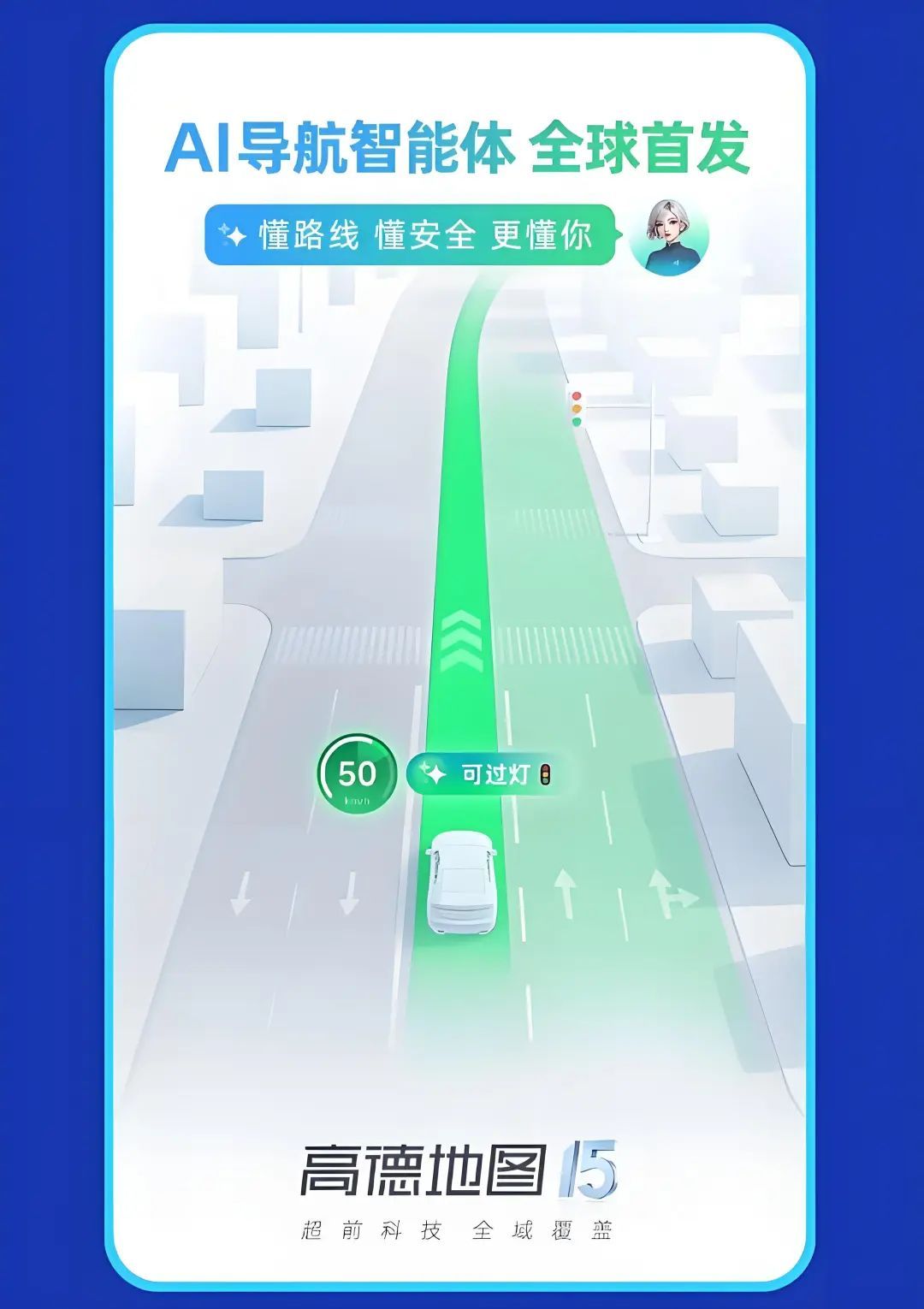
Baidu Maps recently released its V21 version, upgrading to the world's first "autonomous driving-grade navigation." Meanwhile, Amap introduced its AI navigation agent (Navi Agent). Both are committed to improving the driving experience.
In reality, as leading map service providers with both To C and To B offerings, Amap and Baidu Maps are backed by Alibaba and Baidu, respectively, and carry their parent companies' ambitions for commercialization in niche markets. As top players in the same field, their market shares are bound to fluctuate, ensuring long-term competition.
On the other hand, in recent years, Baidu Maps and Amap have relentlessly pursued commercialization, expanding into local services, ride-hailing aggregation, and advertising. These moves reflect their exploration of new avenues under commercial pressure.
Specifically, beyond their overlapping core businesses, Amap and Baidu Maps face strong competition from incumbents like Meituan and Didi in their expansion efforts, with mixed results. The increasing number of add-on features has also drawn criticism for cluttering the user experience.
Against this backdrop, riding the wave of autonomous driving, focusing on core automotive navigation services is undoubtedly a smarter move. In fact, this is also a battle for influence within their respective parent companies.
Years ago, free navigation disrupted traditional map providers' profit models, leading to predictions that maps would become mere traffic funnels for internet giants. However, with the rise of smart cars, autonomous driving, and urban digitization, map providers are still seeking opportunities to reclaim their voice.
Amap Goes Left, Baidu Maps Goes Right
In the Xiaomi SU7 high-speed collision and fire incident, the driver's use of autonomous driving and the system's collision warning time became hot topics. As safety takes center stage amid the marketing frenzy around autonomous driving, public attitudes are splitting into two camps before the full realization of L3 autonomous driving.
The first camp advocates prioritizing human driving and reducing reliance on autonomous driving, which requires more professional, detailed, and user-friendly in-car navigation features.
The second camp seeks additional tools to enhance the safety of autonomous driving until the technology advances further. Map service providers can contribute to both directions.
For the first direction, Amap's AI navigation agent forms an intelligent closed loop through perception, planning, execution, and expression modules, enabling real-time road condition awareness, risk prediction, and proactive navigation adjustments.
Additionally, the AI navigation agent incorporates emotional recognition, intent understanding, and emotional expression to extend navigation services into the realm of emotional value.
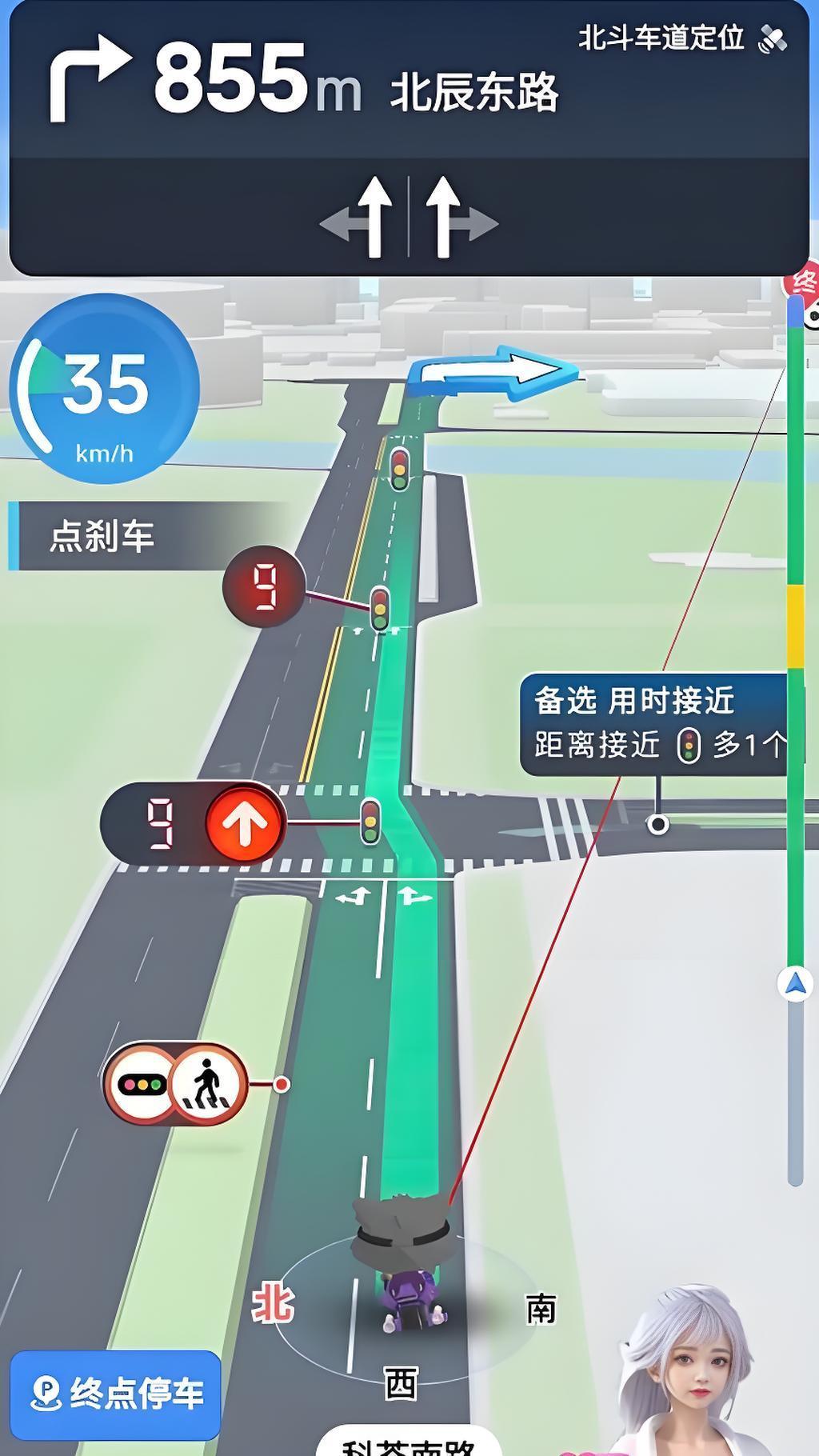
Amap's AI navigation agent leans toward enhancing safety and experience during human driving, offering features like real-time road condition awareness, risk prediction, and AI traffic light navigation.
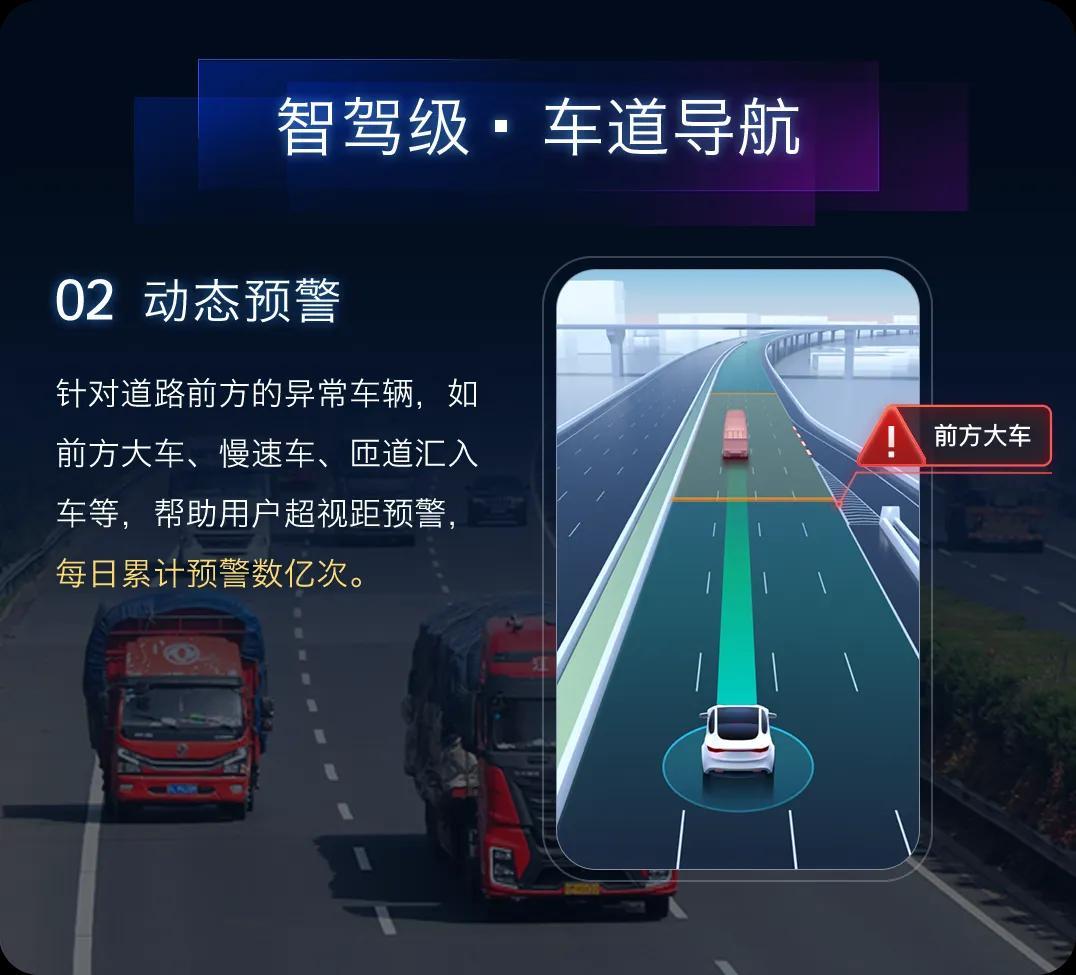
Baidu Maps' V21 release, however, focuses more on the second direction—improving autonomous driving safety. Its new version highlights "autonomous driving-grade navigation," such as lane-level updates, minute-level dynamic updates, and ultra-long-distance warnings to provide safety assurances for autonomous driving systems. Features like autonomous parking navigation and seamless driving-parking integration are also included.
In high-speed scenarios, for instance, the system provides real-time lane-level warnings for sudden events like construction detours or accidents, assisting autonomous driving systems in early avoidance or takeover to prevent emergency lane changes. This is particularly relevant given that in the Xiaomi SU7 collision, the time between the NOA system's "obstacle ahead" warning and the crash was only 2-4 seconds—a key point of controversy.
In fact, the divergent paths of Amap and Baidu Maps have been evident for some time.
Despite support from Alibaba and Baidu, Amap and Baidu Maps' contributions to their parent companies' profits through local services, ride-hailing aggregation, and advertising have been modest.
Baidu no longer discloses Baidu Maps' performance separately in its financial reports, instead integrating it into core businesses like autonomous driving and smart transportation. Amap, part of Alibaba's local services division, achieved its first profit in Q3 of fiscal year 2025. With Alibaba focusing more on AI, the "Amap + AI" combination is unsurprising.
The recent moves by Amap and Baidu Maps reflect their battles for users in both B2B and B2C markets.
While AI has leveled the technological playing field, neither is willing to cede ground in the fight for user mindshare.
Tech Giants Vie for Dominance in Maps
User acquisition is an eternal rule in the business world. For Amap and Baidu Maps, monthly active users (MAUs) are the foundation of monetization in the B2C space, where Amap leads with about 800 million MAUs. In the B2B space, their competition for automakers in core navigation services has led to distinct alliances.
Strong partnerships form their foundation.
Although many cars can use third-party navigation via browsers or CarPlay, default navigation holds a natural advantage and remains a must-win for map providers—especially amid the autonomous driving trend.
For example, Baidu Maps' V21 release was co-developed with Tesla and BYD. Baidu Maps will provide DiLink map navigation services for some of BYD's "Eye of Heaven" models.
Additionally, Leapmotor is among the first automakers to adopt the V21 version.
Amap, meanwhile, has partnered with Nio, XPeng, Xiaomi, and ZEEKR as their default in-car navigation providers.
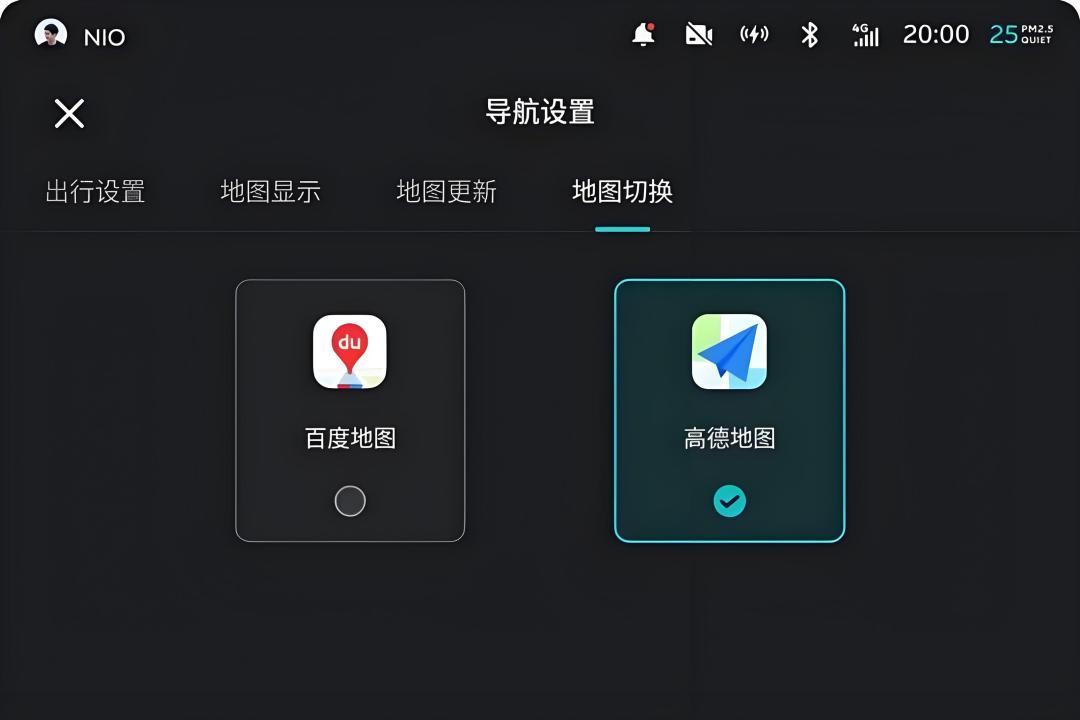
Notably, automakers' partnerships with map providers are the result of multi-faceted considerations and may shift as their strategies evolve. Many automakers also support both Baidu Maps and Amap in-car versions, leaving the choice to users. For instance, Nio initially used Baidu Maps as its default but added Amap as an option in a 2022 update.
For now, Amap and Baidu Maps have each secured notable partnerships with new energy automakers. Their recent efforts aim to win more automaker clients through technological advancements.
Beyond competing with each other, as similarly positioned map providers, they also face threats from other players developing in-house maps.
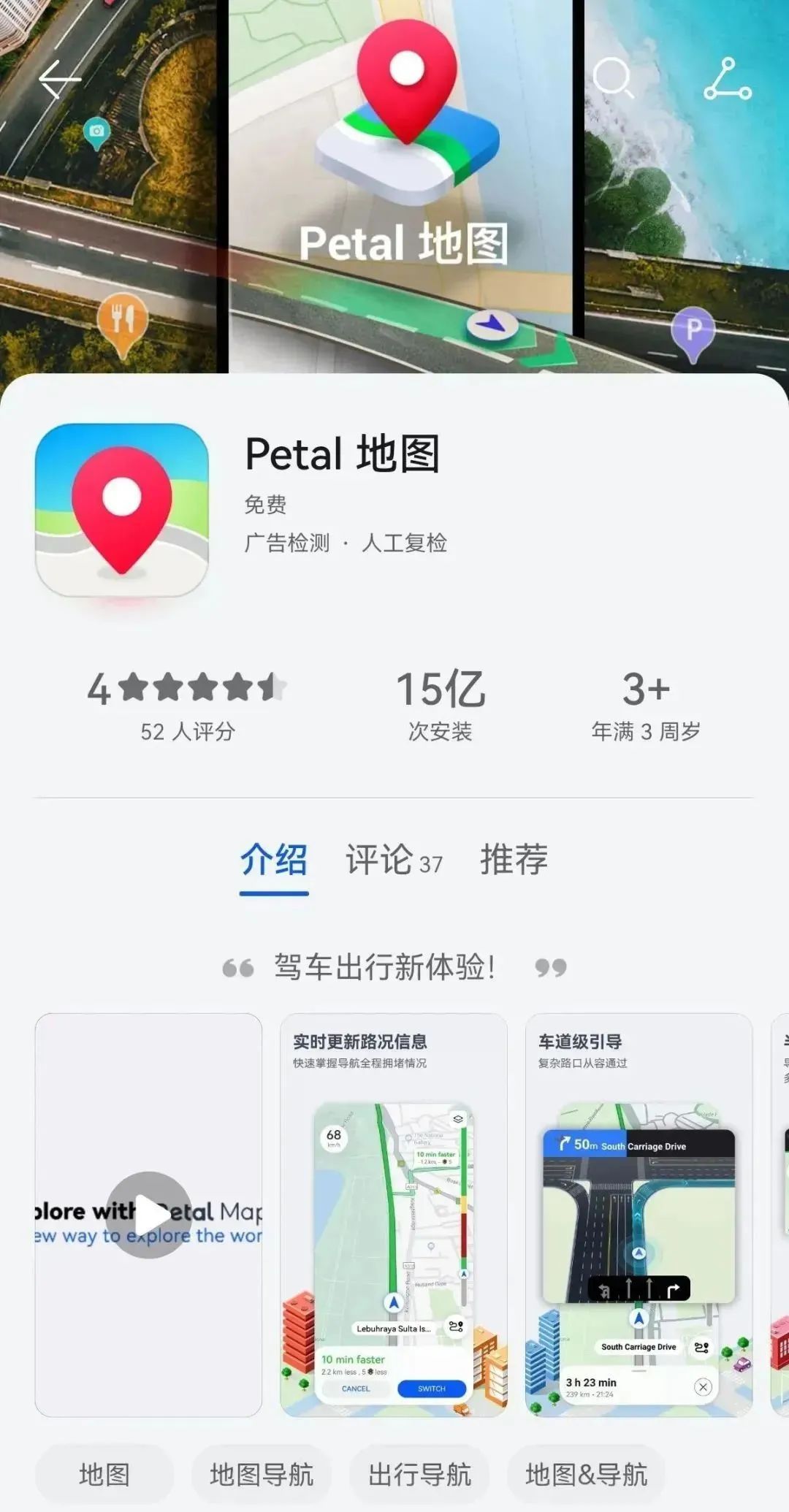
In 2020, Huawei partnered with NavInfo to launch its self-developed Petal Maps, initially targeting overseas users. Reports indicate that some models from Chery, Haval, and Avatr use Petal Maps abroad.
In January 2024, Huawei Petal Maps launched in China's app market. By late March, Petal Maps HarmonyOS version 5.0.0.302 added features like cruise mode, including real-time traffic alerts, speed cameras, and speed limits—encroaching further on traditional map providers' turf.
Ride-hailing platform Didi began developing its map business in 2017. Its subsidiary Didi Maps obtained a Class A surveying and mapping qualification from China's National Administration of Surveying, Mapping, and Geoinformation in December that year. Recently, Didi expanded its self-developed Didi Maps navigation feature from drivers to all users.
Although Huawei Petal Maps and Didi Maps currently have limited reach and lag far behind Amap and Baidu Maps in autonomous driving applications, Huawei's HarmonyOS Smart Mobility and Didi's autonomous driving ambitions could make them formidable new competitors in the future.
No Clear Winner Yet, Competition Intensifies
As similarly positioned competitors, Amap and Baidu Maps are vying for users with their respective strengths. But amid the autonomous driving wave, both face challenges.
Autonomous and intelligent driving are among the hottest topics in the auto industry, attracting fierce competition. Companies across the supply chain are seeking ways to participate.
Chipmakers are designing more advanced automotive chips, and radar manufacturers are producing smaller, cheaper sensors. But for map providers, automakers' needs seem to be shifting.
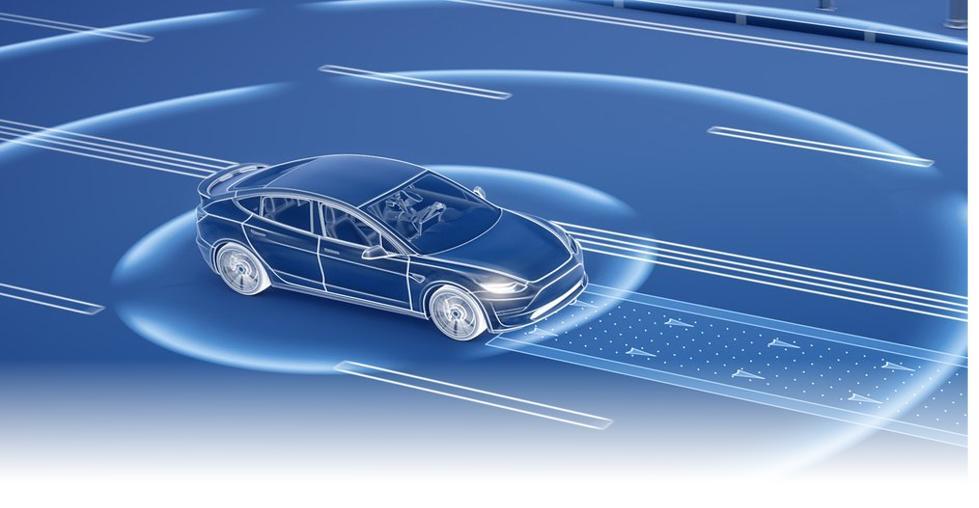
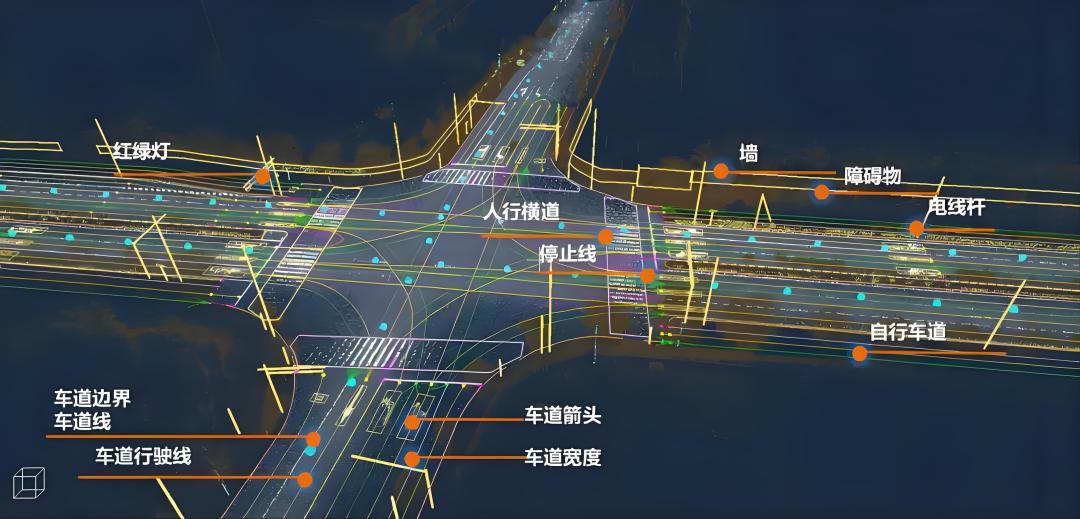
In the early days of autonomous driving, map providers like Amap and Baidu Maps bet on high-definition (HD) maps. Unlike traditional navigation maps, HD maps are designed for computers, providing critical road information for assisted and autonomous driving.
However, HD maps' centimeter-level precision, frequent updates, and rich detail require massive investments in technology and R&D.
According to the "Intelligent Connected Vehicle HD Map White Paper," traditional surveying vehicles can map about 500 kilometers of roads per day at decimeter-level precision, costing around $1.5 per kilometer. Centimeter-level precision reduces daily coverage to about 100 kilometers, with costs potentially reaching thousands per kilometer—amounting to tens of thousands daily.
Beyond high costs, frequent updates pose another challenge. As Huawei's Richard Yu noted, "China's roads change daily. Relying on HD maps makes widespread adoption impossible. Plus, producing HD maps is extremely expensive. Covering the entire country is incredibly difficult—sometimes roads change the day after mapping."
This has led more automakers to explore "map-free" solutions. End-to-end, vehicle-road-cloud integration is becoming the new consensus.
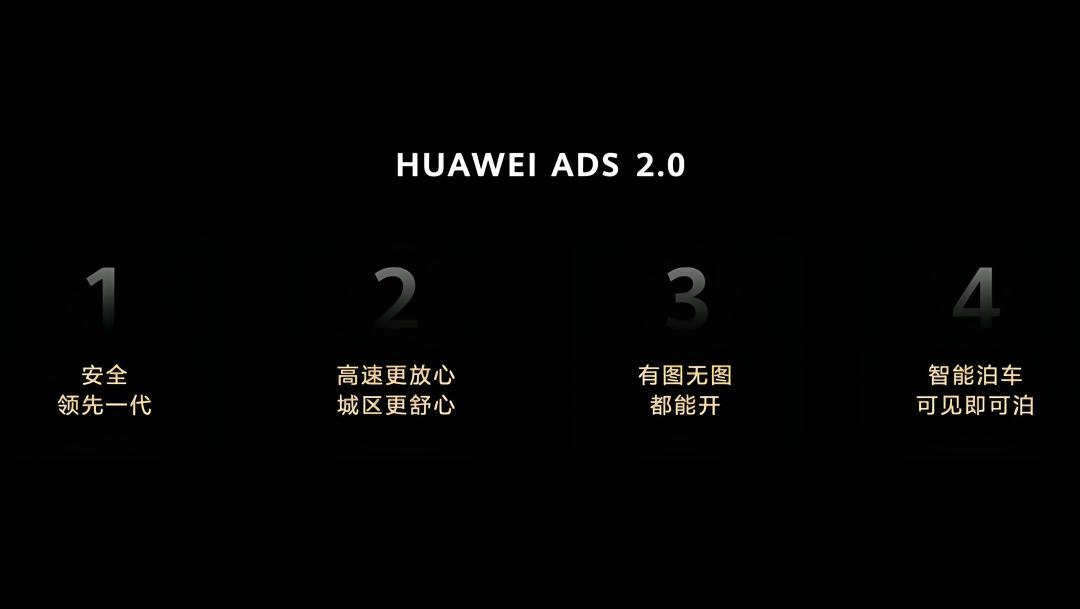
For example, ahead of the 2023 Shanghai Auto Show, Huawei launched ADS 2.0, enabling high-level urban and highway autonomous driving without HD maps. In May 2023, XPeng announced its XNGP advanced driver-assistance system had achieved 100% map-free operation, doubling its coverage. BYD and Li Auto are also pursuing map-free autonomous driving.
Against this backdrop, the former HD map triumvirate—Amap, Baidu Maps, and NavInfo—face severe challenges and must adapt by developing lightweight HD maps.
However, while more automakers are abandoning HD maps, many insiders argue that "map-free" doesn’t mean completely map-less. The transformation of map providers like Amap is inevitable.
Although map-free autonomous driving isn’t yet an industry consensus—many automakers still use HD maps—Amap and others must consider whether lightweight HD maps can generate enough revenue to offset their high R&D and maintenance costs as HD map demand shrinks.
Autonomous driving has forced Amap and Baidu Maps out of their comfort zones. But with evolving technology and regulations, the future of autonomous driving remains uncertain—and the game is far from over for map providers.
References:
Wild Horse Finance, "Xiaomi SU7 Fire: Was Autonomous Driving to Blame?"
First Finance, "No Room for HD Maps on the Road to Autonomous Driving"
Electric Technology, "Dead End for HD Maps: Why Are Automakers Abandoning Them?"
China News Weekly, "Crackdown on Autonomous Driving's 'Reckless Rush': The Government Steps In"
The copyright of this article belongs to the original author/organization.
The views expressed herein are solely those of the author and do not reflect the stance of the platform. The content is intended for investment reference purposes only and shall not be considered as investment advice. Please contact us if you have any questions or suggestions regarding the content services provided by the platform.