Reorganization of Li Hui and Guo Jinyi's responsibilities signals Luckin's imminent return to the main board?

Luckin Coffee's rollercoaster journey over the past five years is nothing short of a miracle in business history: from the eruption of the "Lu Zhengyao fraud scandal" that nearly brought the company to its knees, to its rebirth as the undisputed industry leader with annual revenues nearing 35 billion yuan. While countless companies have faced major crises in business history, few have managed not only to rise from the ashes like Luckin but also to reach new heights in their industry.
Recently, Luckin underwent a management reshuffle: former Chairman Guo Jinyi was appointed Group CEO, while Centurium Capital's Chairman Li Hui assumed the role of Group Chairman. This presents an opportunity to reflect on Luckin's success under Guo Jinyi's leadership and explore the investment potential of its new management structure. Key takeaways:
First, Guo Jinyi was the architect of Luckin's "phoenix-like revival" and the driving force behind its post-2023 focus on market share.
Second, Centurium Capital's unwavering trust in Guo Jinyi ensured sound corporate governance at Luckin.
Third, with management roles redefined, a return to the main board may be accelerating.
Guo Jinyi: The Art of Resurrecting Luckin
In early 2022, a buyer group led by Centurium Capital completed the acquisition of some of Luckin's existing shares, becoming the controlling shareholder with over 50% voting rights. This marked a clean break from previous management and the official start of the Guo Jinyi era.
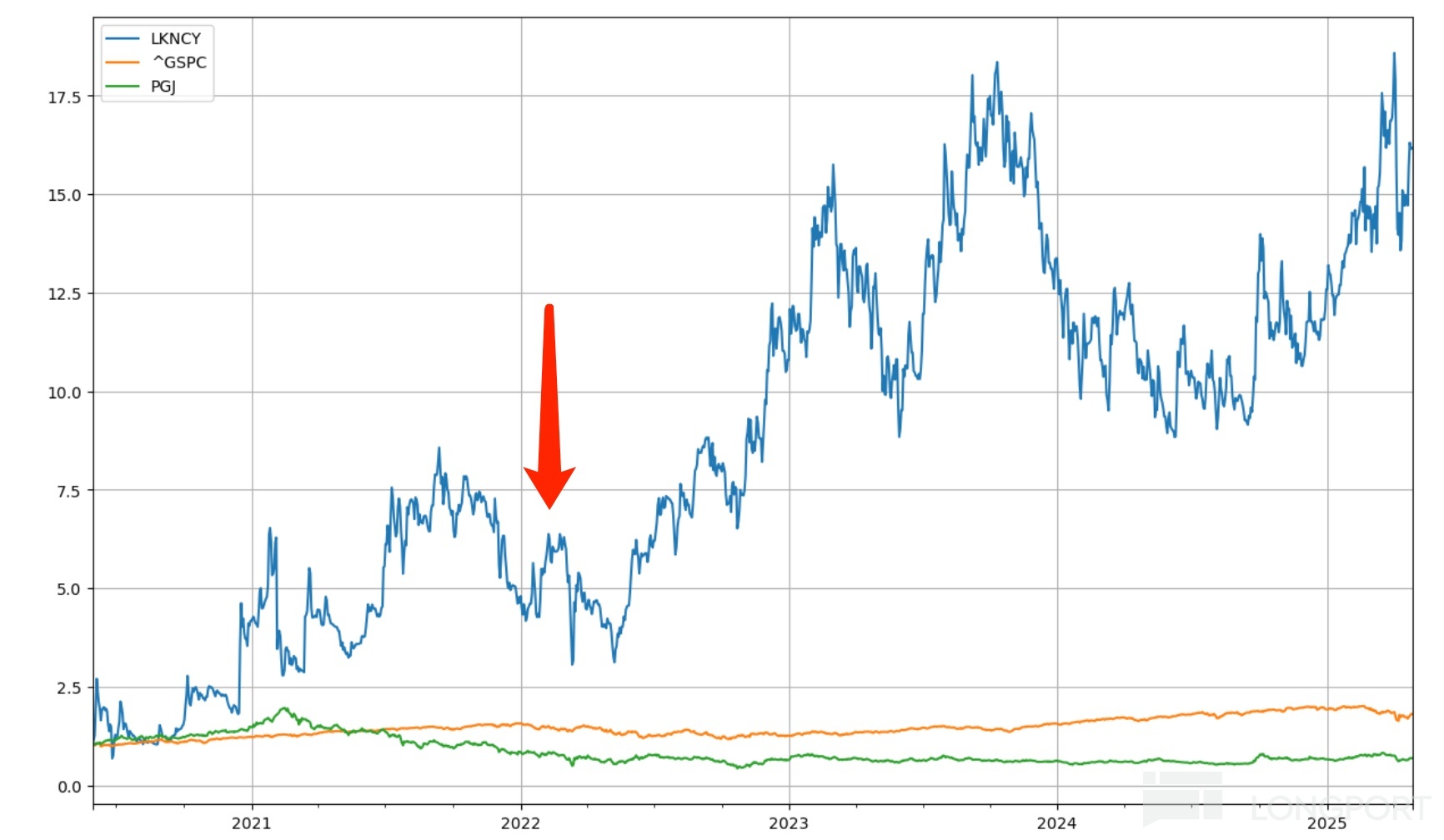
The chart above shows the stock price fluctuations of Luckin, the S&P 500, and the Golden Dragon Index (primarily Nasdaq-listed Chinese companies) in recent years (baseline set at "1"). Before Guo Jinyi took office, Luckin's stock had hit rock bottom (even dipping below the $1 par value), but it then embarked on a sustained rally, soaring over tenfold to date and outperforming both the S&P 500 and Chinese peers.
The market's repricing of the company fundamentally reflects the outcomes of its strategic realignment.
After the 2020 accounting fraud came to light, Guo Jinyi took the helm during crisis, steering Luckin away from its previous "quantity over quality" approach. On one front, he overhauled corporate culture from within, resolving long-standing issues like the disconnect between personal ambitions and corporate mission, and the fragmentation between parts and the whole, achieving unprecedented internal cohesion. On another, he shifted strategy from blind expansion to precision operations, implementing a series of pragmatic reforms centered on stores, products, and operations—optimizing asset structures, upgrading product mixes, and enhancing digital capabilities—dramatically improving operational efficiency. Within a year, individual stores achieved positive cash flow, with 60% turning profitable, laying the foundation for Luckin's rapid growth.
It's crucial to note that a company's core metric isn't revenue but free cash flow. Unhealthy free cash flow renders revenue growth meaningless. Under Lu Zhengyao, Luckin relied heavily on subsidies, losing more the more it sold, yet dared not withdraw them for fear of cratering sales—trapping the company in external funding dependency. Any financing hiccup risked collapse.
The precision operations strategy, however, ensured ample free cash flow for restructuring and growth, bolstering resilience. A hallmark of Guo Jinyi's Luckin was continuous product upgrades and hit items, transitioning from subsidy-driven to experience-driven customer acquisition. This created a win-win: customers felt value for money, boosting repeat purchases, while Luckin earned reasonable profits to fund innovation—transforming a negative feedback loop into a positive one.
Thus began Luckin's counter-pandemic growth streak, with triple-digit increases becoming routine. Repeated outperformance raised profitability expectations, prompting valuation model adjustments and a return to peak market cap by early 2023.
Post-2023, with the "Lu Zhengyao scandal" shadow fading and vitality restored, Guo Jinyi launched a "second revolution": prioritizing market share even at the cost of short-term gains.
Luckin's stores entered hypergrowth, jumping from under 10,000 in early 2023 to over 24,000 by Q1 2025.
Initially, markets and media doubted this strategy, fearing store efficiency dilution.
But by Q2 2024, these concerns vanished as store margins rebounded to near 2022 levels, with Q1 2025 same-store sales up 8%—a "volume-price surge."
Today, Luckin dominates market share, amplifying economies of scale—maintaining robust profitability even amid rising coffee futures—while its ubiquitous stores grant pricing power. Both Starbucks and domestic rivals now benchmark against Luckin, cementing its competitive edge.
Post-mid-2024, Luckin's stock resumed its climb as Guo Jinyi's strategy won full market endorsement.
From crisis leadership to dual revenue-profit growth and now venturing into milk tea, Guo Jinyi has been indispensable. Now positioned on the ready-to-drink beverage boom, this will be his focus as dedicated CEO.
Li Hui: Luckin's Patient Capital
When Centurium became Luckin's major shareholder in 2022, it sparked debate: private equity typically seeks "stability," often clashing with management over risk-taking—a rift that could cloud prospects.
Yet observations show remarkable synergy between Li Hui and Guo Jinyi's team.
Without Li Hui, Luckin might not exist today.
Rewind to the 2020 fraud: facing massive lawsuits, bankruptcy risks, and internal chaos, Li Hui stepped in to restructure operations and stabilize morale. He spearheaded a $240 million overseas debt overhaul, averting collapse.
Moreover, Li Hui frequently appeared at key milestones—bakery launches, the 10,000th store—demonstrating deep operational involvement paired with full managerial trust.
Especially during the 2023 "market share first" strategy, Centurium braved stock and P&L pressures to back management—a rarity. Without Li Hui's support, Guo Jinyi's reforms wouldn't have succeeded so spectacularly. Their mutual trust delivered stellar returns, setting a partnership benchmark.
Now as Chairman and CEO respectively, Li Hui and Guo Jinyi aim to:
1) Capitalize on the ready-to-drink boom: Per Zheshang Securities, China's per capita consumption has 8x+ growth potential. Luckin's expansion into milk tea etc. transitions it from coffee to beverages, reopening growth ceilings.
Guo Jinyi's CEO role reflects board confidence in his ability to lead this transformation.
2) Li Hui may drive Luckin's main board return
As Luckin's stock climbs, calls for a main board relisting grow louder.
With proven strategy (market share priority) and returns (~20x in five years), timing is ideal. Global capital shouldn't miss China's top beverage player.
Li Hui will likely spearhead SEC and exchange communications to expedite this.
$Luckin Coffee(LKNCY.US)
The copyright of this article belongs to the original author/organization.
The views expressed herein are solely those of the author and do not reflect the stance of the platform. The content is intended for investment reference purposes only and shall not be considered as investment advice. Please contact us if you have any questions or suggestions regarding the content services provided by the platform.