


 Top 10 Influencers in 2025
 Likes Received
US Stock Live Trading-20250602: Low position operation, cautious position building

Overview:
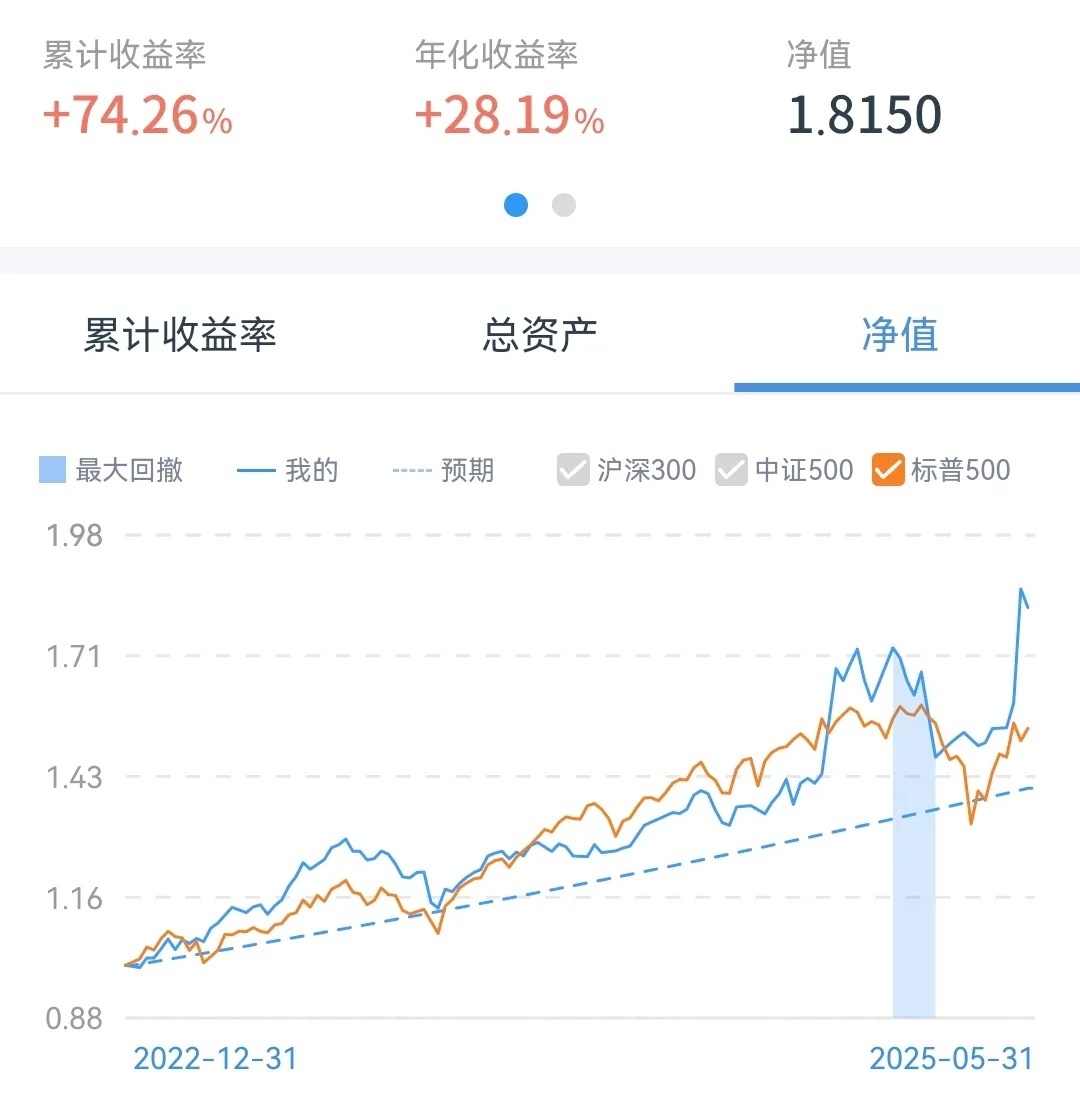
This week, the S&P 500 rose 1.88%, while my actual portfolio value fell 2.27%.
Year-to-date in 2025, the S&P 500 has risen 0.51%, while my actual portfolio value has risen 13.30% (starting the year at 1.60, current value 1.82).
Trades:
Sold 10% BIL and bought an equivalent amount of NAKA (formerly KDLY)
Holdings:
CEP 11.1%, NAKA 9.6%, TLT 17.7%, BIL 61.7%.
Numbers are rounded, and positions below 1% are generally not recorded.
Review:
This week, I was mostly in the suburbs with my family, so the weekly report is a bit late.
First, let’s talk about trades. KDLY (now renamed NAKA), which I sold last week, saw a significant pullback. I thought the drop was about done, so I started buying back. However, as Bitcoin was also falling, related concept stocks generally declined. The main reason for my counter-trend pullback this week stems from this. As I mentioned before, this position is too volatile, so I won’t allocate too much—around 25% is enough. I periodically liquidate most of it and don’t hold it long-term, but I mainly focus on CEP and this one.
This week, international tensions flared up again, and unsurprisingly, the stock market became volatile. I won’t go into details, but Trump stirred up some trouble, Russia-Ukraine saw major developments, the Middle East had some big moves, and China unexpectedly revealed some achievements. I’ll leave the interpretation to the political commentators, but I’ll focus on the potential pros and cons:
1. Positive for global defense stocks, especially those from major powers. I personally favor China’s; I’ve started gradually building positions in A-shares.
2. Short-term negative for the crypto industry. Russia accounts for the second-largest mining power globally, and this wave likely forced many to pause operations.
3. Negative for all global value stocks. With constant macro disruptions, regardless of the outcome, larger companies will find it harder to pivot. Apple is a prime example. Next quarter’s earnings for global giants might not look great.

My main holdings are still U.S. Treasuries. Based on my long-standing view, this year will be a monkey market—there will be plenty of opportunities. Missing one isn’t scary; getting trapped is.
My U.S. stock account only has 20% equity exposure, all in crypto-related stocks. I’m not worried at all—just watching the global show and waiting for a golden opportunity to pick up the pieces.
---
Other stocks:
1. Apple
According to AXIOS: Apple has appealed the European Commission’s specific rules on how the company complies with interoperability requirements. Under the Digital Markets Act, Apple is required to share user data with external developers, and the rules are the EU’s constraints on its compliance. Apple continues to strongly oppose the DMA’s requirements, arguing it forces the company to relinquish intellectual property and harms user privacy.
The EU and U.S. are particularly at odds lately, so global U.S. tech giants will face periodic sanctions. They’ll have to learn to adapt.
2. Microsoft
A Microsoft subsidiary in Russia plans to file for bankruptcy. Russia’s president said this week that foreign service providers like Microsoft and Zoom should be "restricted" to make way for domestic software solutions. After the Russia-Ukraine conflict, Microsoft continued to provide critical services in Russia, but in June 2022, it announced it would significantly scale back operations due to economic conditions and impacts on its Russian business. Documents from the Federal Resource Registry on Friday stated that Microsoft Rus LLC intends to declare bankruptcy.
Microsoft is the only M7 stock rising against the trend this year, as most of its overseas business is "green," especially its ToC segment. After a year of consolidation, it’s now quietly gaining ground—likely the safest tech giant this year.
3. Google
Last Friday, a federal judge suggested he might scale back the DOJ’s proposed remedies for Google’s alleged search monopoly, citing AI’s rapidly changing role in online search.
Judge Amit Mehta, overseeing the high-profile antitrust case, expressed skepticism about forcing Google to share search data, stop payments to Apple and others for default search status, and implement a 10-year oversight plan, Reuters reported.
Mehta said, "Ten years seems short, but in this field, a lot can change in weeks," referring to OpenAI’s decision to acquire Jony Ive’s startup to build AI devices. He added that future competition might not come from traditional rivals like Bing or DuckDuckGo but from AI companies offering fundamentally different user experiences.
Mehta said, "If anything, it’ll be these AI companies—they’re not just search. Why? Because maybe people no longer want ten blue links."
4. Nvidia
Barron’s reported that Nvidia CEO Jensen Huang plans to sell over $800 million in stock this year under a prearranged trading plan.
The company disclosed in an SEC filing Wednesday that on March 20, Huang adopted a Rule 10b5-1 plan to sell 6 million Nvidia shares. Insiders use such plans to avoid bias from nonpublic information. Huang’s plan expires at the end of 2025, but he hasn’t sold any shares yet.
The number of shares Huang plans to sell matches his last plan, which ran from June 14 to September 13, totaling $713 million at an average price of $118.83 per share.
With Nvidia’s stock surge, Huang’s new plan could yield higher proceeds. At Wednesday’s close of $134.81, the shares covered by the plan are worth up to $809 million.
6. Petrobras
Writing this, I suddenly realized I missed mentioning that the weekend’s big news on Russia-Ukraine should also benefit global energy stocks. Petrobras has fallen near the lower Bollinger Band again—it almost always rebounds from this level. The price swings in this range seem safe; if there’s a chance next week, I might take it.
7. Crypto stocks: MSTR/CEP/NAKA
No plans to add more positions for now, especially MSTR. Like Tencent, it might just serve as a reference at some point, paving the way for the other two, which I think have more potential. A 20% position already significantly impacts my portfolio’s volatility. If you’re copying this part of my strategy, I suggest copying the position limits too—otherwise, the volatility might be too much for your heart.
---
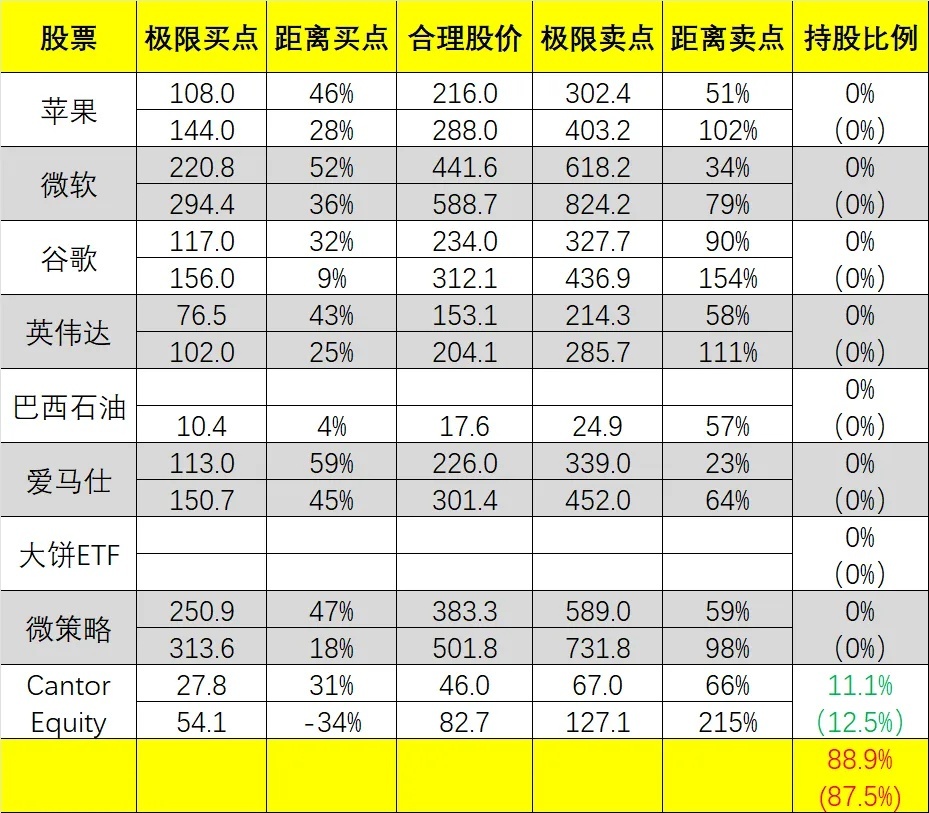
Finally, the valuation table (all figures in USD): Almost empty—I haven’t bought much, and I don’t know when this will end.
Notes (please read):
1. The buy points, fair prices, and sell points in the table above are calculated using my own methods—there’s no standard, and they’re not absolute or guaranteed. They’re just aids for judging current prices.
2. If a price point has two values, the lower is the floor and the higher is the ceiling. Which one I use depends on my judgment and understanding of the company—no standard applies.
3. Blue and red highlights are warnings for me to focus when a stock nears buy/sell zones, but they don’t mean I’ll definitely act.
4. The numbers in the table are adjusted periodically based on my dynamic assessment of company fundamentals. Don’t treat them as long-term references or correct answers.
5. The table is for my personal trading records—it’s not advice. Don’t ask me if you should buy something; the answer is no.
6. If you hold any of these positions, feel free to discuss them with me in the comments—point out my mistakes, and let’s learn and profit together.$Strategy(MSTR.US) $Cantor Equity Partners(CEP.US) $Nakamoto(NAKA.US)
The copyright of this article belongs to the original author/organization.
The views expressed herein are solely those of the author and do not reflect the stance of the platform. The content is intended for investment reference purposes only and shall not be considered as investment advice. Please contact us if you have any questions or suggestions regarding the content services provided by the platform.
