


"Dominant" TSMC, is it the strongest king in the AI era?
TSMC released its Q3 2025 financial report (ending September 2025) before the U.S. stock market opened on October 16, 2025, Beijing time. The key points are as follows:
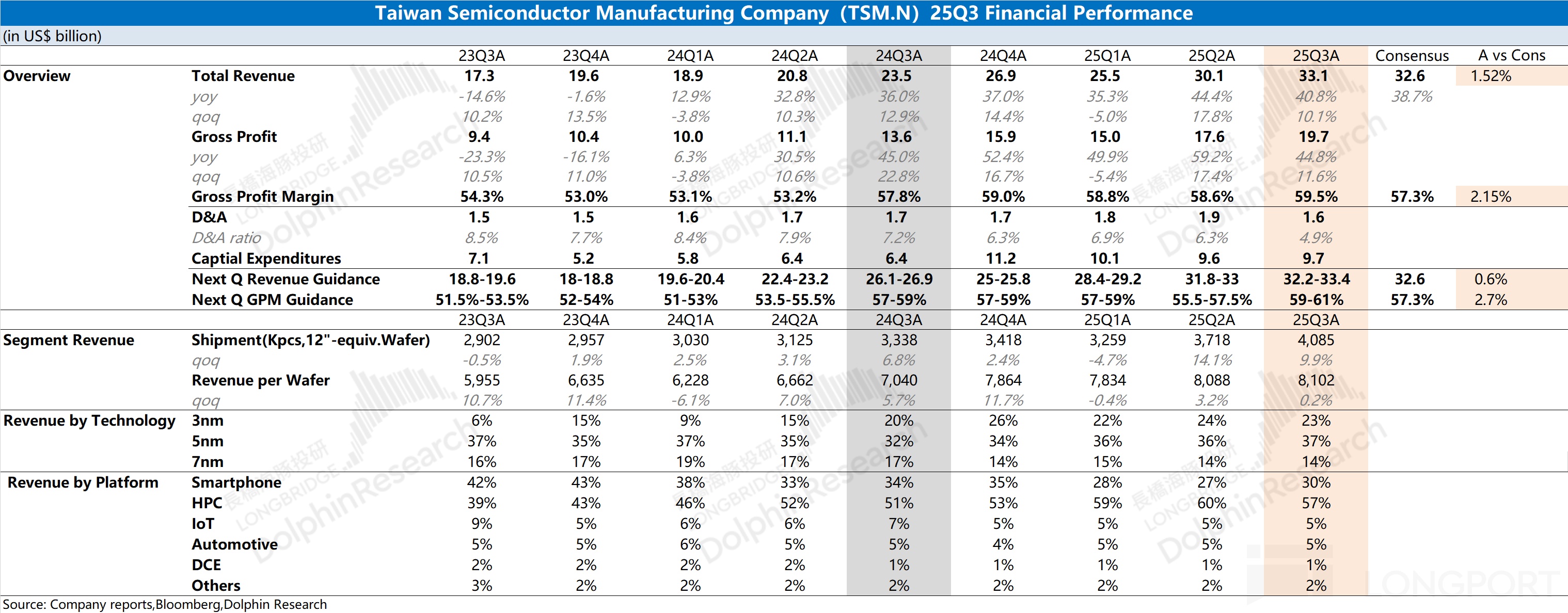
1. Revenue: TSMC's revenue for this quarter was $33.1 billion, a quarter-on-quarter increase of 10.1%, mainly driven by the stocking of electronic products such as iPhones and the growing demand for AI chips. The company's revenue for this quarter exceeded the upper limit of the guidance range ($31.8-33.0 billion), partly due to the depreciation of the U.S. dollar. In terms of New Taiwan dollars, the company's revenue for this quarter increased by about 6% quarter-on-quarter, still within the company's guidance range.
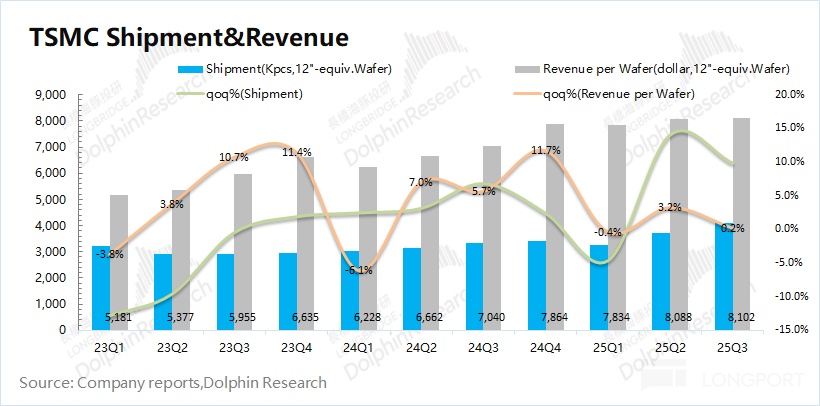
From the perspective of volume and price (equivalent to 12-inch wafers): ①$Taiwan Semiconductor(TSM.US) wafer shipments were 4,085 thousand pieces, a quarter-on-quarter increase of 9.9%; ② TSMC's revenue per wafer (equivalent to 12-inch wafers) was $8,102 per piece, a quarter-on-quarter increase of 0.2%.
2. Gross Margin: The company's gross margin for this quarter was 59.5%, significantly better than the company's guidance range (55.5-57.5%). Breaking down the gross margin, the average selling price of the company's products remained basically flat quarter-on-quarter, and the improvement in gross margin was mainly due to the reduction in unit fixed costs (amortization and depreciation), with increased shipments diluting the cost per wafer. The company still sets its long-term gross margin target at over 53%, which is quite conservative.
3. Specific Business Progress: Process, Downstream Applications, and Regions
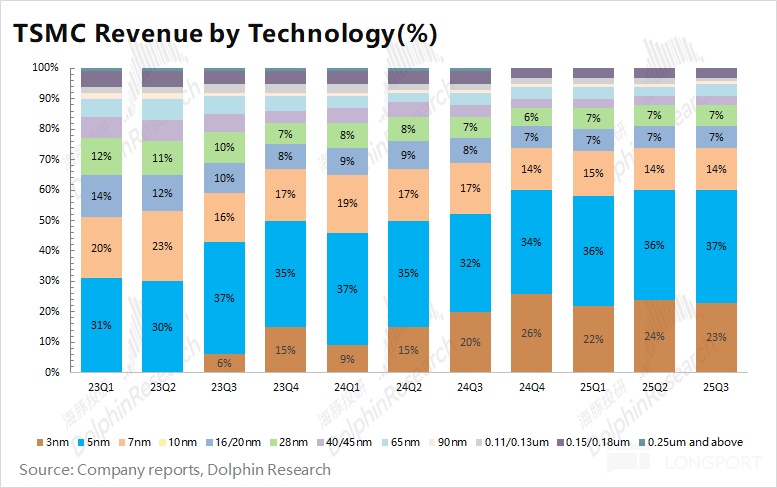
a. By Process: The proportion of advanced processes below 7nm at TSMC this quarter remained at 74%. Driven by AI demand, the company's current 3nm and 5nm capacities are fully loaded, with revenue shares of 23% and 37%, respectively. With the subsequent mass production of the company's 2nm, AI chips will shift from 5nm to 3nm, further tilting the company's revenue structure towards advanced processes.
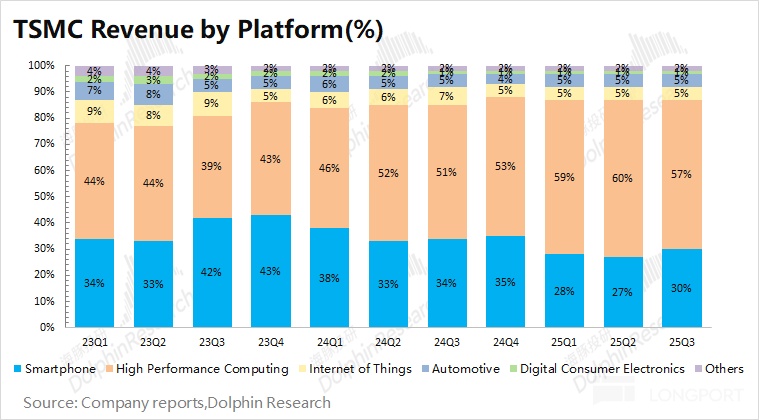
b. Downstream Applications: The main source of the company's revenue growth this quarter came from the mobile business, with the stocking of new iPhones being the main driver. Driven by the demand for AI chips from companies like NVIDIA and Broadcom, high-performance computing remains the company's largest source of revenue, reaching $18.9 billion this quarter, accounting for 57% of revenue.
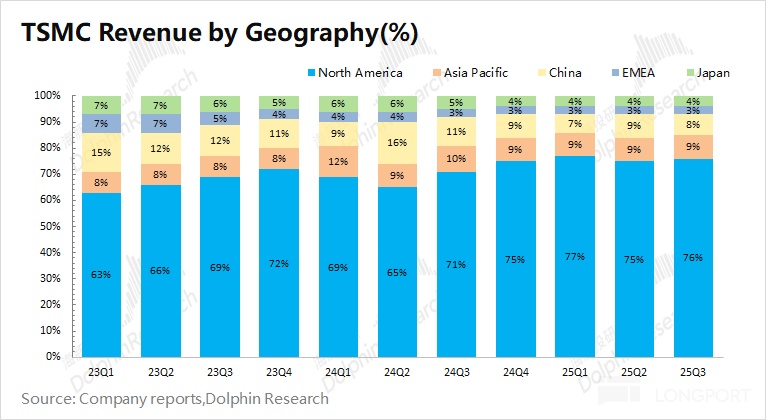
c. By Region: North America remains the company's largest source of revenue, covering major clients like NVIDIA, Apple, and AMD, with a revenue share of 76% this quarter. Revenue from mainland China this quarter was about $2.6 billion, accounting for 8% of revenue, still the company's third-largest source of revenue.
4. Capital Expenditure: TSMC's capital expenditure for this quarter was $9.7 billion, basically in line with expectations. In addition, the company raised its full-year capital expenditure target range to $40-42 billion (originally $38-42 billion). The company's capital expenditure for the first three quarters totaled $29.4 billion, and it is estimated that capital expenditure for the fourth quarter will be between $10.6-12.6 billion. TSMC's upward adjustment of the full-year capital expenditure range further demonstrates the company's confidence in its own operations.
5. TSMC Performance Guidance: The expected revenue for Q4 2025 is $32.2-33.4 billion (buy-side expectation is $32.6 billion) and a gross margin of 59-61% (market expectation is 57.3%). In the next quarter, the company will continue to benefit from the demand for new iPhones and AI chips.
Dolphin Research's Overall View: Amidst the hot AI Capex, the "stabilizing force" remains strong
TSMC's financial report this time is still good, with both revenue and gross margin meeting buy-side expectations (already revised upwards), especially with the gross margin significantly rebounding to a relatively high level of 59.5%.
Compared to this quarter's data, the market is more concerned about the company's capital expenditure situation and future operational guidance:
① Capital Expenditure: TSMC's capital expenditure for this quarter was $9.7 billion, in line with expectations. The company raised its full-year capital expenditure target to $40-42 billion (originally $38-42 billion), and it can be inferred that the capital expenditure for the fourth quarter will reach $10.6-12.6 billion, potentially reaching a new historical high for a single quarter.
For the capital expenditure situation in 2026, the company has not provided specific plans, but the market's expectation for the company's capital investment has been raised to $48 billion, still optimistic about the company's growth and investment level.
② Company Guidance: TSMC's guidance for the next quarter is also good. The company expects next quarter's revenue to be $32.2-33.4 billion, in line with market expectations. The company's 2nm will start mass production next quarter, and the company's gross margin expectation for the next quarter is still around 60%, which also fully reflects the company's confidence in its own profitability.
From the perspective of capital expenditure and the company's guidance, TSMC remains relatively optimistic about its own operations. With the growth of AI Capex demand and the iteration of process technology, both will provide guarantees for the company's continued growth.
Combining the company's financial report and the current industry situation, TSMC's core logic remains solid:
a) TSMC has an indispensable position: a key link in the AI semiconductor industry chain. Whether it is NVIDIA, Broadcom, or AMD, the manufacturing end of AI chips is concentrated at TSMC. Even if there is a dispute between GPU and ASIC, it ultimately cannot bypass TSMC.
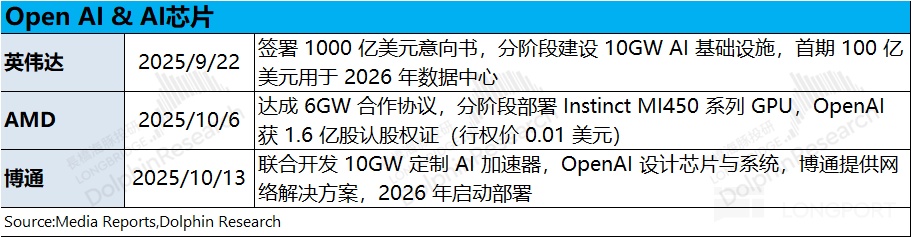
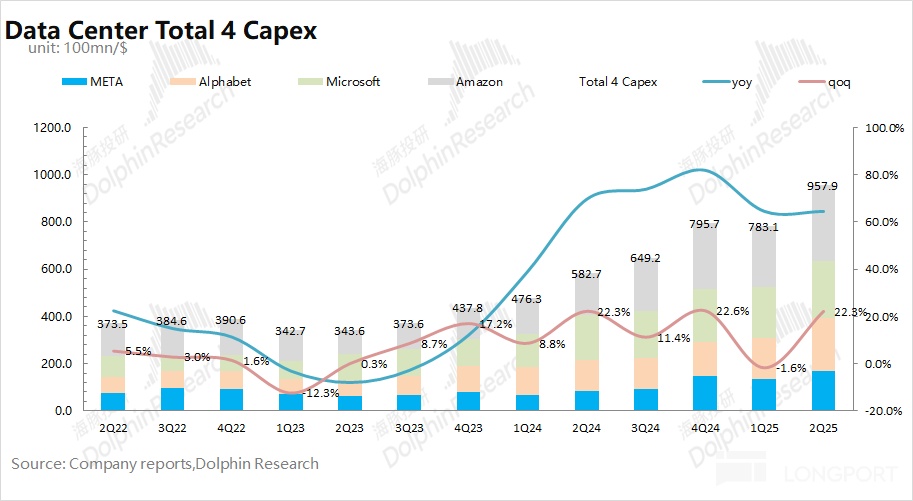
With recent cloud service giants increasing capital investment and Open AI's "big procurement," it can drive the demand for AI chips. As long as companies like NVIDIA and Broadcom make money, TSMC's performance growth can also be guaranteed.
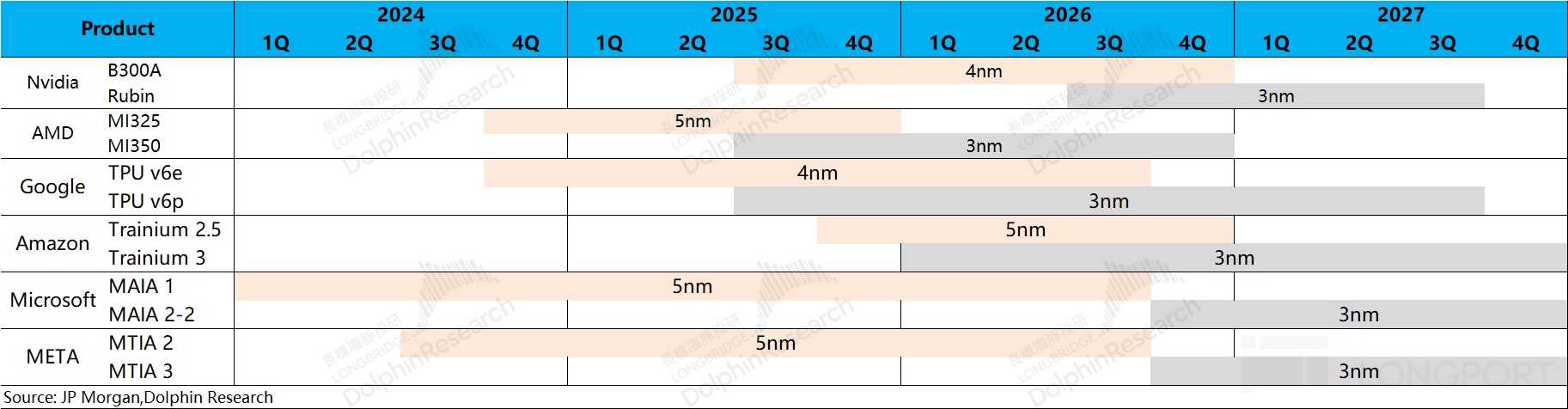
b) Process Technology Iteration and Upgrade: Currently, the company's 2nm progress is smooth, and it is expected that in 2026, mobile chips from Apple and Qualcomm will adopt the 2nm process technology, while AI chips (from companies like Broadcom, AMD, and NVIDIA) will gradually migrate from the 4nm platform to the 3nm process starting in the second half of 2025.
With the iteration and upgrade of process technology, 2nm/3nm will become the main platform for the company's advanced processes, which can directly drive another increase in the average price of the company's wafer products.
c) Significant Technological Advantage: Although Intel has recently received support from the U.S. government, NVIDIA, and others, it mainly involves financial aspects and CPU field cooperation, and currently does not involve product foundry.
Although Intel's 18A process has recently started mass production, there is still a significant gap with TSMC, with transistor density roughly equivalent to TSMC's 3nm (previous generation) level from two years ago.
As for the capability of wafer manufacturing processes, it mainly reflects in transistor density and yield rate. This is similar to how Samsung released its 3nm process early, but due to difficulties in improving yield, external customers like Qualcomm have gradually shifted orders to TSMC. Even Samsung's own flagship models are equipped with Qualcomm processors manufactured by TSMC.
From the perspective of technological capability and roadmap, TSMC is still significantly ahead of Intel and Samsung overall, further strengthening the company's voice in the current AI semiconductor industry chain.
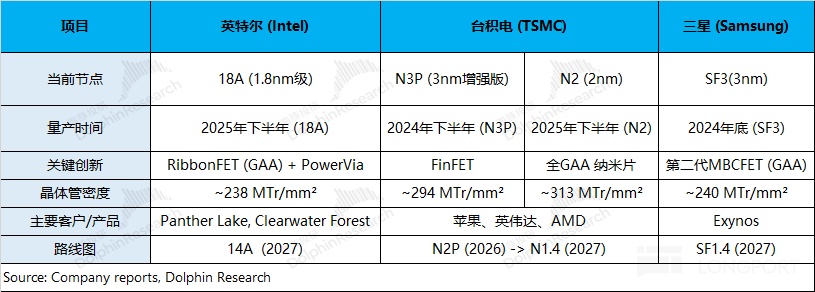
In summary (a+b+c), TSMC's core logic remains solid. With its absolute leading technological capability, TSMC holds an indispensable position in the AI semiconductor industry chain. In the context of large cloud service providers and Open AI significantly increasing capital expenditure, TSMC will directly benefit from the "expansion dividend" of this round of AI Capex.
Considering TSMC's current market value ($1.58 trillion), it corresponds to about 24 times PE for the company's net profit in 2026 (assuming revenue +23%, gross margin 59.8%, tax rate 16.4%). From the company's historical valuation range (20xPE-30xPE), the current valuation level is roughly at the midpoint of the range.
Overall, TSMC's capital expenditure and guidance for this quarter have shown good performance, reflecting the company's confidence in its operations. This mainly comes from the company's leading advantage and industry chain position, as TSMC is currently an "irreplaceable" part of the AI chip industry chain. In the current situation of significantly increased AI Capex, cloud service providers & Open AI all want to get more AI chips, and companies like NVIDIA, Broadcom, and AMD all have to turn to TSMC to make "high-end chips."
From the perspective of industry chain transmission, TSMC is the most important part of this round of AI Capex, so Dolphin Research has always given it the highest weight in the simulated portfolio. With TSMC's technological capability remaining leading, the significantly increased AI Capex will help the company's performance continue to grow, while also pushing the company's valuation to a relatively optimistic position. Please continue to follow, as Dolphin Research will also release management communication minutes and other related content in the future.
The following is Dolphin Research's specific analysis of TSMC:
I. Revenue: Reaching New Heights
TSMC achieved revenue of $33.1 billion in Q3 2025, exceeding the company's previous guidance range ($31.8-33.0 billion). This quarter's revenue increased by 10% quarter-on-quarter, mainly driven by the growth of mobile business and AI chips, as well as the impact of exchange rate changes. In terms of New Taiwan dollars, the company's revenue for this quarter increased by 6% quarter-on-quarter, in line with the guidance range.
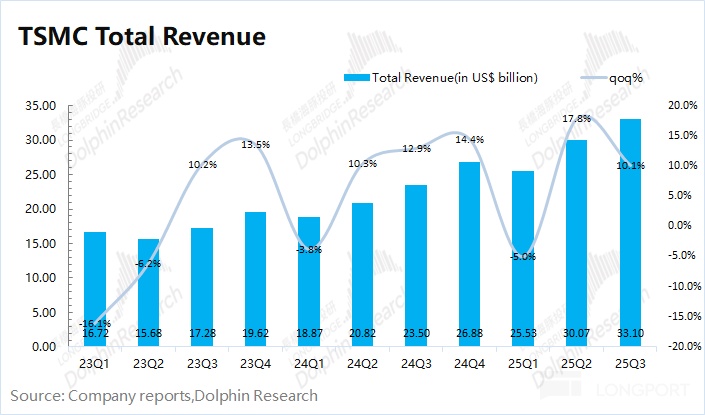
Due to the monthly disclosure of operating indicators, the market has fully anticipated TSMC's quarterly revenue. How did the price and shipment volume change in TSMC's revenue this quarter?
Dolphin Research observes the main driving forces of TSMC's revenue growth this quarter from the dimensions of volume and price:
1) Volume Dimension: In Q3 2025, TSMC's wafer shipments were 4,085 thousand pieces, a quarter-on-quarter increase of 9.9%, mainly benefiting from the stocking of new iPhones and the mass production of the GB series. TSMC's capital expenditure for this quarter was $9.7 billion, in line with expectations. TSMC also raised its full-year capital expenditure range to $40-42 billion, which also shows the company's confidence in its own operations.
2) Price Dimension: In Q3 2025, TSMC's revenue per wafer (equivalent to 12-inch wafers) was $8,102 per piece, a quarter-on-quarter increase of 0.2%. TSMC's 2nm process will start mass production at the end of the year, and then AI chips will shift from 5nm to 3nm, further tilting the company's overall product structure towards advanced processes, and the average product price is expected to further increase.
II. Gross Profit and Gross Margin: Returning to Around 60%
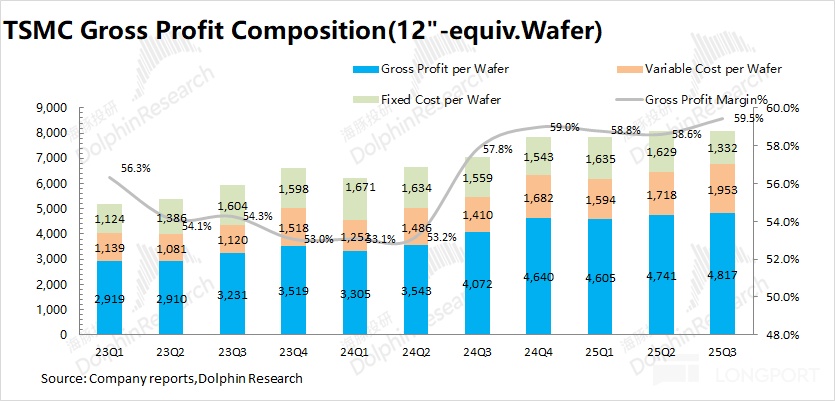
TSMC achieved a gross profit of $19.7 billion in Q3 2025, a quarter-on-quarter increase of 11.6%. The gross margin was 59.5%, a quarter-on-quarter increase of 0.9 percentage points, mainly due to the scale effect diluting some unit costs this quarter.
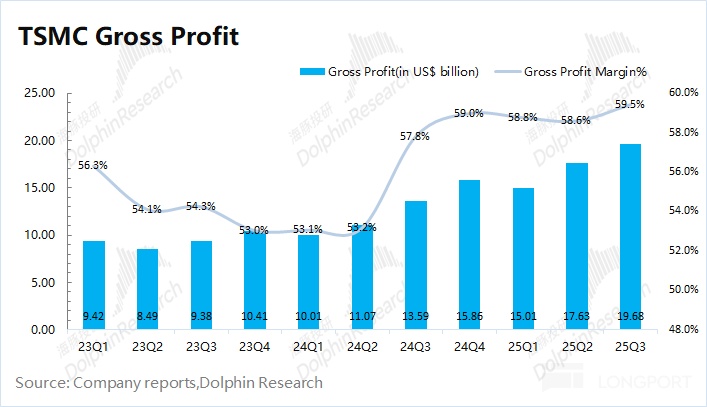
The two most concerning data for the market regarding TSMC are revenue and gross margin. Due to the monthly disclosure of operating data, quarterly revenue is basically anticipated by the market. The gross margin is one of the focal points of this quarterly report. Dolphin Research will analyze the main driving forces behind the improvement in gross margin this quarter:
"Gross Profit = Revenue per Wafer - Fixed Costs - Variable Costs"
1) Revenue per Wafer (equivalent to 12-inch): This quarter, TSMC's revenue per wafer was about $8,102 per piece, a quarter-on-quarter increase of $14 per piece. The average product price slightly increased this quarter, mainly driven by the increase in the proportion of 12-inch wafers;
2) Fixed Costs (Depreciation and Amortization): This quarter, TSMC's average fixed cost was about $1,332 per piece, a quarter-on-quarter decrease of $297 per piece. Due to the 9.9% quarter-on-quarter increase in shipments this quarter, the unit fixed cost of the company's products was directly diluted;
3) Variable Costs (Other Manufacturing Expenses): This quarter, TSMC's average variable cost was about $1,953 per piece, a quarter-on-quarter increase of $235 per piece, mainly due to the increase in manufacturing expenses driven by the increase in the proportion of 12-inch wafers and the growth of advanced processes.
In summary, this quarter, TSMC's gross profit per wafer was $4,817 per piece, a quarter-on-quarter increase of $76. The slight increase in the average product price, the reduction in unit fixed costs more than offset the increase in unit variable costs, leading to a decrease in the unit cost of the company's products, which is the main factor for the quarter-on-quarter improvement in gross margin.
III. Wafer Structure: 3/5nm Fully Loaded, 2nm About to Start Mass Production
3.1 Wafer Revenue Share (by Application Type)
High-performance computing (HPC) has become the company's largest source of revenue, with a revenue share of 57% this quarter. Driven by AI chips such as NVIDIA's GB series, the company's HPC revenue this quarter grew to about $18.9 billion, a quarter-on-quarter increase of 4.6%.
This quarter, the mobile business contributed the most quarter-on-quarter increment to the company. This quarter, the mobile business revenue was $9.9 billion, a quarter-on-quarter increase of 22%, mainly driven by the stocking of new iPhones, accounting for 30% of revenue. In addition, due to the peak season for electronic products in the second half of the year, fields such as IoT and consumer electronics also rebounded.
3.2 Wafer Revenue Share (by Process Node)
The revenue share of processes below 7nm this quarter remained at 74%, with advanced processes being the company's core source of revenue. Specifically, the revenue share of the company's 3nm this quarter was 23%, and the revenue share of 5nm remained at 37%. The company's current 3nm and 5nm capacities are fully loaded, and the company's 2nm process will also start mass production at the end of the year.
As the company gradually transfers 3nm mobile chips and other products to the 2nm platform, the current AI chips will also migrate from 5nm to 3nm. As the company's process structure further migrates to more advanced nodes, it can drive the company's product average price to continue to rise on the one hand, and expand the advantage over competitors on the other hand.
3.3 Wafer Revenue Share (by Region)
From the perspective of revenue by region, North America remains TSMC's largest source of revenue, with a revenue share of 76%. This is due to the presence of major clients such as Apple, NVIDIA, AMD, and Qualcomm in North America, creating a strong commercial binding relationship between TSMC and the United States.
In addition to North America, mainland China and the Asia-Pacific region are the other two major sources of revenue, with shares of 8% and 9% this quarter, respectively. This quarter, revenue from mainland China reached about $2.6 billion, still the company's third-largest source of revenue, and the customer situation in mainland China this quarter was relatively stable.
<End of this article>
Dolphin Research's related research on TSMC
TSMC
July 17, 2025, Conference Call "TSMC (Minutes): Full-year revenue growth revised up to 30%"
July 17, 2025, Financial Report Commentary "The Strong TSMC is the True "Backbone" of Semiconductors!"
April 17, 2025, Conference Call "TSMC (Minutes): 30% of future 2nm capacity will be in U.S. factories"
April 17, 2025, Financial Report Commentary "Tariff chaos does not hinder "explosive" guidance, TSMC remains steady?"
January 16, 2025, Conference Call "TSMC: 2025 capital expenditure raised to $38-42 billion (24Q4 Conference Call)"
January 16, 2025, Financial Report Commentary "TSMC: The "stabilizing force" is already invincible?"
October 17, 2024, Conference Call "TSMC: No intention to acquire Intel (FY24Q3 Conference Call Minutes)"
October 17, 2024, Financial Report Commentary "ASML drags down AI? TSMC steps in to stabilize the situation!"
July 18, 2024, Conference Call "TSMC: Full-year revenue growth over 20% (24Q2 Conference Call Minutes)"
July 18, 2024, Financial Report Commentary "ASML and Trump make two "feints"? TSMC "stabilizes the situation," what is there to fear!"
April 18, 2024, Conference Call "TSMC: Capital expenditure unchanged, maintaining original plan (FY23Q4 Conference Call Minutes)"
April 18, 2024, Financial Report Commentary "TSMC: iPhone underperforms, NVIDIA saves the day"
January 18, 2024, Conference Call "AI is the strongest driving force for future growth (TSMC 23Q4 Conference Call)"
January 18, 2024, Financial Report Commentary "TSMC: 3nm charges forward, Intel "sends a spring breeze""
October 20, 2023, Conference Call "3nm scaling up, planning to enter 2nm (TSMC 23Q3 Conference Call)"
October 20, 2023, Financial Report Commentary "TSMC: Surviving the "performance bottom," 3nm battle song rises"
July 20, 2023, Conference Call "TSMC: AI frantically assists, 3nm finally lands (2Q23 Conference Call)"
July 20, 2023, Financial Report Commentary "TSMC: NVIDIA saves the day, AI lifts the "cycle" bottom"
April 20, 2023, Conference Call "Clear bottom in Q2, 3nm mass production imminent (TSMC 23Q1 Conference Call)"
April 20, 2023, Financial Report Commentary "TSMC: The strongest king, also cannot escape the cycle's ups and downs"
January 12, 2023, Conference Call "Inventory will continue to adjust for half a year, growth to wait until the second half (TSMC 22Q4 Conference Call)"
January 12, 2023, Financial Report Commentary "TSMC's thunder, even Buffett's increase cannot suppress it"
October 13, 2022, TSMC Conference Call "Even with a bright financial report, TSMC cannot avoid industry recession (Q3 Conference Call)"
October 13, 2022, Financial Report Commentary "TSMC: How long can the "lonely brave" in the dark night last?"
July 14, 2022, TSMC Conference Call "How can TSMC continue to grow in the downward semiconductor cycle? (TSMC Conference Call)"
July 14, 2022, Financial Report Commentary "TSMC: The "alternative" backbone in the wave of order cuts"
April 14, 2022, TSMC Conference Call "2nm on the agenda (TSMC Conference Call)"
April 14, 2022, TSMC Financial Report Commentary "TSMC: Strong "faith," regardless of the cycle"
April 8, 2022, TSMC In-depth Stock Analysis "TSMC (Part 2): Price discount, faith not discounted"
March 16, 2022, TSMC In-depth Stock Analysis "After the market crash, talk again about the cremation-level foundry king TSMC"
January 13, 2022, TSMC Conference Call "After giving strong quarterly guidance, what did TSMC management talk about?"
January 13, 2022, TSMC Financial Report Commentary "TSMC is too strong, the "cycle" takes a detour"
October 14, 2021, TSMC Financial Report Commentary "TSMC: The leader takes the lead, still in the limelight"
Risk Disclosure and Statement of this Article:Dolphin Research Disclaimer and General Disclosure
The copyright of this article belongs to the original author/organization.
The views expressed herein are solely those of the author and do not reflect the stance of the platform. The content is intended for investment reference purposes only and shall not be considered as investment advice. Please contact us if you have any questions or suggestions regarding the content services provided by the platform.
