


Tesla: The long winter has begun

After the U.S. stock market closed on October 22, Eastern Time, $Tesla(TSLA.US) released its financial report for the third quarter of 2025, recording total revenue of $28.095 billion, significantly higher than analysts' expectations of $26.4 billion; operating profit was $1.624 billion, also slightly higher than analysts' forecast of $1.58 billion; Non-GAAP EPS was $0.5, slightly lower than the expected $0.55.
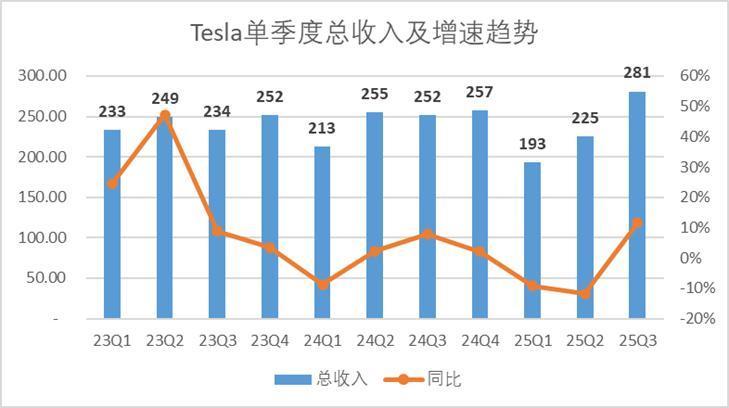
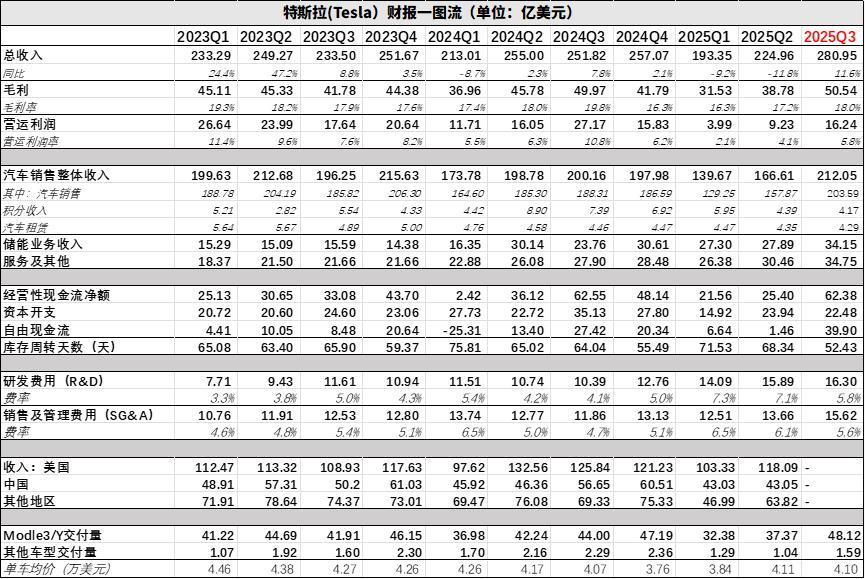
Figure: Summary of Tesla's financial report (unless otherwise specified, units are in billions of dollars), Source: Company financial report, Jinduan Research Institute
Regarding Tesla's financial report, we generally divide it into several parts for understanding: Since Q2 2024, Tesla's market valuation has diverged from its financial performance. The market's valuation of Tesla is based on the current performance of its "vehicle manufacturing" and "energy storage" businesses, the progress of its Robotaxi business, and the long-term valuation of Optimus.
Of course, most of these businesses are included in Tesla's quarterly financial report vision chart. However, we believe that the market's perception of different businesses varies. For example, investors in the energy storage and vehicle manufacturing businesses are more concerned about sustainability and specific gross margin performance, while investors in Optimus and Robotaxi are more focused on early-stage development layouts and technology implementation.
Therefore, we used the Gartner curve to roughly explain Tesla's business layout and development stage. It's not entirely accurate, but it helps briefly understand its core businesses (see the figure below):
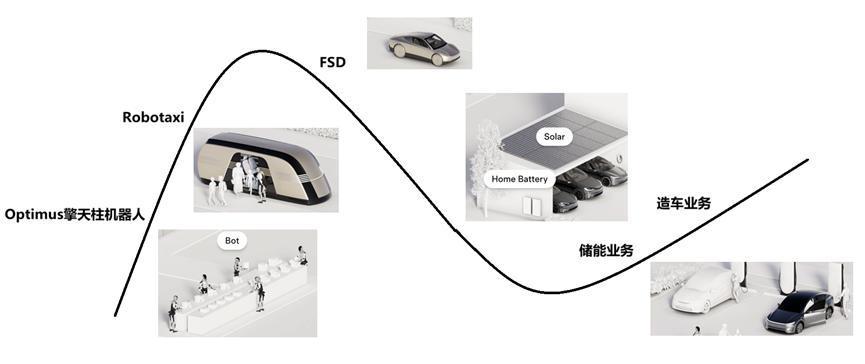
Figure: Tesla's product line combined with the Gartner curve, Source: Jinduan Research Institute
Based on this, we will delve into Tesla's performance in these businesses in Q3. Here are the key takeaways:
1. Existing businesses (vehicle manufacturing and energy): Tesla performed well in Q3. The manufacturing business saw a one-time demand release due to the $7,500 subsidy phase-out, setting a new quarterly record, but this is not sustainable. The energy storage business also set new records in deployment and revenue, with gross margins remaining relatively high. Although revenue share is relatively small, the development outlook is more optimistic compared to the vehicle business.
2. FSD progress: There were no new developments in Europe and China, and the overall penetration rate of 12% is not high, indicating significant business pressure.
3. Robotaxi and Optimus robot: Progress was delayed again. Robotaxi's expansion areas and speed slowed down, and Optimus was postponed again, with the V3 prototype expected to be showcased next spring.
Q4 will undoubtedly be challenging for Tesla, facing potential double pressure on revenue and profits due to subsidy phase-outs and tariffs. Musk's compensation plan remains unresolved. With the Optimus postponement, Tesla is heading into a long winter.
The logic behind this is as follows.
01 Vehicle Manufacturing: Subsidy Phase-Out Leads to Pulse Growth, But Not Sustainable
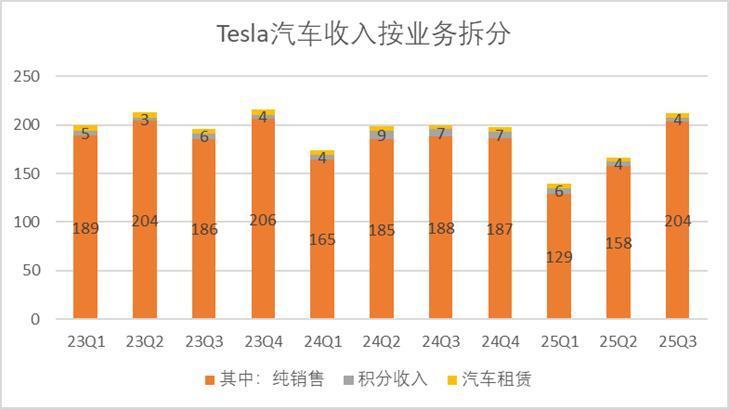
If we only look at the paper data of Tesla's vehicle manufacturing business in Q3, it was the best quarterly performance in nearly three years. The automotive business recorded total revenue of $21.205 billion, reversing the negative growth trend of the past three quarters.
At the same time, the budget version of Tesla was not yet launched in Q3. The revamped Tesla Juniper and the China-specific Tesla L are relatively high-margin products, and Tesla also increased the lease price of Model Y.
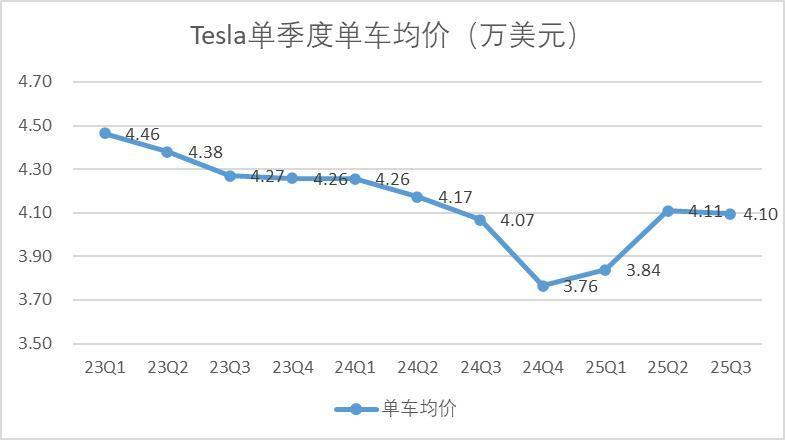
Therefore, although deliveries hit a record high in Q3, it was not achieved by lowering prices. The gross margin and average selling price per vehicle remained stable. Based on pure sales calculations, Tesla's average selling price per vehicle remained at $41,000 in Q3.
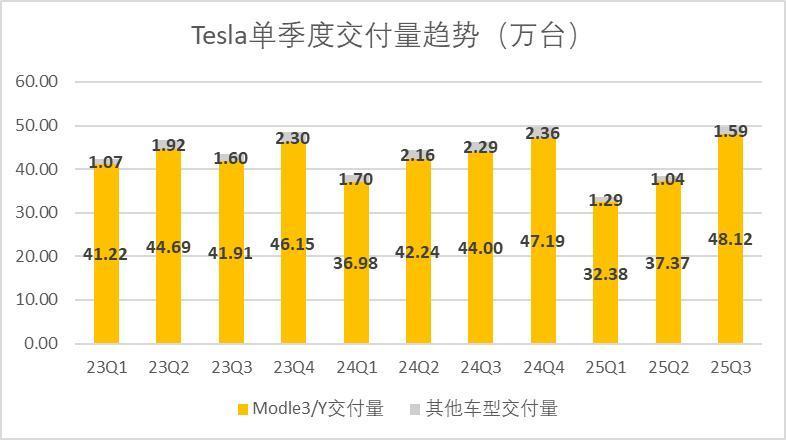
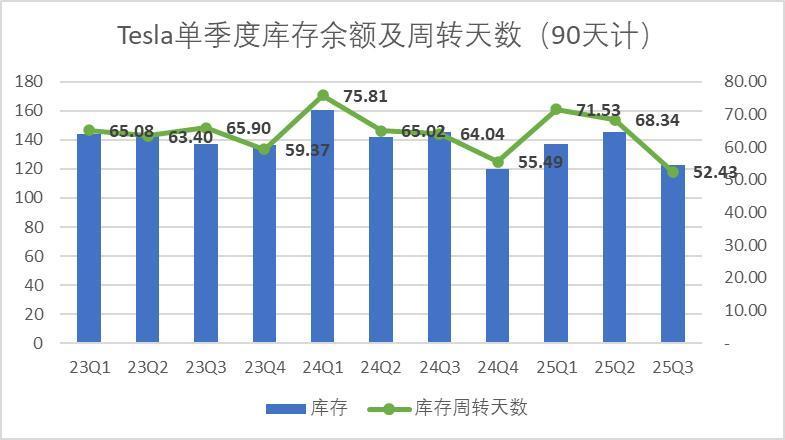
Concentrated deliveries also reduced some inventory. In Q3, Tesla's total deliveries exceeded production by about 45,000 units, significantly improving overall turnover.
As is well known, "9.30" was the deadline for the U.S. electric vehicle tax credit policy cancellation. Therefore, Tesla's supply and demand experienced a pulse-like surge at the end of Q3. The nearly 490,000 deliveries disclosed by Tesla in early October have already been digested by the market, and policy-driven concentrated deliveries are not sustainable.
Overall, Tesla's vehicle manufacturing business did not truly "exceed expectations."
02 Energy: Energy Storage Business Is the Brightest Spot, Deployment Hits New High
The energy storage business was one of the few unexpected highlights in Q3, with revenue reaching $3.415 billion, a new quarterly record, up 44% year-on-year.
Among the released products, both Megapack 3.0 and Powerwall performed well. Powerwall deployments set a record for the sixth consecutive quarter, and management revealed during the earnings call that Megapack 4.0 will be launched next year, which may further drive market demand.
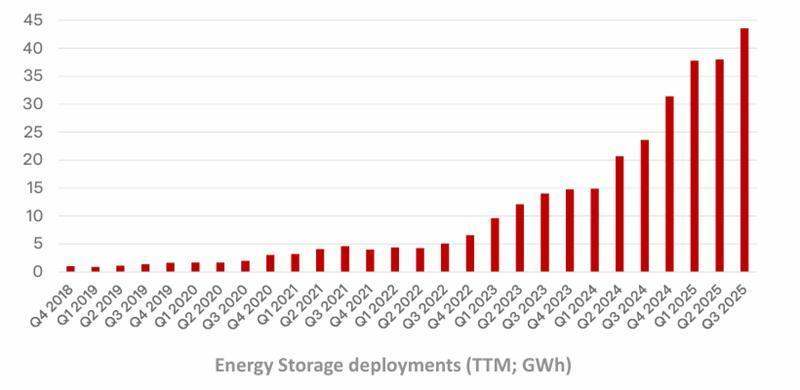
Figure: Tesla's energy storage deployment trends, Source: Tesla financial report
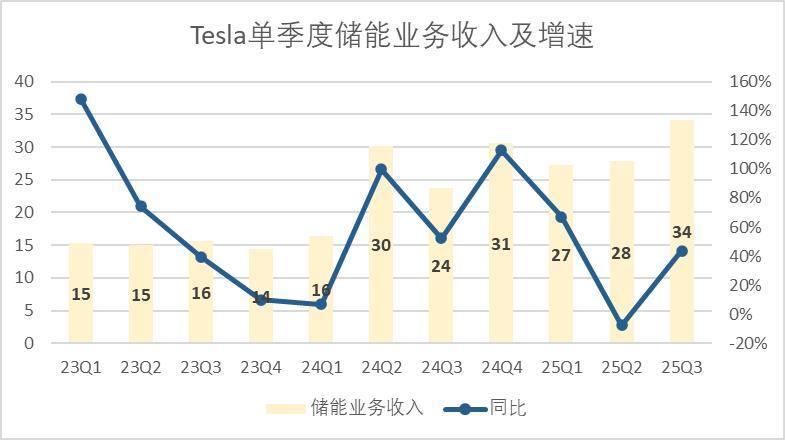
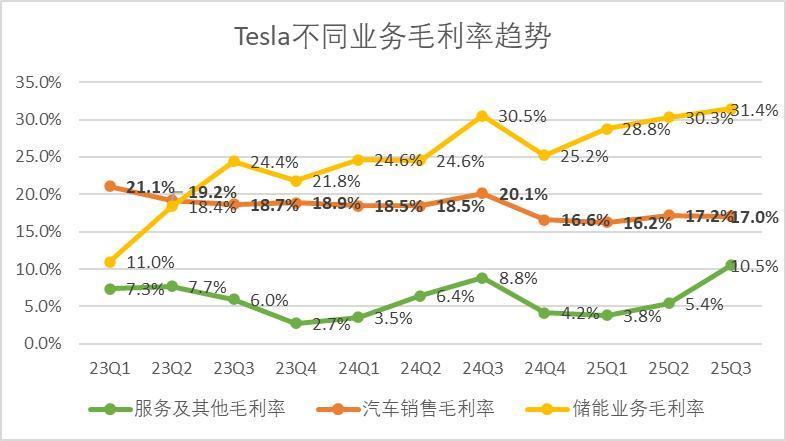
While expanding continuously, the energy storage business maintained high profitability in Q3, with a quarterly gross margin of 31.4%, up 110 basis points from Q2 and 90 basis points year-on-year.
Benefiting from the revenue growth in energy storage and vehicle manufacturing, the service business also achieved relatively high income and profit levels in Q3, with gross margins recovering.
In revenue breakdown, income from regulatory credits further declined. Q3 recorded $420 million, the lowest quarterly figure in two years, down 5% from Q2 and declining for five consecutive quarters.
03 Autonomous Driving: FSD Penetration Under Pressure, Robotaxi Slows Expansion
Excluding profitability factors, one reason for the after-hours drop may be the slower-than-expected progress in FSD adoption mentioned in the report.
Currently, paid FSD customers account for about 12% of Tesla's fleet, and regulatory issues in Europe and China remain unresolved, with no significant progress reported.
FSD is often seen as Tesla's core valuation differentiator from traditional automakers, but the current adoption rate is not ideal. Even excluding policy factors in China and Europe, North America now accounts for over 50% of vehicle sales, yet the 12% penetration rate still falls short of expectations.
Additionally, Robotaxi, Tesla's current core valuation driver, showed no new progress in Q3. The Bay Area and Austin remain the key testing regions, with management emphasizing cumulative mileage during the earnings call. Plans for expanding operational areas are still "in progress."
In existing regions, Austin's operational area expanded from 79 to 173 square miles, with the fleet expected to reach about 1,000 units by year-end. However, this scale is still insufficient to materially impact financials.
Tesla disclosed that by the end of 2025, it will remove safety drivers from Robotaxis in parts of Austin and expand the service to 8-10 cities. This is a clear downgrade from the earlier ambitious goal of covering 50% of the U.S. population.
04 Robotics: Optimus Expected in Q1 Next Year, Mass Production Pushed to Year-End
During the Q3 earnings call, Tesla again highlighted Optimus.
Robotics is now Musk's pet project. Besides boasting about Optimus' current performance and its dexterous hands, a clear production timeline was announced: the Optimus V3 mass-production prototype will be showcased in Q1 next year, with a 1 million-unit annualized production line to start by year-end.
Compared to Q2's guidance, Optimus has also seen lowered expectations. The V3 prototype launch was pushed from "within three months" (i.e., by end-2025) to early 2026. Mass production was delayed from early 2026 to end-2026.
Of course, delays are the norm for Optimus, and the market reaction has been muted so far.
05 Net Profit Decline Is Not the Core of Investor Disappointment
Beyond existing businesses, Tesla's current valuation and pricing primarily focus on potential new growth drivers like FSD adoption and future Robotaxi and Optimus robotics. Thus, we need to analyze the earnings call management commentary to assess the report's value.
Tesla shares fell 4% after-hours post-earnings. Some investors attributed this to the 40% operating profit decline, but that's not the case. Two key reasons:
First, vehicle costs (especially batteries) dropped significantly in Q3 last year, causing gross margins to surge from a high base. Second, Tesla has significantly increased operating expenses this year, with operating margins already declining sharply in Q1-Q2.
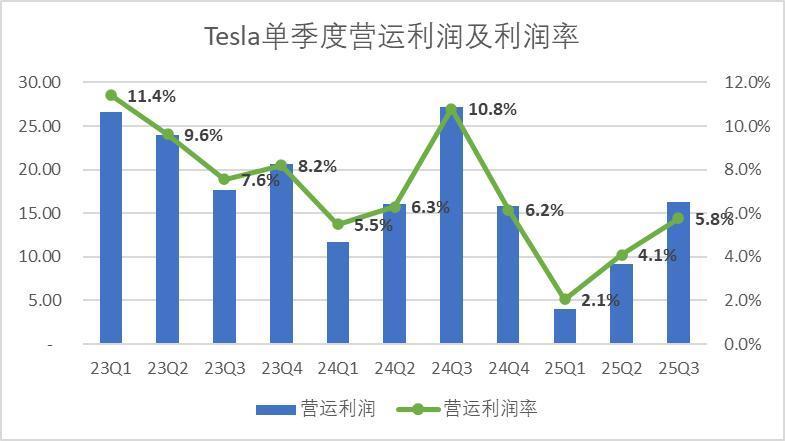
The market had largely priced in profit expectations. Analysts' Q3 operating profit forecast of $1.58 billion assumed $26.6 billion revenue, implying a 5.9% operating margin. The actual 5.8% was close.
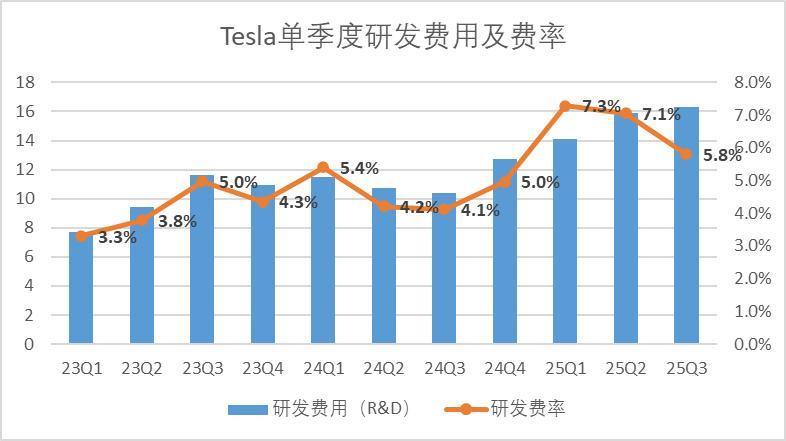
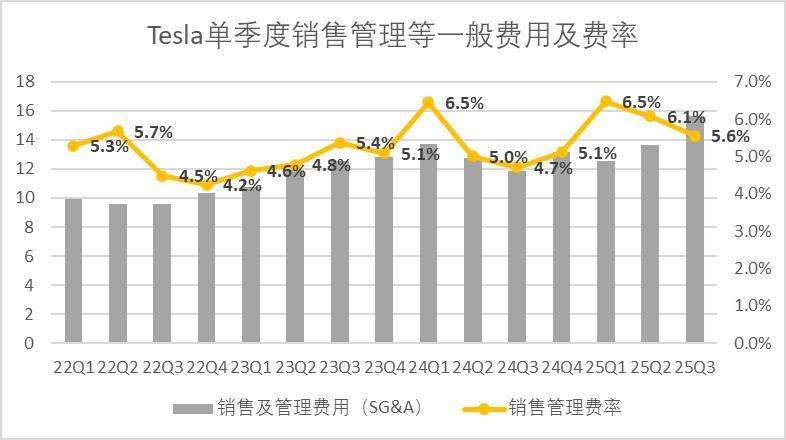
Expense ratios show R&D and SG&A hit record highs of $1.63 billion and $1.56 billion respectively in Q3. But relative to revenue, ratios were just 5.8% and 5.6%—not high—with SG&A including a one-time $240 million restructuring charge.
Capital expenditures showed signs of slowing.
Q3 capex was $2.248 billion, down ~6% QoQ and ~36% YoY, indicating a broader capex slowdown.
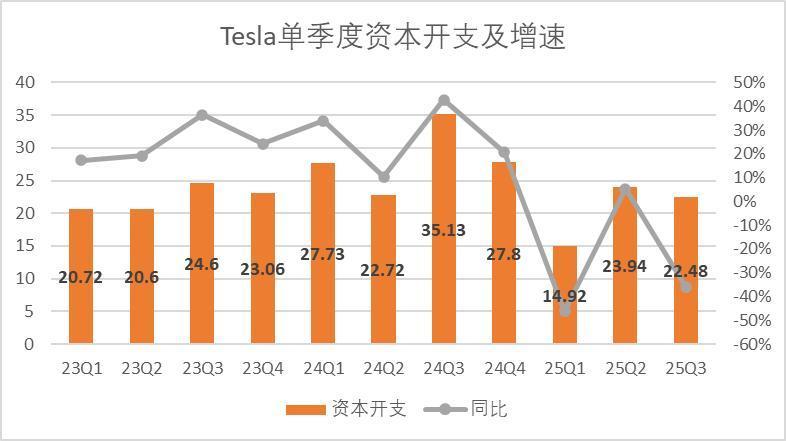
With full-year guidance at $9 billion, Q4 capex should be ~$2.9 billion, potentially showing positive growth.
However, compared to AI peers, Tesla's capex remains conservative—$11.3 billion last year versus $9 billion this year.
06 Q4 Doomed by Internal and External Pressures—Tesla Faces a "Long Winter"
Finally, Tesla's Q4 outlook: several overhangs will resolve, mainly:
● Post-pulse growth, vehicle demand is uncertain and may drop rapidly. Tesla launched a budget Model series, but weak initial reception could combine with subsidy phase-outs to doubly pressure revenue.
● Tariff pressures are mounting. Per earlier calls, tariffs impact ~5-6% of auto profit ($300 million total, 2/3 from autos). The call reiterated worsening tariff effects. Current expectations suggest no quick fix, likely further pressuring auto profits and creating dual revenue/profit pressure in Q4.
● Most critically, Musk's compensation plan vote in early November is a Damocles' sword. In a worst-case scenario where Musk moves AI initiatives outside Tesla as hinted on social media, the impact would be severe. Compromise is likely, given Musk's substantial stake.
Overall, Q4 will be a long winter for Tesla. Optimus and Robotaxi—key valuation supports—won't see progress until spring at the earliest based on current management commentary.
The copyright of this article belongs to the original author/organization.
The views expressed herein are solely those of the author and do not reflect the stance of the platform. The content is intended for investment reference purposes only and shall not be considered as investment advice. Please contact us if you have any questions or suggestions regarding the content services provided by the platform.
