


Luckin, Mixue, and Starbucks: A New Battle in the Billion-Dollar Market of Tea-Coffee Fusion

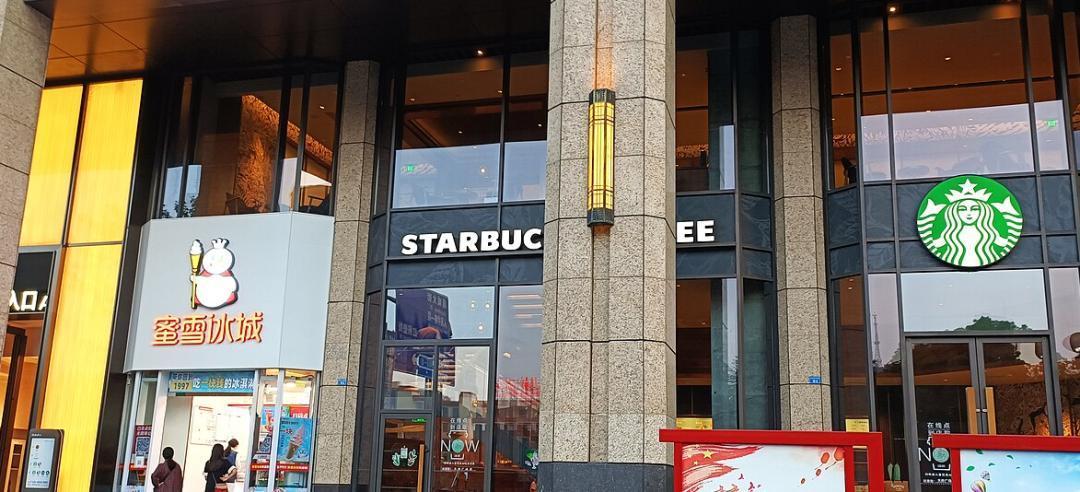
In the chain business models of 2025, the hottest sectors remain milk tea and coffee, ignited by the "food delivery wars." Both markets exceed 100 billion yuan in scale and maintain a rare double-digit growth rate, earning them the highest tier in the "new consumption" pantheon.
In reality, neither milk tea nor coffee is remotely new. Their so-called "newness" lies in their models and efficiency—while not inventing the products, Chinese companies have iterated more efficient "me better" business models: extreme cost-performance, digital operations, franchise expansion, and deep supply chain integration.
Within this sector, the latest trend is the convergence of two major models of efficiency.
If the past decade saw domestic companies in the coffee and tea sectors growing independently, with some becoming giants, the current core trend is a "merger" of competition, where coffee and tea are becoming "similar" products.
Just as Buddhism was localized and merged with Confucianism and Taoism, a revolution 颠覆 ing traditional beverage categories is underway in China: the two trillion-yuan sectors of coffee and tea are moving from parallel universes to deep integration, driven by Chinese companies' business model innovations.
Whether acknowledged or not, coffee brands making tea and tea brands making coffee have become industry norms. This article will delve into the evolution, essence, and hidden challenges of this wave.
01 "Milk Coffee" Devours Starbucks
Freshly made tea drinks originated in Taiwan in the 1980s but were popularized and diversified on the mainland.
It can even be confidently said that China's tea and coffee companies now rank among the world's most efficient chain businesses.
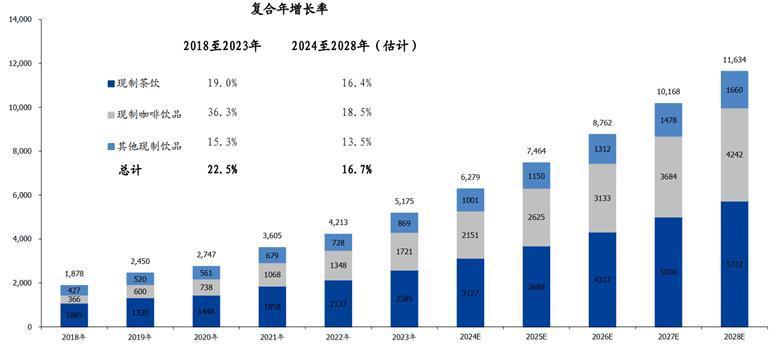
Figure: China's freshly made beverage market GMV by major segments. Source: CIC, Guosheng Securities
By July 2025, China's new-style tea shops numbered nearly 400,000, with a market size exceeding 350 billion yuan, making it the world's largest single market. Chinese new-style chain tea companies have also reshaped the industry's business model—"franchise expansion + supply chain 深耕"—extending their reach even to tea plantations and orchards, balancing efficiency and quality while replicating the Mixue model in Southeast Asia.
Coffee, one of the oldest beverages, has quietly surpassed 200 billion yuan in China's freshly ground market. The past decade has seen local brands overtake foreign ones: as an imported product, coffee's development in China is the story of local companies gradually breaking foreign brands'垄断 through business model innovation.
Chinese companies have 重构 the consumption mindset, user scenarios, pricing logic, and operational models of 220,000 freshly ground coffee shops, leaving Starbucks' business model 摇摇欲坠:
●Luckin Coffee, founded in 2017,颠覆 ed the industry with "digital operations + high cost-performance": online 预订, offline pickup improved efficiency, and 9.9-yuan pricing shattered Starbucks' price system. In 2023, Luckin's sales surpassed Starbucks to become the market leader. By end-2024, Luckin had 22,300 stores, far exceeding Starbucks China's 8,000.
●Meanwhile, Mixue Bingcheng's Lucky Cup 切入 the 下沉 market with 5-10 yuan pricing, with 75% of stores in 三四五-tier cities. By September 2025, it had 8,800 stores,跻身 the top five in the freshly ground coffee market.
●Manner and others combined coffee with mass consumption demand,推出 "affordable premium coffee," controlling prices under 20 yuan with a "small store, high 坪效" model, surpassing 2,000 stores.
Against this backdrop, it's no surprise that rumors of Starbucks China seeking a sale have repeatedly surfaced this year.
02 The Underlying Drivers of "Convergence"
For a long time, coffee and milk tea were seen as distinct sectors. But when Luckin's light milk tea sales 突破 40 million cups monthly, when Guming's coffee products reached 15% 杯占比 in 乡镇 markets, and when Starbucks China's non-coffee drinks climbed to 30%, this assumption is being 颠覆。
The underlying logic of this convergence has at least four layers:
1. Not Parallel Universes: High Consistency in Product Fundamentals
Changing consumer demand is the root driver. Modern consumers' beverage needs have evolved from 单纯解渴 to "diversification, addictiveness, and 社交化."
Both coffee and tea meet these demands, turning two high-growth products into competitors—vying for 年轻人's 休闲饮品杯数, much like 互联网争夺 user time.
Both follow an addictive formula: "sugar (dopamine) + caffeine/tea polyphenols (endorphins),"满足愉悦感和功能性双重需求. Despite 形态差异, their 成分表功能高度重叠。
Addictiveness is the physiological basis for convergence. Coffee has caffeine; milk tea has caffeine and 茶多酚, both highly addictive, fostering stable 消费习惯。
Chinese innovations (tea-coffee hybrids) further increase 消费频次. As consumers have 生理阈值 for 单一产品, brands must constantly launch new items. Coffee-tea 跨界 offers endless innovation possibilities.
More importantly, Chinese companies 主导 "coffee 饮料化" and "tea 咖啡化," narrowing taste differences.
Luckin's fruit coffee series and Guming's coffee milk tea 弱化 coffee's bitterness and tea's astringency, adding fruit,奶盖, etc., creating a 统一风格 of "balanced sweetness and 丰富口感," further blurring category boundaries.
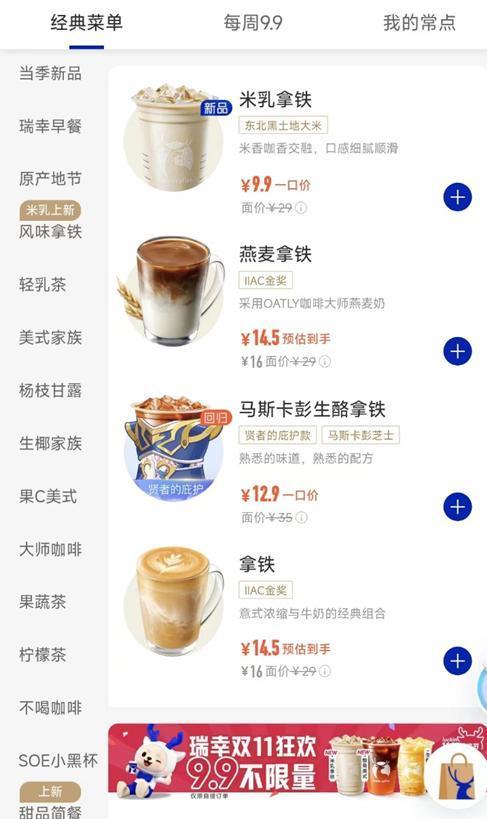
Figure: Increasing crossovers by freshly made beverage leaders
Social 需求 drives 场景融合. New-style tea and coffee have strong 轻社交属性, fitting 年轻人's 拍照打卡,分享生活心理. Brands create "coffee + tea"复合场景, making stores more inclusive 社交空间。
2. Overlapping Price Ranges: Becoming Substitutes
Chinese companies 卷极致内卷. Luckin's 30% 毛利率 is half Starbucks', slashing freshly ground coffee prices from 25+ yuan to 10 yuan, turning coffee from a premium to 平价饮品. Mixue's Lucky Cup even hits 5-10 yuan, covering lower-tier markets.
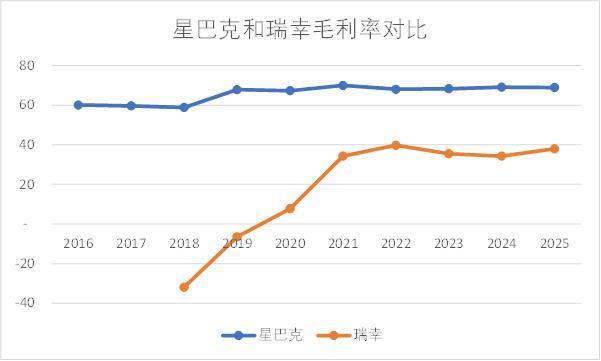
Source: Company filings
Coffee has fallen from its 高贵神坛, even becoming milk tea's "平替." Price overlap means consumers no longer choose based on "coffee or tea" but on price, taste, and 场景。
●Mixue dominates the <10 yuan market, competing with Guming, Lucky Cup, and KFC Coffee.
●Guming, ChaBaiDao, Hushang Auntie, and 霸王茶姬 focus on 10-20 yuan, competing with Luckin and Cotti.
●HeyTea and Naixue's Tea occupy the >20 yuan premium market, competing with Luckin, Starbucks, Manner, and Tim Hortons.
Gen Z's 崛起 accelerates "boundless beverages"心智。他们对品类忠诚度低, prioritizing taste,颜值,社交属性, enabling low-cost switching.
This forces brands to think beyond categories, designing products as "beverage solutions," further driving convergence.
3. Overlapping Anxiety for Second Growth Curves: Full-Day Consumption
The top 3 茶饮 brands (CR3) exceed 40%; coffee's CR3 exceeds 50%. Beyond the leaders, same-store growth has slowed—the land grab is over.
Well-funded post-IPO leaders target each other's core markets: Luckin 重启加盟 and expands tea; Mixue invests in Lucky Cup 下沉; Guming plans 2,500 new coffee stores in 2025.
Making untried drinks is a "shortcut" for same-store growth. Or, turning coffee and tea from "time-bound choices" to "all-day 陪伴," boosting 粘性和坪效。
Tea brands use coffee to 补齐早餐场景: Guming (10,000+ coffee-ready stores) and Hushang Auntie push coffee + 烘焙 in mornings; Mixue's Lucky Cup (30,000-store goal) offers "coffee + ice cream" near schools.
Luckin serves coffee + sandwiches for breakfast, light milk tea + snacks for 下午茶, and low-caffeine tea post-dinner, covering 全天需求。
Starbucks China follows suit, aiming for "coffee mornings, non-coffee afternoons," with non-coffee drinks rising from 5% to 25-30%, targeting 35%.
4. Supply Chain Synergies: Irresistible Expansion
Supply chain 协同 is key to convergence. Chinese companies integrate resources for 原料, cost 优化。
Core 原料高度重合: milk, sugar, fruit, toppings. Mixue's five factories supply 糖浆,奶基底 for tea and coffee, achieving 规模效应. Guming's 冷链 ensures fresh fruit for tea and beans for coffee,复用率提升 30%.
Production processes are similar: tea's "brew + toppings + mix" mirrors coffee's "extract + add + blend." Staff can make both with minimal training. Mixue employees make drinks in 30 seconds, enabling 高周转。
Synergies lower 品类延伸's 边际成本. Brands extend existing supply chains, ensuring quality and controlling costs. This "diversion" is 同心多元扩张。
03 Three Hidden Risks
Convergence is unstoppable, but competition is unprecedented. Homogenization, price wars, supply chain 压力, weak brand barriers, and 下沉 market challenges are 暗礁 for all.
1. Homogenization: Innovation Fatigue
Chinese 茶咖 excel in efficiency but over-focus on models, leading to fierce homogenization. R&D spending is <1%. Coffee brands' tea and tea brands' coffee taste alike, with similar packaging and 营销. Everyone has coconut lattes.
After Luckin launched light milk tea, Cotti and Lucky Cup followed; Guming cut coffee prices, prompting Hushang Auntie and ChaBaiDao to match. Homogenization erodes brand loyalty, forcing price wars.
Worse, homogenization wastes resources. Brands 模仿竞品而非底层创新, hurting industry-wide innovation. Most coffee products are milk/ fruit-based, lacking bean origin/roasting R&D; tea focuses on fruit/milk, neglecting tea leaves.
2. Low-Price Mindset: Brand Erosion
Price overlaps trigger wars,压缩利润空间. In 2024, Cotti launched 8.8-yuan promotions, Luckin followed with 9.9, Lucky Cup with 6.6 (some at 4).
Price wars boost short-term sales but erode long-term brand value.
Luckin's 2024 net profit grew 2.9% (vs. 38.4% revenue), hurt by 毛利率 drops. Cotti 加盟商 face losses post-subsidies, with complaints rising.
Tea brands also suffer:霸王茶姬, avoiding 外卖 price wars, saw June 2025 revenue fall 40%, with orders shifting to Guming and Luckin.
Price wars stem from model homogenization. Without differentiation, brands rely on price, leading to a "low price - low quality - low profit"恶性循环。
Prolonged 外卖补贴战 deepens "price over brand"心智, harming long-term growth, especially as 茶咖 convergence 淡化 brand 调性。
3. Quality Control Challenges
Rising 原料 costs: 2024 coffee beans +29.6%; fruit/milk 波动 add 茶饮压力。品类延伸 increases supply chain complexity, requiring fresh, stable 原料 for both.
Some brands cut costs at 品质's expense. Guming's beans are "too bitter/over-roasted" due to cheap beans; some tea brands' coffee uses instant powder, not fresh grounds, hurting 体验。
配送 efficiency is another 压力. Coffee beans need 避光/防潮; fruit needs 冷链, demanding more from 配送。下沉 market stores face freshness issues due to long 配送半径。
As high-growth consumer 培育 ends, addictives 饮料 buyers will shift from price to value sensitivity, demanding 多样化升级. Supply chains aren't ready.
04 Conclusion: Retracing Starbucks' Path
Convergence is either China's 饮品内卷 outcome or a global business model 创新重构。
Historically,外资 brands set rules: coffee=premium, tea=mass, with clear boundaries. Chinese companies 颠覆 ed this, making coffee and tea boundless mass beverages via "cost-performance + 全场景 + digital"新范式。
Though early-stage and 困难, this model has global potential: Mixue has 4,900 东南亚 stores; Lucky Cup tests Malaysia/Thailand; Guming and Hushang Auntie plan 东南亚; Luckin's U.S. store opens smoothly.
Those better at 整合供应链, optimizing 体验, and building brand 壁垒 will lead convergence—even for imports like coffee (Starbucks surpassed 欧洲 via model efficiency).
Efficiency leaders have emerged in 咖啡 and 茶饮. The "tea-coffee" boundless revolution's 长征 to global 典范 and brand value has just begun.
This article is based on public information for 交流 only, not investment advice.
$Luckin Coffee(LKNCY.US) $MIXUE GROUP(02097.HK) $Starbucks(SBUX.US)
The copyright of this article belongs to the original author/organization.
The views expressed herein are solely those of the author and do not reflect the stance of the platform. The content is intended for investment reference purposes only and shall not be considered as investment advice. Please contact us if you have any questions or suggestions regarding the content services provided by the platform.
