


Microsoft (Minutes): Data centers to double within 2 years, not serving as 'single large customer' steward
The following are the$Microsoft(MSFT.US) FY26Q1 Earnings Call Minutes, for earnings interpretation please refer to "After the "superficial harmony" with OpenAI, is Microsoft still the best choice?"
I. Review of Core Financial Information
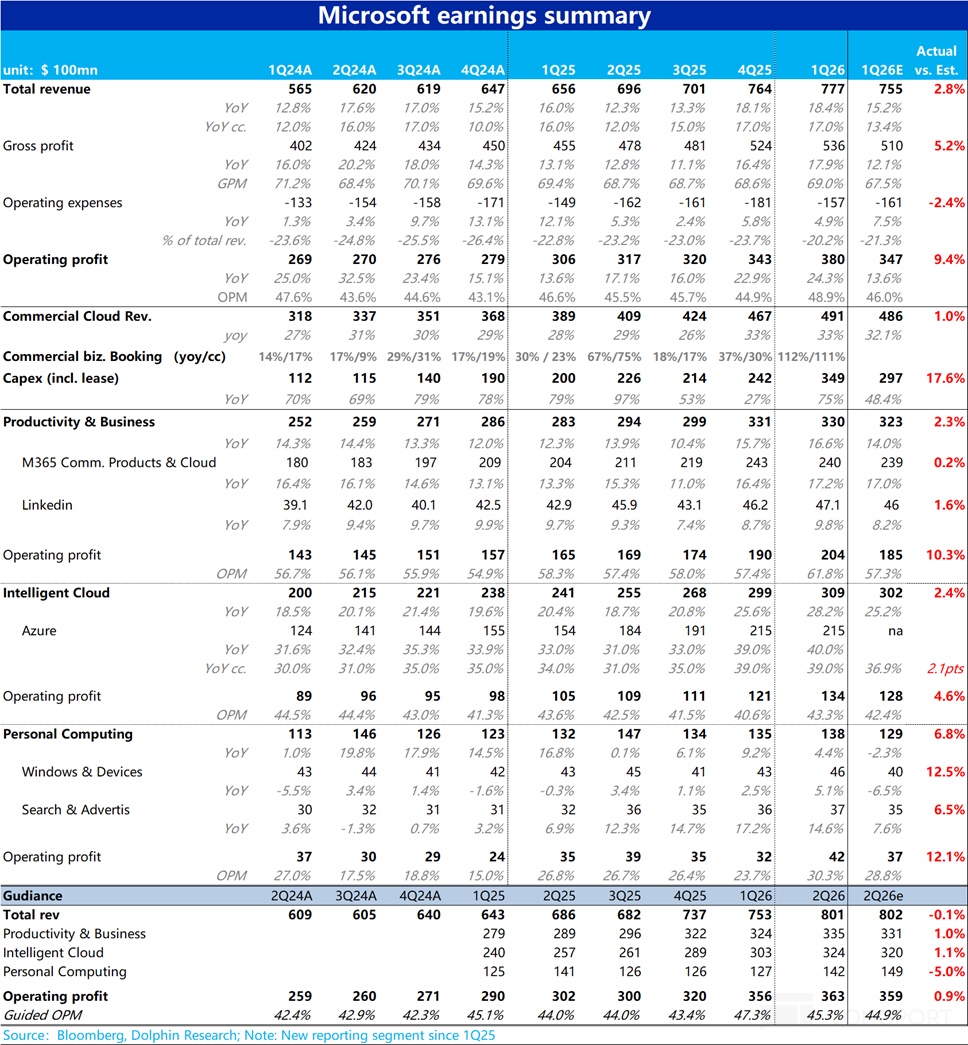
1. Key Business Metrics
a. Bookings: Increased by 112% year-over-year, far exceeding expectations, mainly driven by OpenAI's large Azure commitment contracts, and the continued growth in the number of contracts over $100 million for Azure Cloud and Microsoft 365. Note: This data does not include the newly announced $250 billion commitment from OpenAI.
b. Remaining Performance Obligations (RPO): Increased to $392 billion, up 51% year-over-year, indicating strong visibility of future revenue.
c. Microsoft Cloud: Revenue of $49.1 billion, up 26% year-over-year (25% at constant currency). Gross margin of 68%, slightly better than expected, but down year-over-year due to AI investments.
2. Capital Expenditure: As high as $34.9 billion, mainly to meet the growing demand for cloud and AI. About half is for short-term assets (GPU, CPU). The other half is for long-term assets (mainly large data centers). AI is the core reason for increased capital expenditure and pressure on gross margins, but also a key driver of revenue and order growth.
3. Q2 Performance Outlook:
a. Total revenue guidance of $79.5 billion - $80.6 billion (growth of 14%-16%), expected cost of sales of $26.35 billion to $26.55 billion, up 21% to 22% year-over-year; expected operating expenses of $17.3 billion to $17.4 billion, up 7% to 8% year-over-year.
b. Expected operating profit midpoint of $36.3 billion, implying an operating margin of 45.3%
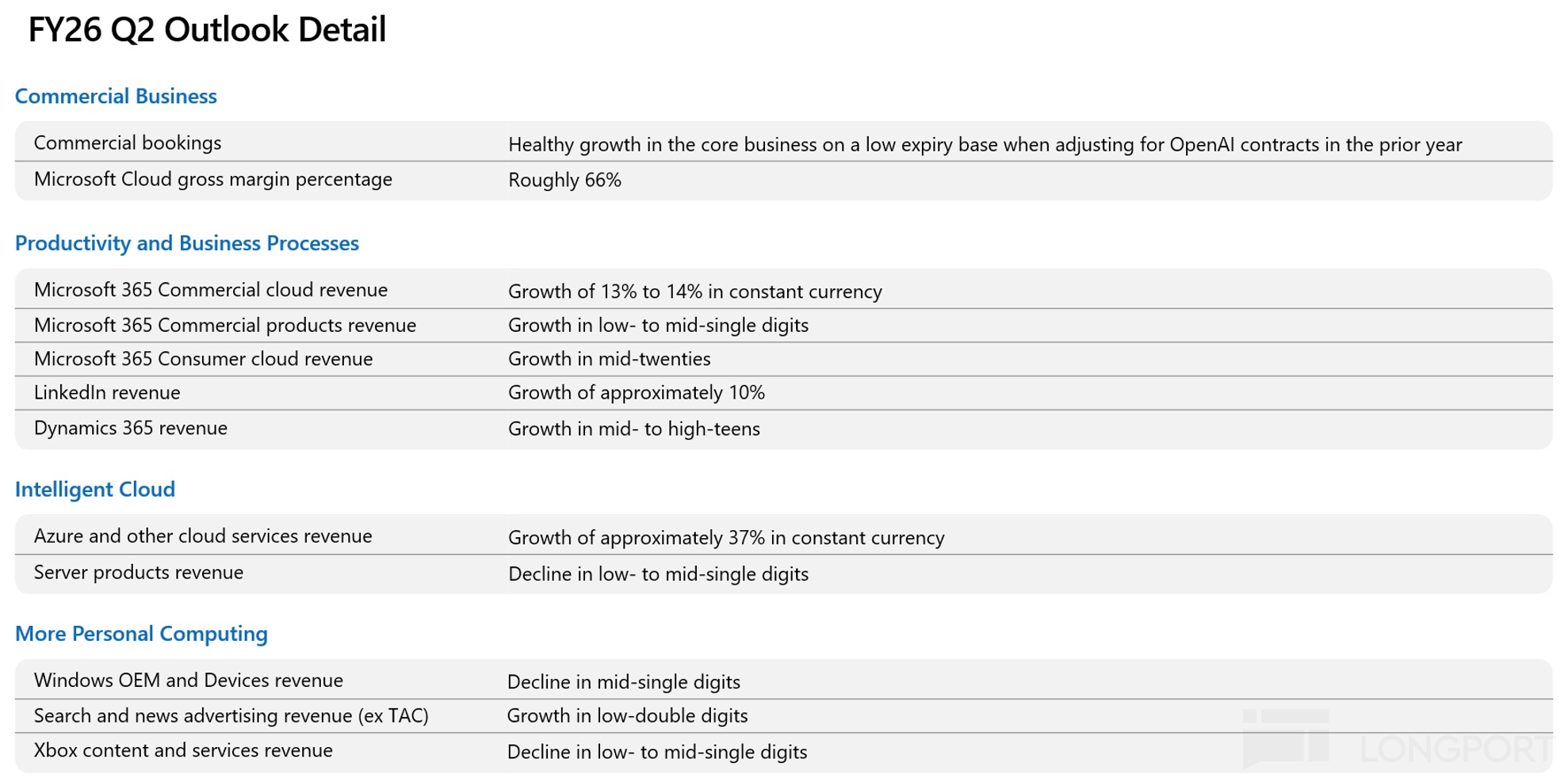
c. Productivity and Business Processes Segment: Expected revenue of $33.3 billion to $33.6 billion, up 13% to 14% year-over-year. Microsoft 365 commercial cloud revenue is expected to grow 13% to 14% at constant currency, with business trends remaining stable compared to the previous quarter. Average revenue per user growth will again be driven by the E5 package and Microsoft 365 Collaborator.
Microsoft 365 commercial product revenue is expected to grow in the low to mid-single digits. It should be noted that Microsoft 365 commercial products contain components affected by current revenue recognition dynamics, which may lead to volatility.
Microsoft 365 consumer cloud revenue is expected to grow in the mid-double digits, mainly driven by average revenue per user growth. LinkedIn revenue is expected to grow by about 10%. Dynamics 365 revenue is expected to grow in the mid to high single digits, with all workloads continuing to grow.
d. Intelligent Cloud Segment: Expected revenue of $32.25 billion to $32.55 billion, up 26% to 27% year-over-year.
Azure cloud revenue for the second quarter is expected to grow by about 37% at constant currency, with demand significantly exceeding existing capacity. Although we are accelerating capacity expansion, we will continue to balance Azure cloud revenue growth with the needs of self-developed applications and AI solutions, our own R&D work, and server upgrades.
We expect capacity to remain tight at least until the end of this fiscal year. It should be noted that due to differences in capacity delivery and commissioning times, as well as revenue recognition differences brought by contract portfolios, growth rates may fluctuate quarterly.
e. More Personal Computing Segment: Expected revenue of $13.95 billion to $14.45 billion.
Revenue from Windows device manufacturers and device business is expected to decline in the mid-single digits. The growth momentum brought by the end of support for Windows 10 is expected to continue, but due to high inventory levels at the end of the first quarter (we expect to digest some inventory this quarter), the growth rate will be affected, so Windows OEM revenue is expected to decline in the low to mid-single digits.
Search and news advertising revenue, excluding traffic acquisition costs, is expected to grow in the low double digits, with a sequential decline, mainly because the benefits brought by previous third-party cooperation have faded, and the growth rate has returned to normal levels. Growth will continue to be driven by traffic and revenue per search from Edge browser and Bing search.
Xbox content and services revenue is expected to decline in the low to mid-single digits, mainly because last year's strong performance of self-developed content drove growth, while this quarter's decline will be partially offset by subscription business growth; hardware business revenue is expected to decline year-over-year.
f. Capital Expenditure Outlook: Will continue to increase sequentially, and the capital expenditure growth rate for fiscal year 2026 is expected to be higher than fiscal year 2025 to meet accelerated demand.
g. Microsoft Cloud Gross Margin Guidance: Expected to decrease to about 66%, affected by AI investments and business mix shifting towards Azure.
Other key guidance can be seen in the figure below
II. Detailed Content of the Earnings Call
2.1 Core Information from Executive Statements
1. AI Infrastructure and Platform:
a. Infrastructure Expansion: Building "planet-scale cloud and AI factories" to support digital sovereignty needs in 33 countries. Plans to increase total AI capacity by 80% this year and double the total data center area within the next two years. Announced the world's most powerful AI data center, Fairwater, to be launched next year, with a scale of 2 gigawatts. Deployed the world's first NVIDIA GB300 large-scale cluster.
b. Technology and Efficiency Optimization: Optimized chips, systems, and software to increase token throughput of GPT-4o and GPT-5 by 30% on a single GPU.
c. Azure AI Foundry Platform: Has 80,000 customers, including 80% of Fortune 500 companies, offering over 11,000 models, including OpenAI's GPT-5 and xAI's Grok-4.
d. Agent Framework: Launched Microsoft Agent Framework to help enterprises build and manage multi-agent systems, used by customers like KPMG to improve audit processes, with Azure's market share continuing to grow this quarter.
2. Cooperation with OpenAI:
a. Signed a new final agreement, opening a new chapter of cooperation, with Microsoft's investment return reaching about 10 times, and OpenAI additionally signing $250 billion in Azure services.
b. Microsoft's revenue sharing, exclusive IP rights, and Azure API exclusivity will continue until AGI is achieved or 2030, with model and product IP rights extended to 2032.
3. Copilot Series:
a. User Scale: The total number of monthly active users of AI features in Microsoft products reached 900 million, with the total number of monthly active users of Copilot series products (covering work, programming, security, health, etc.) exceeding 150 million.
b. Microsoft 365 Copilot: Adoption speed surpasses any other new M365 suite, with a sequential growth of 50%. Over 90% of Fortune 500 companies are using it. Large purchases by Accenture, Lloyds Banking Group (saving 46 minutes per day for employees), PwC (globally deploying over 200,000 seats), etc. Top ISVs (such as Adobe, SAP, ServiceNow) and customers are building agents integrated into Copilot, with agent user numbers doubling sequentially. Launched Agent Mode (turning prompts into high-quality documents) and Teams Mode (multi-person collaboration).
c. GitHub Copilot: Became the most popular AI programming assistant, with over 26 million users. The total number of developers on the GitHub platform exceeded 180 million, with growth at a record high. Launched Agent HQ as a unified platform for managing and orchestrating programming agents from different providers (OpenAI, Google, Anthropic, etc.).
d. Other Copilot Applications:
- Security: Integrated over 36 agents, improving analyst efficiency in detecting phishing emails by 6.5 times.
- Health: Dragon Copilot helped record 17 million patient visits this quarter, growing nearly 5 times year-over-year.
- Consumer: All Windows 11 PCs become AI PCs, supporting voice wake-up and visual interaction. Edge browser market share has grown for 18 consecutive quarters. Bing search market share has grown again, with Copilot consumer app daily active users growing nearly 50% sequentially.
5. Other Business Highlights:
a. Data and Analytics: Fabric revenue grew 60%, with 28,000 paying customers.
b. Database: SQL DB hyperscale version revenue grew nearly 75%.
c. Business Applications: Dynamics 365 market share increased. LinkedIn membership reached 1.3 billion.
d. Security: Gained market share in all security categories served.
e. Gaming: Content and services revenue hit a quarterly high, with "Minecraft" monthly active users reaching 155 million, and the new console Xbox Ally receiving enthusiastic response.
2.2 Q&A Session
Q: Despite Microsoft's performance exceeding expectations for two consecutive quarters (especially the 111% growth in commercial orders), the stock price performance has lagged behind the market. The market seems to be concerned about potential disruptive changes in the future, particularly the "AGI" mentioned in the agreement. Do you think there are any potential disruptive factors in the evolution of AI models and computing architecture that could weaken Microsoft's current strong market position and possibly undermine the company's future advantages? Do you have any concerns about this evolution, especially the future development of generative AI models?
A: First, we are very satisfied with the new agreement with OpenAI, which brings more certainty to our cooperation (including the definition of AGI) and eliminates some market concerns. But more importantly, how we turn AI into real customer value. Even as AI model capabilities advance rapidly, its intelligence will remain "uneven" for a long time, performing well in some tasks and poorly in others.
Therefore, Microsoft's true moat is not the model itself, but building "systems" like M365 Copilot and GitHub Agent HQ. These systems act as an "organizational layer," coordinating multiple specialized agents to work together, "smoothing" the edges of AI, ensuring it is reliable, controllable, and not "off track" when executing complex tasks. For example, in Excel, one agent generates tables, while another agent can analyze and iterate them like a data analyst. We believe that the ability to build multi-agent systems is the key to turning AI progress into lasting customer value and the true source of our confidence. We believe AGI will not be achieved in the short term, but in this way, we can continue to expand our leading advantage.
Q: Regarding the astonishing order growth this quarter, the market is somewhat concerned that it may be overly reliant on a few large customers, i.e., there is a "customer concentration risk." Can you share some information to help us understand the signs of broad-based transactions behind the 51% RPO growth and over 110% order growth, apart from large contracts like OpenAI, to give us more confidence in the health and global distribution of this growth?
A: Regarding order growth, there is no need to worry about customer concentration risk. Our nearly $400 billion RPO balance covers a wide range of products and customers of various sizes, proving the broad-based nature of the growth. More importantly, the weighted average term of these contracts is only two years, meaning customers sign these agreements to quickly consume and use them in the short term, which precisely proves that our AI platform and systems are creating real business value. Although OpenAI is an important part of it, our cooperation with them has allowed us to build leading systems, and their experience and capabilities have benefited all other customers in turn. Therefore, the large RPO scale and short contract term together indicate that our growth is healthy and broad-based, reflecting excellent execution.
Q: What key metrics or factors do you monitor to ensure the company is not overbuilding infrastructure for current demand and to be confident that this strong demand is sustainable?
A: We have not over-invested in demand; on the contrary, our capacity continues to be in short supply. Our capital expenditure is based on existing business: we hold nearly $400 billion in contract balance (RPO), and today's investment is to fulfill these signed orders. From a financial perspective, the risk is controllable because the depreciation cycle of our short-term assets (such as GPUs) is highly matched with the contract term, and for long-term assets like data centers, we are extremely confident that future structural demand will be sufficient to fill them. The demand growth we see is not from a single area but is broad and real, and when customers see the real value of AI, they will commit to real usage. Therefore, our current investment is based on verified demand and extraordinary confidence, not chasing a bubble.
Q: How confident are you that software and consumer internet businesses can ultimately successfully monetize the massive AI investments currently being made globally?
Our investment confidence mainly comes from two levels: efficient infrastructure and high-value applications.
First, we are building an efficient, flexibly schedulable token factory globally. By continuously procuring the latest hardware and utilizing software optimization (such as improving model efficiency by 30%), we are constantly improving the efficiency and utilization of clusters, reducing unit computing power costs.
Second, we have the best agent systems in multiple high-value areas. AI is not a zero-sum game; it is creating a market far beyond previous expansion. Just as "cloud" is much larger than the "server" market, Copilot brings huge ARPU growth potential to businesses like M365 and programming tools. Our layout in multiple fields such as programming, security, health, and the new "advertising + subscription" model on the consumer side all demonstrate strong monetization capabilities.
It is this virtuous cycle of "efficient factories" and "high-value products" that gives us the confidence to invest huge capital and R&D talent to seize AI opportunities.
Q: Regarding the $4.1 billion (loss) related to OpenAI investment under "other income" in the financial report, this number is very large. Can you explain the specific composition of this expense? It far exceeds the amount in previous quarters and seems to be more than just Microsoft's share of OpenAI's operating losses. Does this imply some change in accounting standards or reporting methods? What should we expect for this item in the next few quarters?
A: This $4.1 billion loss is entirely our share of OpenAI's operating losses under the equity method, and does not include any other components. It should be clarified that this number has not been affected by our new agreement with OpenAI.
Q: We seem to have entered a new era where a few AI natives have made astonishing contract commitments, which are not only huge in absolute value but sometimes 20 times their current revenue scale. Conceptually, how do you assess these companies' ability to fulfill such large-scale contracts? How do you consider setting risk "guardrails" for a single customer to control the risk of excessive customer concentration?
A: First, we are building a highly substitutable general AI platform, not providing "hosting services" for a specific large customer. This means even if a large customer's demand changes, its computing power can be seamlessly transferred to our other third-party customers (such as enterprise customers) or Microsoft's own first-party applications, fundamentally reducing reliance on a single customer.
Second, we have a diversified customer and product portfolio as a balance. Although AI native companies are important early customers, the wave of enterprise customer adoption is just beginning, and the customer base will become more balanced. More importantly, our strong first-party applications (such as M365 Copilot, etc.) themselves can consume a large amount of computing power, ensuring high infrastructure utilization and bringing us huge scale leverage.
From another perspective, our infrastructure is a large and flexible cluster that can flexibly serve any demand from first-party, third-party, and commercial cloud. The key is that the actual input of hardware (CPU, GPU, etc.) is matched with the contract fulfillment time, not procured in advance. These large contracts are delivered in stages, giving us a long preparation time to dynamically assess customer performance. Therefore, when we announce financial data such as bookings and remaining performance obligations (RPO), we have fully and prudently considered and included these factors.
In summary, by thoughtfully building a general platform for a wide range of customers, we have effectively mitigated concentration risk.
Q: Can you quantify or roughly explain how much impact Azure's lack of computing power has on current revenue? Although computing power shortage is a challenge faced by the entire industry, is there a risk of customer workloads flowing elsewhere? How do you mitigate this risk?
A: Although it is difficult to quantify precisely, it can be said with certainty that Azure has indeed borne most of the revenue impact brought by the computing power shortage, and its revenue figures could have been higher. This is because when resources are limited, we have a clear priority order. We must first ensure that computing power is allocated to the fastest-growing strategic first-party applications, such as M365 Copilot and GitHub. Second, we prioritize ensuring the computing power needs of internal R&D teams and AI talent to accelerate product innovation. Therefore, Azure's external customer demand is met only after these higher priority internal needs are satisfied, which directly affects its revenue.
Q: What are the core decision criteria when deciding whether to undertake such large-scale AI contracts? Is it just about contract amount or terms, or is there a deeper strategic consideration? Is this related to Microsoft's positioning as a "platform company" rather than just a "cloud service provider"? You seem to have multiple monetization channels such as databases, Foundry model services, and can retain the long-term value of hardware assets after the contract ends. Is this the core perspective for evaluating such transactions? How do you respond to the saying "Microsoft allows competitors to appear out of thin air and take away this big cake"? Can you share your views?
A: For us, the decision always returns to a core principle: building a general platform that can flexibly serve third-party customers, first-party applications, and internal research. Therefore, when certain demands are too concentrated due to customers, geographical locations, or hardware types (SKU) and disrupt this balance, we will refuse. Specifically, if the demand is only for a single resource (e.g., only renting GPUs) and does not utilize our complete computing and storage services, it deviates from our healthy profit structure and long-term business model as a platform company. We must prioritize first-party businesses that bring higher profits and invest resources in our own R&D and model innovation, which is our long-term moat. Therefore, we selectively say "no" to those demands that, although can be met, do not align with our long-term interests. We are very satisfied with these decisions because they ensure the company's strategic direction.
<End here>
Risk Disclosure and Statement of this Article:Dolphin Research Disclaimer and General Disclosure
The copyright of this article belongs to the original author/organization.
The views expressed herein are solely those of the author and do not reflect the stance of the platform. The content is intended for investment reference purposes only and shall not be considered as investment advice. Please contact us if you have any questions or suggestions regarding the content services provided by the platform.
