


Mercado (Minutes): Not for Short-term Profit, but for Long-term Value
The following is a summary of the Mercado 2025 Q3 earnings call organized by Dolphin Research. For financial report analysis, please refer to "Meli: Profit Miss? It Might Just Be the 'Growing Pains' Before Victory"
I. Review of Core Financial Data
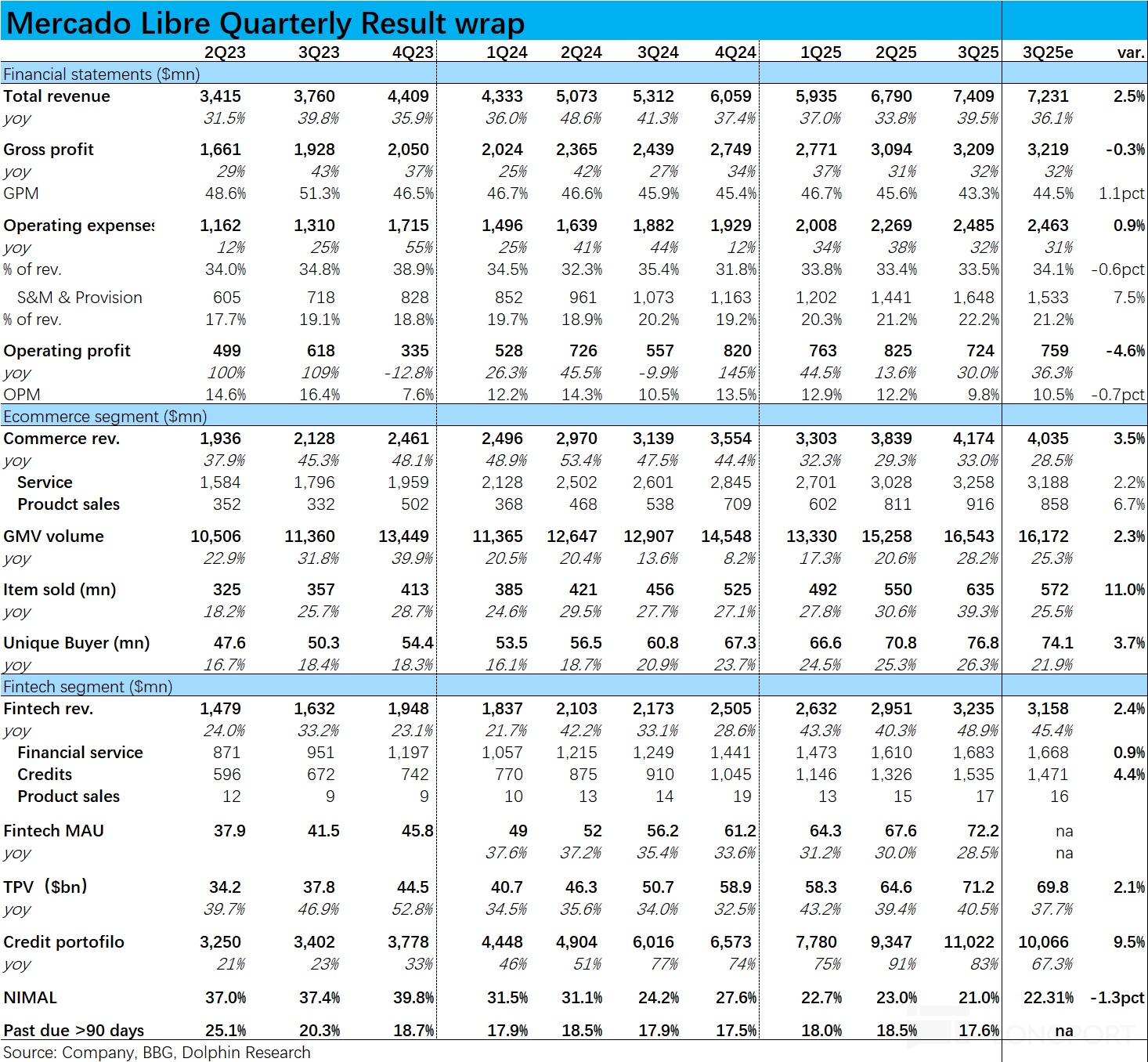
II. Detailed Information from the Earnings Call
Key Information from Management Statements
1. Market Opportunities and Company Positioning
The company will continue to invest resources to seize the upcoming significant growth opportunities in the e-commerce and fintech sectors. The company has unique advantages to drive financial inclusion in Latin America and the transition from offline to online retail.
2. E-commerce Business Performance
Brazil Market: The recent reduction in the free shipping threshold has shown initial success, with both GMV and product sales accelerating this quarter.
User Metrics: The number of buyers has increased significantly, with improvements in conversion rates, retention rates, and purchase frequency.
Seller Ecosystem: More sellers are joining the platform, with a surge in listings for products priced between 19 and 79 Brazilian Reais.
Logistics Efficiency: The increase in transaction volume has reduced the logistics cost per item in Brazil by 8%, and the delayed delivery strategy has effectively released idle capacity.
Brand Building: Thanks to marketing investments and pre-shipment policies, brand preference scores have reached new highs across the region.
Mexico Market: GMV growth has accelerated, and fulfillment unit transportation costs continue to decline.
3. Mercado Pago Fintech Business
User Growth: With Brazil's net promoter score reaching a record high, the growth rate of monthly active users has significantly increased.
Product Driven: Continues to create value for users through user experience optimization, credit card, and paid account products.
Scale Demonstration: The strong growth in asset management scale and credit portfolio highlights the immense potential of Mercado Pago.
Credit Card Business: Plays a key role in net promoter score and core business, rapidly expanding due to an enlarged user base and increased wallet share.
Risk Control Performance: Expanded the loan portfolio while maintaining credit quality, with the first repayment default rate hitting a record low, and more credit cards reaching maturity.
4. Argentina Market Situation
Business Resilience: GMV, buyer numbers, and TPV maintained resilient growth in the third quarter.
Macroeconomic Challenges: Growth slowed towards the end of the quarter due to macroeconomic challenges, impacting both growth and EBIT margin.
Long-term Prospects: Despite headwinds, Argentina remains a market with strong profitability and long-term growth potential.
5. Profitability and Investment Strategy
Profitability Proof: Revenue growth demonstrates the ability to balance growth investment with profitability and the powerful force of scale effects, which should continue to create favorable conditions for us.
Strategic Investment Direction: Strategic investments in free shipping, logistics, 1P, and credit card sectors continue to drive strong revenue growth but exert some pressure on margins.
Operating Expenses: This growth allows us to scale key operating expenses, such as product development and management and administrative expenses.
2.2 Q&A
Q: Regarding the macroeconomic challenges faced by the Argentine market, such as GMV, TPV, and financing costs, how have these factors evolved this quarter? And what is your view on Argentina's economic outlook following the recent elections, and how will this affect your growth investment plans in the country?
A: Argentina has always been a very important market for us. We continue to focus on enhancing the platform's value proposition, opening a second fulfillment center in Argentina this quarter and launching credit cards, remaining optimistic about the long-term business prospects. The first half of the year saw very strong growth in commerce and fintech, but growth slowed in the third quarter due to macroeconomic instability brought by the mid-term elections, with rising interest rates affecting consumption and increasing financing costs.
Nevertheless, we still achieved robust growth: dollar revenue increased by 39% year-on-year, and local currency revenue grew by 97%. The credit book achieved a 100% year-on-year growth under a prudent strategy, with a healthy asset portfolio and stable non-performing loan indicators. We are adept at managing volatility and expect some of the volatility to dissipate post-election. In the long term, Argentina remains a market with strong profitability and significant growth potential.
Q: Of the 6 to 7 million new quarterly active users added from the second to the third quarter, can you analyze the proportion of entirely new users versus those who were not active every quarter but increased their usage frequency this quarter? What are the demographic characteristics of these new users? Is there a potential risk of these new users being more promotion-sensitive and thus churning when coupon or marketing spending decreases?
In this context, could you discuss how to view the trend of marketing spending next year, and whether the current level of investment will be adjusted?
A: Our user base performed exceptionally well this quarter, with the total number of buyers on the platform growing rapidly, reaching nearly 77 million active buyers. About 4 million of these are new buyers to the platform, while the rest are buyers who have previously purchased on MercadoLibre.
We believe both the total number of buyers and the number of new users are very healthy, fully demonstrating our efforts to improve the value proposition, including lowering the free shipping threshold and rates in Brazil, while also performing well in Mexico, Chile, Colombia, and Argentina.
In terms of marketing spending, it accounted for about 11% of revenue this quarter, consistent with the second quarter. We have increased investment in user acquisition, particularly in performance marketing and affiliate channels, with the affiliate channel growing fourfold year-on-year, an effective way to attract new user groups, especially young people.
Looking ahead, we will continue to maintain a similar investment range. We have a mature user acquisition methodology to ensure that the users we bring in can genuinely contribute to profits and increase sales for the ecosystem, and we are confident that the current level of investment can support sustained growth.
Q: Regarding the recent merchant acceptance in Brazil, changes in search algorithms, and promotional support eligibility, what are your comments? In the context of intensified competition, how should we view the cost structure and auxiliary revenue streams?
A: This short-term price monitoring initiative has been tested for several months, with competitors testing similar initiatives simultaneously. We are always committed to providing the best value proposition for both buyers and sellers on the platform, including optimal speed, price, and payment methods, to promote purchasing behavior and thus create more demand for sellers.
We naturally display products that can provide the best experience for customers at the storefront, thereby increasing sales. Therefore, we introduced this system to ensure that buyers always see the most competitive products and the best experience items.
This initiative is advancing in sync with our record investment levels, including faster logistics, more free shipping, lower shipping costs, discounts, and a large number of promotions and coupons during Black Friday. We expect high merchant acceptance as this is an effective way to improve the value proposition for both buyers and sellers. The platform's display positions and investment capacity are inherently limited, so we want to ensure that limited resources are allocated to merchants and products that can provide the best experience for customers. It is too early to discuss the results, but we believe this system will create an ideal value proposition for both buyers and sellers.
Q: Regarding unit transportation costs, you mentioned an 8% sequential decline, which seems related to improved utilization, particularly with slow delivery measures. How much optimization space do you think remains in this area? Relatedly, how much have you invested in robotics and automation for medium- to long-term opportunities?
A: To clarify, we disclosed an 8% sequential decline in unit transportation costs in the Brazilian market. This is mainly due to significant business volume growth helping us dilute the fixed costs of logistics operations, while also allowing us to utilize idle capacity and improve operational efficiency. The cost reduction is primarily related to scale effects, and there is still some room for continuous optimization in slow delivery methods, but this will take more time. The decline in unit transportation costs is a good result, affecting not just slow delivery but the overall unit cost. We believe unit transportation costs should trend downward in the long term, although not necessarily linearly.
In the future, we will gain more benefits through productivity and process improvements, but this requires us to continuously iterate and adjust systems and implement technology. Regarding the second question, we are deploying robotics technology and various technologies in different warehouses and conducting tests and learning in different places. We are optimistic about the productivity improvements brought by these technologies, whether in shelving, picking, or packaging, and have seen significant effects with each deployment.
Q: Regarding the profitability of the credit card business, particularly the profitability status of last year's customer base. You previously mentioned they were close to breakeven; does this mean they will turn into profit contributors next year?
A: We have always stated that customer groups over two years old have achieved profitability, and this situation continues. Therefore, the profitability of the overall credit card portfolio in specific countries mainly depends on the composition structure of the customer groups we have. For the Brazilian customer group from 2023 and earlier, they have already achieved profitability.
Q: This quarter, Brazil's GMV accelerated significantly, but the contribution margin fell to the lowest level in recent years. Considering the current competitive landscape, how do you view the trade-off between growth and margins? Are existing marginal investments sufficient to achieve growth and market share goals? Are you willing to accept lower margins to accelerate market share acquisition?
A: When we discuss margins, it needs to be viewed in the context of growth. We see tremendous growth opportunities in commerce and fintech, and our primary task is to ensure we seize these opportunities and continue to invest as we have in the past.
Last year's investment in the credit card business did lead to margin contraction, but now the business is beginning to mature and improve. This quarter, we made significant investments in lowering the free shipping threshold, which has yielded strong results. Not only did GMV grow, but the growth rate of product sales in Brazil also accelerated from 26% last quarter to 42% this quarter, while user growth, engagement, conversion rates, and NPS all reached new highs.
We do not manage the business for short-term profits but for long-term value creation. As long as we can maintain the current level of growth, we are on the right track. Even if faced with short-term profit pressure, we will not hesitate to invest. In the long term, as the business scales and investments in credit cards, 1P, etc., gradually mature, we remain optimistic about the business's profit prospects.
Q: Will NIMAL (Net Interest Margin) exhibit the same seasonal dynamics in the coming quarters, i.e., rising sequentially in the fourth quarter and then declining again in the first quarter? As we enter next year, with the expansion of credit card issuance in Argentina and potentially sustained high funding costs, will NIMAL remain under pressure even as the profitability of old customer groups in other countries improves?
A: Recent changes in NIMAL are mainly due to changes in the business mix. The decline in NIMAL last quarter was primarily driven by Argentina, due to significantly rising funding costs in that market, while performance in other regions was similar to previous quarters.
In the credit card business, Brazil already has a sufficient number of old customer groups, with nearly 50% of card volume and TPV achieving profitability, and the overall credit card business in Brazil is expected to be profitable in the medium term. Mexico started later, and the issuance of new cards is still large relative to the stock scale, with old customer groups accounting for a small proportion of the total portfolio, not yet overall profitable. As the Brazilian business matures and Mexico develops subsequently, we will accelerate credit card issuance in Argentina and continue to invest in this market over the coming years.
Regarding seasonality, the fourth quarter is usually slightly better than the first quarter, but fluctuations in recent quarters are mainly related to the business mix rather than seasonal factors.
Q: Regarding the Argentine credit card business, can you provide early user engagement metrics for new card releases? How does its adoption curve compare to Brazil? Will the breakeven cycle in the Argentine market differ from the two years previously mentioned? What is the penetration target for the next 12-18 months?
A: We only launched credit cards in Argentina at the end of the quarter, so information is still insufficient. However, we are confident in the product's success because we have a large user base in Argentina, and users are very active in interacting with Mercado Pago. More importantly, the vast majority of credit cards in the Argentine market charge monthly fees, while our product does not. Combined with our ecosystem benefits and existing acquiring network, these factors make us encouraged and excited about the opportunity. But since the product has only been launched for a few weeks, it is too early to comment on the results, and we cannot provide specific guidance for the next 12-18 months, but we are very optimistic about the product.
Q: Regarding fulfillment centers, with a significant increase in shipment volume, is there a need to add fulfillment centers outside the original plan? Can you elaborate on further investment plans in Brazil for the next quarter?
The second question is about the credit business, the Mexican market is highly competitive, what early trends have you observed? Which products are performing well? How is the asset quality in the Mexican market?
A: Regarding fulfillment centers, we have indeed seen a 28% sequential increase in logistics volume in Brazil, which puts pressure on network capacity, but we are prepared to manage it. Some slow delivery orders help us manage traffic at various stages of the logistics chain. We have not opened any unplanned fulfillment centers, and such large warehouses cannot be built quickly in the short term. We are not adjusting short-term plans, and existing capacity is sufficient to handle current traffic. However, we will continue to assess medium- to long-term capacity needs and build necessary facilities accordingly. Logistics is a strategic core, and we will continue to invest to ensure service speed and reliability, enhancing customer retention and NPS.
Regarding the Mexican credit business, we are encouraged by the scale of market opportunities. We have ecosystem advantages, providing huge distribution channels and user insights, making the cost of acquiring cards and credit extremely low. We are already the second-largest financial institution by monthly active users, with the highest download volume. We perform strongly in both consumer credit and credit card fields. In the first half of this year, we temporarily paused new credit card issuance, but now we have accelerated again and achieved positive results. The MercadoLibre ecosystem provides a virtuous cycle support for our credit business in Mexico.
Q: Regarding dominance, the shareholder letter mentioned an 11 percentage point increase in Brazil and a 2 percentage point increase in Mexico. How do you define dominance? And, to further enhance dominance, is there a plan to launch financial services that are not currently offered, or are the existing services sufficient?
A: We are excited about the growth in dominance, especially in Brazil, with some improvement in Mexico as well. We measure dominance by whether a customer processes at least 50% of their income through Mercado Pago, mainly assessed through surveys and open banking data. We have already deployed the two most important services: interest-bearing accounts and robust transaction services. What we currently lack is the ability to receive wages through Mercado Pago accounts in Mexico, as we are not yet a bank, and we are obtaining a banking license, which is a necessary prerequisite. In Brazil, some users mainly receive wages through portability via Mercado Pago, but the scale is still small, and we believe there is a huge opportunity there.
Q: In the current investment cycle, are you satisfied with the existing level of investment? Are there areas that require additional resources? Should we expect certain operating expense lines to continue to generate operating leverage?
A: We are very satisfied with the investment results. This quarter, we saw the comprehensive effects of the investment: market transaction volume growth, rapid growth in the number of sellers and products in the 19-79 Reais price range, and the supply side also benefited. We reduced logistics costs and will continue to optimize the slow delivery network. We are also continuously investing in other areas of the ecosystem.
The 1P business grew rapidly this quarter and continued to improve profitability, while the old customer group in the credit card business has been profitable, but we are still investing in new markets such as Argentina.
Other smaller initiatives, such as new fulfillment centers (annual capacity increased by 41%), also require investment. On the other hand, we have achieved over 30% growth for 27 consecutive quarters, and this scale growth helps us dilute fixed costs.
This quarter, we achieved strong dilution effects in administrative management expenses and product development. We are optimistic about the company's long-term profit margin trajectory and will continue to focus on the growth of commerce and fintech, and invest disciplinedly as necessary to seize opportunities.
From the business performance perspective, we achieved an increase in buyer frequency, record conversion rates and retention rates, a new high in Brazil's NPS, and an increase in the number of listed products and sellers, making us more optimistic about becoming a driving force for the transition from offline to online retail. We will continue to reduce friction in online purchases, attract more users, and continuously improve efficiency to support this process.
Q: Firstly, regarding the recently announced B2B plan and cooperation with Casas Bahia, can you help us understand its potential impact and opportunities, and how it will drive future GMV growth?
Secondly, regarding the credit card business, the average loan size is growing, but you are known for your risk discipline, starting with small loans. While continuing to issue a large number of cards, have you relaxed credit limits from the start, or are you still maintaining the same underwriting standards and credit quality as before? I want to better understand the driving factors behind this dynamic.
A: Regarding the cooperation with Casas Bahia, this is an exciting opportunity for us. Our 1P business continues to perform excellently, but our strategy has always been to fill the gaps in third-party sellers' selection or price competitiveness. As a seller, Casas Bahia can bring more competitive selection and prices in a category where our market share is relatively low. Our penetration rate in the overall market for heavy and bulky items (especially white goods) is indeed lower than our average market share.
Additionally, Casas Bahia brings expertise in handling the logistics of these complex items. We are excited about this and see it as another opportunity to improve the bilateral effects of our network, complementing everything we do in 1P and 3P businesses. Regarding B2B, this is a super long-term opportunity worth billions of dollars. We are just taking the first steps, and it will take time; we need to learn and adjust, but we see it as another way to serve our customer and seller base.
Regarding credit cards, we certainly maintain the same underwriting discipline as before. When we see deterioration in non-performing loans, we become more cautious, as we did in Mexico at the end of last year and the beginning of this year. As we can improve models, continue to grow while controlling non-performing loans, and maintain the same repayment targets, we are more willing to issue more cards, and this has always been the case.
In this process, we not only create a new generation of credit models approximately every six months in each market but also improve the technology used, allowing us to upsell to customers more frequently. Therefore, when we start working with someone and they repay as planned, if we deem it appropriate, we can increase their credit limit monthly or every few months. So, we are satisfied with the current situation, and we can accelerate card issuance while maintaining the original underwriting discipline.
Q: Regarding the payment business, particularly the pace of acquiring TPV growth in Brazil. Industry growth is low, but your company shows a significant increase in market share, with a year-on-year growth of about 28% this quarter. What are the driving factors behind this? What is the future sustainability?
A: Our growth in Brazil is indeed accelerating and faster than the market level. This is mainly due to our complete change in market strategy for offline POS machines a few years ago: shifting from relying on third parties to building our own sales team and direct-to-consumer channels (through MercadoLibre and Mercado Pago apps).
This adjustment began to drive accelerated growth more than a year ago and continues to outperform the market. We also see acceleration in online payments, especially in the credit card acquiring field. At the beginning of this year, we were more selective about Pix acquiring because some customers had too low profit margins, so we focused on credit card acquiring and successfully expanded our share. It is worth noting that this positive trend is reflected in all other core markets (Mexico, Argentina, Chile), and we are confident in continuing to gain share in each market.
Q: Regarding the performance of other markets (excluding Brazil, Mexico, and Argentina), you have performed very strongly in all indicators (GMV, revenue, TPV, margins). Can you reveal some of the initiatives implemented in these markets? Is this led by Mercado Libre or market-driven? What are your expectations for the future?
A: We are extremely satisfied with the performance of other markets. In terms of commerce, Chile's GMV growth has accelerated for the third consecutive quarter, while Colombia's growth rate has increased by more than 10 percentage points sequentially, both trends driven by successful product sales. We have increased market share in both markets, especially in Chile, where market share growth is stronger.
There is no single secret behind this, but rather the result of efforts in fulfillment, logistics optimization, selection work, demand generation, and promotional activities. Chile's NPS also improved sequentially. We are building a very solid foundation to continue growing, bringing offline retail online, and consolidating our leadership position in each market.
In fintech, the new market we have focused on in recent years is Chile. We have indeed seen results: the monthly user base has grown by 75% year-on-year, interest-bearing accounts are also growing significantly, and we see an acceleration in the number of products used by customers. We are very excited about the results we see in Chile, although there are still products to be launched, we are very encouraged by the achievements so far.
Q: How do you view OpenAI's recent moves into the e-commerce field, such as launching its browser and partnering with companies like Shopify and Walmart? Do you see potential opportunities or threats here? Will similar situations arise in South America?
A: We are very excited about the potential of agent AI to enhance discovery, service, and productivity within the ecosystem. We have already taken some steps in this regard: we have just launched our own seller assistant, a conversational tool that provides sellers with personalized advice on how to manage platform activities;
In the fintech field, we have launched the first AI assistant that can help users complete transfers, query operations, and other tasks through a conversational platform. But this is just the first step of many for Mercado Pago and MercadoLibre in the future. Regarding the specific part of your question, the key information is that we need to continue to focus on building the best agent experience within our own platform, which will provide flexibility for our future actions.
It is too early to comment on OpenAI's cooperation with Etsy, Shopify, etc., and we need to understand its long-term development and the role of agent AI in consumer relationships before ultimately deciding whether different actions are needed. Our current priority is to deploy relevant technology in MercadoLibre and Mercado Pago to achieve the near-term agent experience.
Q: Can you talk about the competitive environment in Brazil? Do you think competitors' behavior is rational? Or have you seen any signs of irrational competition in the market?
A: Brazil has always been a highly competitive market because it is very attractive: it has a large population, is one of the world's top ten economies, and e-commerce penetration is still far below global standards or benchmarks like the UK, US, or China. Over the past 26 years, we have built a strong value proposition for buyers and sellers, which has placed us in a market leadership position.
Our e-commerce market share has doubled since 2014 and doubled again since the pandemic, but compared to Brazil's total retail sales, our sales are still very small. Our record NPS, preference, retention, and conversion rates prove the strength of everything we do. We are very confident in our ability to successfully compete with different players in Brazil, just as we have competed with many opponents over the past 26 years.
We do not consider anything we do to be irrational, such as lowering the free shipping threshold, which is a very rational move that significantly enhances our competitive position, increases user satisfaction, and promotes retention. As long as we maintain a user-centric strategy rather than focusing on competitors, we are confident in becoming the long-term preferred platform for buyers and sellers.
<End of Text>
Risk Disclosure and Statement of this Article:Dolphin Research Disclaimer and General Disclosure
