


Nio: Cost Reduction and Efficiency Improvement Are Effective, But Is It Really a 'Turnaround'?
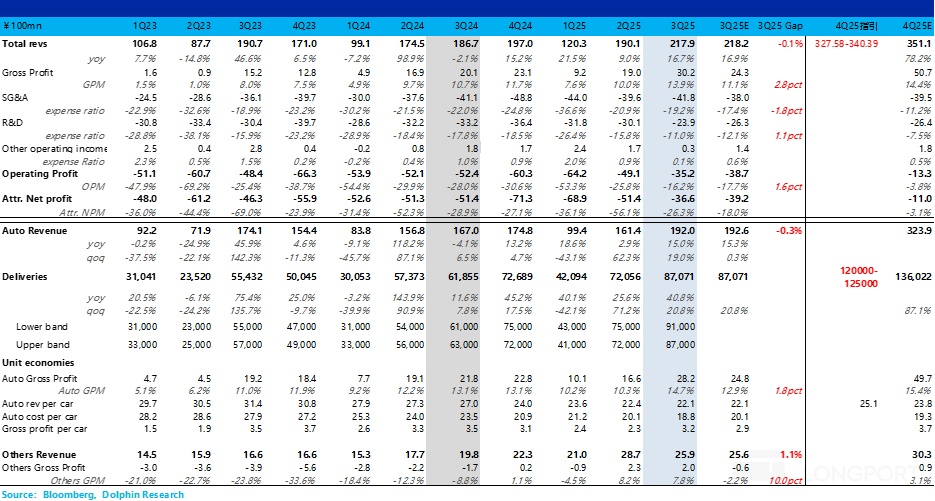
$NIO Inc(NIO.US) released its Q3 2025 financial report before the U.S. stock market opened and after the Hong Kong stock market closed on November 25, 2025, Beijing time. The third-quarter results clearly show that Nio's cost reduction and efficiency improvement strategy has achieved good results, but the guidance for the fourth quarter is below expectations. Specifically:
1. Cost reduction and efficiency improvement led to a significant quarter-on-quarter improvement in gross margin: Nio's gross margin in the third quarter was 13.9%, up nearly 4 percentage points quarter-on-quarter, mainly due to the increase in vehicle sales gross margin.
The vehicle sales gross margin in the third quarter was 14.7%, a significant increase of 4.4 percentage points quarter-on-quarter, and also higher than the market expectation of 12.9%. While the vehicle sales price is still declining, the improvement in vehicle sales gross margin is mainly due to a significant reduction in the cost per vehicle, which decreased by 13,000 yuan quarter-on-quarter to 188,000 yuan this quarter.
Dolphin Research believes that the quarter-on-quarter decline in the cost per vehicle is partly due to the scale effect brought by the quarter-on-quarter increase in sales (up 21 percentage points to 87,000 vehicles), and more importantly, Nio's series of cost reduction and efficiency improvement measures have made significant progress (Nio reduced costs by 10,000 yuan through self-developed NX9031 intelligent driving chips, increased platform integration, streamlined suppliers, and removed the blind material stacking of NT2.0 in NT3.0, etc.).
2. Overall revenue is basically in line with market expectations: The overall revenue in the third quarter was 21.8 billion yuan, basically in line with market expectations, while the core vehicle sales revenue was 19.2 billion yuan, up 19% quarter-on-quarter, mainly due to the explosive sales of Nio's L90 in the third quarter. However, the vehicle sales price slightly decreased by 3,000 yuan quarter-on-quarter to 221,000 yuan, mainly due to the "free battery upgrade" leading to a disguised price reduction, and the increase in the proportion of the relatively lower-priced Le Tao L90 in the model structure, resulting in a downward shift in the model structure.
3. Nio is still accelerating its loss reduction: In terms of net profit, Nio's net loss in this quarter decreased by 1.48 billion yuan quarter-on-quarter to -3.66 billion yuan, better than the market expectation of -3.9 billion yuan, partly due to the significant improvement in gross margin brought by cost reduction and efficiency improvement, and partly due to Nio's drastic cut in R&D expenses, which decreased by 600 million yuan quarter-on-quarter to 2.4 billion yuan, mainly due to layoffs in the R&D team and the completion of early-stage basic R&D work.
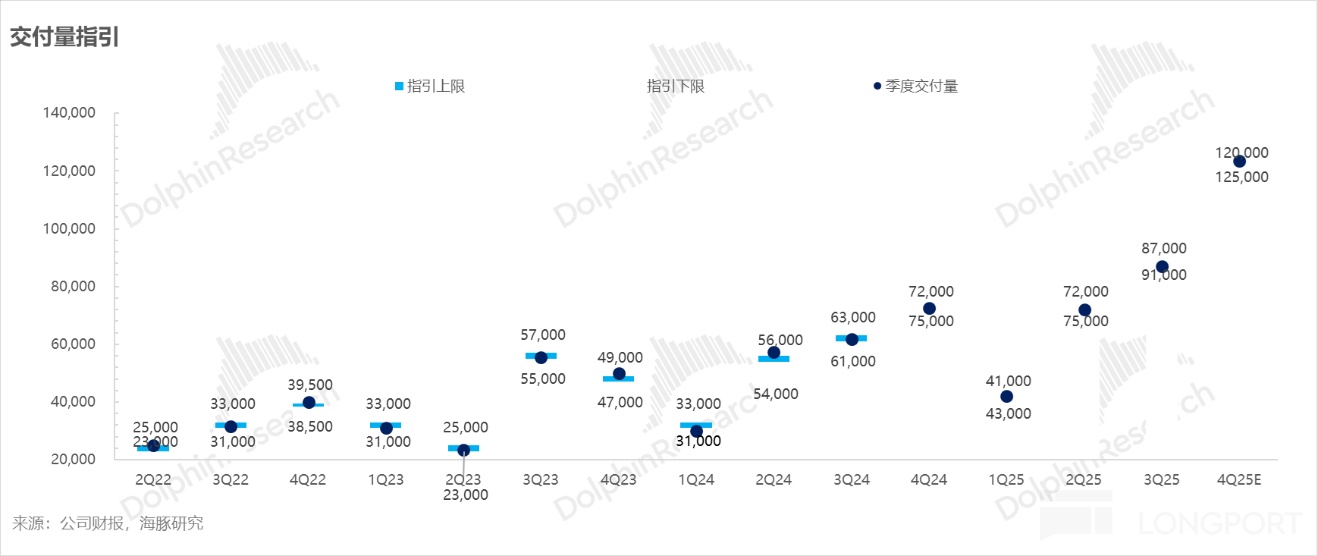
4. However, the fourth-quarter sales guidance is below expectations: Nio's fourth-quarter sales guidance is 120,000-125,000, below the market expectation of 136,000, and also below Nio's previous guidance of 150,000 for fourth-quarter deliveries.
This sales guidance implies an average monthly sales of 40,000-42,000 vehicles in November/December, with no incremental increase compared to October's 40,000 sales. On the one hand, it indicates that the release speed of ES8 production capacity is significantly below expectations (the waiting period for Nio's ES8 model has reached 22-23 weeks), and on the other hand, it is mainly due to the negative impact of the decline in replacement subsidies on Le Tao's sales, and the fourth-quarter L90 sales may not meet expectations.
5. Fourth-quarter revenue guidance is also dragged down by sales: The fourth-quarter revenue guidance is 32.7-34 billion yuan, also below the market expectation of 35.1 billion yuan. The revenue guidance is below expectations mainly due to being dragged down by sales that did not meet expectations.
In terms of vehicle sales price, with other revenue remaining flat quarter-on-quarter in the fourth quarter, the implied price expectation in the revenue guidance is up quarter-on-quarter to 251,000 yuan, mainly due to the increase in the proportion of the high-priced ES8 in the fourth quarter.
Dolphin Research's View:
Overall, Nio's third-quarter report performed well, with the operational aspect continuing to improve, and Nio's series of cost reduction and efficiency improvement reforms have made good progress:
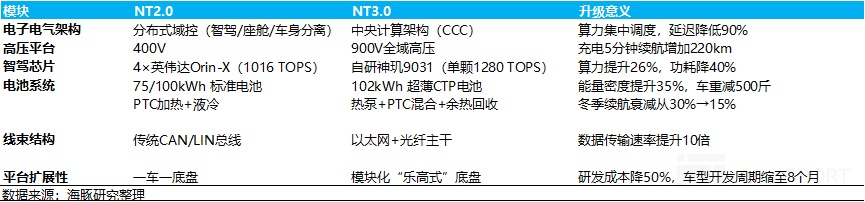
① In terms of BOM cost: Nio replaced four NVIDIA Orin-X chips with its self-developed NX9031 intelligent driving chip, and in the design of NT3.0 platform models, Nio focused on areas with the strongest user perception (large size + improved comfort configuration) at a lower cost, removed the blind material stacking of NT2.0, and reduced redundant designs (such as reducing aluminum content, lightweighting, etc.).
Nio has also made efforts in the supply chain and product iteration, such as increasing platform integration, streamlining suppliers, and implementing the CBU cost unit accounting method to reduce BOM costs. For details, see "Finally 'understood'! But can Nio really 'reborn'?".
Finally, the vehicle sales gross margin in this quarter increased by 4.4 percentage points quarter-on-quarter to 14.7% while the vehicle sales price was still declining, and the better-than-expected gross margin in this quarter also dispelled market concerns about the gross margin of the low-priced L90.
② Nio has started to strictly control the three expenses since the second quarter:
In terms of sales expenses, Nio has been shaping a high-end brand image with high-end services and luxurious Nio houses, but since the second quarter, Nio has started to reform the channel side: integrating the separately laid Le Tao into the main Nio brand to form a shared channel, and laying off the sales and service team. However, due to the launch of the two new cars ES8 and L90 this quarter, sales and management expenses have increased quarter-on-quarter, but the high marketing expenses have indeed resulted in explosive sales of the two models.
In terms of R&D expenses, Nio has completed the basic R&D work of the NT3.0 platform, and through layoffs in the technical team, subsequent R&D investment has returned to normal levels.
After this cost reduction and efficiency improvement reform, Nio has successfully created explosive models through the two models L90 and ES8 by upgrading product power and competitive pricing, starting a turnaround from adversity, and its market value once broke through the high point of 130 billion yuan.
Looking ahead to the fourth quarter, although the sales guidance is below expectations, the trend of loss reduction remains unchanged:
Nio's fourth-quarter sales guidance is 120,000-125,000, and this sales guidance implies an average monthly sales of 40,000-42,000 vehicles in November/December, with no incremental increase compared to October's 40,000 sales. On the one hand, it indicates that the release speed of ES8 production capacity is significantly below expectations (the waiting period for Nio's ES8 model has reached 22-23 weeks, with deliveries scheduled for 2026), and on the other hand, it is mainly due to the negative impact of the decline in replacement subsidies on Le Tao's sales, and the fourth-quarter L90 sales may not meet expectations.
Although the fourth-quarter sales guidance is below expectations, with the high-priced ES8 driving the continued quarter-on-quarter improvement in fourth-quarter gross margin (Nio previously guided that the fourth-quarter vehicle sales gross margin will continue to increase quarter-on-quarter to 16%-17%), and the continued strict control of the three expenses (Nio guided that the fourth-quarter non-GAAP R&D expenses will be 2 billion yuan, and non-GAAP SG&A expenses will be within 10% of sales revenue), Nio still expects to achieve profitability in the fourth quarter, so the trend of loss reduction remains unchanged.
However, the market is still concerned about whether Nio's sales momentum in 2026 can be maintained:
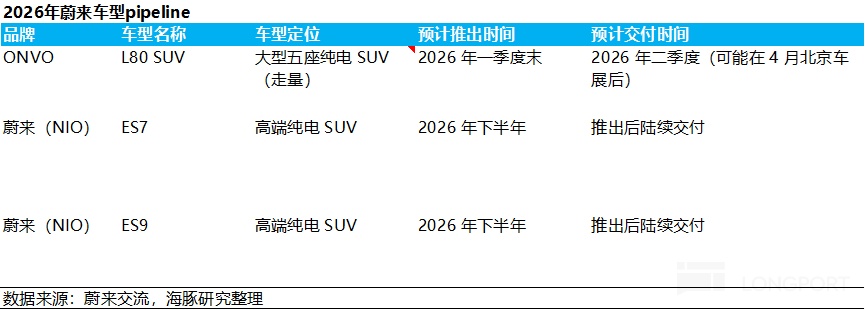
From Nio's own new product cycle, next year it will launch three models: ES9, the five-seat SUV ES7, and Le Tao L80, with ES7 and Le Tao L80 being the main models responsible for volume sales.
However, Nio's "5566" (ET5, ET5T, ES6, and EC6) has been upgraded to the 2025 model based on the NT2.5 platform this year (including interior, exterior, intelligent systems, and standard 100-degree battery), and as Nio's top models, there are no major upgrades or redesign plans based on the new NT3.0 platform next year, so with only two new volume models launching in 2026, this new product cycle is not strong.
Major car companies are about to usher in a "big battery + small fuel tank" route optimization in 2026, addressing the pain points of urban car use and continuing as a transitional solution. Dolphin Research expects competition to return to the battle between extended-range and pure electric routes, and whether Nio's ES8 sales momentum can be maintained remains doubtful, while also facing the negative impact of the decline in purchase tax subsidies. Meanwhile, Le Tao's L90 has already shown signs of decline after being affected by the decline in replacement subsidies.
Fortunately, Nio's net cash level this quarter increased significantly by 10.2 billion yuan quarter-on-quarter to 22 billion yuan, and this net cash level can at least support Nio until 2027, giving Nio some room for further trial and error.
In terms of Nio's valuation, Nio's current stock price corresponds to a P/S multiple of 1.2 times for 2025 (with an annual sales volume of 323,000 vehicles in 2025), and a P/S valuation of 0.8-0.9 times for 2026 (with an expected annual sales volume of 420,000-480,000 vehicles in 2026). Given that Le Tao L90 is already facing a slowdown in demand growth due to the decline in replacement subsidies, and Nio's overall model cycle in 2026 is still relatively weak, this valuation is not low, indicating that Nio's "turnaround from adversity" is still on the way.
I. Vehicle Sales Gross Margin Significantly Increased Quarter-on-Quarter
As the most critical indicator during each earnings release, let's first look at Nio's vehicle sales profitability:
Nio previously guided that due to the launch and delivery of the revamped ES8 and Le Tao L90 in the third quarter (ES8 delivered in late September, Le Tao L90 delivered in August), and the scale effect brought by the quarter-on-quarter increase in sales, Nio's vehicle sales gross margin in the third quarter could improve quarter-on-quarter to 13%-14% (10.3% in the second quarter), and the market expected Nio's vehicle sales gross margin to be around 12.9%.
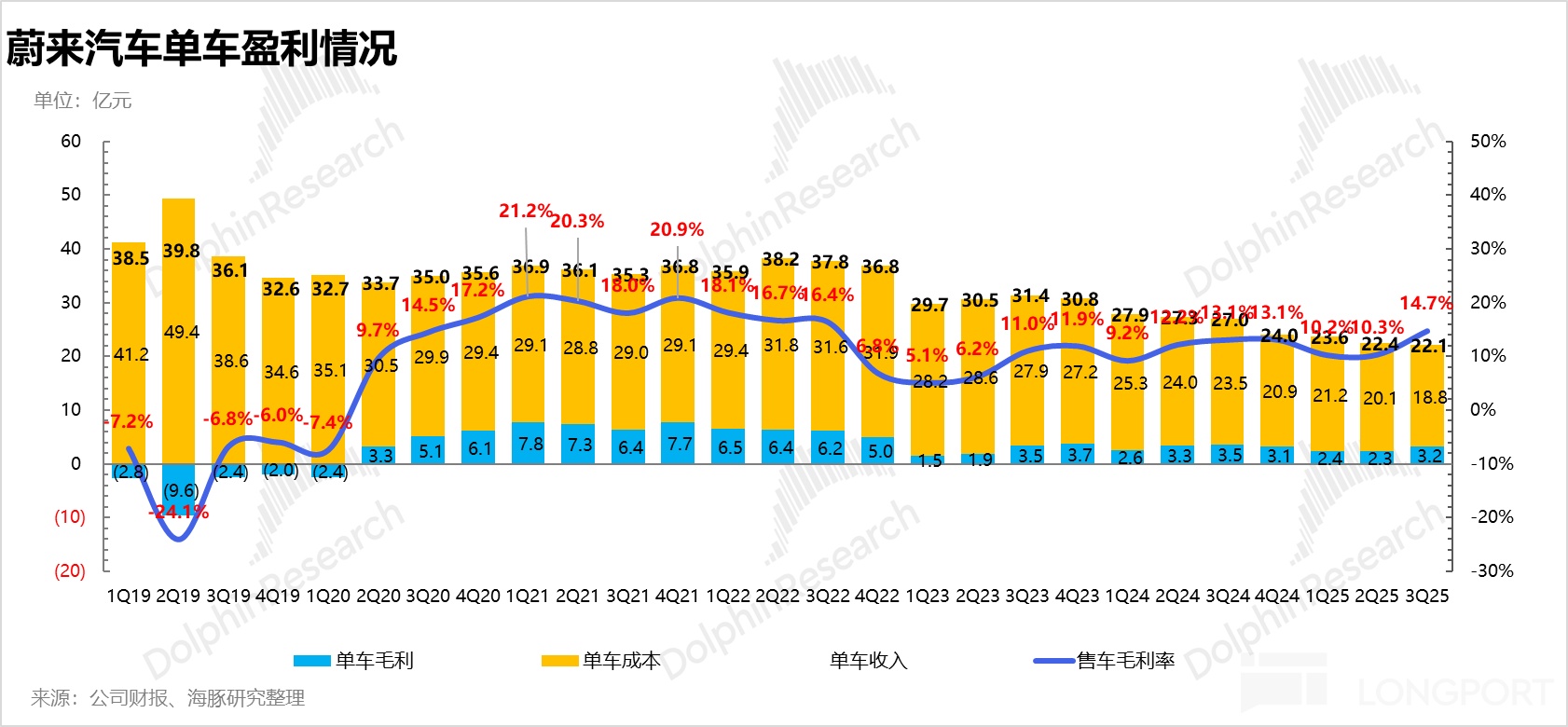
The vehicle sales gross margin in the third quarter was 14.7%, a significant increase of 4.4 percentage points quarter-on-quarter, and also higher than the market expectation of 12.9% and Nio's previous guidance of improving the third-quarter vehicle sales gross margin to 13%-14%. While the vehicle sales price is still declining, the improvement in vehicle sales gross margin is mainly due to a significant reduction in the cost per vehicle:
1) Vehicle Price: The vehicle sales price in the third quarter is still declining, mainly due to "disguised price reduction" and model structure sinking
This quarter, Nio's vehicle sales price was 221,000 yuan, down 3,000 yuan quarter-on-quarter from 224,000 yuan last quarter:
① "Disguised price reduction" brought by free battery upgrade:
Due to the overall pure electric range of the original NT2.0 platform being lower than that of competing models in the same class, resulting in insufficient competitiveness of NT2.0 platform models and sales not meeting expectations, Nio was once on the "edge of life and death". To save the precarious sales and cash flow levels, Nio also began "disguised price reduction".
At the Chengdu Auto Show on August 29, Nio equipped all its models with a 100kWh long-range battery pack as standard, keeping the starting price of the whole vehicle unchanged (i.e., the same as the previous price with a 75kWh standard battery pack), and also reduced the starting price of the entire BaaS solution by 38,000 yuan.

② Model Structure Sinking:
In the third quarter, due to the high-priced and explosive ES8 being launched and delivered in late September, it did not contribute much to the third quarter, while the relatively lower-priced Le Tao L90 became the main sales force in the model structure, with its proportion in the model structure increasing by 25 percentage points quarter-on-quarter, while the proportion of the relatively higher-priced Nio main brand models in the model structure decreased by 23 percentage points quarter-on-quarter, resulting in a downward shift in the model structure.
2) Vehicle Cost: Cost Reduction Strategy + Scale Effect Release, Vehicle Cost Continues to Decrease by 13,000 Yuan Quarter-on-Quarter
In the third quarter, Nio's vehicle cost was 188,000 yuan, continuing to decrease by 13,000 yuan quarter-on-quarter, mainly due to:
① Nio's ongoing cost reduction strategy: In R&D, Nio replaced NVIDIA's four Orin-X chips with its self-developed "NX9031" chip, reducing the cost per vehicle by 10,000 yuan. In design, Nio reduced the BOM cost by reducing the aluminum content of the body and lightweighting, while increasing the generalization rate of NT3.0 parts to achieve scale cost reduction.
Nio also guided that although Le Tao L90 and ES8 are priced very low (compared to competing models, the pricing is very competitive), both models achieved double-digit gross margins when monthly sales exceeded 10,000 units, and the faster-than-expected cost reduction this quarter also dispelled market concerns about the low gross margin of L90.
② Due to the explosive sales of L90 this quarter, Nio's overall sales increased by 21% quarter-on-quarter to 87,000 vehicles, releasing the scale effect and bringing down the amortized cost per vehicle.
3) Vehicle Gross Profit: Vehicle Sales Gross Profit Increased by 9,000 Yuan Quarter-on-Quarter to 32,000 Yuan
In the third quarter, Nio's vehicle gross profit was 32,000 yuan, up 9,000 yuan quarter-on-quarter from 23,000 yuan last quarter, and the vehicle sales gross margin this quarter was 14.7%, higher than the market expectation of 12.9%, mainly due to the increase in gross margin brought by cost reduction and efficiency improvement.
II. Fourth-Quarter Sales and Revenue Guidance Both Below Expectations
1) Fourth-Quarter Sales Guidance of 120,000-125,000 Vehicles, Production Capacity Release Slower Than Expected:
In the most critical fourth-quarter guidance, the fourth-quarter sales guidance is 120,000-125,000, below the market expectation of 136,000 vehicles. Since the fourth quarter is the complete delivery season for Nio's two explosive new cars, ES8 and Le Tao L90, and due to the explosive sales of ES8 (Nio's new ES8 SUV was launched in September, with an overall order volume expected to reach about 96,000 vehicles, and an additional overall order volume of about 40,000 vehicles in October), and the current waiting period for ES8 has also reached 22-23 weeks, with delivery time extended to 2026. This means that Nio's fourth quarter is in a "supply exceeds demand" state, and the sales guidance directly corresponds to the release speed of ES8's production capacity.
Since Nio's October sales of 40,000 vehicles are known, this sales guidance corresponds to an average monthly sales of 40,000-42,000 vehicles in November/December, and Nio's previous quarterly performance meeting guided a quarterly delivery target of 150,000 vehicles for the fourth quarter (with ES8 production capacity reaching 15,000 vehicles in December, and Le Tao L90 production capacity reaching 15,000 vehicles in October). This sales guidance indicates that the release speed of ES8's production capacity is significantly below expectations, and it is mainly due to the negative impact of the decline in replacement subsidies on Le Tao's sales, and the fourth-quarter L90 sales may not meet expectations.

2) Fourth-Quarter Revenue Guidance of 32.7-34 Billion Yuan, Implied Price Rising Quarter-on-Quarter:
The fourth-quarter revenue guidance is 32.7-34 billion yuan, also below the market expectation of 35.1 billion yuan. The revenue guidance is below expectations mainly due to being dragged down by sales that did not meet expectations.
In terms of vehicle sales price, with other revenue remaining flat quarter-on-quarter in the fourth quarter, the implied price expectation in the revenue guidance is up quarter-on-quarter to 251,000 yuan, mainly due to the increase in the proportion of the high-priced ES8 in the fourth quarter.
Due to the increase in price, in terms of gross margin, Nio previously guided that the fourth-quarter vehicle sales gross margin will continue to increase quarter-on-quarter to 16%-17%, with the gross margin target for L90 and ES8 being 20% in the fourth quarter.
Although the fourth-quarter sales guidance is below expectations, with the high-priced ES8 driving the continued quarter-on-quarter improvement in fourth-quarter gross margin, and the continued strict control of the three expenses (Nio guided that the fourth-quarter non-GAAP R&D expenses will be 2 billion yuan, and non-GAAP SG&A expenses will be within 10% of sales revenue), Nio still expects to achieve profitability in the fourth quarter.
Looking at Nio's overall situation:
III. Cost Reduction and Efficiency Improvement Drive Overall Gross Margin to Continue to Improve Marginally
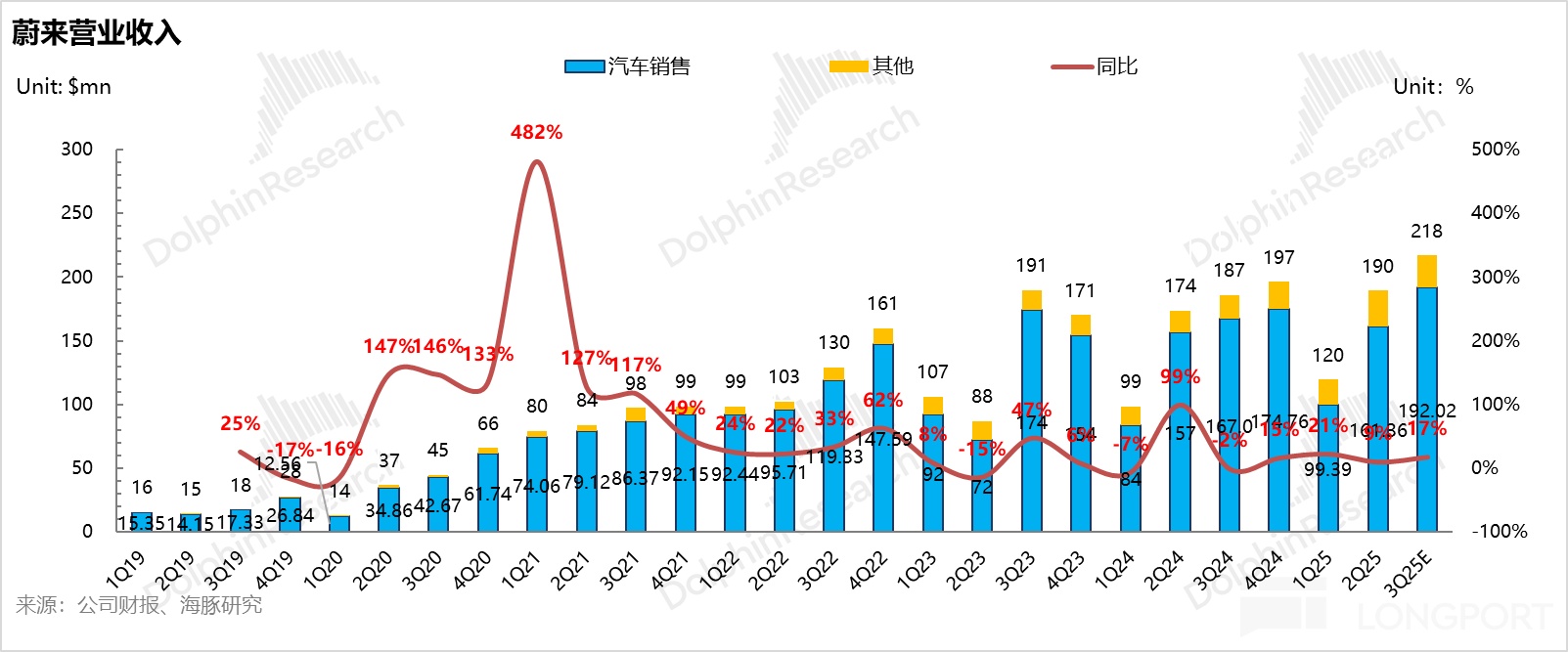
Nio's overall revenue in the third quarter was 21.8 billion yuan, with a year-on-year growth rate of 17%, basically in line with market expectations. Among them, the vehicle sales business was 19.2 billion yuan, and although the vehicle sales price declined quarter-on-quarter due to the model structure and other stage impacts this quarter, the explosive sales of L90 directly drove the vehicle sales volume to reach 87,000 vehicles, with a quarter-on-quarter growth rate of 21%. For Nio, sales are the hope of survival.
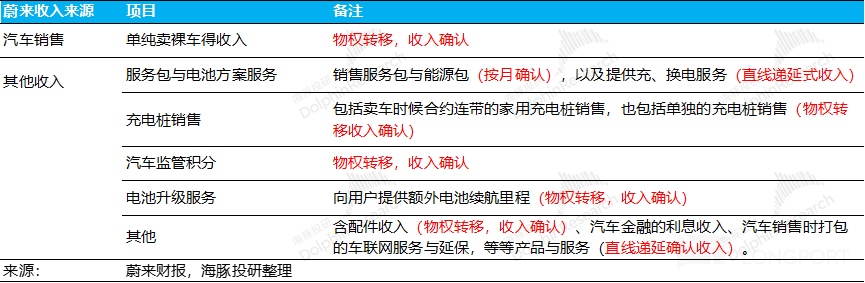
Nio's other revenue this quarter was 2.6 billion yuan, down 280 million yuan quarter-on-quarter, mainly due to the decrease in used car sales and R&D service revenue.
In terms of gross margin, Nio's overall gross margin was 13.9%, up 3.9 percentage points quarter-on-quarter, and also higher than the market expectation of 11.1%. On the one hand, it was due to the decrease in vehicle cost driving the vehicle sales gross margin up 4.4 percentage points quarter-on-quarter to 14.7%, and Nio's cost reduction strategy has already begun to show results this quarter.
On the other hand, it was mainly due to the good performance of other income gross margin this quarter, with other income gross margin at 7.8%, significantly higher than the market expectation of -2.2%, mainly due to cost reduction and efficiency improvement (Nio's layoffs also focused on redundant sales and service teams), leading to an increase in the gross margin of parts, accessories sales, and after-sales services.
IV. R&D Expenses Begin to Be Slashed
Nio has always been "lavish" in spending to shape a luxury car brand, but in the face of continued cash flow constraints and being on the "edge of life and death," Nio has also begun drastic reforms. Although sales and management expenses have increased quarter-on-quarter due to the launch of new cars this quarter, Nio has begun to slash R&D expenses:
1) Sales and Administration: Due to increased marketing expenses for new car launches, this quarter has instead increased quarter-on-quarter
Previously, due to the layout of luxurious Nio houses and a very complete service system and staffing, and the separate channel layout of Le Tao and Nio's main brand, sales and management expenses have remained high. However, subsequently, the separately laid channel of Le Tao has been integrated into Nio's main brand to form a shared channel, and layoffs in the sales and service team have been made. Since the second quarter, there have been obvious signs of sales and management expenses reduction at Nio.
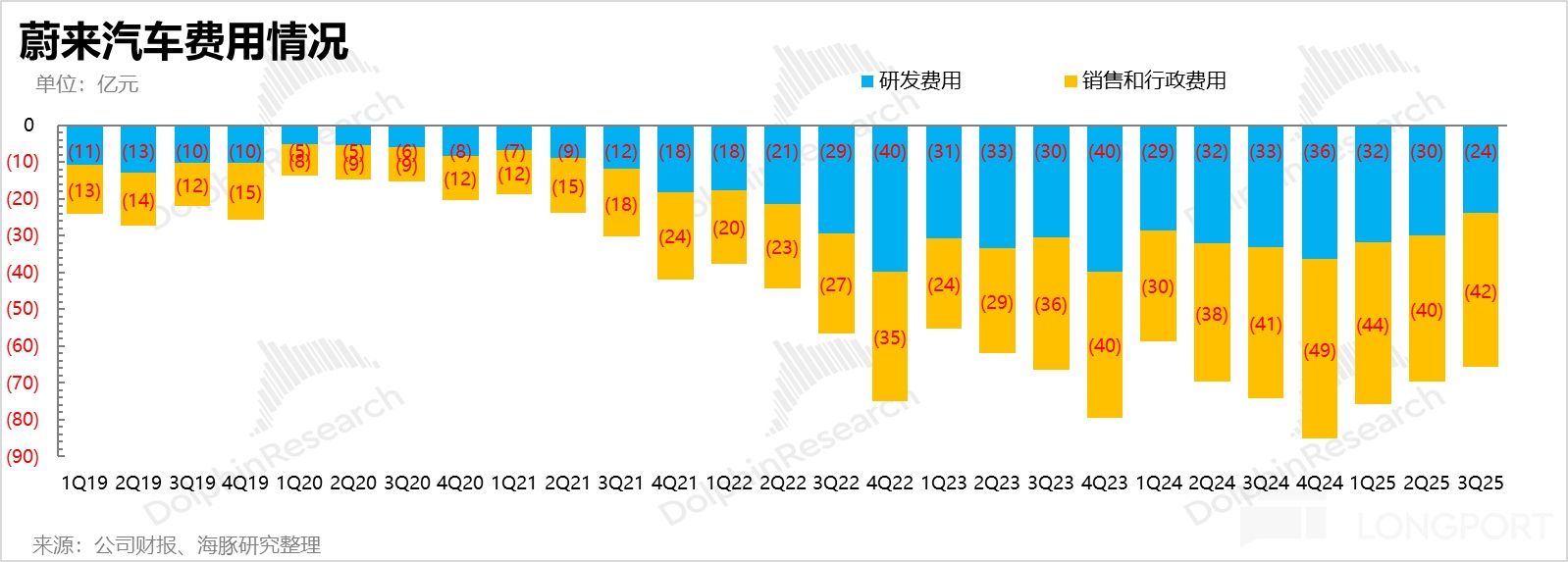
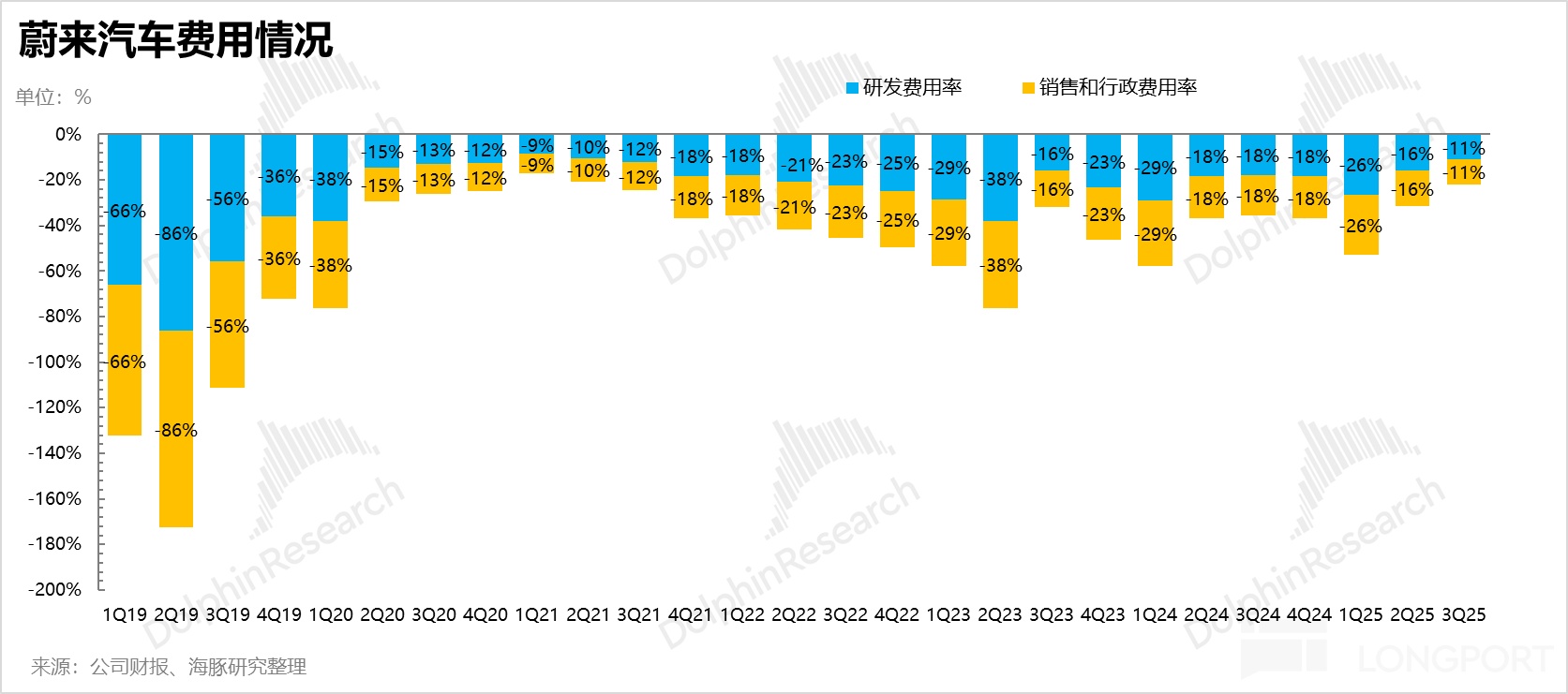
However, due to the launch of the L90 and ES8 models this quarter, marketing expenses are still needed for new models, resulting in sales expenses instead increasing by 220 million yuan quarter-on-quarter to 4.18 billion yuan this quarter, higher than the market expectation of 3.8 billion yuan.
However, Nio previously guided that since there are no new car launches in the fourth quarter, the fourth-quarter non-GAAP SG&A expenses will be controlled within 10% of sales revenue (expected to be 3.3-3.4 billion yuan under non-GAAP, down 500-600 million yuan quarter-on-quarter from this quarter).
2) R&D: R&D Expenses Significantly Reduced, Down 600 Million Yuan Quarter-on-Quarter
This quarter's R&D expenses were 2.39 billion yuan, down 600 million yuan quarter-on-quarter from 3 billion yuan last quarter, and basically in line with Nio's previous guidance of non-GAAP R&D expenses of around 2 billion yuan for the third and fourth quarters.
Nio's R&D investment has returned to relatively normal levels, mainly due to the completion of early-stage basic R&D expenses (the early-stage R&D of the NT3.0 platform has been completed), and layoffs in the R&D team were also completed in the first half of the year, resulting in a reduction in R&D salaries in the third quarter.
V. Nio is Also Accelerating the Pace of Loss Reduction
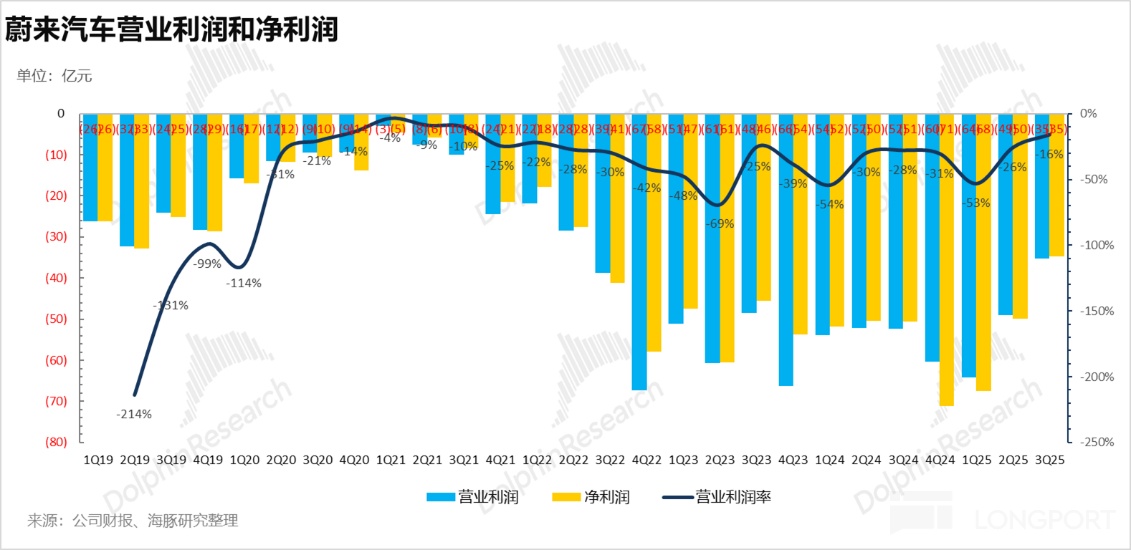
In terms of operating profit, this quarter's operating loss decreased by 1.4 billion yuan quarter-on-quarter to -3.5 billion yuan, better than the market expectation of a loss of 3.87 billion yuan, mainly due to the increase in gross margin brought by cost reduction and efficiency improvement, and the significant reduction in R&D expenses, with the operating loss rate also improving by 10 percentage points quarter-on-quarter from -26% in the second quarter to -16.2%.
In terms of net profit, this quarter's net loss decreased by 1.48 billion yuan quarter-on-quarter to -3.66 billion yuan, better than the market expectation of -3.9 billion yuan, and the pace of loss reduction has accelerated.
<End Here>
For more in-depth research and tracking comments on Nio by Dolphin Research, click:
Financial Reports:
September 2, 2025, Financial Report Interpretation "Completely Abandoning 'Price' to Survive, Is Nio's Turnaround 'Tasty' Enough?"
September 3, 2025, Conference Call Minutes "Nio (2Q25 Minutes): Still Maintaining the Fourth Quarter Breakeven Target"
June 3, 2025, Financial Report Interpretation "Nio: Drawing Pies is Useless, Surviving is the 'Future'"
June 4, 2025, Conference Call Minutes "Nio (1Q25 Minutes): Cutting Three Expenses, Shrinking the Layout, Can Nio Save Itself?"
March 23, 2025, Conference Call Minutes "Nio (Minutes): 2025 Plan for NIO Brand Gross Margin 20%, ONVO Brand 15%"
March 22, 2025, Financial Report Interpretation "Nio: Nio is Lost, Le Tao is Weak, Can Nio Still Have a Future?"
November 20, 2024, Financial Report Interpretation "Le Tao Can't Support the 'Fractured' Nio Anymore"
September 5, 2024, Financial Report Interpretation "Nio: Rarely Didn't Collapse, Can Le Tao Support the Future?"
September 6, 2024, Conference Call Minutes "Expected Le Tao L60 December Delivery Volume to Exceed 10,000, Q1 Vehicle Gross Margin to Reach 15%"
June 7, 2024, Financial Report Interpretation "Sales Return, Stock Price Still Falls, What Can Nio Rely on to Save Itself?"
June 7, 2024, Conference Call Minutes "Expected Q1 Vehicle Sales Gross Margin to Return to Double Digits"
March 15, 2024, Financial Report Interpretation "Another Huge Loss! Can Nio Only Rely on Middle Eastern Investors to Survive?"
March 6, 2024, Conference Call Minutes "Still Maintaining an Annual Gross Margin of 15%-18%, Hoping Monthly Deliveries Quickly Return to 20,000"
Event
September 9, 2025, "Finally 'Understood'! But Can Nio Really 'Reborn'?"
Research
June 13, 2023, Nio Hotspot "Nio: Finally Doing Subtraction"
December 21, 2021, Nio NIO DAY Research "'Blockbuster' ET5 Debuts, Nio Wants to Reignite the 'Future'"
In-Depth
September 25, 2024, In-Depth "Under the Luxurious Exterior, There Are Still 'Lice', Is Nio Still Worth Loving?"
Risk Disclosure and Statement of This Article:Dolphin Research Disclaimer and General Disclosure
The copyright of this article belongs to the original author/organization.
The views expressed herein are solely those of the author and do not reflect the stance of the platform. The content is intended for investment reference purposes only and shall not be considered as investment advice. Please contact us if you have any questions or suggestions regarding the content services provided by the platform.
