


Meituan (Minutes): 3Q loss peaks, but 4Q will continue the loss trend
The following are the $MEITUAN(03690.HK) FY25 Q3 earnings call minutes organized by Dolphin Research. For earnings interpretation, please refer to the article Meituan: A Loss of Nearly 20 Billion! Did Alibaba Successfully Steal the Show This Time?.
I. Core Financial Data Review
Performance Overview:
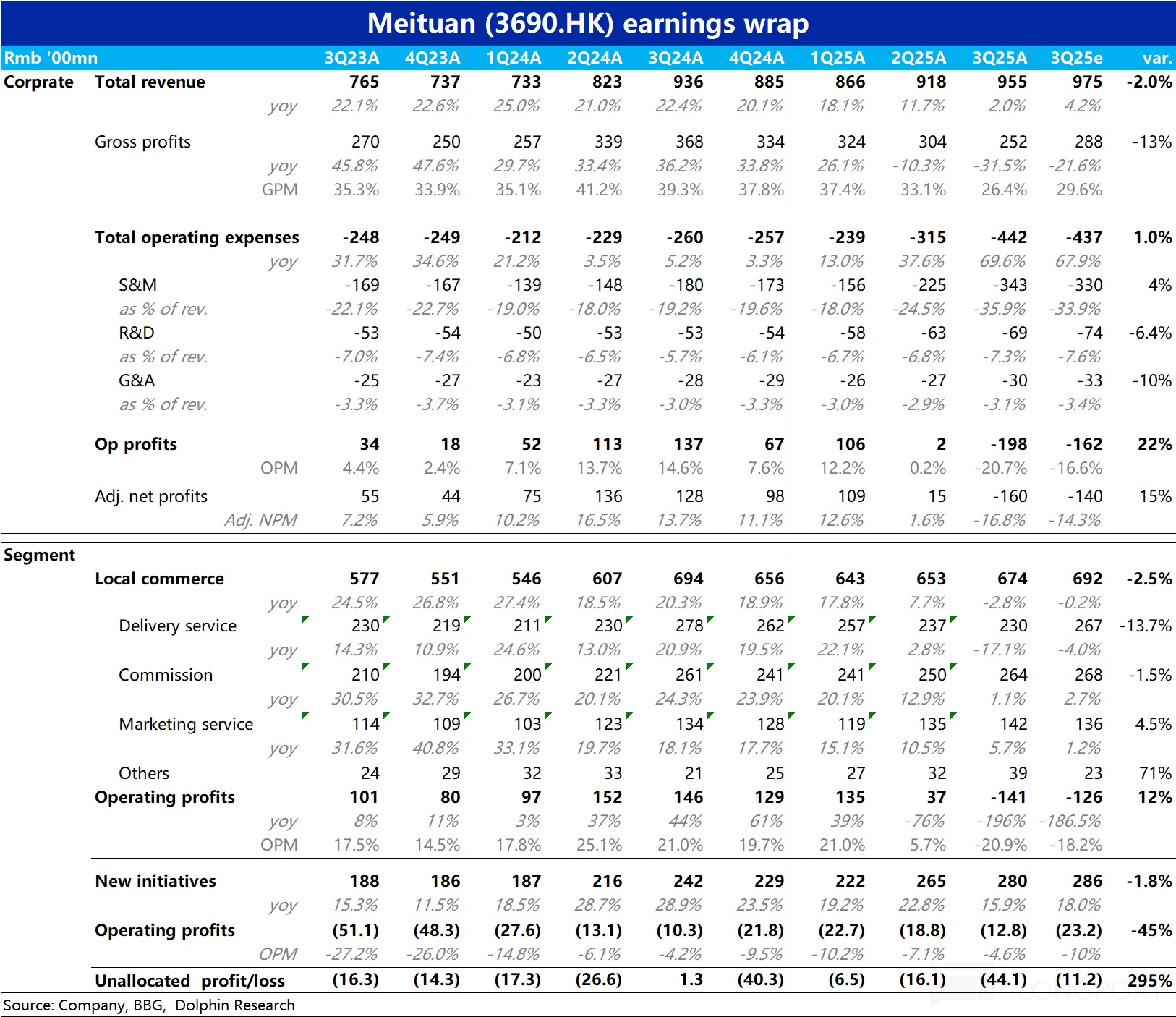
Total Revenue: RMB 95.5 billion (YoY +2%).
Profitability: Operating cost ratio 73.6% (YoY +12.9pts), mainly due to rider incentives and rising overseas costs; adjusted net loss of RMB 16 billion, impacted by irrational industry competition and strategic investments.
Expense Structure: Sales expense ratio 35.9% (YoY +16pts), due to increased spending on promotions and user incentives; R&D expense ratio 7.3% (driven by AI investments).
Cash Flow: Operating cash flow of -RMB 22.1 billion (impacted by competitive investment spending), cash and equivalents of RMB 141.3 billion.
New Business: Revenue of RMB 28 billion (YoY +15.9%), narrowing loss to RMB 1.3 billion (operating loss ratio 4.6%).
II. Detailed Information from the Earnings Call
Key Information from Senior Management Statements
Food Delivery Business:
Accelerating supply-side innovation and service upgrades, deepening cooperation with quality merchants through models such as "Pin Hao Fan," "Shen Qiang Shou," and "Brand Satellite Stores," providing products at all price points; launching value-added services such as on-time delivery and exclusive delivery to strengthen core fulfillment competitiveness.
Daily active users of the food delivery business in Q3 reached a record high (+20% YoY), and monthly active transaction users also hit a new high, expanding the advantage of user structure. New user growth and core user purchase frequency in the flash sale business further increased.
In October, officially launched the "Brand Flash Sale Flagship Store," supporting retail brands with instant retail infrastructure, warehousing, instant delivery, and digital systems.
From November, the rider pension insurance subsidy plan will cover the entire country, and the scope of work injury insurance will be expanded to 17 provinces and municipalities; implementing a comprehensive delivery personnel welfare plan, including key position support, children's education funds, skill enhancement, etc.; in the future, we will continue to improve the welfare protection of couriers.
In-store Business:
The number of in-store merchants and user base in Q3 reached a record high, growing nearly 20% YoY, with user transaction frequency continuing to grow strongly; optimizing the product and content ecosystem to provide simple and reliable shopping decision references.
The platform has accumulated over 20 billion real user consumption reviews, with nearly 3.5 billion new reviews added in the past 12 months; using AI technology to filter out low-quality reviews, building a real review ecosystem; expanding the coverage of quality lists (such as "Black List," "White List," "Most Trusted List"), covering 34 and 144 cities, and will expand to more regions in the future.
Iterating product features, such as "Immediate Pickup," LTE smart ordering, one-click payment, etc.; deepening the "安心学" plan, expanding to fields such as fitness to enhance the trust in prepaid services; upgrading the self-service scene reservation system to provide a smooth experience.
In the medical and health field, expanding video and phone consultation services, introducing more top-tier hospital doctor resources, providing 24-hour instant consultation and 30-minute prescription drug delivery services;
New Business Segment:
The fresh retail business maintains strong growth momentum, consolidating market position and improving operational efficiency.
Overseas business (such as Keeta) accelerates global layout: entered Qatar in August, Kuwait and UAE in September, and started pilot operations in Brazil in October; in the future, we will continue to leverage product technology and operational expertise to provide food delivery experiences in more regions worldwide.
Meituan membership services iterate and promote, adding multiple local service category exclusive member benefits and discounts, strengthening user management capabilities, and increasing member transaction frequency; mid-tier users upgrade membership levels, and the number of high-value members grows steadily; the upgraded membership system drives the growth of core business segments, and we will continue to optimize to enhance user stickiness and transaction frequency in the future.
Artificial Intelligence and Technological Innovation:
In Q3, continued investment in AI, achieving multiple milestone progress, launching several models in the Lonca Flash series with leading performance; launching AI decision-making tools exclusive to restaurant merchants, and the Xiaomi APP, an intelligent life assistant for consumers (currently in large-scale testing).
In the future, we will deepen the industry focus and service orientation of AI, providing merchants with full operational decision-making scenario solutions, making consumer decisions and experiences more intelligent, convenient, and personalized.
Ecosystem and Investment Focus:
Core local business order volume and GMV maintain healthy growth, instant delivery business accelerates order growth; core user base grows steadily YoY, with low-frequency users converting to high-frequency users, increasing transaction frequency; in-store business performs well in small and medium-sized city markets.
Although investments impact short-term profitability, they consolidate leadership in the food delivery and Meituan Flash Sale fields, with market share in core categories and inventory categories remaining stable.
Q&A
Q: Please comment on the changes in the competitive landscape of the food delivery industry in Q4; have industry subsidies started to decrease; how does the investment of competitors in membership programs affect the engagement and retention trends of core users; and from a financial perspective, are there any changes in the expected performance of the food delivery business in Q4 and the long-term growth and profitability outlook?
A: We reiterate our opposition to price wars, believing they are unsustainable and do not create real value. Recently, in October and November, industry subsidy levels temporarily decreased compared to the summer peak, but we are still closely monitoring market dynamics and adjusting strategies accordingly. Our market share and order volume have rebounded, maintaining a leading position in mid-to-high AOV orders, for example, GTV share of orders with an average order value above RMB 15 exceeds two-thirds, and the share of orders above RMB 30 exceeds 70%.
Core user retention is high, with stable growth in consumption frequency. Meituan remains the preferred platform for hundreds of millions of consumers, with core users' consumption frequency several times that of average users, and high brand loyalty. They value delivery experience and service quality more than low prices.
Through the Meituan membership program, we offer more attractive discounts and exclusive service upgrades, enhancing user stickiness. Financially, we believe food delivery losses peaked in Q3, and substantial losses will still occur in Q4, but we will make necessary investments to maintain our leadership position, dynamically adjusting investments. Our long-term goal of achieving 100 million high-quality daily orders remains unchanged, and we are confident in maintaining industry-leading unit economics and operational efficiency, expecting delivery profits to return to normal levels. The medium-to-long-term competitive landscape remains dynamic, with the industry shifting from capital-driven to efficiency-driven and innovation-driven.
Q: Other e-commerce platforms are increasing their efforts in instant retail, bringing traditional e-commerce brands into this field. How does management view our competitive advantage? What is the future strategy of Meituan Flash Sale after the Double 11 event? Will investments be expanded in Q4?
A: We have a particularly strong competitive advantage in native supply for instant retail, even stronger than our food delivery business. The logic of instant retail is completely different from traditional e-commerce and half-day/next-day delivery; it means zero inventory and instant gratification. Through years of understanding market demand and merchant pain points, we have achieved digitalization of offline supply and used technology to better meet instant demand. Simply transferring traditional e-commerce supply to instant retail channels will not create incremental value for merchants or consumers.
We are promoting industry-wide infrastructure and service experience upgrades, such as expanding the instant pharmacy network, adding refrigeration facilities for alcohol, and introducing quality assurance services for fresh fruit cuts. More importantly, our food delivery business has cultivated a group of users highly dependent on 30-minute certainty, making our platform the most suitable for instant retail, providing merchants with the highest conversion rates and incremental sales.
In the new competitive landscape, we are deepening comprehensive cooperation with brands and launching the "Brand Flagship Store" project on Meituan Flash Sale, providing 24/7 instant delivery services, including warehousing, delivery, and digital systems. During the Double 11 period, hundreds of brands joined. For example, Hanes brand saw a 30% increase in sales on the first day of the flash sale brand flagship store.
In Q4, we will continue to invest in supply-side operations while ensuring the best user experience and strengthening user education. The operating loss of the Meituan Flash Sale business in Q4 may slightly expand compared to Q3. However, our competitive advantages in supply, user base, and fulfillment will enable us to maintain leadership with higher subsidies and operational efficiency. We are confident in solving profitability issues in the medium to long term and achieving reasonable and sustainable profit margins.
Q: Recently, Amap launched the "3 Star Initiative" and group buying transactions. How does management view the impact of these initiatives on the competitive landscape of the in-store business? What specific measures will the company take to address challenges in the new competitive environment?
A: Our in-store business model and operational strategy differ from competitors in terms of category mix, merchant scale and type, and marketing ROI. Through long-term accumulation of real, accurate, and easily accessible POI data, we have established a dominant consumer mindset, becoming the preferred platform for local services. On the other hand, competitors, as navigation tools, have clear user perceptions, making it difficult to cultivate consumer habits of searching for local services.
Based on over 25 billion real user reviews accumulated over the past decade, we have built a comprehensive user review ecosystem, which is one of the key reasons consumers trust and choose Meituan. We also have the broadest category coverage and selection in the local service field, providing consumers with one-stop services. We maintain industry-leading merchant coverage, leveraging an experienced offline business team and deep industry insights to provide the best service to merchants. These core competencies are difficult for other platforms to replicate quickly.
To address competition, we continue to accelerate product and operational capability building:
1. By expanding the coverage of "Must Eat List," "Must Visit List," and "Black Pearl Guide," and introducing more professional lists, we cultivate an ecosystem favorable to quality merchants, providing them with more precise traffic promotion and higher transaction conversion.
2. Optimizing rating standards, encouraging merchants to focus on product and service quality rather than just the number of reviews, and using big data to intelligently identify and automatically handle abnormal reviews.
3. Launching more user-friendly products, such as VR merchant tools, reservation pre-ordering, and smart in-store ordering digital solutions.
In the future, we will continue to focus on three key directions: ecosystem optimization, service innovation, and operational upgrades, providing consumers with a seamless experience and empowering merchants with full lifecycle capabilities covering customer acquisition, conversion, and retention. Competition may impact in-store business profit margins in the short term, but we expect the long-term competitive landscape to remain unchanged. We are fully confident in maintaining market leadership and continuing to lead industry ecosystem evolution.
Q: The company has launched AI assistants for testing. What is the current progress and future plans? Will AI assistants be directly integrated into the APP in the future? Please share future plans and investment strategies in the AI field.
A: This quarter, we continued to iterate capabilities in three core dimensions: internal training, product AI-ization, and work AI-ization. We have launched several open-source LLM Lonca Flash series models, which have received positive feedback from the developer community and are deeply integrated with our core application scenarios, driving innovation based on real needs to support long-term strategic growth.
In terms of AI applications, we have upgraded a series of AI tools, such as our restaurant advisor tool that helps restaurant merchants with product planning and site selection; smart operation tools integrating AI reception, operational analysis, and review response functions, empowering merchants for efficient operations.
We have also launched an intelligent life assistant APP for users, currently in large-scale testing. At the same time, we have introduced the AI assistant "Ask Xiao Tuan" in the Meituan APP.
We are simultaneously testing independent AI applications and plan to integrate AI assistant functions into the main APP. These assistants cover global service scenarios such as dining, accommodation, transportation, travel, entertainment, and shopping, completing the entire process from search and comparison to ordering, providing users with more intelligent and personalized services.
We will also continue to develop AI programming tools and apply no-code applications to improve employee work efficiency.
Looking ahead, we will further enhance the competitiveness of self-developed foundational models, explore more AI assistant application scenarios in local services, and iterate AI assistant strategies based on operational insights and user feedback, driving deeper AI empowerment in the ecosystem.
Q: Please introduce the progress of new businesses in Hong Kong and the Middle East, the competitive strategy in the Brazilian market, and the capital allocation strategy and loss expectations for new businesses.
A: Keeta's Hong Kong business achieved profitability in October 2025, ahead of the original three-year plan, validating our customer-centric model, operational expertise, and technological capabilities to deliver superior unit economics. We expect other markets to follow a similar path.
In the Middle East, we entered Qatar in August, Kuwait and UAE in September, and are still in the early stages. The Gulf region has a similar market structure and is a highly attractive food delivery market, with some countries having more mature food delivery habits and richer restaurant supply, offering significant penetration potential.
Brazil is one of the top five food delivery markets globally by GMV, with an annual growth rate of over 20%. We found that a large number of transactions are still completed through traditional channels such as WhatsApp and phone calls, indicating significant online penetration potential. Leveraging the world's most efficient delivery platform technology established in China and the localized operational capabilities accumulated in Hong Kong and Saudi Arabia, we are confident in bringing a superior experience to the Brazilian market.
In terms of capital allocation, Keeta and fresh retail are our firm long-term strategies. We will expand the well-performing Xiaoxiang Supermarket and pilot new offline retail formats in 2026. Although the upfront investments in the Gulf market and Brazil are significant in Q4, based on the successful experience in Hong Kong, we believe the unit economics of these markets will improve rapidly, and the market size is sufficient to accommodate multiple participants. Overall, we expect the losses in the new business segment next year will not exceed those in 2025.
<End of Text>
Risk Disclosure and Statement of this Article:Dolphin Research Disclaimer and General Disclosure
