


Alibaba, ByteDance, and Li Auto are rushing into the market; are AI glasses becoming the 'next big thing'? (Minutes)
Recently, the deeper Dolphin Research delves into the AI industry chain, the more it realizes that amidst the massive upstream investments, it is crucial to understand whether this AI industrial revolution is primarily about stock replacement or creating incremental growth.
Because stock replacement often signifies a battle between new and old forces, the acceptance by the general public (for instance, during the steam revolution era, it was mainly about manpower replacement, which led to incidents like railways being vandalized, whereas the internet primarily changed the way information is disseminated, focusing on creating incremental growth) largely determines the slope of new technology penetration.
In terms of AI creating incremental growth, Dolphin Research is more hopeful that AI will transform human-machine interaction from typing input to genuine natural language interaction, bringing new hardware opportunities, allowing hardware to transition from screen-based entry to AI new hardware that may or may not have physical screens.
Among these potential new hardware, AI glasses, besides having the portability and mobility features of a phone, can leverage AI's characteristics for natural language interaction (image recognition, audio interpretation, instant conversation, continuous interaction), rather than requiring basic knowledge like typing, which limits usage to literate individuals, excluding groups like illiterates and children, thus significantly lowering the user entry barrier.
Therefore, in the scenarios of AI hardware implementation, AI glasses are becoming the strategic entry point fiercely contested by tech giants. From Li Auto's automotive ecosystem, Alibaba's commercial services, to Xiaomi and Huawei's smart living chains, and even Meta and Google's virtual reality explorations, various manufacturers are entering the fray, attempting to capture the peak of user perception and usage time through this new form.
The reason AI glasses are considered the 'next-generation personal mobile entry' and the most likely challenger to mobile phones as mobile terminals is mainly due to their advantages in three dimensions:
① All-weather natural interaction, building seamless intelligent companionship
Unlike the 'take out-light up-operate' mode of mobile phones, AI glasses, with their all-weather wearable and instant use features, truly achieve the ideal state of an intelligent assistant that 'understands me and is always ready.' Their interaction method is closer to human instinct—no need to interrupt current actions, what you see is what you get, what you ask is what you answer, transforming intelligent services from active awakening to seamless companionship.
② Full-scene deep coverage, surpassing hardware physical boundaries
Compared to devices like mobile phones or cars, AI glasses achieve a dual breakthrough in space and time for service scenarios. They cover diverse environments from work, socializing, travel, to home, seamlessly connecting online services with offline experiences, extending capabilities far beyond single hardware. Especially as 'first-person perspective head devices,' they can capture over 80% of human sensory input, making them a more potent human-machine interaction sensory hub than mobile phones.
③ Native AI data entry, driving continuous intelligent evolution
AI glasses, integrated with cameras, microphones, and other sensors, naturally possess the ability to collect first-person perspective data and run multimodal AI. This not only provides users with a native interaction entry but also becomes a key data source for continuously feeding AI models and achieving intelligent iteration. Their strategic importance is already comparable to current mobile terminals.
Facing this massive incremental market (over 1.5 billion pairs globally) with potentially shorter replacement cycles, Alibaba has positioned Quark AI glasses as the 'center of human-machine interaction revolution' and 'AI entry,' making comprehensive strategic investments.
Dolphin Research has noticed that recently major companies have been releasing AI glasses or have AI glasses launch events scheduled, such as the recent Quark AI glasses launch (November 27), Li Auto AI glasses (December 3), Xreal and Google's AR glasses debut (December 25), Byte glasses release (Q1 2026), Meta glasses launch event (Q1 2026), and Amazon glasses (H2 2026), among others.
This article mainly organizes the information from the recent Quark AI glasses and Li Auto AI glasses launch events, along with the core AI hardware parameters, for reference. In 2026, Dolphin Research will closely monitor the progress of AI landing on new hardware.
Below are the details:
1. Li Auto Livis: Extension of Automotive Ecosystem Strategy
On December 3, 2025, Li Auto released its first AI glasses Livis, focusing on lightweight wear (36g), long battery life (18.8 hours), and deep connectivity with the vehicle ecosystem.
The functions brought by AI glasses essentially extend Li Auto's 'human-car-home' intelligent ecosystem in space and time, aiming to expand the capabilities of 'Li Auto Assistant' from in-car scenarios to users' all-day lives, enhancing car convenience and in-car entertainment experience, further strengthening owner loyalty:
1) Building a data loop, enhancing ecosystem stickiness
Data loop: As a device worn 24 hours, Livis can collect richer user life scene data (commuting, office, social, family) than cars. This data feeds back to Li Auto's MindGPT large model, enabling it to better understand users, thereby optimizing the experience of car systems and smart home, forming an enhanced loop of 'data-algorithm-experience.'
Ecosystem stickiness: Li Auto, through deep adaptation with Li Auto vehicles (such as voice-controlled cars, headrest speaker linkage), further consolidates the 'human-car-home' full-scene intelligent loop, achieving seamless extension in space and time through glasses, enhancing users' dependence and stickiness to the Li Auto ecosystem.
2) Creating high-frequency touchpoints, driving sales for car business
Cars are low-frequency, high-priced consumer goods with limited user touchpoints. AI glasses priced from 1699 yuan allow non-Li Auto owners to experience 'Li Auto Assistant's' AI capabilities at low cost. This is Li Auto's move to 'break out,' expanding brand influence from car owners to a broader tech consumer group, also driving store sales.
3) Using low-threshold hardware to explore overseas markets
Compared to cars, smart glasses have higher universality and lower cultural acceptance thresholds, especially suitable for mature markets like Europe and the US with high acceptance of smart wearable devices. Through Livis, Li Auto can not only establish overseas brand recognition in advance, accumulate user data, form initial ecosystem layout, but also pave the way for subsequent vehicle exports.
4) Preemptively positioning for the next-generation AI hardware entry
For a 'tech company' like Li Auto, it needs to have a place in the next-generation hardware entry, otherwise, it may face the risk of being 'pipelineized' by other ecosystems in the future (future users may control vehicles through AI assistants from giants like Huawei, Xiaomi, etc., downgrading Li Auto Assistant to a mere execution terminal, losing interaction definition rights, high-value data accumulation capabilities, and service ecosystem leadership).
Through Livis, Li Auto extends 'Li Auto Assistant' from in-car to all-day life scenarios, aiming to maintain the core of user experience, consolidate the data loop, and avoid becoming a hardware pipeline dominated by other tech ecosystems in the AI era, while preemptively positioning for future human-machine interaction revolution.
2. Quark AI Glasses: Panoramic Integration of Alibaba Ecosystem
The software functions of Quark AI glasses reflect Alibaba's strategic ambition to seize the next-generation AI entry after the mobile phone era, focusing on deeply integrating Alibaba's vast ecosystem services (payment, navigation, e-commerce, content) with first-person perspective AI creation capabilities (3K recording, live streaming, translation), creating an all-weather personal AI assistant platform:
① Seizing the next-generation AI hardware entry, initiating interaction revolution
The current product focuses on tool and auxiliary positioning, targeting practical scenarios like navigation, payment, translation, product recognition, travel management, and has integrated Alibaba ecosystem and some external applications (such as NetEase Cloud Music, QQ Music). In the future, it will expand horizontally to fields like identity authentication, sports health, learning.
② Extending and consolidating ecosystem advantages, enhancing user stickiness:
Alibaba possesses full-stack capabilities from self-developed hardware, Quark AI application model, Qianwen large model to Alibaba Cloud computing power. AI glasses become a new carrier connecting these capabilities, providing users with seamless closed-loop service experience through deep integration with core ecosystems like Alipay, Gaode, Taobao, Alibaba Travel. Choosing Quark AI glasses means accessing the entire Alibaba ecosystem.
③ Positioning future creation and data entry
Alibaba believes 'AI glasses + AI creation' will become the mainstream form of future content production, first-person perspective shooting will generate massive data and AI creation demand. By integrating AI creation capabilities of Qianwen Image model, Wanxiang model, and Quark Cloud storage, Alibaba aims to occupy key nodes of future AI creation ecosystem, controlling the new round of data entry.
AI Glasses Specific Configuration and Functions:
One, Pricing and Channels
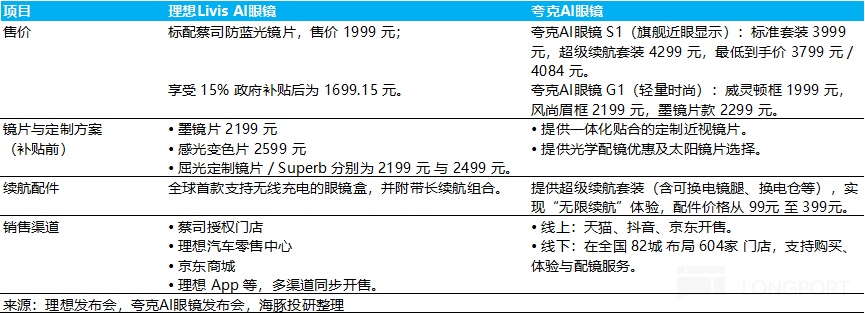
1. Pricing:
Li Auto Livis: Adopts single version, high cost-effectiveness strategy
All models come standard with Zeiss lenses, priced from 1999 yuan (after government subsidies, starting at 1699.15 yuan), directly targeting Quark G1's entry-level price.
Lenses and customization options (before subsidies): Sunglasses 2199 yuan, photochromic lenses 2599 yuan; refractive custom lenses / Superb are 2199 yuan and 2499 yuan respectively.
Quark AI Glasses: Adopts dual version strategy, covering a wider audience, forming full price range coverage:
S1: Mainly targets flagship near-eye display scenarios, standard package priced at 3999 yuan (excluding backup battery leg), super battery package priced at 4299 yuan (including battery leg), minimum price 3799 yuan/4084 yuan;
G1: Focuses on lightweight and fashion, Wellington frame priced at 1999 yuan, fashion brow frame priced at 2199 yuan, sunglasses version priced at 2299 yuan;
Battery accessories: Provides super battery package (including replaceable battery leg, battery compartment, etc.), achieving 'infinite battery life' experience, priced from 99 yuan to 399 yuan, this is an innovative design of the product.
2. Channels:
Li Auto sales channels: Zeiss authorized stores, Li Auto retail centers, JD.com, Li Auto App, etc., simultaneously available through multiple channels;
Quark AI Glasses channels: Online sales on Tmall/Douyin/JD.com, and layout of 604 offline stores in 82 cities nationwide
Two, Hardware End:
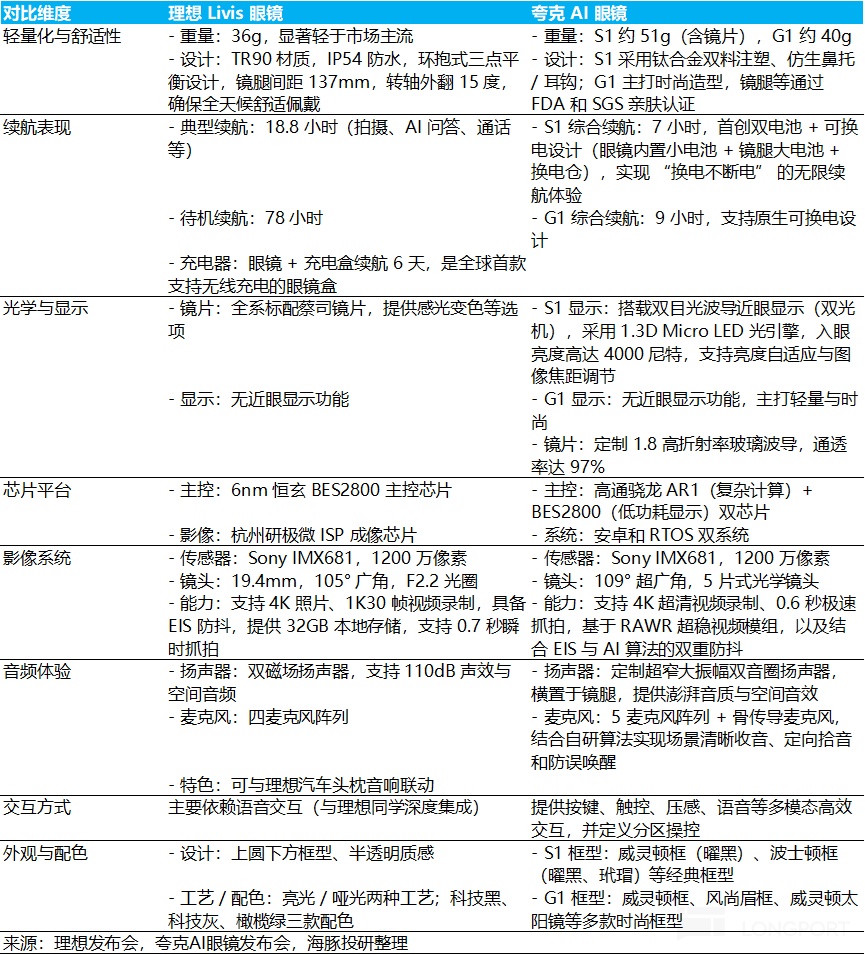
Li Auto Livis pursues extreme lightweight (36g) and long battery life (18.8 hours), focusing on burden-free all-day wear, and deeply binding with automotive ecosystem (audio linkage). Hardware configuration is balanced, highlighting basic experience and cost-effectiveness.
Quark, on the other hand, has significant advantages in near-eye display (dual-eye waveguide), high-performance computing (Snapdragon AR1 chip), and first-person perspective creation (3K video), and solves battery anxiety through innovative replaceable battery design, deeply integrating with Alibaba ecosystem to form differentiation.
1. Lightweight Design and Comfort: Li Auto has more advantages in lightweight
Li Auto: Focuses on lightweight design
Uses TR90 material, the whole machine weighs only 36g, significantly lighter than the market mainstream 42–45g (20% lighter than industry mainstream).
Comfort: IP54 waterproof rating, temple distance 137mm, hinge outward flip 15 degrees, nylon wall thickness 0.8mm, wrap-around design, three-point weight balance, 36g ultra-lightweight achieves all-day comfortable wear.
Quark: The whole machine is slightly heavier, mainly because S1 adds near-eye display function
S1: The whole machine weighs about 51g (including 0-degree myopia lenses), achieving industrial design with 7.5mm temple, 3.3mm frame under extreme dimensions, and uses titanium alloy dual-material injection, bionic nose pad/ear bend, and 1:1 front and rear balance, greatly improving long-term wear comfort
G1: The G1 series further extends the 'daily use' concept, retaining the same source chip, acoustics, and shooting configuration, removing optical display, reducing the whole machine weight to about 40g, and providing multiple stylish frame types including sunglasses.
Skin-friendly certification: Parts of the temples that contact the skin are certified by FDA and SGS for skin-friendliness.
2. Battery Performance: Li Auto has stronger battery life
Li Auto: More advantageous in battery life, overall battery life reaches 18 hours
Levis battery capacity 240mAh, typical battery life 18 hours (including shooting, AI Q&A, Bluetooth calls, etc. typical application scenarios), standby battery life 78 hours, glasses + charging case battery life 6 days, is the world's first glasses case supporting wireless charging.
Quark: First dual battery + replaceable battery design, overall battery life 7-9 hours
S1: Battery capacity 287mAh, comprehensive battery life 7 hours (standby >25h, music >6h, continuous recording >1h). First dual battery + replaceable battery design (glasses built-in small battery + temple large battery + battery compartment), achieving 'battery replacement without power interruption' infinite battery life experience.
G1: Built-in 272mAh large capacity dual battery, comprehensive battery life up to 9 hours, also supports native replaceable battery design
3. Optics and Display: Quark S1 equipped with dual optical engine, has near-eye display function
Li Auto: No near-eye display function
Lenses: All models come standard with Zeiss lenses, providing options like photochromic
Display: No near-eye display function
Quark: S1 equipped with dual-eye waveguide near-eye display technology (dual optical engine), has near-eye display function
Display engine: Equipped with JBD Hummingbird Mini Micro LED monochrome optical engine, volume as small as 0.6CC, brightness up to 3 million nits, eye brightness up to 4000 nits, supports brightness adaptation and image focal length adjustment.
Dual-eye solution core advantage: Compared to industry common single-eye, external lens solutions, dual-eye dual optical engine design is more in line with human eye visual habits, effectively reducing visual fatigue from long-term use.
G1: No near-eye display function, focuses on lightweight and fashion
Display: No near-eye display function, focuses on lightweight and fashion
Lenses: Custom 1.8 high refractive index glass waveguide, transparency rate up to 97%
4. Chip Platform: Quark dual-chip performance is stronger
Li Auto: Uses single chip BES2800
Main control: 6nm Hengxuan BES2800 main control chip
Imaging: Hangzhou Yanjingwei ISP imaging chip
Quark: Equipped with Qualcomm Snapdragon AR1 and low-power processor BES2800 dual-chip
Equipped with Qualcomm Snapdragon AR1 and low-power processor BES2800 dual-chip, and Android and RTOS dual systems, achieving high performance and low power consumption (long battery life)
Main chip: Qualcomm Snapdragon AR1, dedicated to handling complex computing tasks (such as high-quality shooting, voice processing, computer vision).
Low-power processor: Low-power display processor, responsible for daily lightweight tasks and display driving.
5. Imaging System: Quark video recording clarity is higher, both have anti-shake function
Li Auto Livis:
Imaging equipped with Sony IMX681, sensor 12 million pixels, 19.4mm wide-angle lens achieves 105° wide-angle, F2.2 aperture, 4k quality, EIS anti-shake, supports 1k 30 frames different size video recording, and provides 32GB local storage.
Quark:
Sensor: Equipped with Sony IMX681 sensor, 12 million pixels, 1/3.6 inch.
Lens: 109° ultra-wide-angle, 5-piece optical lens, 1/3.6 inch.
Imaging: Equipped with 12Mp IMX681, supports 3K recording, posture calculation + algorithm anti-shake
Core capability: Supports 3K ultra-clear video direct output (industry-leading), 0.6-second rapid capture, super night mode based on RAW domain, and dual anti-shake combining EIS and AI algorithm.
7. Audio Experience: Li Auto can link with vehicle audio
Li Auto: Four microphones + dual magnetic circuit speakers, supports 110dB sound effect and spatial audio, and can link with vehicle audio, also supports Bluetooth calls, recording, etc.
Quark: Speaker: Custom ultra-narrow large amplitude dual voice coil speaker, horizontally placed in the temple, achieving surging sound quality and spatial sound effect.
Microphone: Integrated 5-microphone array + bone conduction microphone, combined with self-developed algorithm, achieving clear sound reception in all scenes, directional pickup, and anti-miswake.
8. Interaction Method: Quark AI glasses interaction method is more diverse
Li Auto: Mainly relies on voice interaction (deeply integrated with Li Auto Assistant)
Quark: Achieves easy and smooth single-handed operation, defines partition control, and provides multi-modal efficient interaction such as buttons, touch, pressure sensing, voice, compatible with different control habits
9. Appearance Color:
Li Auto: Upper round lower square frame, semi-transparent texture, provides two processes of glossy / matte, and three color options of tech black, tech gray, olive green.
Quark:
S1: Provides Wellington frame (black), Boston frame (black, tortoiseshell) and other classic frame types, emphasizing elegant tech integration.
G1: Provides Wellington frame, fashion brow frame, Wellington sunglasses and other stylish frame types, meeting different dressing preferences.
Three, Software Functions
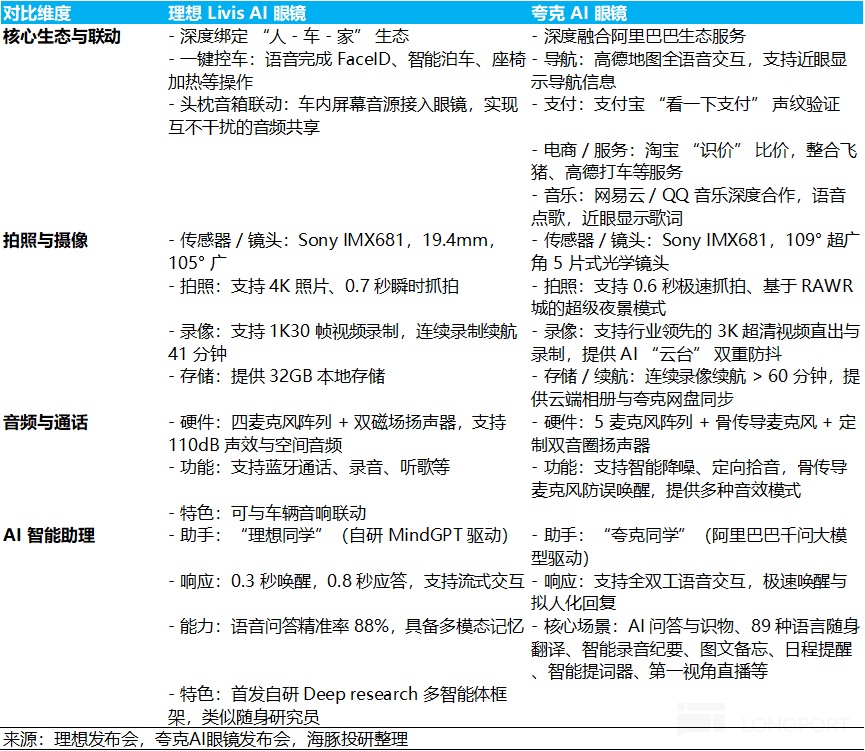
Li Auto Livis's software functions are an extension of its automotive ecosystem strategy, focusing on seamlessly extending the capabilities of 'Li Auto Assistant' from in-car to all-day life, enhancing car convenience and in-car entertainment experience to increase owner stickiness.
Quark AI glasses' software functions reflect its strategy to seize the next-generation entry, focusing on deeply integrating Alibaba's vast ecosystem services (payment, navigation, e-commerce, content) with first-person perspective AI creation capabilities (3K recording, live streaming, translation), creating a new, all-weather personal AI assistant and creation platform.
1. Ecosystem Linkage: Li Auto creates 'human-car-home' ecosystem, Quark deeply integrates with Alibaba ecosystem
Li Auto: AI glasses link with car, can achieve one-click car control, car speaker linkage, etc.:
Glasses provide HUD function, voice can complete speaker control, FaceID, trunk opening, smart parking, sliding door, air conditioning and seat heating operations. Previously, it took 7-8 seconds to take out the phone, open the app, click the button, and start, now one sentence can achieve one-click car control.
Headrest speaker linkage: Linked with Livis headrest speaker, car screen audio source access to glasses, family members sleeping beside can still listen to all car screen audio sources (music, books, navigation, TV), without interference.
Quark: Deeply integrated Alibaba ecosystem services
Navigation: Deeply customized with Gaode Map, supports full voice interaction, near-eye display of navigation information, and arrow following head direction.
Payment: Jointly with Alipay, supports 'look and pay,' voiceprint verification through bone conduction microphone, ensuring safety.
E-commerce and services: Jointly with Taobao exclusively provides 'price recognition' comparison service; integrates Fliggy, Gaode Taxi, Flight Manager, etc., providing intelligent itinerary reminders.
Music and audio: Deep cooperation with NetEase Cloud Music, QQ Music, supports voice on-demand, lyrics display (near-eye view lyrics), and scene-based playlist recommendations.
2. Photography and Videography: Quark has higher clarity in videography, and can sync cloud album with Quark Cloud
Li Auto:
Imaging equipped with Sony IMX681, sensor 12 million pixels, 19.4mm wide-angle lens achieves 105° wide-angle, F2.2 aperture, 4k quality, and has EIS anti-shake, and provides 32GB local storage.
Photography: 4k photo and other parameters are top-level, supports 0.7-second instant capture, 4:3 and 16:9 two ratios, transparent picture, accurate color, supports 3-second live photo.
Video recording: Supports 1k30 frames different size video recording, can complete 41 minutes continuous recording battery life.
Quark:
Imaging equipped with Sony IMX681 sensor (12 million pixels), combined with 109° ultra-wide-angle 5-piece optical lens, achieving 'what you see is what you get' shooting from first-person perspective.
Photography capability:
Rapid capture: Through deep optimization of imaging chain, achieving 0.6-second rapid capture experience.
Super night mode: Industry first super night mode based on RAW domain, significantly improving dynamic range and picture purity in low light and night scenes.
Intelligent experience: Supports 'open mouth to shoot,' no need to wake up, directly say 'Quark take photo' or 'Quark record' command to trigger. Thanks to near-eye display, also supports pre-shoot aiming and post-shoot preview.
Videography capability:
Supports industry-leading 3K ultra-clear video direct output and recording, is the first AI glasses in China to support this specification.
Anti-shake technology: Uses combined EIS electronic anti-shake and cloud AI anti-shake algorithm Ai 'cloud platform' dual anti-shake, can shoot stable and smooth footage close to handheld physical cloud platform in running and other sports scenes
Battery life and storage: Supports 1080P long-time shooting, continuous recording battery life can reach over 60 minutes. Provides cloud album service to free up local storage, and syncs with Quark Cloud across multiple devices.
3. Audio and Calls
Li Auto:
Built-in four microphones for sound reception + dual magnetic circuit sandwich speakers, supports 110dB sound effect and spatial audio, can achieve Bluetooth calls, recording, listening to music, audio, etc.
Quark:
Audio hardware: Uses custom ultra-narrow large amplitude dual voice coil speaker, through unique horizontal placement in the temple, directly transmits sound to the ear, achieving surging sound quality and spatial sound effect. Provides standard, surging, quiet three sound effect modes.
Calls and recording:
Microphone array: Integrated 5-microphone array + bone conduction microphone
Intelligent noise reduction: Through end-cloud fusion large model algorithm, achieving clear sound reception in all scenes. Can filter environmental noise in noisy subway, can directional pickup in multi-person meetings, accurately capture target speaker.
Privacy protection: Bone conduction microphone can accurately recognize the owner's voice, effectively preventing others from miswaking
4. AI Intelligent Response:
Li Auto: Core AI assistant—'Li Auto Assistant':
Stream intelligent voice framework: Equipped with Hengxuan BES2800 main control chip + Li Auto self-developed MindGPT model, quickly achieving voice control, 0.8-second response speed, 0.3-second voice wake-up, extremely fast response speed, Li Auto Assistant can listen to instructions, think, and answer, naturally smooth like communicating with people.
Answer accuracy industry-leading: MindGPT, has multi-modal memory capabilities like photos, videos, conversations, voice Q&A accuracy rate reaches 88%.
Has memory function: The new Li Auto Assistant App provides multi-modal memory capability assistance, helping the model grow, and increasingly understanding you.
First self-developed Deep research, multi-agent framework, similar to carrying a researcher, will continue OTA iteration in the future.
Quark: Core AI assistant—'Quark Assistant':
Driven by Alibaba Qianwen large model, has context understanding, active thinking, and continuous evolution capabilities. Quark and Qianwen large model capabilities are closed-source models, can be customized and optimized for glasses scenarios, rather than simply accessing general models, also supports full-duplex voice interaction, can listen and see, provides rapid wake-up and human-like response.
Core application scenarios:
AI Q&A and object recognition: Supports general voice Q&A and real-time image Q&A based on first-person perspective.
Portable translation: Supports 89 languages for dialogue translation, simultaneous interpretation, and photo translation.
Recording minutes: Supports intelligent noise reduction, speaker differentiation, and can automatically transcribe, translate, generate summaries and to-do items.
Text and schedule reminders: Supports voice and photo quick notes, and can create and query schedules with one sentence, achieving proactive reminders.
Intelligent teleprompter: Near-eye display teleprompter, voice follow scrolling, suitable for speeches, live broadcasts, and other scenes.
First-person perspective live broadcast: Achieves 'what you see is what you broadcast.'
<End here>
Risk Disclosure and Statement of this Article:Dolphin Research Disclaimer and General Disclosure
The copyright of this article belongs to the original author/organization.
The views expressed herein are solely those of the author and do not reflect the stance of the platform. The content is intended for investment reference purposes only and shall not be considered as investment advice. Please contact us if you have any questions or suggestions regarding the content services provided by the platform.
