Small cost to profit from stock price "stagnation"—Long Butterfly Spread (21st Issue)

Imagine this scenario: A blue-chip company you're bullish on is about to release its earnings report, and its stock price is at an all-time high. You have a strong hunch that it will hover around this level for a while, but you're hesitant to enter the market—if your judgment is wrong, the losses could be significant.
This article introduces an options strategy tailored for this scenario—the Long Butterfly Spread. It's like buying "price range insurance" for your judgment: the maximum loss is locked in at the time of opening the position (often just tens of dollars), and if the stock price stabilizes within your target range as expected, the maximum potential return could be over ten times the cost.
Long Butterfly Spread - Low-Risk Bet on Stock Price Stability
Strategy Composition:
Involves trading three types of options simultaneously:
Buy 1 lower strike price (X1) Call, paying premium (C1)
Buy 1 higher strike price (X3) Call, paying premium (C3)
Sell 2 middle strike price (X2) Calls, receiving premium 2×C2
Strike price relationship: X2 = (X1 + X3)/2
i.e., the strike price of the sold options is the average of the two bought options' strike prices
Initial net premium expenditure = C1 + C3 - 2×C2
Note: If the strategy yields a net premium income, there might theoretically be an arbitrage opportunity, but this is rare in today's well-developed options trading systems, and even if it exists, it may not cover transaction costs.
Note the trading ratio: Call1(buy) : Call3(buy): Call2(sell) = 1: 1: 2
All options have the same expiration date
This strategy can also be built using Puts, with the same logic as using Calls. The two are very similar in terms of returns and risks.
Investment Significance:
The core idea is to bet that the underlying asset's price will precisely land near the middle strike price (X2) before the options expire, with minimal volatility.
Essentially, it can be seen as a combination of a Bull Call Spread and a Bear Call Spread:
Buy low strike Call1 + Sell middle strike Call2 = Bull Call Spread
Buy high strike Call3 + Sell middle strike Call2 = Bear Call Spread
Combined, it becomes a neutral strategy: indifferent to stock price movements, profitable in sideways markets.
Strategy Expiration P&L Chart and Calculation Formula:
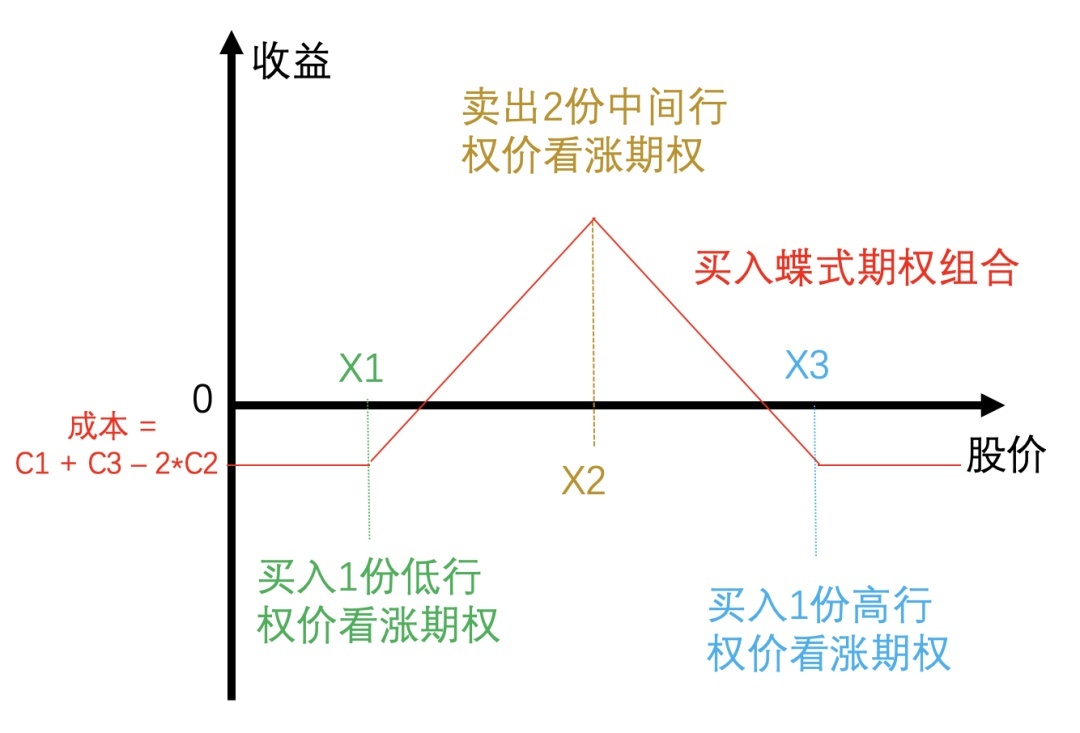
The red line represents the Long Butterfly Spread's strategy returns.
Net cost to open position = C1 + C3 - 2×C2
Downside breakeven stock price = X1 + net cost to open position/100
Upside breakeven stock price = X3 - net cost to open position/100
Profit is possible only if the stock price is between the two breakeven points.
When stock price = middle strike price X2, the return is maximized
Maximum return = (X2 - X1)×100 - net cost to open position
When stock price < X1 or stock price > X3, the loss reaches its maximum
Maximum loss = net cost to open position
Strategy Features
1. A neutral strategy with relatively small returns and risks; the closer the stock price is to the middle strike price, the higher the profit; the further it deviates, the greater the loss, with the maximum loss being the net premium paid when opening the position.
2. Low-risk short volatility: Compared to other short volatility strategies (e.g., Short Straddle), the Long Butterfly Spread has limited maximum loss, more controllable risk, but relatively lower returns, making it suitable for risk-averse investors.
3. Suitable for sideways markets: When the market lacks a clear trend,volatility is high (higher premiums when opening the position, making selling middle options more cost-effective),and volatility is expected to decline afterward.
4. High cost efficiency: By "selling 2 middle options," part of the cost of buying options is offset, lowering the entry barrier.
Beta Practical Strategy Application
Disclaimer: The following content is for illustrative purposes only and does not constitute any investment advice. Users should refer to Beta's actual operation interface.
Assume a stock is currently priced at $633/share. Xiao Li believes the stock price won't fluctuate much in the short term (one week) and will oscillate narrowly around $635. As a risk-averse investor, Xiao Li is willing to sacrifice some returns for lower risk and peace of mind. For this investment need, Xiao Li chooses the Long Butterfly Spread.
Operation steps:
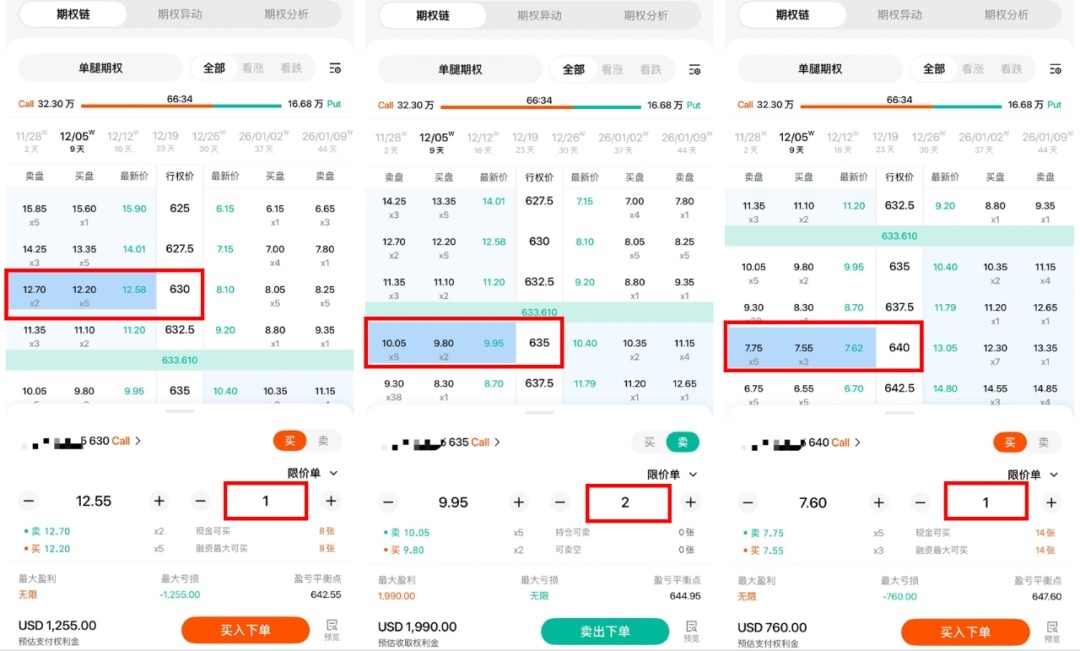
Buy 1 contract of Call1 with strike price 630
Buy 1 contract of Call3 with strike price 640
Sell 2 contracts of Call2 with middle strike price (635)
Net cost to open position = C1 + C3 - 2×C2 = 1255 + 760 - 2×995 = $25
$25 is also the strategy's maximum loss, occurring when the stock price <= 630 or >= 640.
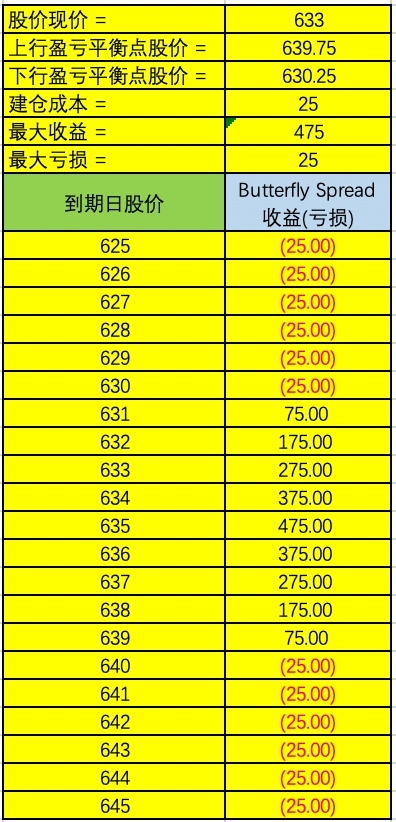
Downside breakeven stock price = X1 + net cost to open position/100 = 630 + 25/100 = 630.25
Upside breakeven stock price = X3 - net cost to open position/100 = 640 - 25/100 = 639.75
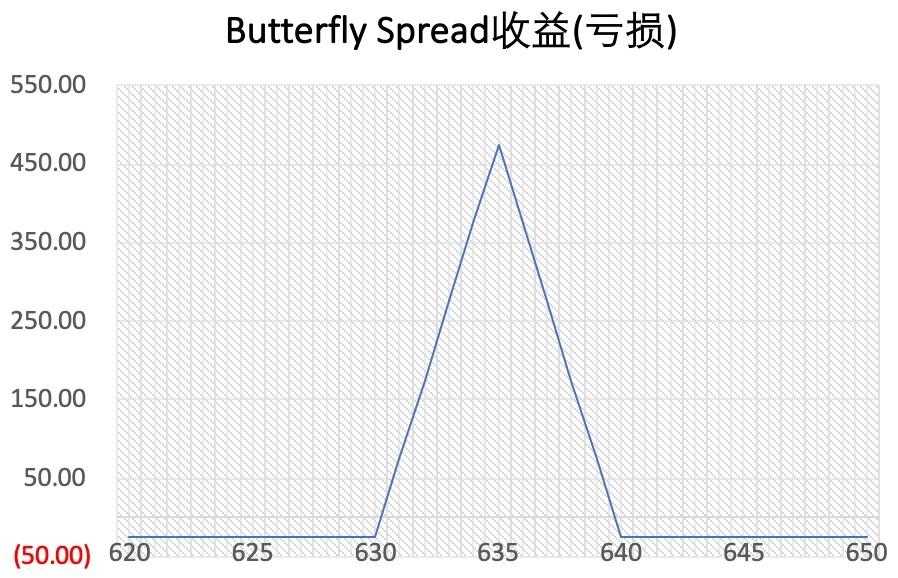
Profit is possible if the stock price is within [630.25, 639.75] (Note: Theoretical scenario excluding transaction costs).
Note that the closer the stock price is to the middle strike price of 635, the higher the profit.
Maximum return = (X2 - X1)×100 - net cost to open position = (635 - 630)×100 - 25 = $475
Scenario 1: Stock price crashes to $500/share
Call1 and Call3 are not exercised; premium loss = 1255 + 760 = $2015
Call2 is also not exercised; premium income = 2×995 = $1990
Total loss = 2015 - 1990 = $25, showing the strategy's low-risk nature.
Scenario 2: Stock price at $631/share, slightly above the downside breakeven point of 630.25 (begins to profit but not at maximum)
Call1 P&L = (631 - 630)×100 - 1255 = -$1155 (loss)
Call2 and Call3 are not exercised; premium P&L = 995×2 - 760 = $1230
Total return = 1230 - 1155 = $75
Scenario 3: Stock price at $635 (maximum return achieved)
Call1 P&L = (635 - 630)×100 - 1255 = -$755 (loss)
Call2 and Call3 are not exercised; total P&L = 995×2 - 760 = $1230
Total return = 1230 - 755 = $475
The following charts show the strategy's returns at different stock prices:
Usage Recommendations (For Reference Only)
1. This strategy is generally suitable for near-month contracts with short-term expirations (around 20-30 days). Shorter-term expirations (7-14 days) are riskier and only suitable for experienced traders. The Long Butterfly Spread requires the stock price to "quickly stabilize around the middle strike price." If the time frame is too long, the probability of the stock price breaking out of the range increases, and unexpected events (e.g., earnings shocks, policy changes) may disrupt the sideways expectation, rendering the strategy ineffective.
2. Strike price selection:
Typically, sell ATM (at-the-money) options, i.e., middle strike price = current stock price. This makes the strategy's risk and return more symmetric (Delta near neutral).
For the spacing between the two bought strike prices, it depends on your expected range of stock volatility. Narrower spacing makes profitability harder (as the breakeven range narrows), but the initial cost (and maximum loss) is lower, and the maximum return is also smaller, making it suitable for beginners. Wider spacing increases the profit range but raises the initial cost significantly, and potential losses and returns are amplified. Since the Long Butterfly Spread is inherently a low-risk, low-return strategy, narrower strike spacing is generally recommended. Investors seeking high-risk, high-return strategies usually avoid the Long Butterfly Spread.
3. Enter when implied volatility is high, and monitor for major events during the window.
The strategy is essentially shorting stock volatility, suitable when implied volatility is high relative to historical volatility and no major events (e.g., earnings releases, policy changes) are expected before expiration. Option volatility tends to mean-revert; without event catalysts, volatility will gradually decline from highs to the mean, benefiting the strategy.
4. Beginners should avoid highly volatile assets (small-cap stocks, Bitcoin, etc.) and prioritize liquid, balanced-volatility assets like blue-chip stocks or broad-market ETFs.
5. Avoid holding to expiration:
Beginners often make the mistake of "holding until expiration." If the underlying price deviates from the expected range (e.g., the stock keeps rising after opening the Butterfly Spread), close the position early to limit losses, avoiding the erosion of time value. Since the strategy involves selling options, if not closed before expiration, assignment may demand significant capital to buy stocks (naked short scenario), creating funding pressure.
For 30-day expirations, consider closing the position about a week before expiration based on market conditions to avoid gamma risk.
We will introduce more options combination strategies in the future. Interested friends are welcome to follow【Beta Investment Think Tank】for exclusive strategy tutorials + market opportunity analysis. Open the Beta APP and experience the charm of options trading firsthand!
Risk Warning: Options trading is a high-risk investment activity that may result in the loss of all principal. Investors should carefully consider whether such investments are suitable based on their investment experience, objectives, financial situation, and other relevant circumstances, after fully understanding the product's features and risks.
The copyright of this article belongs to the original author/organization.
The views expressed herein are solely those of the author and do not reflect the stance of the platform. The content is intended for investment reference purposes only and shall not be considered as investment advice. Please contact us if you have any questions or suggestions regarding the content services provided by the platform.