


 Cash Plus Booster
 Commemorative
Why not do day trading? — In-depth analysis of profit sources in a zero-sum game

Day trading (T) is using short-term price fluctuations to average down holding costs.
But if we look beyond the surface, we’ll find this is a brutal zero-sum game.
Because day trading doesn’t create new value (the number of shares remains unchanged), every cent you earn must correspond to someone else’s loss. In this "winner-takes-all, loser-pays" game, when you profit from day trading, where does your profit actually come from? And who is the one losing money?
The Essence of Profit Sources: A Brutal Zero-Sum Game
Day trading profits aren’t generated out of thin air—they come from other market participants "cutting losses." When you profit from day trading, the ones losing money are usually the following:
- "A version of yourself from another timeline" (the harshest truth):
Often, day trading profits are just survivorship bias. We tend to remember the times we got it right but forget the times we got it wrong. If you made a 2% profit today, it’s because you didn’t panic-sell at the low or FOMO-buy at the high. But if the one who panic-sold at the low or FOMO-bought at the high was also you (or your account), then you’re the one losing money. Success in day trading often means you’ve outplayed your own emotional, irrational "other self." - Weaker retail traders ("dumb money" cannibalizing each other):
In volatile markets, countless retail traders make disorderly trades. When you successfully buy the dip for a day trade, your shares often come from panic-selling retail traders. When you successfully sell high for a day trade, your shares are often bought by greedy FOMO traders. Your profit directly fills their losses. - Followers "reverse-harvested" by big players:
In one-sided trends or when big players are shaking out weak hands, if you profit from day trading, it often means you’ve accidentally positioned yourself against the big players. For example, you bought the dip when big players were accumulating (shaking out weak hands), or you sold high when big players were distributing (dumping shares). In this case, the followers blindly mimicking the big players and getting "reverse-harvested" become your profit source.
A table to understand "counterparties in day trading"
To better visualize this capital transfer, let’s look at the table below. When you profit from day trading, here’s what your counterparties are doing:
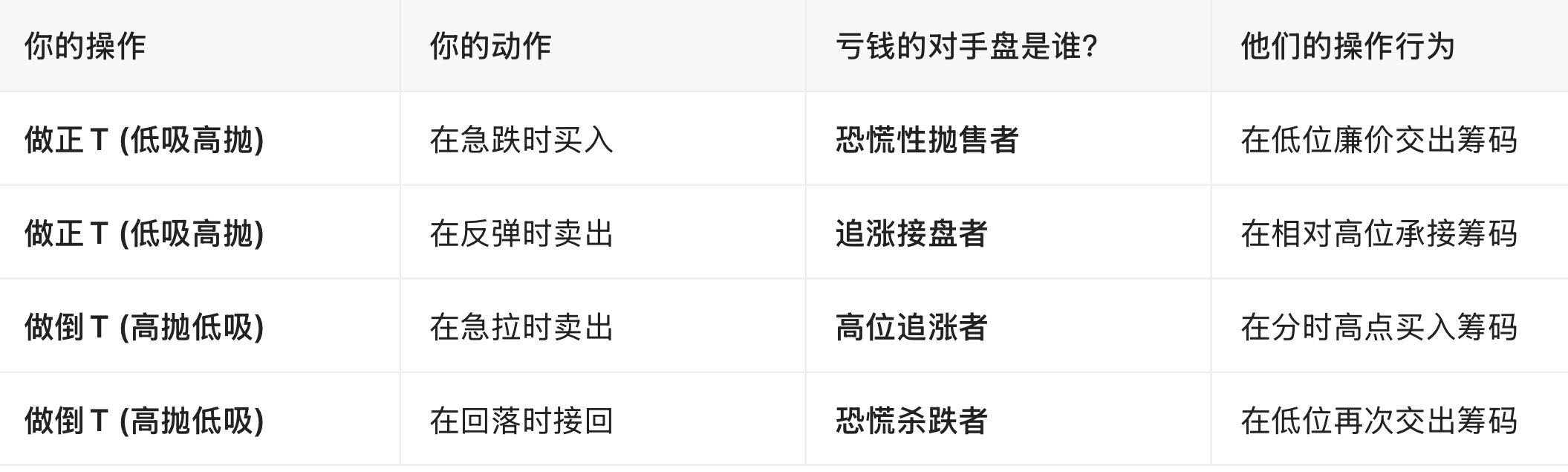
So, when you profit from day trading, you’re essentially taking money out of other market participants’ pockets.
● In volatile markets, you’re profiting from retail traders who can’t read the market and trade emotionally.
● In one-sided markets, if you profit from day trading, it often means you’ve accidentally positioned against big players.
This is why I’ve decided not to day trade:
Because when you think you’re smart for making money, you’re just temporarily not the one being harvested. Once your skills fall short of algorithms, your reactions lag behind big players, or your emotions take over, you’ll instantly go from being a profit-taker to a bagholder funding others’ profits. The principle is: don’t be the counterparty to big players, and don’t be the "weak link" hurting your own team.
Also, I’d like to thank my broker for serving a low-quality client like me ⁄(⁄⁄•⁄ω⁄•⁄⁄)⁄. Honestly, serving me probably isn’t very profitable for them.
The copyright of this article belongs to the original author/organization.
The views expressed herein are solely those of the author and do not reflect the stance of the platform. The content is intended for investment reference purposes only and shall not be considered as investment advice. Please contact us if you have any questions or suggestions regarding the content services provided by the platform.
