



The only full-industry-chain SiC IDM making a second attempt to list in Hong Kong, the mid-game battle of hard technology for Basic Semiconductor

In the Hong Kong stock market's tech sector in 2025, from AI servers to robotics, capital continues to value future narratives, but the assessment of hardcore operational metrics such as cash flow and mass production capabilities is also gaining more weight. Meanwhile, against the backdrop of global supply chain restructuring and accelerating global tech competition, we continue to see hard-tech companies intensively rushing to list under Chapter 18C of the Hong Kong Exchange. Some are betting on sectors, some on production capacity, and others on technological barriers.
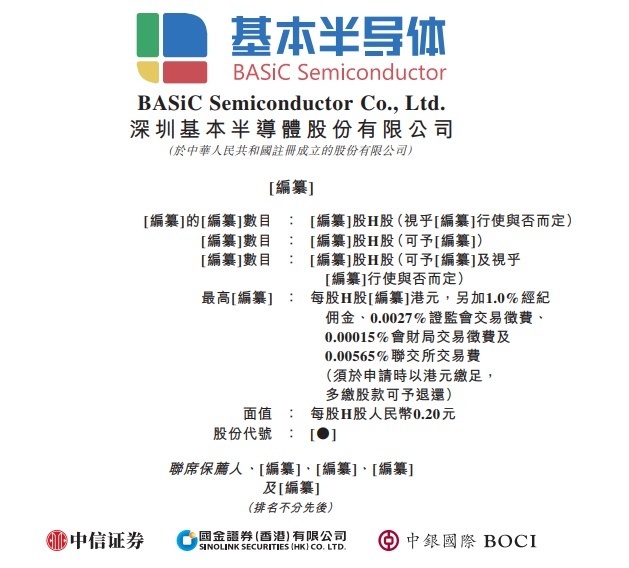
On December 4, Basic Semiconductor submitted its IPO prospectus (Chapter 18C) to the Hong Kong Exchange for the second time, becoming a rare case of a third-generation semiconductor company making another sprint this year.
Unlike consumer electronics and photovoltaic equipment, silicon carbide (SiC) power devices are not a high-frequency hotspot but rather an industry that is "slow to warm up but has a long runway and thick snow." Over the past three years, China's new energy vehicles, photovoltaic energy storage, and industrial control inverters have entered the high-voltage, high-power stage on a large scale, turning SiC devices from an "option" to a "must-have." However, for companies, this sector also means longer R&D cycles, heavier capital expenditures, and higher yield thresholds.
Basic Semiconductor is at a typical "hard-tech tipping point": revenue growth, narrowing losses, pressured gross margins, rising technological barriers, and a formed IDM model, but it still needs time to achieve true commercial-scale profitability.
In the Climb Zone, Not the Mature Zone
Founded in 2016, Shenzhen Basic Semiconductor is a leading domestic third-generation semiconductor power device company and the only IDM (Integrated Device Manufacturer) in China with in-house capabilities covering the entire value chain from SiC chip design, wafer production, and module packaging to gate driver design and testing. All segments have achieved mass production.
This "full-stack" layout forms the core narrative highlight of its prospectus.
The IDM model means the company internalizes multiple segments such as design, manufacturing, and packaging. Its advantage lies in achieving efficient synergy between R&D and manufacturing, accelerating product iteration, and better ensuring supply chain security and product consistency.
Over the past decade, by 2024 revenue, the company has ranked seventh globally and sixth in China's SiC power module market (data from Frost & Sullivan).
From a fundamental perspective, Basic Semiconductor shows strong revenue growth, but gross margins have rebounded from negative territory. Overall, it remains in the "revenue growth without profit growth" climb zone rather than the mature zone.
According to the prospectus, revenue grew from nearly RMB 120 million in 2022 to RMB 300 million in 2024, with a compound annual growth rate of nearly 60%. In the first half of 2025, revenue reached RMB 104 million, up 52.7% year-on-year, maintaining growth and even accelerating further. This growth performance is actually better than most domestic SiC startups.
Growth is mainly driven by the continuous scaling of power modules and high coverage in new energy vehicle factories. However, gross margin fluctuations are significant, improving to -9.7% year-on-year in 2024 but dropping to -28.8% in the first half of 2025.
The reason for the "further decline" in gross margins is not demand issues but the typical logic of IDM expansion. Low yields during the ramp-up phase of new production lines, phased increases in unit costs due to module process iterations, and long customer validation cycles make it difficult for capacity utilization to keep up with revenue growth in the short term.
In fact, compared to peers, this is a normal phenomenon during expansion. Silan Microelectronics' SiC business once had gross margins below -10% in its early stages, StarPower Semiconductor also experienced a long gross margin climb, and SICC Technologies saw single-digit gross margin fluctuations during automotive module validation. Therefore, Basic Semiconductor's widening losses are not "operational deterioration" but rather a typical climb phase of "insufficient production line maturity × extended customer certification cycles."
In the first half of this year, its net loss expanded year-on-year to RMB 177 million. In other words, the short-term decline in gross margins is a structural cost of long-cycle hard tech.
Over Half of R&D Investment: Can Losses Secure the Future?
Compared to these, Basic Semiconductor's adoption of a rare "hardcore approach" in China is also commendable.
Although small in scale, its annual R&D ratio has long remained in the 30% range, which is extremely rare in the industry.
More importantly, R&D investments have been effective. As of June 30, it held 171 patents, submitted 118 applications, and had 39 integrated circuit layout designs. Operationally, the IDM model is fully implemented, with in-house mass production capabilities spanning wafer manufacturing, module packaging, and gate driver design.
The benefits of IDM include synergistic optimization of device parameters and module structures, higher long-term gross margin ceilings, more stable customer delivery capabilities, stronger customer stickiness, and advantages in automotive-grade design wins. However, the short-term results may include high capital expenditures, heavy depreciation and amortization, slow yield ramps, and tight cash flow.
It can be said that Basic Semiconductor's losses are more like a choice to "press costs, capacity, and processes in advance for the future." The capital market may worry about short-term profitability, but in the third-generation semiconductor sector, this level of R&D intensity and production line layout is a necessity.
Of course, while the revenue structure shows Basic Semiconductor has completed "from 0 to 1," "from 1 to 10" still takes time. By 2024 revenue structure, SiC power modules remain the core, accounting for 48%, gate drivers nearly 40%, and SiC discrete devices shrinking further.
In terms of valuation reference, Basic Semiconductor shares the same sector logic as peers but with different focuses.
Comparable listed companies include Silan Microelectronics as an IDM with broad product offerings, mature processes, and stable profits; StarPower Semiconductor as the leader in IGBT/SiC modules, with high module gross margins and deep automotive penetration; and SICC Technologies, which leans toward equipment and some power semiconductor businesses.
Basic Semiconductor's differentiation lies in its more thorough IDM depth and more concentrated automotive module layout. Despite smaller revenue scale, it grows faster; gross margins fluctuate more, but technological barriers are higher. In other words, Basic Semiconductor's IPO logic is not profit but industry positioning.
The question the capital market needs to answer is whether it can become "one of China's top three automotive-grade SiC module suppliers" in the next two years. If the answer is yes, its long-term valuation logic will be significantly different.
On the Eve of an Industry Watershed, a Second IPO Application for a Ticket
The industry is accelerating domestic substitution, and SiC is entering a "second inflection point." Competition is not a zero-sum game but a move toward a scale watershed. Winners will come from stable mass production capabilities, not single-point technologies.
According to Frost & Sullivan, China's SiC power module market grew at a compound annual rate of 32.9% from 2020–2024 and is expected to reach 36.6% from 2025–2029. Growth drivers include the shift from IGBT to SiC MOSFET in new energy vehicle powertrains, 800V platform penetration, improved efficiency in photovoltaic storage and industrial inverters, and increased demand for high efficiency in data centers.
This means SiC is not a short-cycle industry but a structural one with sustained volume growth over the medium to long term. Especially in new energy vehicles, China's automotive-grade SiC penetration is expected to rise from single digits to 30%–50% from 2024–2029, a huge and certain trend.
In terms of competition, China's SiC power module market is highly concentrated, and "entering the top six" is itself a barrier. Beyond modules, Basic Semiconductor holds a 2.8% market share in SiC devices (ranking eighth) and 1.7% in gate drivers (ranking ninth). While not dominant, this indicates significant room for improvement, and technological changes present this opportunity.
Automotive-grade SiC modules face high supply chain barriers, with validation cycles lasting 18–36 months, complex module structures, and difficult yield improvements. The IDM model is hard to replicate. Once in the supply chain of leading automakers, even if not in the first tier, a company's competitive barriers become very solid.
Currently, Basic Semiconductor has secured design wins from over 10 OEMs and more than 50 vehicle models, including supply chains like BYD and Li Auto. This is a clear signal that the company is transitioning from technological breakthroughs to product delivery.
However, as the industry's pain point shifts from "lack of capacity" to "lack of high-quality capacity," the value of IDM is becoming more apparent. Companies like StarPower and Silan are expanding production, and automakers are also supporting local module suppliers. As new capacities ramp up, the industry's top players will diverge further over the next three years. Companies with IDTM, stable delivery capabilities, and automotive-grade qualifications will grow with higher gross margins and order stickiness. In contrast, those relying solely on foundries or low-end capacity may face price wars.
Basic Semiconductor is currently before this watershed. Its future trajectory depends on production capacity maturity, yield improvement speed, and automotive module scaling pace.
This also explains the logic behind Basic Semiconductor's second IPO application in December: not "urgent financing" but a combination of the following factors.
First, IDM production lines are entering the mass production validation phase, requiring capital expenditures to support yield improvements. Second, automotive customer design wins are entering the implementation phase, and supply chain positioning needs capital market confirmation. Additionally, listing during a hard-tech cooling-off period may lead to more reasonable valuation expectations.
Basic Semiconductor is not a "storytelling" AI company nor a light-asset firm with short-term profitability inflection points. Its IPO is more like a ticket to enter the long-term competitive landscape rather than the endpoint of profit realization.
Basic Semiconductor is navigating the "hard-tech mid-game."
The copyright of this article belongs to the original author/organization.
The views expressed herein are solely those of the author and do not reflect the stance of the platform. The content is intended for investment reference purposes only and shall not be considered as investment advice. Please contact us if you have any questions or suggestions regarding the content services provided by the platform.
