


 Rate Of Return
 Total Assets
Why are index funds considered the cheapest quantitative investment?

Nowadays, more and more people in the market are saying one thing: "Index funds are essentially the cheapest form of quantitative investing."
This view sounds a bit strange, but this statement is not just a marketing slogan. Behind it lies a fundamental understanding of investment logic:
Index funds are not just "tools for passive gains" but rather a complete, mature, and low-cost rule-based investment system.
And "rule-based investing"—that is the essence of quantitative investing.
To understand why index funds are the "cheapest quantitative," we need to break it down from three angles: What do they resemble? What are they cheaper than? And what are they missing?
The Essence of Quantitative: Not Models, but Rules
Many people think quantitative investing is about high-frequency trading, machine learning, algorithmic arbitrage, or strategy engineers. But these are just manifestations.
The core essence of quantitative investing is just one sentence: Replace subjective judgment with repeatable, verifiable rules.
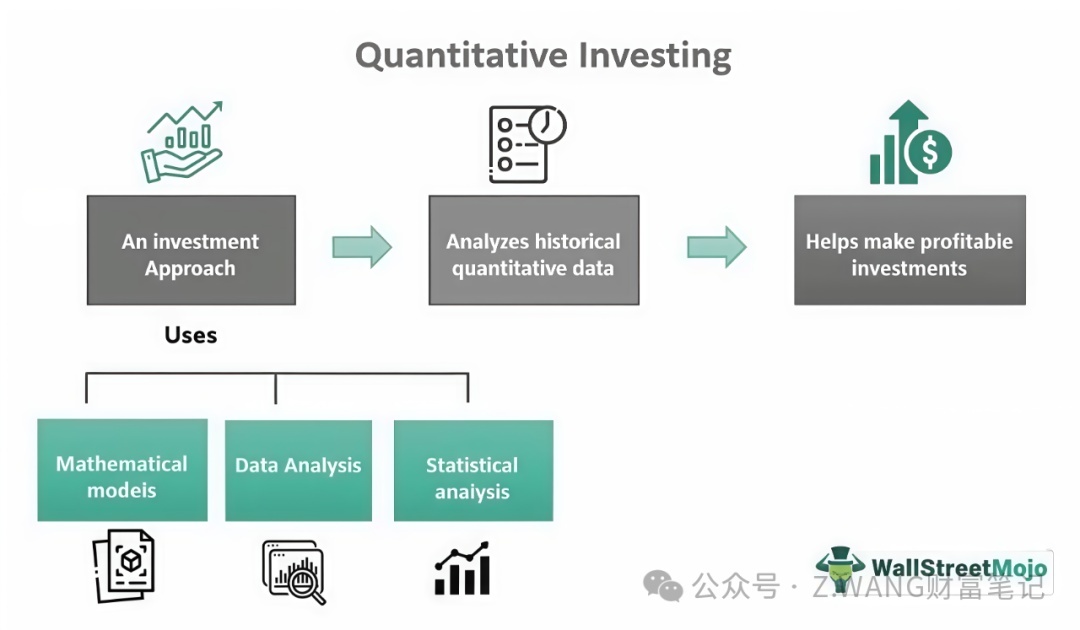
Take the simplest example:
An investor picking stocks based on gut feeling—that’s not quantitative.
An investor setting a clear rule, like "the top 50 tech stocks by market cap, rebalanced quarterly," without personal bias—that’s already the most basic form of quantitative.
So, is this the logic of an index? Exactly—this is the underlying logic of index funds.
Who gets into the index? There are rules (market cap, profitability, liquidity requirements).
How are weights calculated? There are rules (constituent stock market cap ratios).
When is rebalancing done? There are rules (quarterly, semi-annual updates).
Does it rely on a fund manager’s gut feeling? No. Does it require predicting the future? Also no.
This is the most primitive, simplest, and most straightforward quantitative model.
Index Funds vs. Quantitative Funds: Similar or Not?
From a professional investment framework, index funds and quantitative investing share some overlapping logic—just at different levels of complexity. Below is a simple comparison between index funds and quantitative funds:
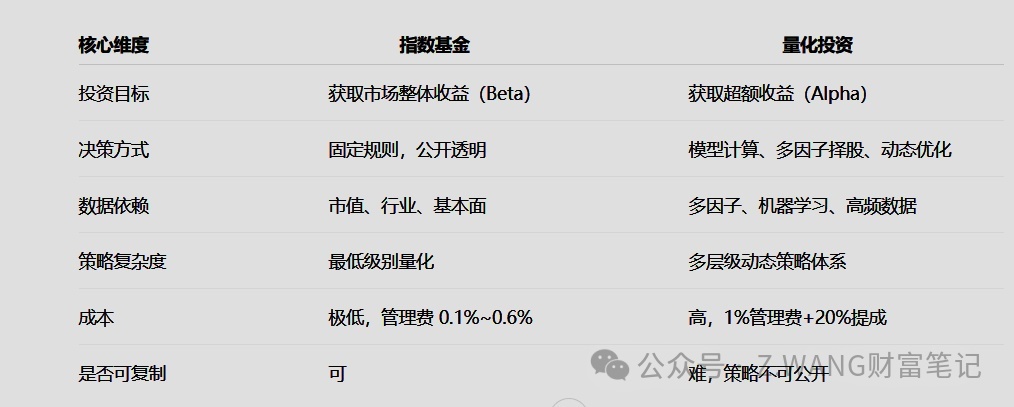
So, what are index funds?
Index funds = Extremely low-cost, transparent, long-term effective "Beta-type quantitative strategies."
They are not the entirety of quantitative investing, but they are the "underlying template" for all quantitative strategies.
In fact, many quantitative-enhanced funds (Enhanced Index) in the market are essentially just index funds with additional stock-selection factors, wrapped in a "quantitative fund" package.
★ Recommended reading: How Do Quantitative-Enhanced Index Funds Actually Enhance Performance?
Where Are Quantitative Funds 'Expensive'?
Why is quantitative investing expensive? The main cost sources are:
Data Costs
Quantitative funds rely on high-dimensional financial/cross-sectional/high-frequency data, while index funds have extremely low data costs.
Computational Costs
Quantitative funds require models, servers, and engineers to run strategies, while index funds have almost none.
Management Fees
Quantitative funds come with 1%~2%+ or even higher performance fees, while index funds, which are primarily passively managed, have very low fees—usually 0.1%~0.6%.
Additionally, quantitative funds require massive data & computing power: strategy research teams, backtesting systems, high-frequency trading systems, and risk control models.
Meanwhile, index fund strategies are extremely simple: market-cap ranking + periodic rebalancing.

Compared to quantitative funds, index funds are rule-based, stable, extremely low-cost, and highly transparent, making them suitable for long-term execution and more appropriate for ordinary investors to hold over time.
More importantly: Some low-alpha quantitative strategies, after fees, underperform the index in the long run. But the index keeps up with the market in every bull run.
Index Funds Are the 'Evergreen' Quantitative for Ordinary Investors
From an investment outcome perspective, for ordinary investors, the advantages of index funds are solid: They offer relatively high return stability and strategy transparency, drawdowns move in sync with the market, investments are easier to stick with, and long-term holding has a greater probability of profitability.
We may not be able to make the fastest money in quantitative investing, but we can likely earn the money from time and compounding.
Take Vanguard, the most well-known index fund company, as an example. Its index-based ETFs, despite their extremely low costs, have still generated very impressive returns for investors over the long term.
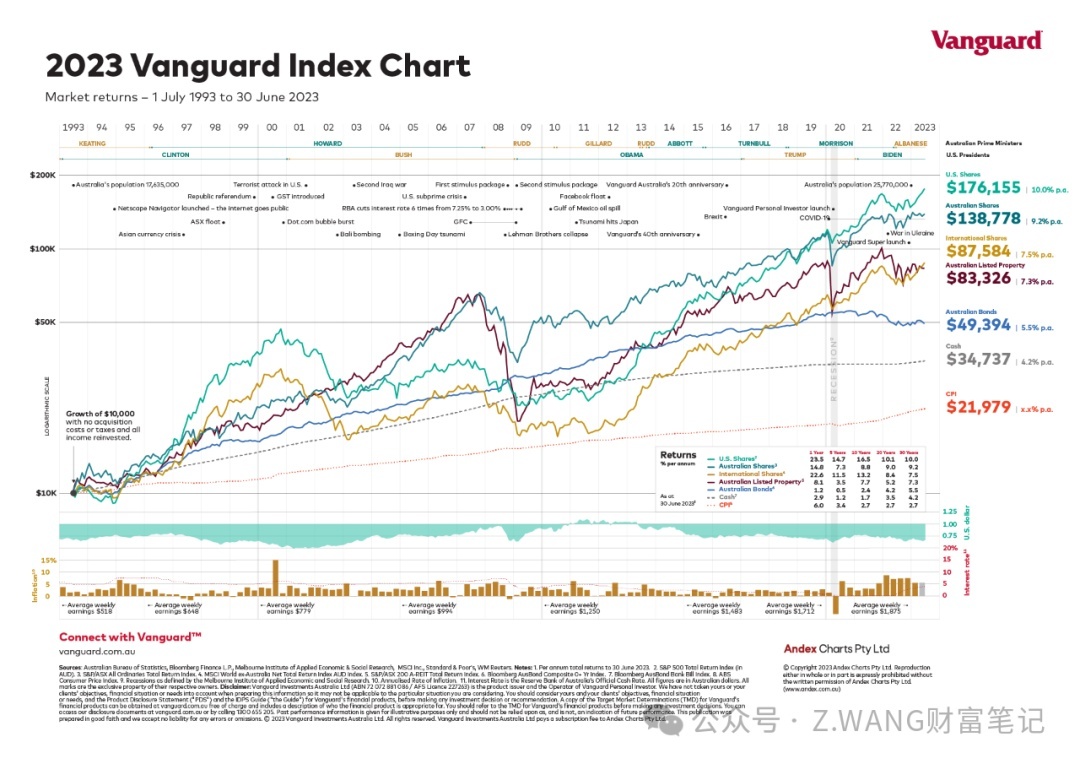
Index funds, because they are simple to understand, effective over long cycles, have controllable drawdowns, and require no market timing, have a lower investment threshold—making them more suitable for the vast majority of ordinary investors.
Index Funds Aren’t Perfect—What Are They Missing?
Lack of Alpha: Index funds only provide market-average returns and cannot outperform the market.
Concentrated Holdings: For example, the Nasdaq is heavy on tech stocks, while the CSI 300 leans toward cyclical financials.
Lack of Flexibility: They cannot implement timing, hedging, or arbitrage strategies.
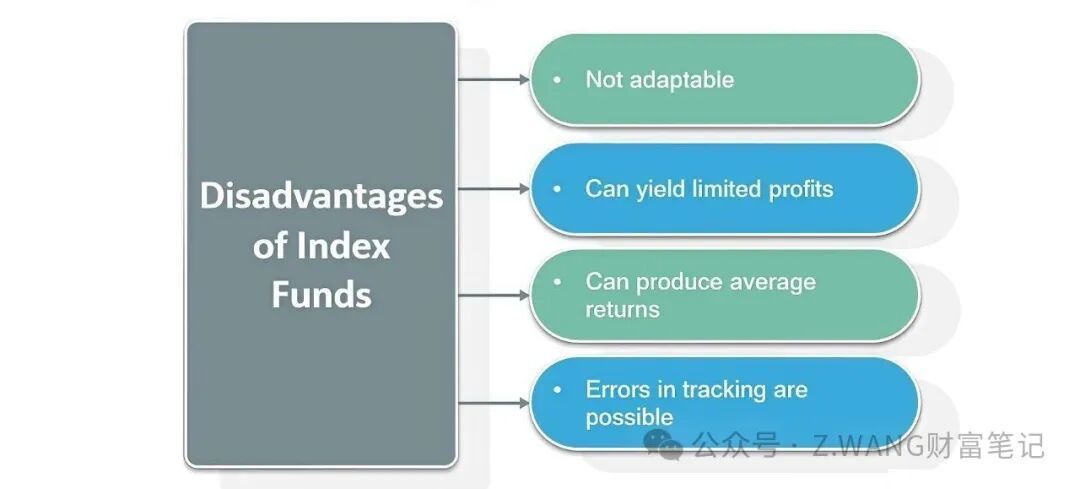
This is why products like quantitative-enhanced indices, Smart Beta, factor ETFs, and CTA hedge indices have emerged in the market.
Their core idea is: On the "skeleton" of low-cost quantitative index funds, incorporate some quantitative models to achieve structural Alpha.
So, index funds are not the end of quantitative investing—they are the starting point.
Index Funds Are the 'Cheapest Quantitative'
Index funds are not about "mindless passivity" but rather a lowest-cost, highest-transparency, long-term effective quantitative investment framework. They neither chase short-term windfalls nor rely on machine learning or complex models, yet they can:
Replace judgment with rules, aligning with the essence of quantitative
Be simple and transparent enough for long-term adherence
Have extremely low costs, making them the most cost-effective among all quantitative strategies
In the long run, their reliability even surpasses most complex quantitative strategies
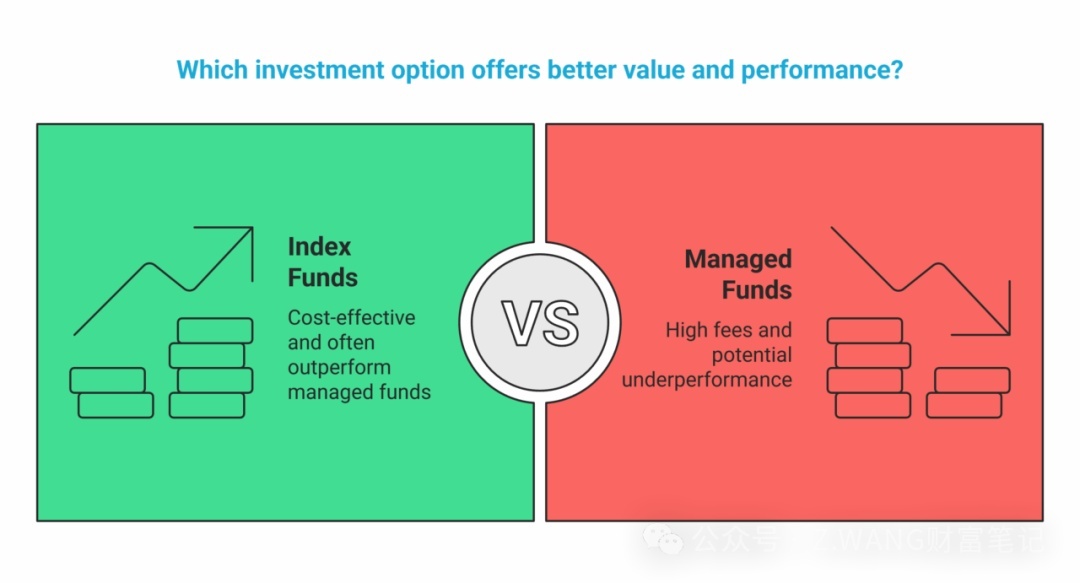
So, I believe: "Index funds are the cheapest quantitative—and the only quantitative that ordinary investors can hold long-term."
To Understand Quantitative, First Understand Index Funds
Whether you prefer active investing or are fascinated by complex quantitative models, you’ll eventually discover a simple truth: Most of the market’s returns come from holding a simple, transparent, low-cost rule-based system over time.
This system is index funds. They don’t rely on emotions, don’t require predictions, and won’t suddenly "go offline" due to model failures—yet they quietly and steadily compound market growth into our accounts over the long term.
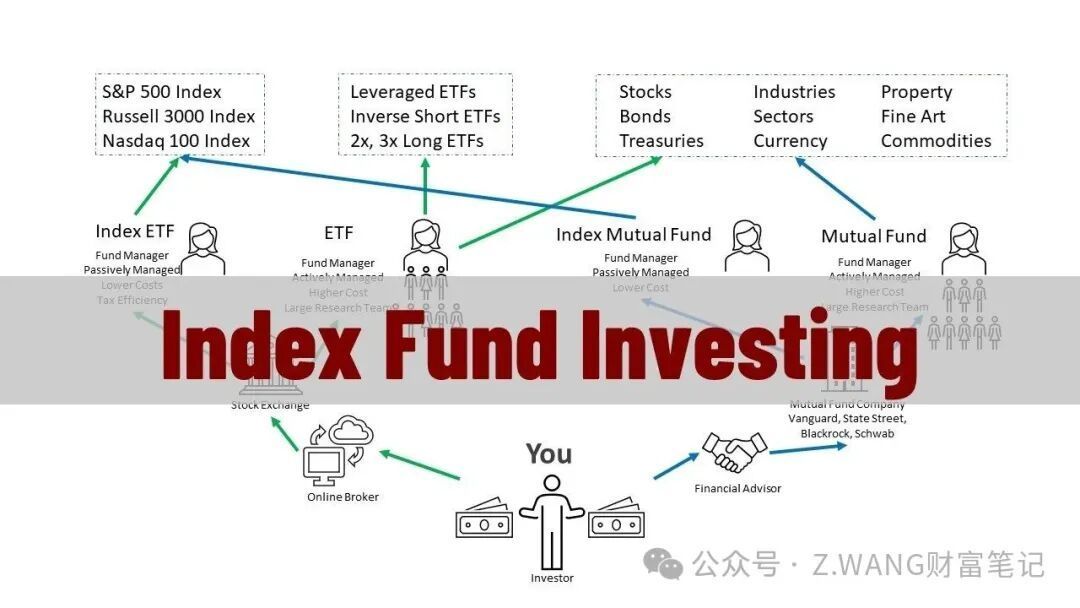
So, "index funds are the cheapest quantitative" is not just an investment slogan—it’s a cognitive upgrade. When we stop obsessing over beating the market and start thinking about how to effectively participate in it, investing becomes simpler, easier, and more likely to succeed.
Maybe we don’t need to become quantitative experts, but you can absolutely have your own quantitative framework.
And index funds are the most cost-effective key to that.
The copyright of this article belongs to the original author/organization.
The views expressed herein are solely those of the author and do not reflect the stance of the platform. The content is intended for investment reference purposes only and shall not be considered as investment advice. Please contact us if you have any questions or suggestions regarding the content services provided by the platform.
