


 Rate Of Return
 Total Assets
If Japan starts raising interest rates, what impact will it have on U.S. stocks?

For the past 30 years, Japan has been the "super stabilizer" of the global financial system:
Zero/negative interest rates provided the world's lowest-cost funding currency;
Massive savings and cross-border investments supported long-term demand for U.S. Treasuries and dollar-denominated assets;
The yen carry trade (Yen Carry Trade) formed the underlying structure of global leveraged capital chains.
But as inflation dynamics shift, wage growth recovers, and the Bank of Japan gradually exits YCC, a Japanese rate hike is becoming an increasingly "potentially forced" policy scenario.
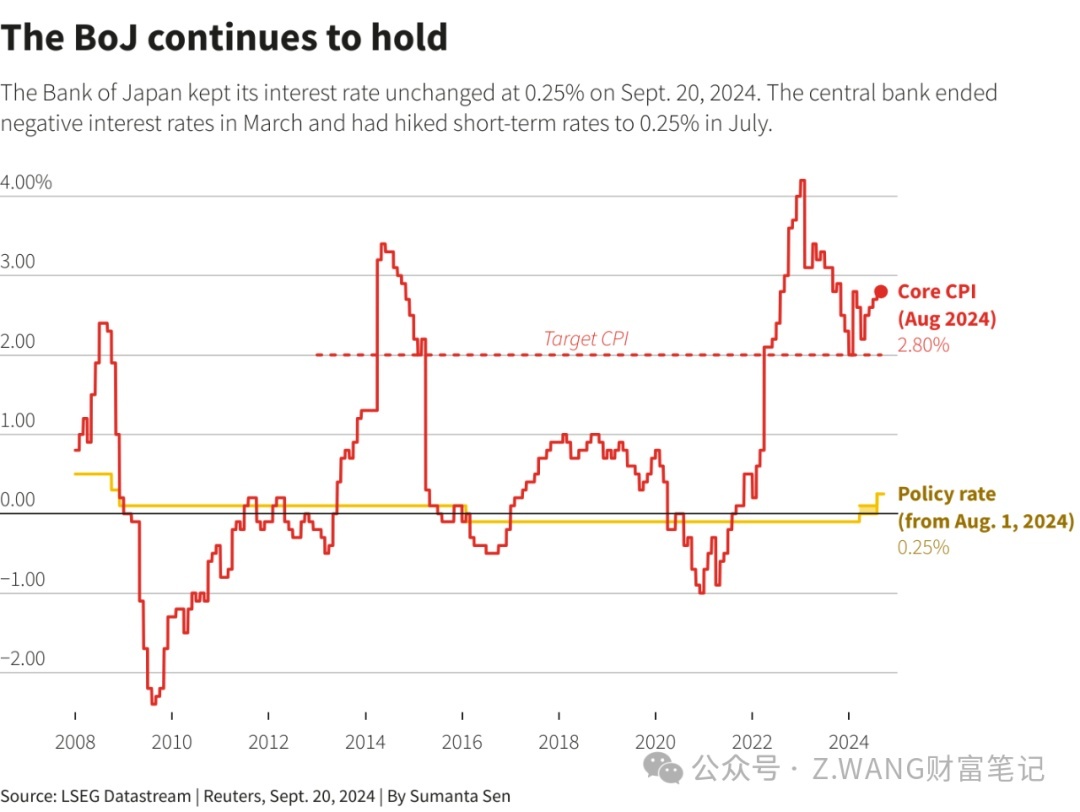
Although the Bank of Japan has ended negative interest rates and raised its policy rate to 0.25%, monetary conditions remain highly accommodative; while Japanese inflation has eased, it remains above the 2% target.
If Japan initiates rate hikes, the impact will extend far beyond exchange rate volatility—it will trigger a repricing of the global asset valuation system. The most directly affected market, without question, is—U.S. equities.
The reason is simple: U.S. stocks are the world's most liquid, largest, and most globally cost-of-capital-dependent assets. Once the global leverage chain reverses, the shock will inevitably land first on growth assets like U.S. stocks.
This article will explore the issue from five dimensions: capital structure, historical precedents, asset pricing, sector pathways, and scenario analysis.
The Underlying Logic of Japan's Rate Hike: The Era of the World's "Cheapest Money" May Be Ending
1. Core Reasons for Maintaining Ultra-Loose Policy for So Long
Population decline
Deflationary inertia and weak demand
Insufficient corporate wage hikes
Low risk appetite in the banking sector
Highly financially repressed government bond market (~90% held by domestic demand)
Thus, for decades, Japan has relied on the extreme combination of zero rates + QE + YCC.
This policy has led to:
The yen becoming a cheap funding currency
Japanese investors massively buying foreign bonds (especially U.S. Treasuries)
The formation of a global "Yen Carry Pool"
As long as Japan maintains zero rates, this system can operate indefinitely.
2. The Risk Reversal: Japan's Inflation Dynamics Are Changing
Since 2022, Japan has seen three historically rare trends:
Core CPI persistently >2%
Significant wage growth (spring wage negotiations near 30-year highs)
YCC band widening (0→0.25→0.5→1%)
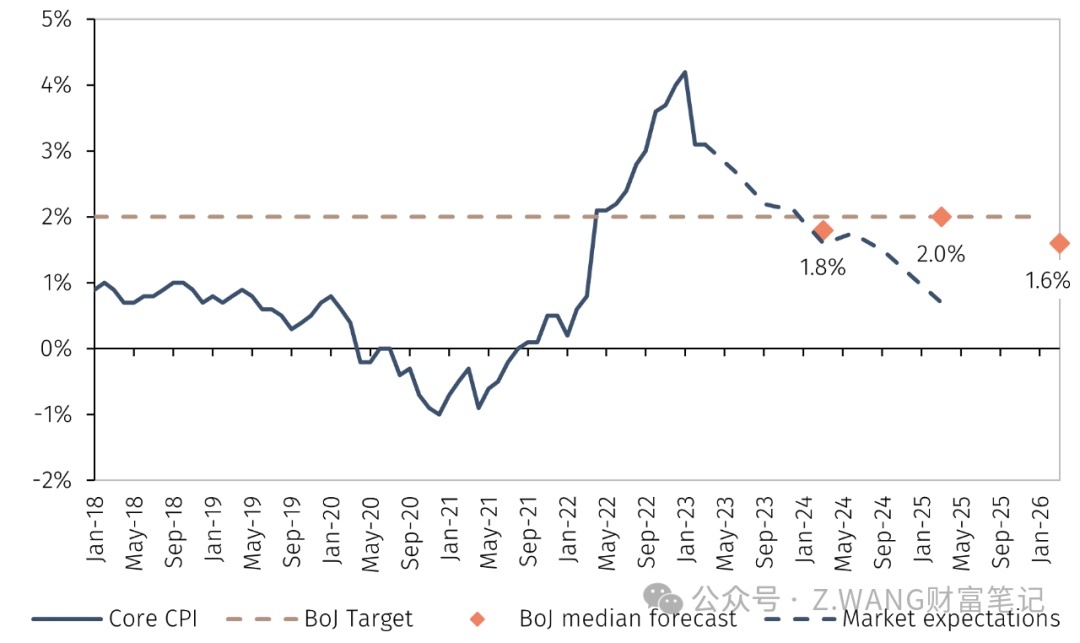
As shown above, Japan's inflation is currently declining and will likely fall below the central bank's target in the next two years. This implies: markets believe Japan's current high inflation is unsustainable, limiting room for rate hikes.
But the BOJ can no longer indefinitely maintain its "pretend deflation" policy. For the first time, the probability of a Japanese rate hike is truly being priced into markets.
3. Triggers for a Japanese Rate Hike
From an institutional perspective, if Japan hikes, the following combination of signals is likely:
Core inflation >2% with persistence
Wage growth entering the 3% range
U.S.-Japan rate differentials narrowing to unsustainable carry levels
Rising volatility in U.S. Treasury yields forcing Japan to reduce foreign bond allocations
Government bond yields breaking the BOJ's tolerance band (e.g., 10-year >1.5%)
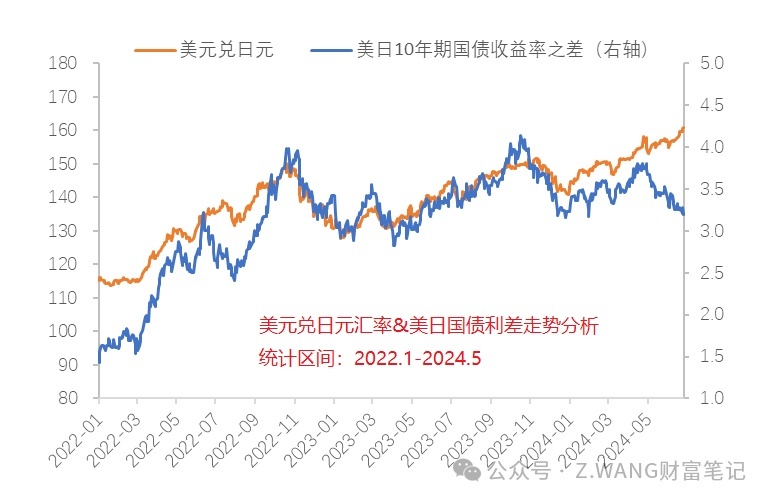
If Japanese rate hikes materialize, the global financial market's cost-of-capital structure will face significant shocks.
Repricing the Carry Chain: Why Would a Japanese Rate Hike Detonate Global Risk Assets?
The impact of Japanese rate hikes on U.S. stocks isn't about "Japan's economy affecting America"—it's about:
Japan = the world's most critical leverage pool.
Yen rate hikes = draining that pool.
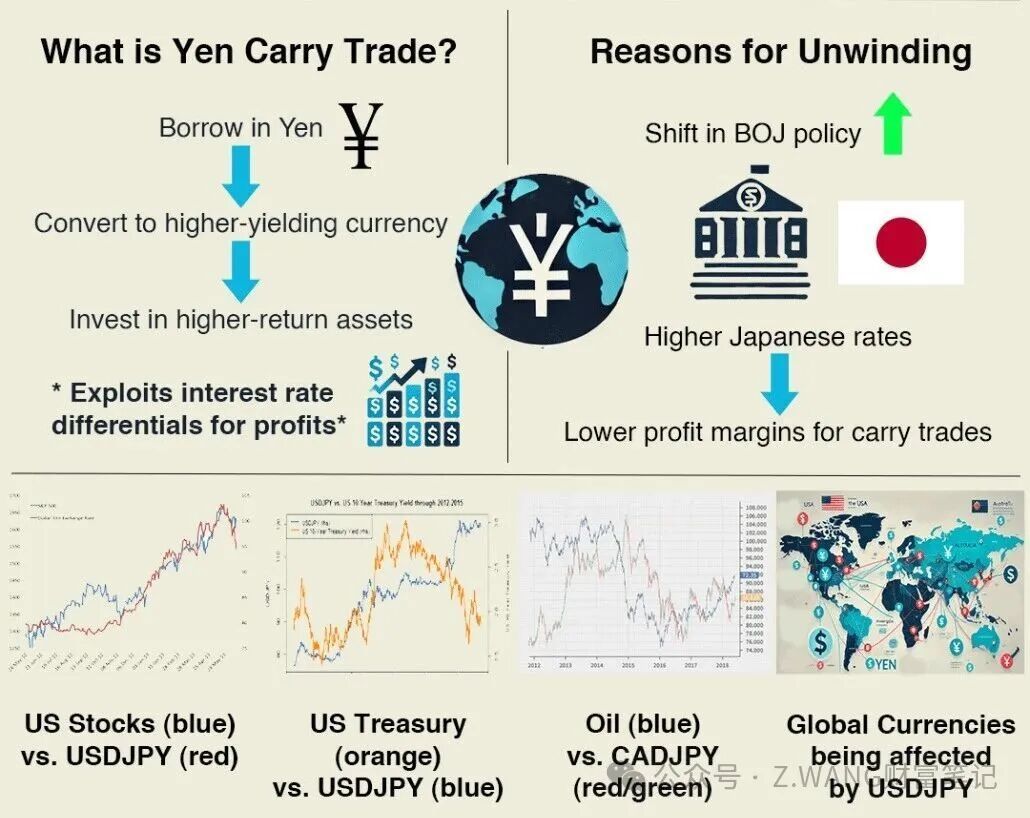
1. The Structure of Yen Carry Trade
The typical arbitrage chain:
Borrow yen (low cost)
Sell yen → buy dollars/other currencies
Invest in U.S. Treasuries, equities, high-yield assets
Capture yield spread + asset appreciation
Use dollars to repurchase yen and repay debt
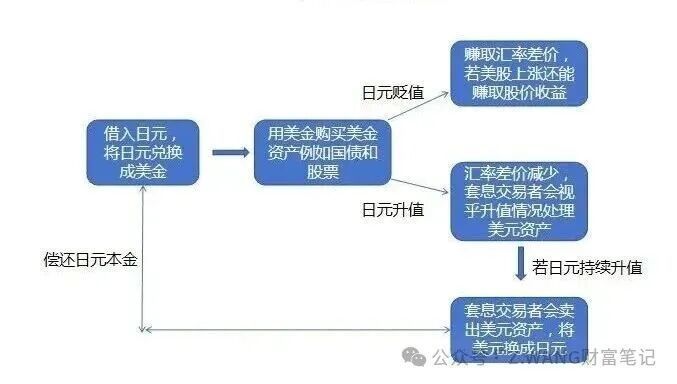
In reality, trillions in global capital depend on this model.
2. Japanese Rate Hikes Would Lead to: Carry Trade Unwind
Higher funding costs → shrinking arbitrage margins
Yen appreciation → mark-to-market losses on existing positions
Forced liquidation → selling U.S. stocks, Treasuries, EM assets
Accelerated selling → further yen strength (vicious cycle)
This is a classic "reflexive liquidation cascade" mechanism.
3. Historical Precedents of Global Asset Price Collapses
History shows that whenever the yen appreciates sharply, U.S. stocks are never spared. Three 典型案例 are summarized in the table below:

4. Why U.S. Stocks Are the Most Vulnerable
Because they exhibit:
World's largest liquidity pool → ideal for carry trades
Tech/growth stocks have "long duration" → most rate-sensitive
High concentration of foreign ownership
U.S. equities are the global risk appetite anchor → first sold during deleveraging
Thus, yen rate hikes are effectively a trans-Pacific headwind for U.S. stocks.
The Transmission Path of Japanese Rate Hikes to U.S. Equities
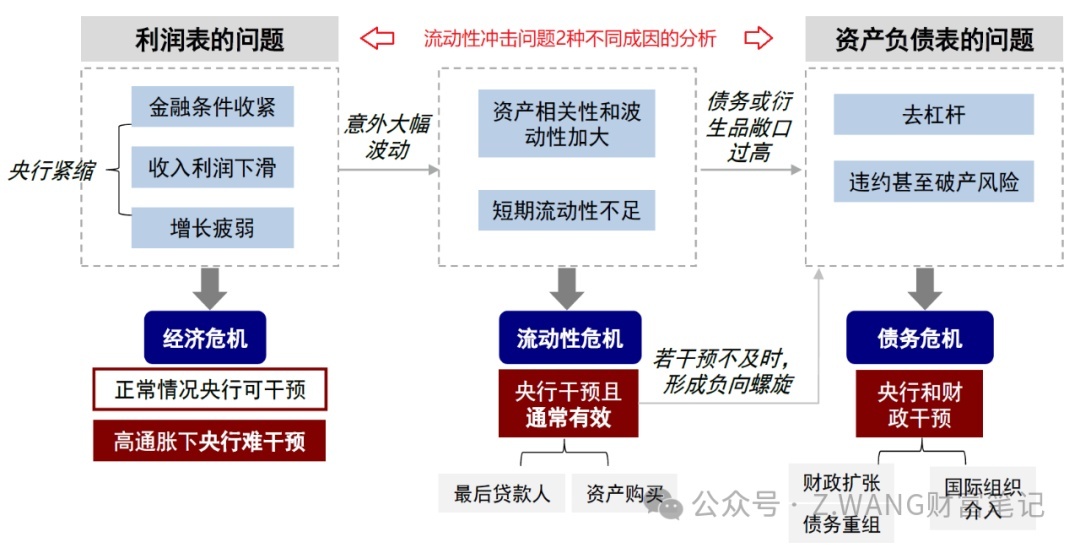
The shock path can be summarized as moving from FX to rates to equity valuations and positioning. This section is the core analytical framework and the asset pricing chain most watched by institutional investors.
1. First Shock: Violent USD/JPY Volatility
Japanese hikes → yen appreciation → dollar under pressure
Then: Carry unwind → global risk-off → dollar rebounds against yen, creating a classic "dollar dip-then-rip" two-phase move, implying short-term Treasury yield plunges (safe-haven bids).
Subsequent Treasury selloffs amid tightening liquidity and rising U.S. funding needs → amplified equity valuation swings.
2. Second Shock: U.S. Yield Curve Turmoil
Treasuries typically rally first (safe-haven) then sell off (liquidity pressures). This directly impacts:
Tech valuations (long-duration assets hyper-sensitive to rates)
Growth/high-multiple sectors facing "valuation compression"
Higher risk-free rates → expanded equity risk premia
3. Third Shock: Capital Flight from U.S. Assets
During carry unwinds:
Foreigners sell Treasuries first, then U.S. equities, then EM ETFs, with funds temporarily repatriating to Japan or fleeing to havens (cash, gold, short-dated bonds), potentially triggering a U.S. stock price-volume collapse.
4. Fourth Shock: Dual Compression of Valuations & Risk Appetite
Typical sequence:
Rising rate risk → wider equity risk premia → marginal liquidity tightening → reduced tolerance for "long-dated growth" → high-multiple sectors lead declines.
5. Fifth Shock: Most Crowded Trades Get Hit First
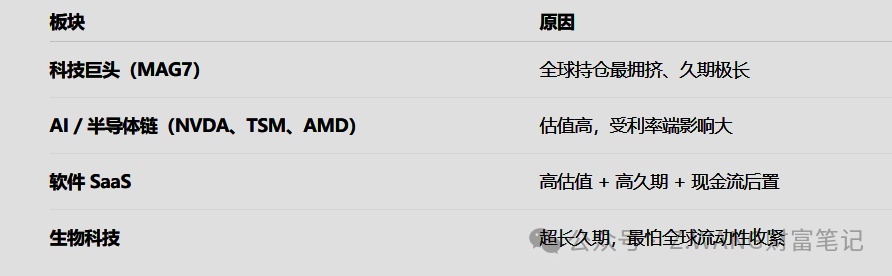
Currently, the hottest, most overcrowded U.S. sectors would be vulnerable:
E.g., AI/semiconductors, MAG7, software/cloud, biotech (ultra-long duration multiples)—their capital structures make them the first liquidation targets.
Sector Pathways: Which U.S. Equities Are Most at Risk? Which Are Safer?
1. Most Exposed: Long-Duration + Globally Crowded Trades
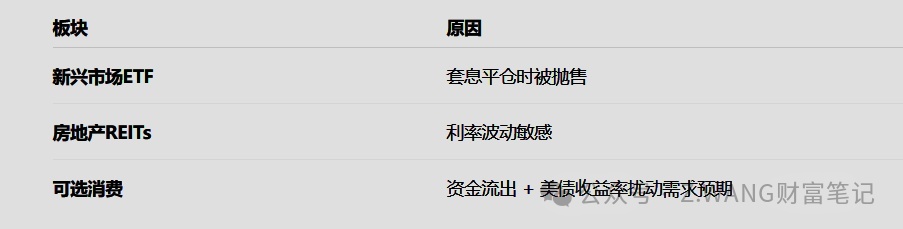
2. Moderate Impact: Cyclicals & Emerging Markets
3. Relative Outperformers/Resilient Sectors

If Japan Hikes, What Market Phases Could U.S. Stocks Experience?
Here's a "three-phase shock model" commonly used by institutions. I'll attempt to project the three stages of yen hike impacts.
Phase 1 (Most Violent): Leverage Chain Rupture → Rapid Selling
Duration: ~2-4 weeks
Market characteristics:
Sharp yen appreciation (USD/JPY potentially breaking 130-135)
Major U.S. equity correction (10%-20%)
Impact severity: NASDAQ > SP500 > Dow
VIX spikes to 25-35 range
Treasury yields plunge (safe-haven demand)
Massive flows into money funds, short-dated bonds, gold
Institutions will interpret this as a classic "exogenous liquidity shock."
Phase 2 (Choppy): Rate Repricing → Macro Recalibration
Duration: ~1-3 months
Market characteristics:
Dollar whipsaws
Treasury yields stabilize with modest rebounds
Growth attempts rallies but lacks follow-through
Value shows "relative strength"
Markets start pricing "earlier Fed cuts"
Overall lower volumes + amplified volatility
This is the phase most prone to "fake rallies."
Phase 3 (Recovery): Risk Appetite Returns → Style Rotation
Duration: ~3-12 months
Market characteristics:
Shift from "explosive growth" to "balanced growth"
Valuation digestion completes; "long-duration" no longer overcrowded
Gradual base-building
Capital likely reallocates sequentially to:
Large-cap value
Industrials, energy
U.S.-centric demand plays
Select repriced tech leaders
Ultimately, U.S. stocks remain the global capital endgame, but with markedly shifted sector leadership.
Summary: The "Chain Reaction" of Japanese Rate Hikes on U.S. Stocks
This article attempts to outline an analytical framework:
(1) The yen isn't marginal—it's the centerpiece of global leverage
Japanese hikes would trigger cross-market systemic unwinds, reversing carry trades.
(2) Yen strength → Carry unwind → U.S. equities hit first
Not Japan affecting America, but rather "capital chains" impacting U.S. stocks.
(3) The sequence is increasingly clear:
Tech giants/AI → growth → EMs → large-cap value → gold/energy relatively resilient
(4) Rate shocks force structural asset repricing
Ultimately, U.S. markets restart, but likely shift from "hyper-growth" to "balanced growth."
(5) Key leading indicators to watch:
USD/JPY (accelerating appreciation?)
Japanese wage-inflation dynamics
10-year Treasury volatility (MOVE index)
U.S. tech positioning/crowding
Global ETF flows
In short: Japan hikes = global deleveraging = U.S. growth's "exogenous shock.
Final outcomes may include:
Short-term: Major U.S. equity adjustment
Medium-term: Valuation reset
Long-term: U.S. remains capital's endgame, but with transformed sector leadership
Japanese rate hikes aren't a negative—they're the start of global asset repricing.
Whether Japan hikes superficially depends on central bank decisions, but fundamentally hinges on the world's largest capital chain. Every yen rate fluctuation reshapes global risk pricing.
With current inflation easing and policy dovish, Japan may not immediately detonate risks, but this "stealth liquidity landmine" remains armed. The true test is future capital rebalancing in a higher-rate world.
The copyright of this article belongs to the original author/organization.
The views expressed herein are solely those of the author and do not reflect the stance of the platform. The content is intended for investment reference purposes only and shall not be considered as investment advice. Please contact us if you have any questions or suggestions regarding the content services provided by the platform.
