



How do traditional automakers in the Hong Kong stock market compete for leadership?

A silent yet profound value reassessment is unfolding in the traditional auto sector of Hong Kong stocks.
The era when capacity and market share of fuel vehicles determined success has ended, replaced by a stricter new evaluation system: the determination of electrification transformation, the implementation of intelligent technology, and the ability to expand in global markets now form the new lens through which investors examine these traditional giants, as these may be the key factors determining their future sustainable growth.
In this competition without gunpowder, the divide is already clear—some companies are reshaping themselves at unprecedented speed, while others are still struggling through the pains of transformation.
BYD: The Scale Advantage and Global Expansion of the New Energy Leader
$BYD COMPANY(01211.HK) was the first traditional automaker to establish a new energy development strategy, officially announcing the cessation of fuel vehicle production in March 2022, becoming the first traditional automaker globally to completely abandon fuel vehicles.
In terms of technology, BYD (002594.SZ) has consistently adhered to a vertically integrated strategy, with a full industry chain layout from batteries and electric drive systems to vehicle manufacturing, giving it a natural advantage in cost control and technological iteration. At the same time, its products cover the entire price range from low-end to high-end, retaining mainstream models under the BYD Ocean and Dynasty series while entering the mid-to-high-end market through the Denza and Yangwang brands, meeting the needs of consumers at different levels and building a comprehensive product ecosystem.
Over the past two years, BYD has often been compared to Tesla (TSLA.US), as the gap between the two automakers in terms of new energy vehicle deliveries, especially pure electric vehicles, has been narrowing. As shown in the chart below, BYD's pure electric passenger vehicle sales have successfully surpassed Tesla's, and the gap is widening.
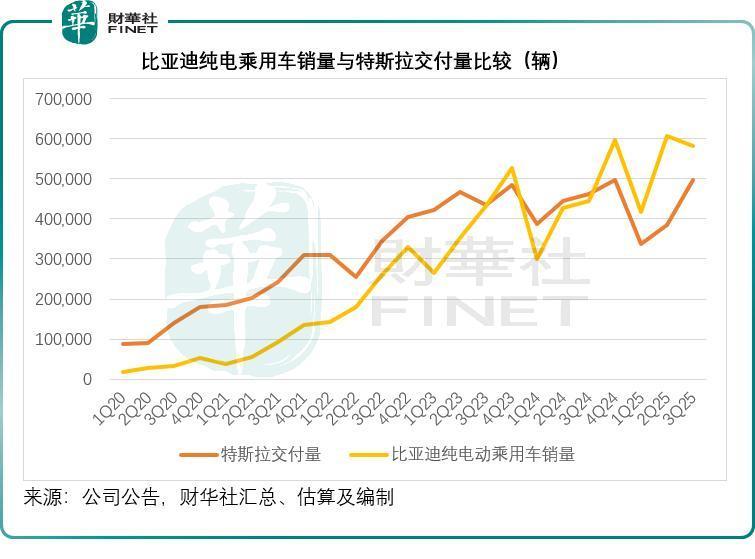
However, we have noticed that since the second half of this year, the company's new energy vehicle sales growth has begun to slow. From July to November, its cumulative new energy vehicle sales totaled 2.0361 million units, a year-on-year decline of 5.05%, although pure electric passenger vehicle sales still grew by 25.45%, reaching 1.0426 million units.
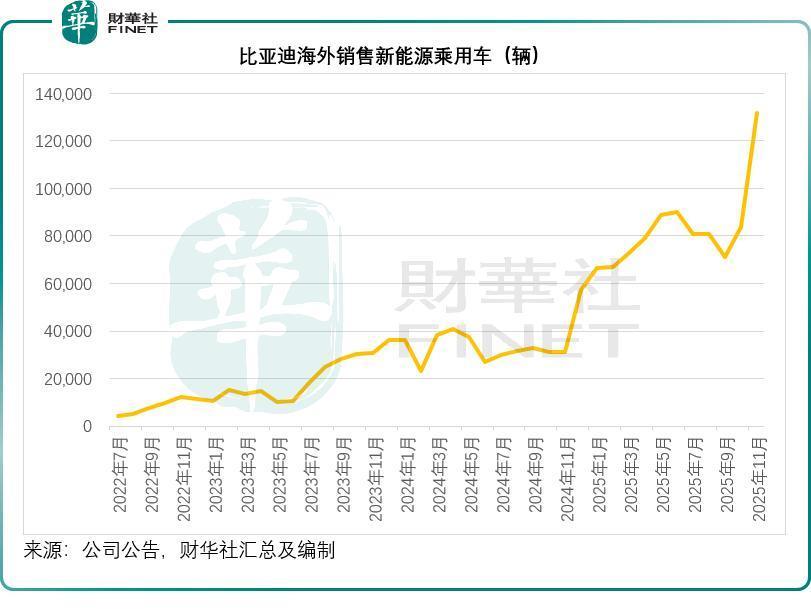
Nevertheless, overseas expansion has been a core growth highlight for BYD this year, with international markets becoming its second growth curve. In the first 11 months of this year, BYD's total new energy vehicle deliveries reached 4.182 million units, a year-on-year increase of 11.30%, while overseas new energy vehicle sales totaled 912,900 units, a year-on-year surge of 153.55%, accounting for 21.83% of total new energy vehicle sales, up from 9.58% in the same period last year. As shown in the chart below, despite the slowdown in overall delivery growth, its overseas sales have been climbing sharply.
But when it comes to overseas expansion, $GWMOTOR(02333.HK) is another key player to watch.
Great Wall Motor: Balanced Transformation and Overseas Resilience
Amid the noisy price war, Great Wall Motor has chosen a differentiated path focused on system health and profit quality. In the first 11 months of this year, its total sales grew by 9.26% year-on-year to 1.1997 million units, with new energy vehicles steadily increasing to 30.40% of the total.
Great Wall Motor's (601633.SH) strategy centers on "technology as the foundation" and "ecosystem globalization." In terms of new energy, it does not blindly pursue pure electric vehicles but leverages its self-developed Hi4 hybrid technology to develop hybrid, pure electric, and fuel vehicles in parallel, particularly establishing a moat in niche markets like off-road new energy (e.g., Tank Hi4-T).
In overseas expansion, Great Wall has entered the "ecosystem globalization" phase, maintaining steady performance over the years. In the first 11 months of this year, its cumulative overseas sales reached 448,600 units, a year-on-year increase of 8.94%, accounting for 37.40% of total sales, slightly down from the same period last year. Compared to BYD, Great Wall Motor's overseas sales have unique multi-dimensional advantages.
First is the first-mover advantage and long-established channel barriers. Great Wall Motor entered overseas markets as early as 1997 with its pickup products and has built a sales network covering over 170 countries and regions.
Second is the localized production and full industry chain ecosystem advantage. Great Wall Motor has established multiple full-process vehicle manufacturing bases and factories worldwide, including wholly-owned plants in Rayong, Thailand, Tula, Russia, and São Paulo, Brazil, forming strategic footholds in Southeast Asia, Eastern Europe, and Latin America. This has enabled a transition from vehicle exports to "ecosystem globalization" of the entire industry chain, with a 65% localization rate for components at its Tula plant in Russia, effectively avoiding tariff barriers and reducing logistics costs.
Third is the adaptability advantage of its product matrix. Under the ONE GWM brand strategy, Great Wall Motor has formed a global product layout covering Haval, Ora, Tank, WEY, and Poer, meeting the demand for fuel SUVs and pickups in emerging markets while also offering new energy models for electrification transitions. This "dual-track" product structure better aligns with the transitional needs of most overseas markets.
Lastly is the depth advantage in localized operations. Great Wall Motor not only localizes products but also emphasizes technology and cultural globalization, as well as localized sales, ensuring its overseas teams and decision-making mechanisms are more localized, enabling rapid responses to market changes and forming a full-chain globalization of R&D, production, supply chain, sales, and service.
Geely Auto: The Dark Horse of New Energy Transformation and Technological Breakthrough
$GEELY AUTO(00175.HK) has delivered impressive sales performance in the first 11 months of this year, with cumulative total sales of 2.7878 million units, a year-on-year increase of 41.76%, making it the "growth dark horse" among traditional automakers. Among these, new energy vehicle sales are estimated at 1.5335 million units, up 37.35% year-on-year, with the share of new energy models rising sharply from 39.51% to 55.01% compared to the same period last year. Pure electric vehicle sales surged 99.12% to 994,700 units, accounting for 35.68% of total sales, demonstrating strong momentum in the pure electric segment.
In terms of new energy strategy, Geely has adopted a multi-brand, multi-technology approach, deploying pure electric brands like Zeekr and Geometry to capture the mainstream market while retaining Thunder hybrid technology to meet user needs during the transition from fuel to electric vehicles, achieving comprehensive coverage of technology routes. At the same time, its continued investment in smart cockpits and autonomous driving has strengthened the technological attributes of its products, aligning precisely with market demand.
For overseas expansion, Geely has taken a diversified path: leveraging the first-mover advantage of its Lynk & Co brand in the European market while directly entering key overseas markets through acquisitions like Renault Brazil and establishing a factory in Malaysia.
In the first 11 months of this year, its export sales reached 379,800 units, a slight year-on-year decline of 1.98%, with the share of total sales dropping from 19.70% to 13.62% compared to the same period last year. Compared to other leading automakers, its overseas business still has room for improvement, which is seen as a key growth driver for the future. As a result, Geely's valuation is shifting from that of a traditional automaker to a technology-driven global mobility service provider.
GAC Group: Technological Deepening and Overseas Ambitions Amid Transformation Pains
$GAC GROUP(02238.HK) has shown slightly weaker sales performance in the first 11 months of this year, with cumulative total sales of 1.534 million units, down 10.80% year-on-year. New energy vehicle sales totaled 371,700 units, a slight decline of 1.51%, although the share of new energy models rose from 21.95% to 24.23% compared to the same period last year. The overall sales decline has directly dragged down the company's profitability, even leading to negative gross margins, primarily because key new energy models are still in the sales ramp-up phase and have not achieved expected growth.
In terms of new energy strategy, GAC Group has sought a balance between independent R&D and external partnerships. On the independent front, it has overcome key core technologies such as sponge silicon anode batteries, magazine battery system safety technology, and 12-in-1 integrated electric drive systems, building a technological moat. Externally, it has deepened collaboration with Huawei, planning to launch its first jointly developed high-end smart new energy model in 2026, while also making early moves in cutting-edge areas like flying cars and embodied AI robots, accumulating technological potential for future development. However, this is likely to continue pressuring its profit margins and raise investor concerns about whether its diversification strategy will dilute focus on its core business.
Despite sluggish overall sales, GAC Group has demonstrated strong determination in overseas expansion. In the first half of 2025, its independent brand overseas terminal sales exceeded 50,000 units, covering 84 countries and regions, with the Indonesia smart factory successfully completed and put into operation. The company plans to add over 170 overseas sales outlets this year, introducing four new models and entering 10 new countries, while also making strides in high-potential markets like Europe, Australia-New Zealand, and Brazil. The group has set a target of exporting 500,000 units by 2027, showcasing clear global ambitions.
Dongfeng Group: New Energy Breakthrough and High-End Overseas Expansion Under Asset Spin-Off
Dongfeng Motor Corporation Limited (00489.HK) saw a slight year-on-year decline of 0.34% in sales in the first 11 months of this year, with cumulative total sales of 1.697 million units. However, its new energy business performed well, with total new energy vehicle sales reaching 489,200 units, up 39.13% year-on-year, accounting for 28.83% of total sales, up from 20.65% in the same period last year. Among these, new energy passenger vehicle sales grew 40.62% to 449,600 units. Its high-end new energy brand, Voyah, which plans to list by introduction, was particularly outstanding, with sales of 132,600 units in the first 11 months, up 91.97% year-on-year, accounting for 7.82% of the group's total sales.
In terms of new energy strategy, Dongfeng has chosen a unique path of asset spin-offs. The group is set to be privatized by its major shareholder, while Voyah will list on the Hong Kong Stock Exchange by introduction. This move essentially aims to shed the valuation drag of traditional fuel vehicle business, allowing Voyah, a high-quality new energy asset, to receive capital market pricing that better matches its growth potential. Additionally, Dongfeng continues to focus on high-end new energy, with brands like Voyah and M-Hero targeting different niche markets, forming a differentiated high-end product matrix.
For overseas expansion, Dongfeng's export sales in the first half of the year reached 99,000 units, up 5.8% year-on-year, following a high-end and localized approach. The Voyah brand has successfully entered the Middle East and European markets, while the M-Hero 917 has entered high-end markets like Switzerland and Spain. The company has also partnered with Nissan China for export business, gradually building high-end brand recognition overseas. However, due to the overall sales decline, its overseas scale has yet to achieve a major breakthrough.
Brilliance China: Transformation Dilemma and Overseas Contraction Under Joint Venture Dependence
Brilliance China (01114.HK) derives most of its revenue from non-BMW vehicle and auto parts sales and auto financial services, but its main profits come from its 25% stake in the BMW Brilliance joint venture, resulting in a singular profit structure heavily reliant on BMW Brilliance's performance.
In the first half of 2025, BMW Brilliance's domestic sales fell 16.7% year-on-year to 260,455 units, while exports plummeted 88.9% to just 1,550 units. The contraction of the joint venture business has directly impacted the group's overall performance, highlighting the issue of its singular profit structure.
BAIC Motor: Differentiated Route of Off-Road Electrification and Overseas Beginnings
BAIC Motor (01958.HK) operates mainly through four brands: BAIC Brand, Beijing Benz, Beijing Hyundai, and Fujian Benz. Among these, BAIC Brand is its independent brand, while it holds a 49% stake in Beijing Benz, a 50% stake in Beijing Hyundai through subsidiary BAIC Investment, and a 35% stake in Fujian Benz.
BAIC's new energy transformation follows a differentiated route. The BAIC Brand has launched new energy off-road models like the BJ30 Mohe and BJ40 EREV, achieving breakthrough innovations in off-road electric drive technology that cover both urban and off-road scenarios, expanding its product matrix from fuel to pure electric and hybrid. Beijing Benz, leveraging the Mercedes-Benz Modular Architecture (MMA), has introduced the first pure electric long-wheelbase CLA, further expanding its pure electric lineup and strengthening its "dual-track" strategy. Meanwhile, through a combination of independent R&D and collaborative development, it has overcome multiple core technology bottlenecks, achieving mass production of key components like range extenders and power batteries while gradually expanding external sales.
For overseas expansion, BAIC Motor primarily drives international business through overseas sales companies, KD (Knock Down, where complete vehicles are disassembled for export and reassembled in target markets) technical cooperation, and vehicle distribution. In the first half of this year, the BJ series entered international markets for the first time, accelerating overseas certification and channel development. Beijing Hyundai, meanwhile, has adopted a "domestic sales + exports" dual-drive approach, continuously enriching its export models and regions.
Comprehensive Comparison
In the first 11 months of this year, BYD's vehicle sales remained at the forefront, with new energy vehicle sales further consolidating its leading position. At the same time, Geely Auto's growth has been remarkable, with new energy vehicles accounting for 55.01% of its sales, reflecting a rational product layout. In terms of overseas performance, Great Wall Motor maintains its advantage, while BYD, Geely, and GAC are also making strides in overseas markets, with significant room for growth, as shown in the table below.
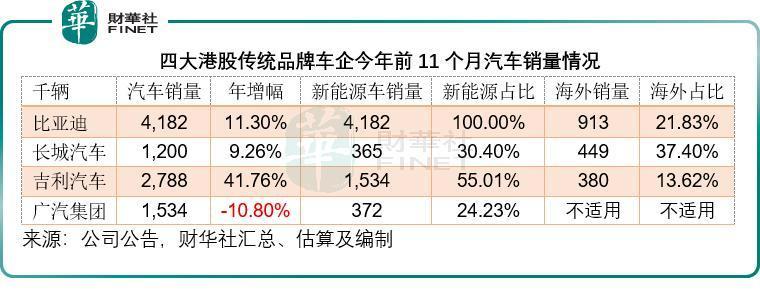
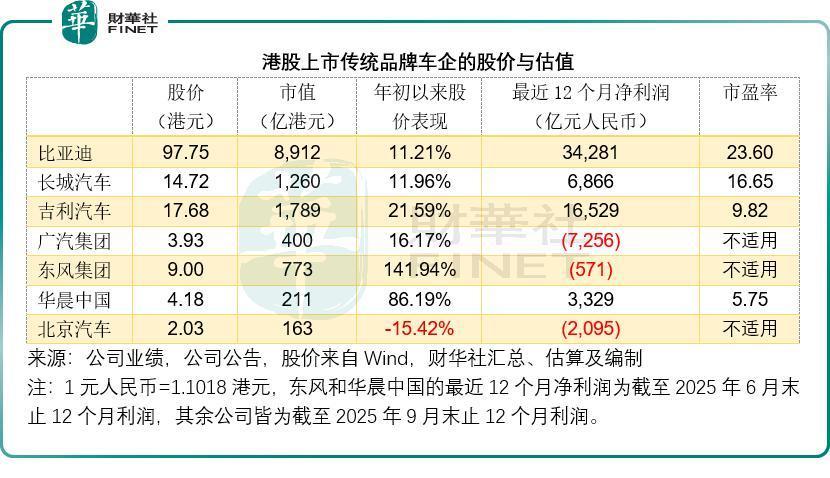
In terms of stock performance, except for BAIC Motor, traditional automakers have seen rising share prices this year. However, apart from Dongfeng Group, which plans to privatize, and Brilliance China with its low P/E ratio, other automakers have underperformed the broader market, with the Hang Seng Index rising 27.32% year-to-date.
Conclusion
Radical transformers like BYD and Geely, leveraging first-mover advantages and comprehensive technological layouts, have built moats in sales scale and new energy penetration. The core of their valuation story lies in whether they can replicate their domestic success globally and continue to raise their brand ceilings. Meanwhile, balanced players like Great Wall Motor, through their deep cultivation of niche markets and "ecosystem globalization" model, have demonstrated profit resilience and globalization depth that can weather cycles, with their value stemming more from system health and risk resistance.
At the same time, companies like GAC and Dongfeng are experiencing the pains of transformation. Their deep cultivation of core technologies, partnerships with tech giants, and persistent exploration of high-end brands and overseas markets are key chips for reversing their valuations, with the market closely watching whether these strategic investments can translate into tangible growth curves. On the other hand, companies like Brilliance China, heavily reliant on single joint venture profit sources, highlight the potential risks of lacking independent core capabilities amid industry upheaval.
This value reassessment is far from over—it is a comprehensive marathon of technology, strategy, and endurance. Ultimately, those who win long-term favor in the capital markets will be the ones with the right direction, solid foundations, and the ability to transform China's manufacturing advantages into global brand value. As the "Top 100 Hong Kong Stocks" awards approach, this selection will undoubtedly provide a highly referential barometer for understanding this sweeping industrial transformation and value reconstruction, allowing us to see which automakers can stand out under new evaluation dimensions and lead the future.
Author: Wu Yan
The copyright of this article belongs to the original author/organization.
The views expressed herein are solely those of the author and do not reflect the stance of the platform. The content is intended for investment reference purposes only and shall not be considered as investment advice. Please contact us if you have any questions or suggestions regarding the content services provided by the platform.
