


Tianrun Cloud (02167.HK) points out the pain points of AI implementation: 90% of intelligent agents 'die' due to lack of operation

$TI CLOUD(02167.HK)
Over the past year, corporate investment in AI has surged rapidly: smart customer service, knowledge assistants, automation platforms, large model integration... almost every company is accelerating its "AI implementation" plans.
But in practice, a concerning trend is emerging that managers should be wary of—technology deployment is getting faster, but the effectiveness of AI adoption is becoming increasingly polarized.
With the same model capabilities and similar product solutions, some companies achieve significant automation rate improvements within months, enabling Agents to truly take on measurable business tasks. Others, despite deploying AI, remain heavily reliant on human intervention, with Agents showing volatile performance, optimization difficulties, and long-term mismatches between input and output.
In reality, this divergence doesn't stem from the technology itself but from a deeper factor: whether companies have built an "operational system" that allows Agents to continuously evolve.
In the Agent era, technology is no longer the core variable determining success. What truly creates differentiation is whether companies treat "operations" as part of the product.
1. Why Do the Same AIs Produce Wildly Different Results?
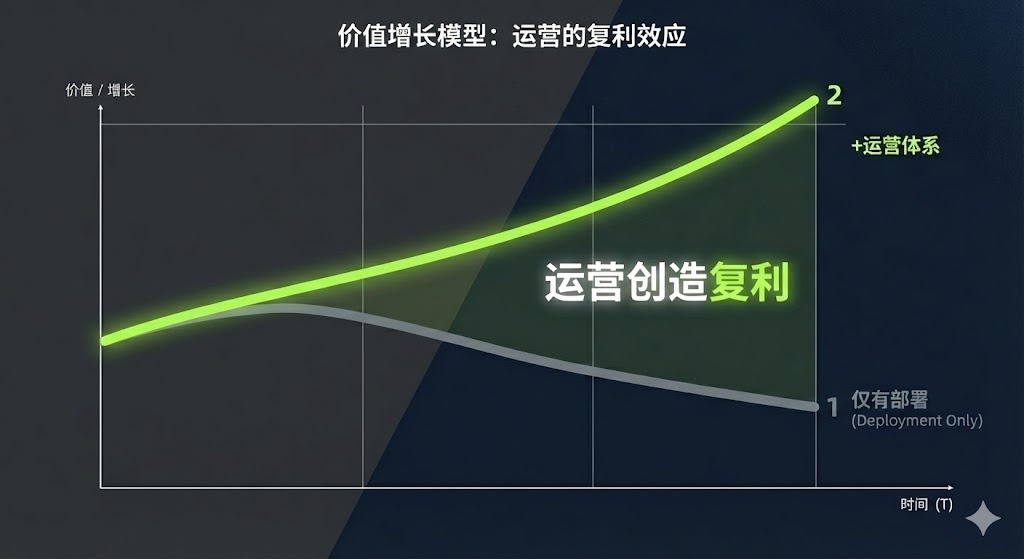
In the software era, a system's capabilities were determined by its "development completeness"—once features were launched, the product's value was largely formed. Subsequent operations mainly focused on promotion, training, and maintenance, playing only a supporting role.
But Agents operate on completely different logic.
An Agent isn't a one-time delivered "finished product" but rather a "continuously evolving system." Its capabilities aren't determined on delivery day but are shaped every day after by the feedback, knowledge, corrections, and training provided by the company.
This is precisely why an Agent's true competitiveness is never "bought"—it's "cultivated."
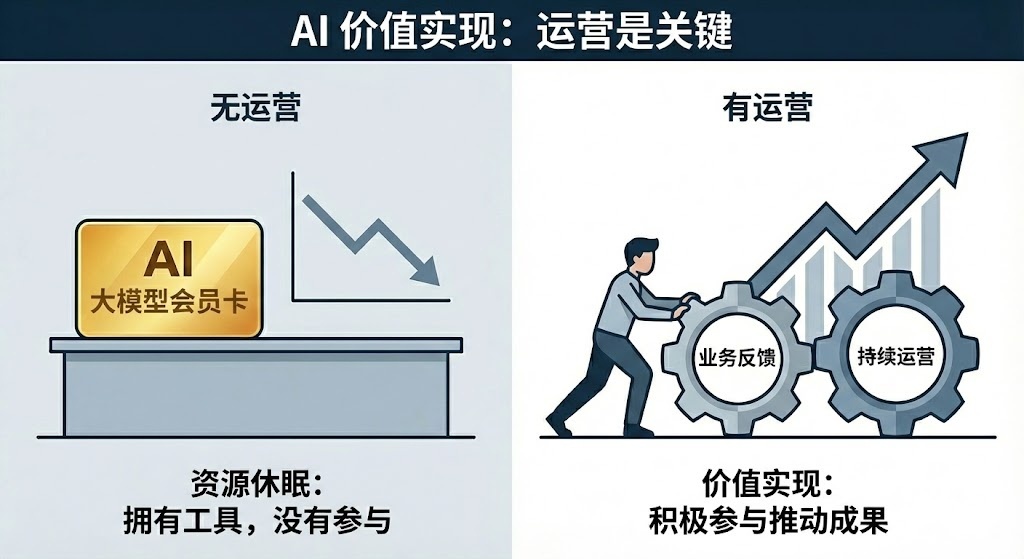
This also explains why many companies develop a misconception during AI implementation—believing that "using the same model" should yield "the same results."
In reality, the opposite is true: the more similar the models, the more pronounced the differences become.
Because models provide general intelligence, not corporate intelligence. What gives an Agent "job-ready capability" is whether the company has established a healthy operational system that allows the Agent to continuously learn business processes, correct deviations, accumulate experience, and ultimately become a unique productivity unit for the enterprise.
If models are the foundation, then operations are the structural engineering that keeps the building growing taller and more stable. No matter how solid the foundation, without construction, the building will never be completed; no matter how advanced the model, without operations, its capabilities will remain at the "demo level."
2. The Secret to Making Agents Continuously Stronger: Feedback, Knowledge, and Operational Loops
To see whether a company's Agent has an operational system, look for three things: Are errors being recorded? Is experience being accumulated? Is performance continuously improving? Meeting these three criteria means entering the "evolution zone."
This is the biggest difference between Agents and traditional software: Agents don't "execute by rules" but rather "judge based on experience." Thus, they make mistakes, misinterpret intentions, and expose limitations in new tasks.
These mistakes aren't inherently problematic—what ultimately determines an Agent's trajectory is whether the company can "catch and correct" these errors.
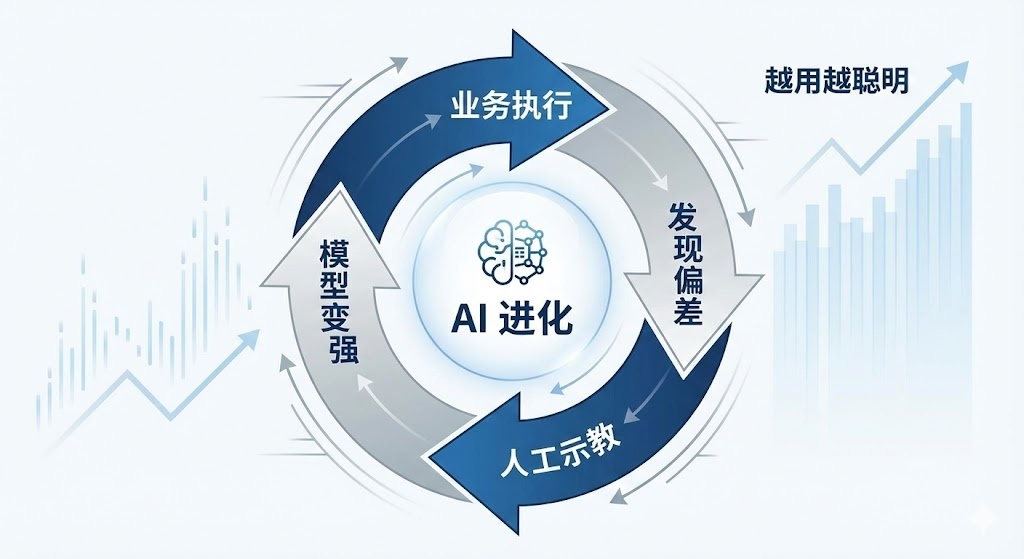
In some leading companies, the reason Agents can quickly evolve from "assistive tools" to "core roles" within two to three months isn't because they were smart from the start but because the company established a complete "feedback → correction → learning → re-execution" loop system. Every time a user says "you didn't understand," every manual intervention, and every new scenario task is treated as valuable feedback and incorporated into continuous training cycles.
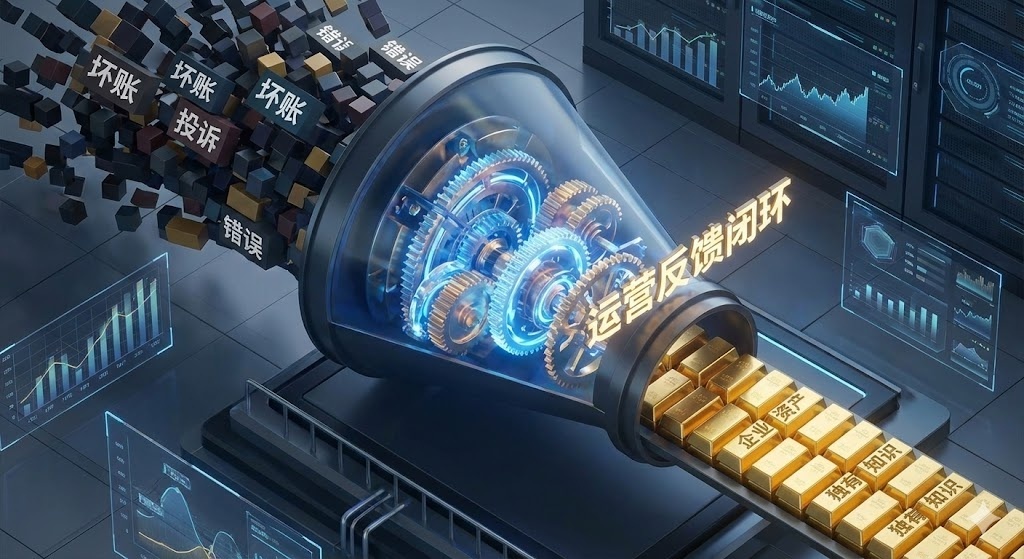
Conversely, companies where Agents remain "unstable" often don't suffer from poor technology but rather from a lack of such operational mechanisms: errors aren't recorded, knowledge isn't accumulated, and feedback isn't utilized, leaving Agents stuck repeating the same mistakes.
In traditional organizations, this "knowledge transfer" typically relies on senior employees mentoring newcomers, on-site training, and FAQ documentation. But Agents don't have "senior employees" and can't intuitively grasp business through experience.
Thus, in the Agent era, companies must proactively structure, label, and encode their business rules, industry experience, and tacit knowledge, injecting them through continuous operations.
Therefore, operations are no longer an ancillary link but part of the Agent product itself. The deeper the operations, the higher the Agent's intelligence ceiling.
If the traditional software era was about competing on "development capabilities," the Agent era is about competing on "operational capabilities."
The underlying logic is that while the AI systems may appear the same, what's really being competed is whose "feedback flywheel is faster, knowledge system is more complete, and learning loop is tighter."
In this sense, a continuously evolving operational system isn't just the foundation for stable Agent performance—it's the underlying moat for future intelligent competition.
3. Competition in the Agent Era: Who Can Keep AI Effective Long-Term?
Finally, as Agents begin to participate in every detail of business operations, organizational dynamics are quietly shifting:
Companies no longer rely on "deploying a system once" to extract value but rather on "continuously keeping the system effective."
This means that stable, scalable, truly implementable AI capabilities will increasingly depend on whether a company has a mature operational system—one that enables Agents to adapt to business, integrate into workflows, and steadily approach goals in practice.
On this front, Tianrun Rongtong not only provides advanced Agent products but also end-to-end lifecycle operational support. From scenario analysis and knowledge governance to runtime monitoring and performance optimization, we help companies turn AI into reliable productivity rather than a fleeting experiment.
Competition in the Agent era ultimately comes down to whether organizations can "use AI well, nurture it well, and extract long-term value."
And our purpose is to ensure every company has this capability.
$TI CLOUD(02167.HK)
The copyright of this article belongs to the original author/organization.
The views expressed herein are solely those of the author and do not reflect the stance of the platform. The content is intended for investment reference purposes only and shall not be considered as investment advice. Please contact us if you have any questions or suggestions regarding the content services provided by the platform.
