



[IPO Watch] Valuation Soars 22 Times in 5 Years! Junshi Biosciences Bets Big on TIL Therapy?


Recently, the first-day performance of Hong Kong stocks has shown significant divergence, while the concept of innovative drugs continues to lead. $BAO PHARMA-B(02659.HK) and $VIGONVITA-B(02630.HK) both surged over 130% on their first day, becoming the strongest-performing new stocks in the Hong Kong market since November.
On December 10, another innovative pharmaceutical company—Shanghai Junshi Biotech Co., Ltd. (referred to as "Junshi Biotech")—officially submitted its prospectus to the Hong Kong Stock Exchange, planning to list on the main board under Chapter 18A of the Hong Kong Stock Exchange, with CITIC Securities as the sole sponsor.
Valuation Soars 22 Times in 5 Years
Junshi Biotech's development history is not long. This innovative pharmaceutical company was established in June 2019, just over 6 years ago. As a startup biopharmaceutical company, Junshi Biotech has completed 7 rounds of financing between 2020 and 2025, with investors including Suzhou Industrial Park Origin Seed Venture Capital Enterprise (Limited Partnership), Guangzhou Kaide Phase I Biomedical Industry Investment Fund Partnership (Limited Partnership), Waigaoqiao Private Equity Fund, and Power Capital, among other professional investment institutions.
In terms of valuation, Junshi Biotech's post-investment valuation was RMB 92.5 million after the Pre-A round in January 2020. By the completion of the Series C round in 2025, the valuation had climbed to RMB 2.137 billion, a 22-fold increase in five years.
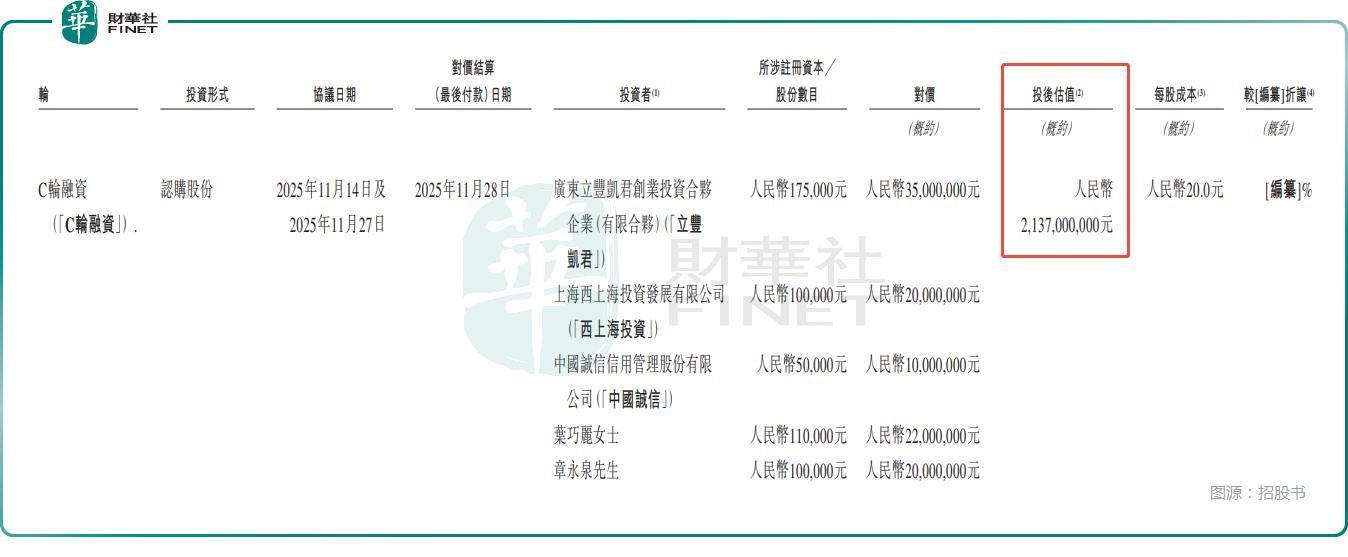
From the Pre-A round to the submission of the prospectus to the Hong Kong Stock Exchange, Junshi Biotech's capital steps have maintained a high-frequency and smooth rhythm, reflecting investors' confidence in the company's prospects to some extent.
Focus on Lymphocyte (TIL) Therapy
According to data, tumor-infiltrating lymphocyte (TIL) therapy activates TIL cells derived from tumor tissue in vitro, expands them on a large scale, and injects them into patients to exert therapeutic effects. At the in vitro level, TIL cells can be more fully activated, giving patients a greater chance of cure. As a "living" cell drug, it has autonomous adaptability in vivo and can precisely locate and kill tumors with its high tumor specificity and superior tumor homing ability, exerting safe, effective, and long-lasting anti-tumor effects. TIL cell therapy is currently one of the T-cell therapies with the highest level of clinical evidence and the most definitive efficacy in solid tumor treatment, demonstrating efficacy beyond PD-(L) 1 antibodies.
However, TIL therapy is a personalized therapy, and its core advantage lies in its breakthrough efficacy, but it also has some disadvantages, such as cumbersome preparation processes, complex clinical protocols, resulting in high comprehensive costs, low accessibility, and limited widespread application.
Junshi Biotech is a biotech company dedicated to innovative cell therapies and drug development for solid tumors, leading the development of TIL and solid tumor therapies in China. It has a gradient product pipeline, with research indications including high-incidence tumors such as lung cancer, breast cancer, head and neck cancer, and colorectal cancer, as well as refractory tumors such as glioblastoma, pancreatic cancer, ovarian cancer, and melanoma; covering different stages from early to advanced, and from adjuvant therapy to later-line therapy.
According to Frost & Sullivan, Junshi Biotech's core product GC101 is the world's first TIL therapy that does not require high-intensity lymphodepletion chemotherapy or IL-2 administration, and is expected to become the first TIL therapy approved for marketing in China.
Currently, GC101 is undergoing a key Phase II clinical trial for the treatment of melanoma, with a Biologics License Application (BLA) expected to be submitted in 2026; GC101's clinical pipeline for non-small cell lung cancer is currently in Phase Ib; early-line combination therapy and postoperative adjuvant therapy for multiple indications have also been laid out, as shown in the figure below.
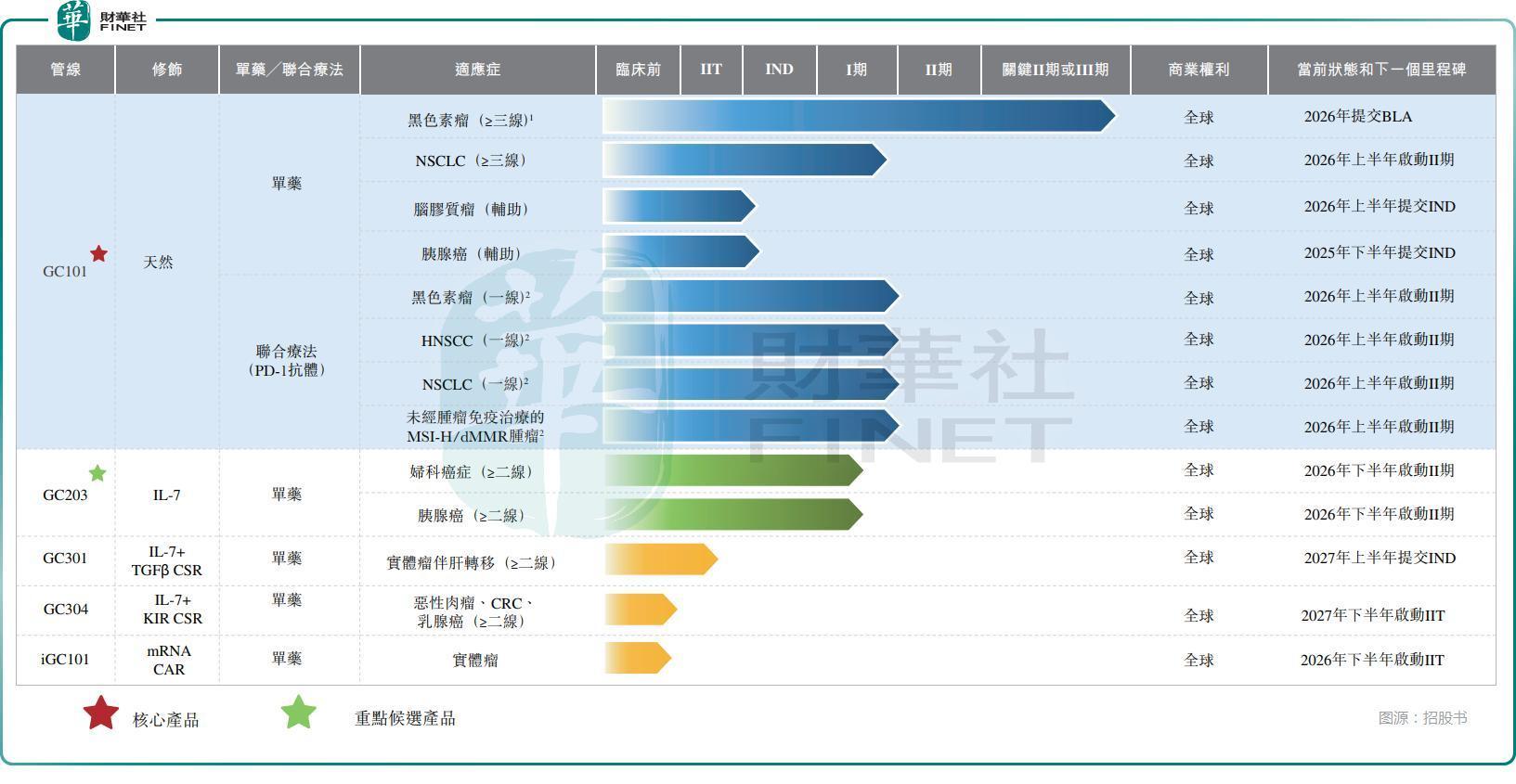
It is worth mentioning that GC101 was initially developed based on the independently original DeepTIL™ platform. After clinical validation, GC203 was developed on the basis of GC101 using the NovaGMP™ platform for single-gene modification to enhance anti-tumor activity.
The prospectus discloses that Junshi Biotech's key product GC203 is the world's first non-viral vector gene-modified TIL cell drug. Based on GC101, GC203 overexpresses the company's original membrane-bound, self-aggregating IL-7, enhancing the in vivo adaptability of TIL cells and endowing them with the ability to mobilize endogenous immune cells.
Currently, GC203 has been approved for IND and can be used to treat advanced pancreatic cancer, advanced gynecological tumors, and other solid tumors that have failed standard treatment.
Continued Losses in Performance
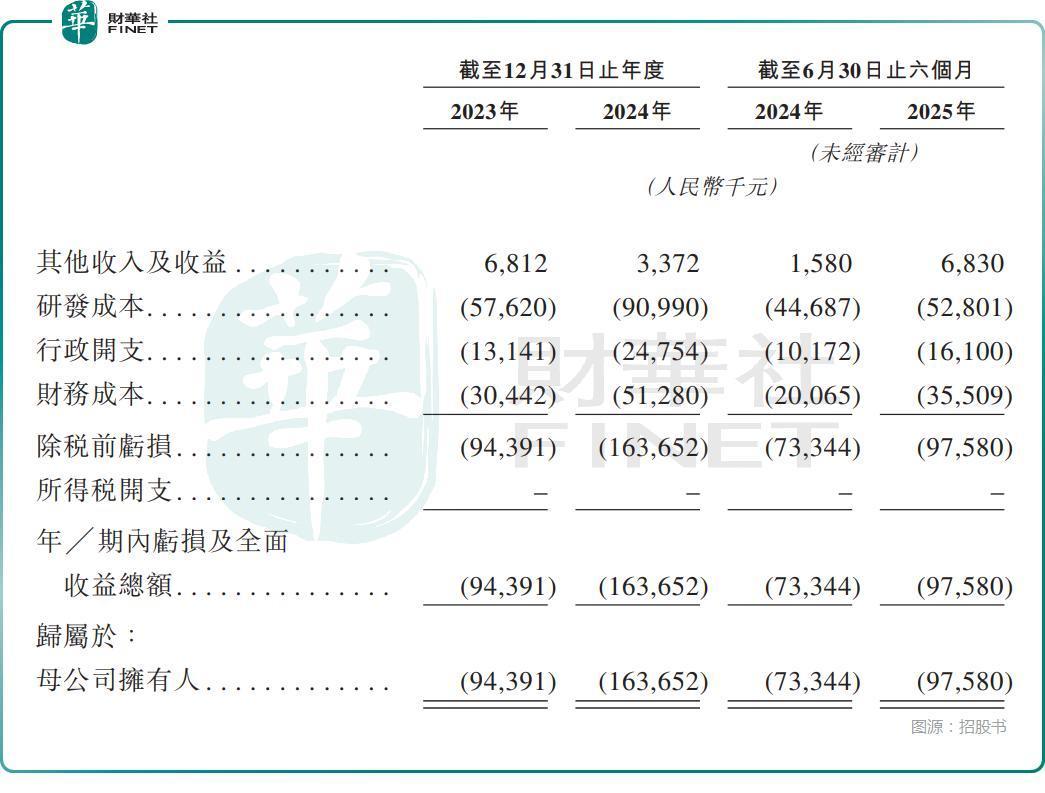
Due to the lack of commercialized products, Junshi Biotech has not yet achieved product sales revenue. However, in 2023, 2024, and the first half of 2025, the company recorded other income and gains of RMB 6.812 million (RMB, same below) , RMB 3.372 million, and RMB 6.830 million, mainly including government subsidies, interest income from debt investments measured at fair value through other comprehensive income, and bank interest income.
In addition, in 2023, 2024, and the first half of 2025, Junshi Biotech's R&D expenses were RMB 57.620 million, RMB 90.990 million, and RMB 52.801 million, respectively; financial costs were RMB 30.442 million, RMB 51.280 million, and RMB 35.509 million, respectively.
Ultimately, in 2023, 2024, and the first half of 2025, Junshi Biotech's total losses and comprehensive income were -RMB 94.391 million, -RMB 164 million, and -RMB 97.580 million, respectively.
Tight Cash Flow, Where Will the Funds Be Invested?
The prospectus also discloses that as of the end of October 2025, Junshi Biotech held cash and cash equivalents of RMB 55.02 million, financial assets measured at fair value through profit or loss of RMB 101 million, and another RMB 24 million in debt investments measured at fair value through other comprehensive income.
Currently, Junshi Biotech still requires substantial funds to advance R&D and commercialization efforts. Its cash reserves are not particularly ample and still require financing support.
The prospectus discloses that Junshi Biotech's strategy is to use the raised funds (1) to advance the clinical development of the TIL product pipeline; (2) to continuously upgrade and iterate the DeepTIL™ and NovaGMP™ platforms, as well as the development of the RiverTIL™ platform, including process improvements, automation enhancements, and analytical capabilities; (3) for equipment procurement and facility upgrades for the manufacturing base and TIL seed cryopreservation facilities; (4) for working capital and other general corporate purposes.
Overall, Junshi Biotech has achieved some success in the field of lymphocyte (TIL) therapy, but the company is still in a loss-making state. Whether this Hong Kong listing will be successful remains to be seen.
Author: Yun Zhi Feng Qi
The copyright of this article belongs to the original author/organization.
The views expressed herein are solely those of the author and do not reflect the stance of the platform. The content is intended for investment reference purposes only and shall not be considered as investment advice. Please contact us if you have any questions or suggestions regarding the content services provided by the platform.
