



Yadi stands at the crossroads of the new national standard?

The "Mao Dou" incident has exposed the challenges in the transformation of the two-wheeled electric vehicle industry.
Recently, Yadea's new "Mao Dou" electric bicycle, compliant with the new national standards, faced public criticism for its "single-commuter version" being "unable to carry children" and "lacking storage space," leading to a PR crisis. The company later apologized and stated that this model has different versions, subsequently launching a version with a short-seat enclosure.
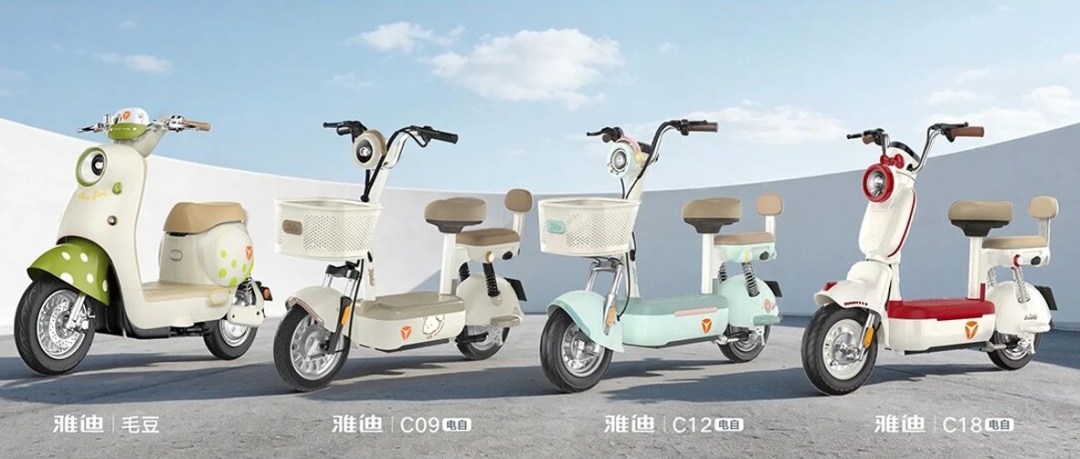
Source: Yadea Electric Vehicle
What seemed like an ordinary product controversy has revealed an unusual undercurrent in the market.
National subsidies for trade-in programs have gradually phased out by the end of October, while the so-called "strictest-ever" new national standards ended their transition period on December 1, marking the industry's full entry into a compliance-driven era.
The two-wheeled electric vehicle industry has reached another historic turning point, as the old cycle of relying on subsidies and scale expansion has come to an end. For Yadea, which sits firmly at the top, the very foundation of its survival is undergoing fundamental changes.
The real test has only just begun. The "Mao Dou" incident is a minor case of Yadea struggling to adapt to the new national standards, but it also exposes the company's shortcomings in product competitiveness and user experience in the new industry cycle.
Yadea needs a self-evolution to defend its throne in the two-wheeled electric vehicle industry.
Yadea's Defense Battle
The "Mao Dou" incident was no accident—the broader environment of the two-wheeled electric vehicle industry has changed.
Over 92% of daily commutes in Chinese cities occur within 50 kilometers, and this vast number of short-to-medium-distance trips forms the core market for two-wheeled electric vehicles.
However, this core market is becoming increasingly crowded. According to Guosheng Securities data, as of April 2025, China's two-wheeled electric vehicle fleet exceeded 420 million units, equivalent to one vehicle for every three people, indicating market saturation.
Although the first half of 2025 saw a surge in sales due to policy incentives, this boom was merely a feast of replacement demand.
Consumer preferences are quietly shifting from "owning a vehicle" to "enjoying a mobility experience," with smart interaction, personalized design, and even the emotional value of vehicles becoming new purchasing drivers.
At this turning point, Yadea remains the industry leader, but competitive pressures are mounting.
In the first half of 2025, Yadea secured its top position with sales of 8.7935 million units, supported by its nationwide distribution network of over 40,000 sales outlets—a key factor in its past victories and rise to dominance.
But in the new competitive landscape, "big" does not necessarily mean "strong."
The industry has now formed a tripartite rivalry between Yadea, Aima, and TailG, with new players like Ninebot and Niu rapidly catching up.
Among its peers, Aima has built strong influence in niche market by targeting young female consumers with lightweight designs, stylish aesthetics, and thoughtful details. Meanwhile, newcomers like Ninebot are making breakthroughs in the premium segment with smart technology.
Now, Yadea must fiercely compete with old rivals like Aima and TailG in the mass market with high cost-performance ratios to defend its core business, while also trying to challenge the high ground occupied by these new players.
It was amid this strategic dilemma of being "stuck in the middle" that the "Mao Dou" incident erupted.
To meet the strict weight limits of the new national standards and maintain its cost-performance advantage, Yadea sacrificed some "non-essential" features related to comfort and practicality...
The Magnifying Glass of New National Standards
2025 is a year for Yadea to regain growth.
In the first half of this year, Yadea delivered impressive results, with revenue up 33.1% year-on-year to RMB 19.186 billion, net profit attributable to shareholders surging 59.5% to RMB 1.649 billion, and sales reaching 8.7935 million units.
With the help of national subsidies, Yadea shook off the shadow of last year's revenue and sales decline, as well as the halving of net profit.
However, with the end of subsidies and the implementation of new national standards, Yadea and the entire industry must face new challenges. The long-relied "volume-for-price" strategy is no longer sufficient, and manufacturers must seek breakthroughs in user experience innovation under the pressure of the new standards.
Yadea's "Mao Dou" single-commuter version exposed the contradiction faced by the industry leader in the "compliance race." While focusing on meeting hard metrics, the company overlooked the most basic needs of Chinese family users—carrying people and goods.
To cope with the transition and clear old-standard inventory, Yadea adopted price-cutting promotions last year. In 2025, despite product mix optimization, the nationwide "trade-in" subsidy policy played a key catalytic role.
While policy incentives quickly boosted sales, they may have also masked the true competitiveness of products and reinforced the brand's "high cost-performance" rather than "high-value" image.
Thus, the controversy over the "Mao Dou" model goes far beyond a mere design flaw in the seat.
The profound significance of the new national standards lies in raising technical and financial barriers, driving a deep supply-side reform in the industry.
The entire two-wheeled electric vehicle industry stands at a critical inflection point of restructuring. The era of relying solely on economies of scale and price wars is over. The ticket to the future must be earned through technological prowess, safety redundancy, and precise alignment with user value.
As the industry leader, Yadea should draw motivation for transformation from product controversies, evolving from scale-driven to value-driven.
Shortly after the "Mao Dou" apology, Yadea held its 2026 Global New Retail Summit, announcing a new national standard product matrix covering 71 models and advancing user-centric digital transformation and brand rejuvenation strategies.
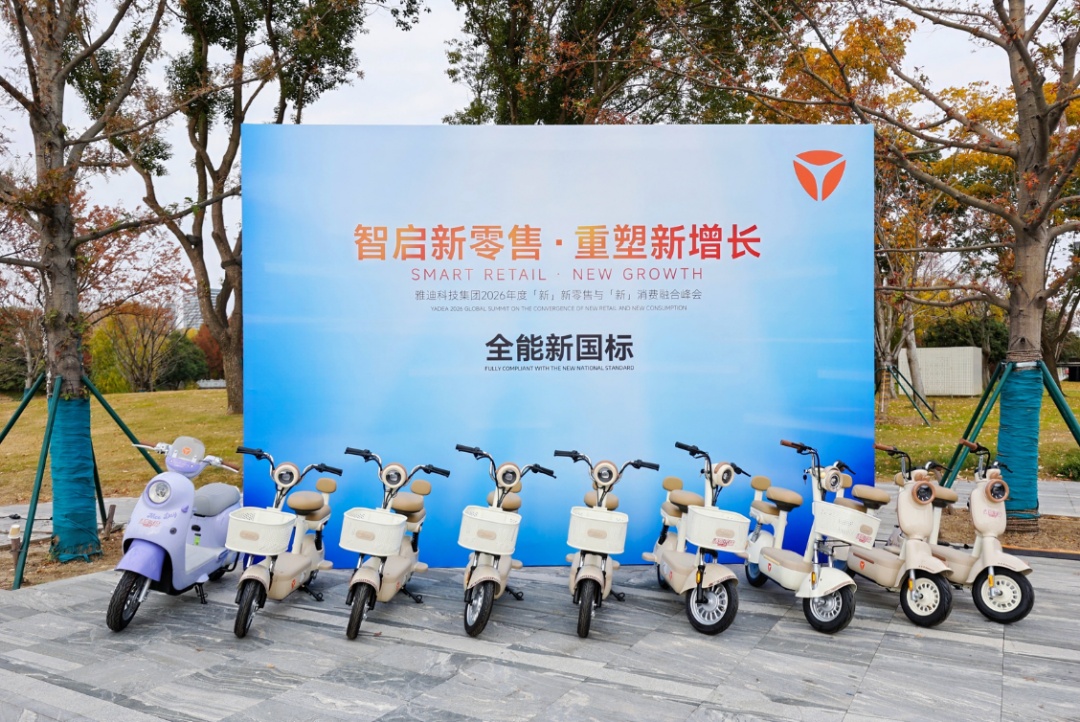
Source: Yadea Electric Vehicle
For Yadea, the battle to defend its market lies in winning consumer minds. Competitors have already built strongholds in the high ground of "tech-savvy trends" or "fashionable gadgets." and Yadea urgently needs a complete overhaul—from product definition to user communication—to prove it can be not just the "sales king" but also the "value choice."
Otherwise, the crown of the two-wheeled electric vehicle industry may quietly slip away.
"New" New Retail and New Consumption: Three Transformations Targeting the Deep Waters of the Existing Market
The pain has already arrived, but the inflection point also signals the beginning of rebirth.
Yadea must step out of its comfort zone and undergo value reconstruction. To survive and thrive in the new national standard era, it must complete three key transformations—from core to periphery.
First, the starting point of value reconstruction must shift from "manufacturing scale" back to "user insight."
The old "push" logic centered on distribution and production capacity is no longer sustainable in a saturated market. Yadea's swift apology and product adjustments after the "Mao Dou" incident, along with its commitment at the recent global summit to deepen user-centric digital transformation and analyze riding habits through big data, show the company recognizes the urgency of this shift.
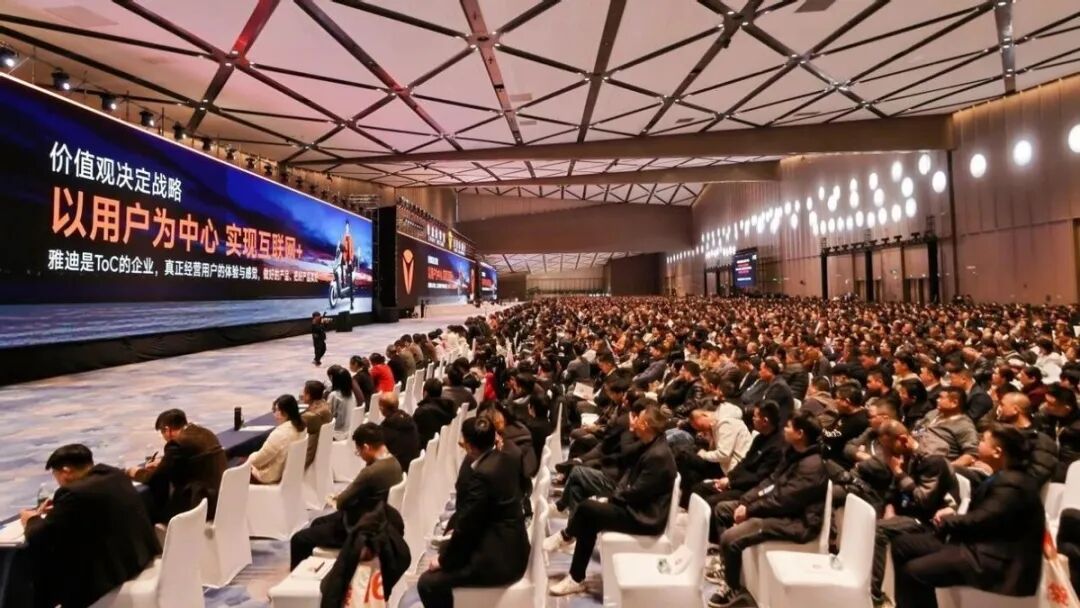
Source: Yadea Electric Vehicle
Yadea has begun systematically implementing standardized "test ride" experiences in stores. This service change returns the judgment of product value to users, reflecting a fundamental shift in mindset from "what we sell" to "how users experience it."
In the future, whether Yadea can transform its vast store network from a scale burden into capillaries and data nodes for user insights will be key to its success.
Second, the core barrier of competition in two-wheeled electric vehicles has evolved from "hardware specs" to "smart experience."
The industry's future growth inevitably lies in the human-vehicle relationship reshaped by smart technology. Yadea is accelerating its efforts, launching the "Xiao Di Xiang Yun" and "Di Wang Wang" smart mobility IP matrix on December 10, using AI to enable more intuitive interaction and companionship.
However, the competition in smart technology goes far beyond voice assistants. Some companies have released AI driving models integrating TCS traction control and ESP stability systems, targeting full-scenario riding experiences. This means future smart technology will be a system-level competition integrating vehicles, cloud, and ecosystems.
Beyond hardware barriers like batteries and motors, Yadea must build a truly open, evolving software and data ecosystem, transforming electric vehicles from mere transportation tools into intelligent, connected mobility terminals.
This race is not about tools—it's about ecosystems.
The implementation of the new national standards has brought a more imaginative growth narrative. Chinese two-wheeled electric vehicle companies must strive to become "global standard" definers, seeking blue oceans in the era of China's tech expansion.
The full rollout of the new national standards has positioned China as the first to establish the world's most systematic and stringent safety and technical standards for electric bicycles. For leading Chinese companies like Yadea, whose products are already sold in 100 countries, this is a historic opportunity.
Simple exports are no longer remarkable—the next phase of globalization is about exporting technical solutions and standards. Companies like Luyuan and Ninebot have partnered with BMW to systematically introduce micro-mobility technology and German engineering standards as leverage for high-barrier global markets.
In the future, Chinese two-wheeled electric vehicle companies must adapt and promote the "new national standard" safety systems, energy ecosystems, and smart mobility solutions validated in the domestic market, securing a high-value position in the global green mobility revolution.
Perhaps one day in the future, Yadea's "apology" will be seen as a footnote to the end of an old cycle and a prologue to the beginning of a new one.
Source: HK Stock Research Society
The copyright of this article belongs to the original author/organization.
The views expressed herein are solely those of the author and do not reflect the stance of the platform. The content is intended for investment reference purposes only and shall not be considered as investment advice. Please contact us if you have any questions or suggestions regarding the content services provided by the platform.
