


 Buffett's junior apprentice
Just now! U.S. stocks plummeted across the board, AI 'faith' collapsed? Broadcom plunged 11%, is there still hope for a Christmas rally?

Hello everyone, welcome back to "US Stock Notes". Today is Friday, December 12.
We thought Friday would be a quiet trading day, but Wall Street gave us a "black comedy" as the market unexpectedly faced a wave of selling. The Nasdaq plunged over 2% intraday, while the S&P 500 closed down 1.07%, with tech stocks suffering heavy losses.
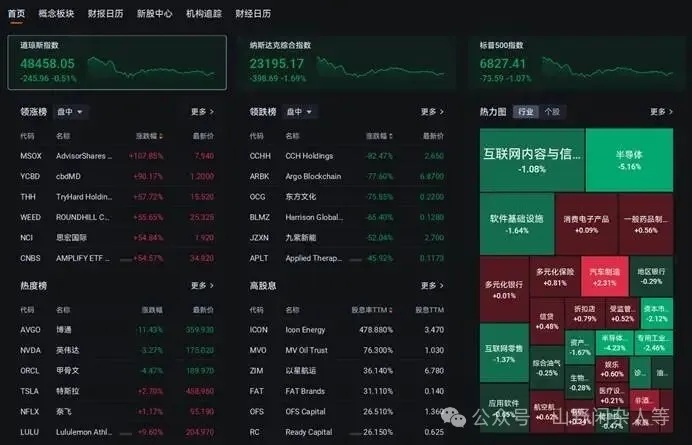
Behind this was valuation panic triggered by Broadcom's earnings report, combined with a "surprise" hawkish speech from Fed officials, which completely shattered market sentiment. Not only tech stocks but also cyclical stocks were dragged down, with the only bright spot seemingly being speculative "weed stocks" betting on policy easing and LULU's leadership change.
Is this wave of decline a signal of the end of the bull market or the last "deep dip" before the Christmas rally? Today, we’ll take a deep dive into it.
1. AI Faith Collapse? Broadcom's "Injustice" and Nvidia's "Pain"
The main force behind this sell-off is none other than our former "sweetheart"—the AI sector.
AI chip giant Broadcom saw its stock plunge 11.4% after releasing seemingly strong earnings, marking its worst single-day performance this year. The reasons for the plunge appeared "justified": AI orders didn’t exceed expectations, gross margins dipped slightly, and there was no upward revision to long-term guidance… But the truth is: Wall Street just found an excuse for a long-overdue high-level liquidation.
Broadcom’s stock had previously surged mindlessly on the coattails of Google and AI hype, with a forward P/E ratio as high as 42x—far above its 10-year average (17x). This valuation was even pricier than Nvidia’s, yet its growth rate and moat were inferior to Nvidia’s. Moreover, the market wanted "explosive growth," but Broadcom delivered "steady growth." In an extremely crowded trade, "not impressive enough" is a sin.
As Citi analysts put it: "This isn’t an earnings problem; it’s an expectations problem." This sell-off is essentially a case of big money taking profits and squeezing out bubbles after the earnings catalyst played out. For long-term investors, if Broadcom falls to its 200-day moving average, it might present a rational entry point.
Nvidia and AMD were also dragged down. Nvidia, in particular, saw its stock break below the key support level of $176 despite positive news (Panda’s H200 demand exceeded expectations). Nvidia has been ground down to the point of being "stretched." The current situation is: good news doesn’t lift the stock, but bad news amplifies the drop. The market is reassessing the logic that "AI investment equals linear growth." Oracle’s delay in data center construction further fueled concerns—investors are starting to worry whether corporate AI capital expenditures will become more rational.

For Nvidia, if it falls further to $164, that might be a more comfortable buying point. Only when it’s fully sold off will there be a comfortable entry. The current slow bleed is the most agonizing.
2. The Fed’s "Player" Playbook: Easing While Talking Hawkish
If AI’s decline is the internal factor, the Fed is the external one.
Early in the session, the Nasdaq was still holding up—until several Fed officials came out "bombing." Cleveland Fed President Mester and Kansas City Fed President Schmid took turns warning: "Inflation is too high; rates must stay restrictive!" Do you see the Fed’s game now? It’s textbook "player" behavior: easing in action but talking hawkish. Why? Because they’re afraid of an economic crash (hence the easing) but also afraid of runaway inflation from soaring asset prices (hence the scare tactics).

This has led to a huge divergence between stocks and bonds: stocks are pricing in "deep rate cuts next year," while bonds are pricing in "stubborn inflation, slower cuts." The result? The 10-year Treasury yield is pushing toward 4.2% again. When stocks and bonds diverge, history tells us bonds are usually right. And it’s not just the U.S.—global bond markets are in turmoil, with long-term yields in Europe and Japan also spiking. This reflects the market’s realization: the global central bank easing cycle may not go as smoothly as expected, and high rates will last longer.
3. Market Oddities: Meme Stock Frenzy and LULU’s "Last Gasp"
Amid the sea of red, some sectors were still partying.
LULU (Lululemon) surged to lead the S&P—what irony! Its earnings were mixed, but the stock gapped up, breaking through its 200-day moving average. Why? Because the CEO, long criticized by investors, is finally leaving! Combined with a $1 billion buyback, LULU staged a textbook "oversold bounce" (a technical rebound after a 69% drop from its peak).

There was also action in weed stocks, as the market speculated about potential deregulation under a Trump administration. But "US Stock Notes" must warn: these stocks are pure speculation. The U.S. ruling party is inherently conservative, and the odds of real deregulation are slim. This is just money, with nowhere else to go after big tech’s retreat, riding a wave of "endgame rotation" on headlines. These junk stocks with no fundamentals? Look, but don’t touch—whoever believes buys the bag.
Nvidia is holding a "Power Summit" next week to address AI’s energy bottleneck. This weekend, focus on the power sector—after recent pullbacks, there may be short-term trading opportunities.
4. Next Week Outlook: "Golden Pit" or "Crematorium"?
Back to the broader market. The Nasdaq broke below its 5- and 10-day moving averages on Friday, testing the critical 50-day moving average. Although it clawed back slightly by the close, the alarm isn’t over—this is the bulls’ last line of defense. Hold here, and the uptrend remains; lose it, and the next support is the 200-day moving average. The S&P 500 is stuck in a 6800-6900 range.
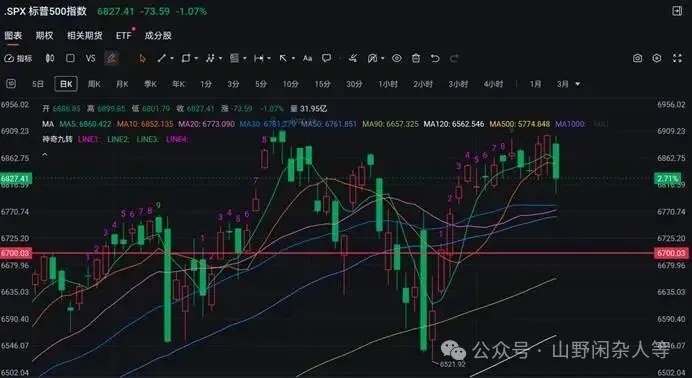
Next week is a super week for year-end direction: U.S. CPI and nonfarm payrolls data loom, and the Bank of Japan may hike rates. Morgan Stanley’s predicted "high volatility, strong divergence" market has arrived.
"US Stock Notes" key takeaways:
1. The pullback is fundamentally a "valuation reset": Money is flowing out of overbought, overvalued AI and big tech into new areas (today’s cyclical stock rally hints at this). A risk release before the Christmas/New Year "dead zone" could set up next year’s rally.
2. Watch these levels: If the S&P 500 falls further to 6700 or even 6600 next week, don’t panic—that’s the market’s Christmas gift to you.
3. Trading advice: Cash is king. Don’t go all-in.
4. Thematic plays: As money spills out of big caps, themes like power stocks and oversold names may get a boost. But remember—"small bets for fun"—these are just tactical, not the main game.
5. Closing Thoughts
The market is always right. Our job isn’t to predict the wind but to adjust the sails.
The Fed dances on a knife’s edge as global central bank games enter deep water. For investors, the turning point from "mindless buying" to "selective picking" may have arrived. Respect the market, stay patient, and wait for the next high-conviction swing.
Remember: Rational pullbacks are the market’s gift to the patient.$Oracle(ORCL.US) $Broadcom(AVGO.US)
The copyright of this article belongs to the original author/organization.
The views expressed herein are solely those of the author and do not reflect the stance of the platform. The content is intended for investment reference purposes only and shall not be considered as investment advice. Please contact us if you have any questions or suggestions regarding the content services provided by the platform.
