


SSE 50 vs Dow Jones: The gap between traditional industries in China and the US has narrowed, with future divergence only in technology


Last week, we compared the differences in valuation and fundamental changes between the Nasdaq and Hong Kong-listed China concept internet stocks over the past three years.
If the Nasdaq represents the frontier of growth, then the Dow Jones Industrial Average and the Shanghai 50 are more like concentrated representations of the most stable and mature core assets of the Chinese and U.S. economies, directly reflecting the overall landscape of the two economies.
Amid heightened global market fluctuations, observing the pricing logic and relative performance of these two "core portfolios" may provide us with a more solid reference for understanding the market.
01 Component Overview: Shanghai 50 Has Higher Industry Concentration, Dow Jones Has More Rational Industry Distribution
At the outset, as usual, we first standardize the data comparison framework: based on the GICS industry classification, the Dow Jones Industrial Average currently has 30 component stocks, covering 27 GICS sub-industries, with only three companies in the same sub-industry; while the Shanghai 50 has 50 component stocks, covering only 26 GICS sub-industries, with nearly half of the components not being the only peer in their industry.
From the perspective of industry weight distribution, based on the primary GICS industry weights, the top two weights for both are finance and information technology, but the financial sector weight of the Shanghai 50 is higher, reaching 34%, while the financial weight of the Dow Jones Industrial Average is only 20.2%.
The difference is even more pronounced at the sub-industry level. Among GICS sub-industries, the concentration of the Shanghai 50 is much higher than that of the Dow Jones Industrial Average, with commercial banks accounting for nearly 20%.
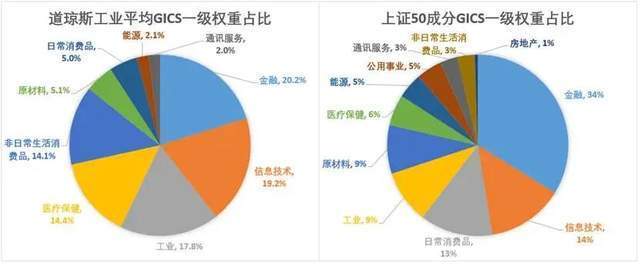
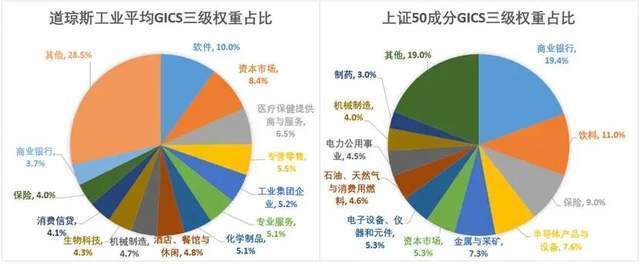
Clearly, in terms of industry dispersion, the current component structure of the Shanghai 50 is not as rational as that of the Dow Jones, with an overly high weight of commercial banks, and this is already the case after multiple rounds of adjustments.
This can also be glimpsed from the average valuation of the two indices. The PE valuation of the Dow Jones Industrial Average is roughly three times that of the Shanghai 50
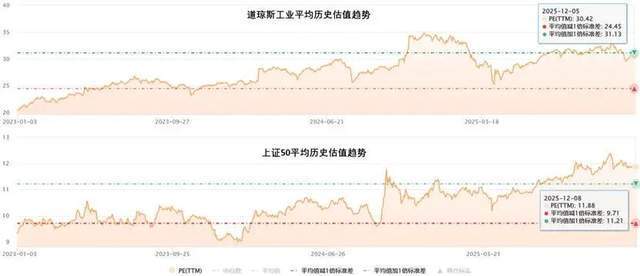
Of course, we can also understand that, given the current capital market, the market capitalization of A-share banks is inherently high. Excessive stripping of the weight of commercial banks may also lead to index distortion.
However, it is clear that the Shanghai 50 currently does not have the objective conditions for a direct comparison with the Dow Jones Industrial Average. Therefore, we selected 12 GICS sub-industries covered by both and included the companies with the highest market capitalization in each industry in the sample pool to form comparable samples, as shown below:
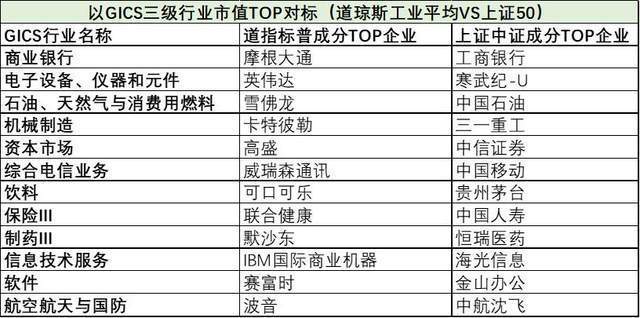
In the following text, we will replace the comparison between the Dow Jones and the Shanghai 50 with the comparable samples in the picture (all units are unified as "billion U.S. dollars", and the data are all from the Choice financial client), the specific comparison is as follows.
02 Valuation Level: The Strength of Traditional Cornerstone Industries in China and the U.S. Is Close, and There Is No Significant Valuation Difference Between the Dow Jones and the Shanghai 50
First, let's look at the overall valuation level of the comparable samples:
(1) The gap in total market capitalization has narrowed, and the real market capitalization growth rate of the Shanghai 50 excluding cutting-edge semiconductors is higher
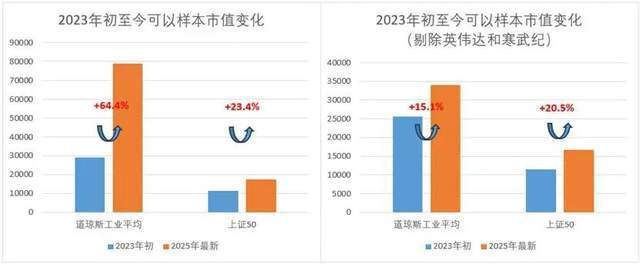
We still look at the comparable samples from a three-year perspective. The gap between the Dow Jones Industrial Average and the Shanghai 50, if all comparable samples are included, the overall valuation of the Dow Jones has surged from $2.9 trillion at the beginning of 2023 to $7.9 trillion, with an annualized compound growth rate of market capitalization reaching an astonishing 64.4%. Although the performance of the Shanghai 50 is also good, the compound growth rate is only 23.4%, which is about one-third of that of the Dow Jones.
But in fact, since the outbreak of the AI era, in the Dow Jones comparable samples, only Nvidia's market value has surged from $360 billion to about $4.5 trillion, contributing the vast majority of the Dow Jones's market value increase, so the horizontal comparison is relatively distorted. Therefore, we simultaneously removed Nvidia from the Dow Jones sample and Cambrian from the Shanghai 50.
In relatively mature industries, the Dow Jones's overall market capitalization grew from $2.6 trillion to $3.4 trillion over three years, with an annualized compound growth rate of 15.1%, while the Shanghai 50 comparable samples grew from $1.15 trillion to $1.67 trillion, with an annualized compound growth rate of 20.5%.
That is to say, after excluding cutting-edge semiconductors, the market capitalization growth rate of the Shanghai 50 in the past three years is higher than that of the Dow Jones average, and it is gradually catching up with the gap in total market capitalization.
(2) The valuation logic of the Shanghai 50 and the Dow Jones Industrial Average is converging, and the valuation levels are not much different
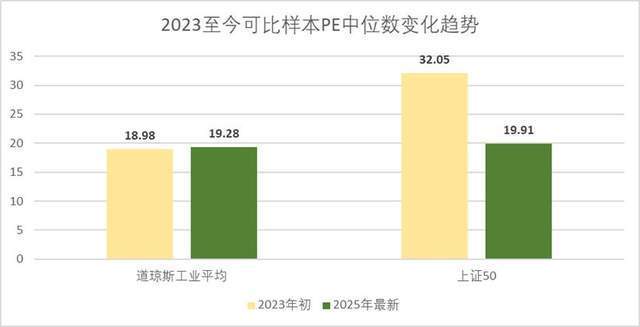
Corresponding to the total market capitalization, the Shanghai 50 has experienced a wave of valuation and post-pandemic fundamental recovery in the past three years, and the overall valuation gap with the Dow Jones Industrial Average has also narrowed significantly.
Similarly, in order to ensure that the data is not distorted (Cambrian has not yet achieved scale profitability), we still exclude cutting-edge semiconductors. Based on the latest quarterly financial report of this year, the PE-ttm of the Dow Jones Industrial Average is about 19.3x, and that of the Shanghai 50 is about 19.9x, the difference between the two is not large.
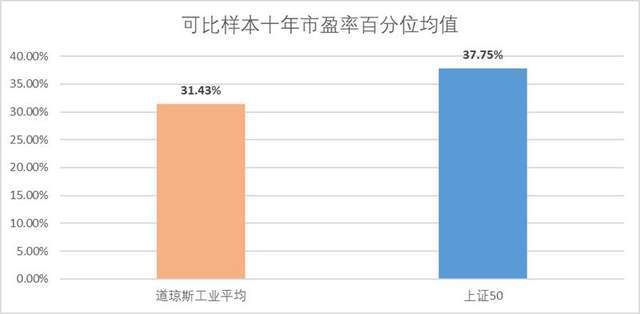
From the perspective of historical percentile, the average ten-year historical percentile of the Dow Jones Industrial Average comparable samples is currently around 31.4%, and the ten-year historical percentile of the Shanghai 50 comparable samples is around 37.8%. The horizontal comparison between the two is not very different, and both are below the median level. After all, from the perspective of sample size, most industries are not popular industry targets in capital.
Overall, in sharp contrast to the Nasdaq and China concept internet stocks, if cutting-edge semiconductors are excluded, despite the differences in the markets they face, from a capital perspective, the differences between the traditional industries representing the economic cornerstones of China and the U.S. in the capital market are not large, and the valuation level of the traditional industries of the Shanghai 50 is even slightly better.
03 Income Level: Looking Only at Profits, the Shanghai 50 Has Slightly Outperformed the Dow Jones Industrial Average in the Past Three Years
Let's look at the performance of the Dow Jones Industrial Average and the Shanghai 50 on the revenue side:
(1) In the same global village, the revenue growth of traditional industries in China and the U.S. is converging
From the beginning of 2023 to the present, the quarterly revenue scale of the Dow Jones Industrial Average comparable samples has grown from $313 billion to about $408 billion. Based on the latest third-quarter report of this year, the growth rate reached 14%. The quarterly revenue of the Shanghai 50 has hardly grown, and even experienced a phased decline. It rebounded in the third quarter of this year, with a year-on-year growth rate of about 10.5% (of course, mainly due to the low base in the third quarter of last year).
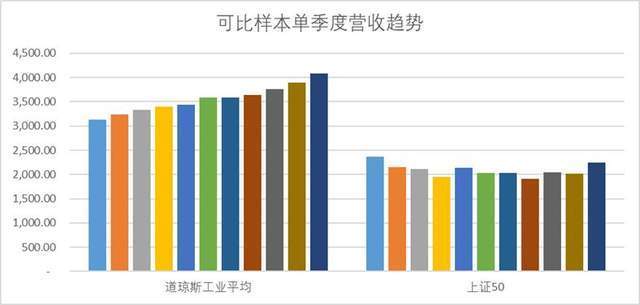
Similarly, from another perspective, after excluding cutting-edge semiconductors, the year-on-year growth rate of the Dow Jones Industrial Average in the third quarter of this year is about 8.7%, while that of the Shanghai 50 is 10.4%, which is slightly higher than that of the Dow Jones.
The reason is also relatively easy to understand. The degree of globalization of the industrial chain in mature industries is relatively high, the penetration rate is also relatively high, and the market faced is relatively stable, so the gap between enterprises will not be very obvious.
(2) The system advantage is obvious, and the profit level of the Shanghai 50 has surpassed that of the Dow Jones
At the profit margin level, unlike the narrative of Internet companies, the gross profit gap between China and the U.S. in mature industries is not as large as imagined. The inertial logic surrounding the low gross profit of the manufacturing industry in the past, the market usually believes that the profit difference between Chinese and U.S. enterprises at different stages of development is relatively obvious. But the actual situation is that the maturity of China's traditional industries is already very high, and the overall gross profit difference is almost non-existent.
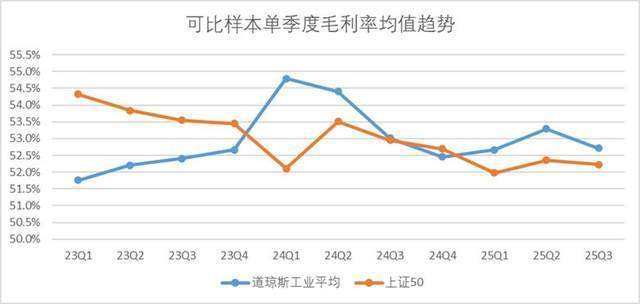
At the same time, thanks to the system advantages of some industries, in cornerstone industries with relatively monopolized resources (such as oil services, communications, and beverages), our overall profit level is significantly higher than that of the Dow Jones Industrial Average. Moreover, our net profit scale is very stable.
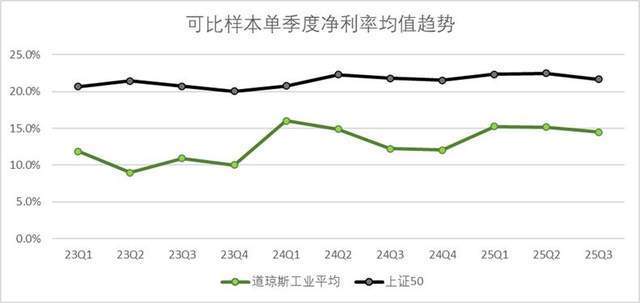
Therefore, from the perspective of profits, the investment stability of the traditional industries of the Shanghai 50 is even higher than that of the Dow Jones Industrial Average.
04 Cost Structure: The Shanghai 50 Is Relatively More Conservative, and the Dow Jones Is Relatively More Mature
Finally, let's focus on the differences in cost composition and capital structure:
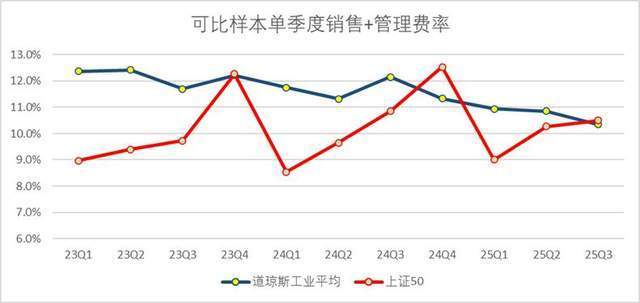
(1) There is almost no difference in the expense ratio, and the quarterly expense ratio of the Shanghai 50 fluctuates more
U.S. stock reporting rules generally disclose the quarterly sales expense ratio and management expense ratio as a single item. Correspondingly, we also process the Shanghai 50 sample targets in the same caliber and exclude the financial industry (accounting rule differences).
From the perspective of the overall expense ratio, as of the third quarter of this year, the overall sales + management expense ratio of the Shanghai 50 comparable samples is about 10.5%, while the Dow Jones expense level is about 10.3%, the two are close to each other.
From the trend, the Dow Jones has shown a clear trend of gradually reducing the expense ratio in the past three years, while the Shanghai 50 has fluctuated upward, but the overall growth rate is also relatively low. However, due to the characteristics of domestic business (concentrated in the fourth quarter of the year to spend budgets and file taxes), the difference in the quarterly expense ratio of the Shanghai 50 is large, but the trend of the quarterly expense ratio of the Dow Jones is not obvious.
In terms of R&D expense ratio, the gap between the two is even smaller. We excluded companies that did not disclose the R&D expense ratio. Among the comparable samples, the R&D expense ratio of the Dow Jones and the Shanghai 50 fluctuates within the range of 11%.
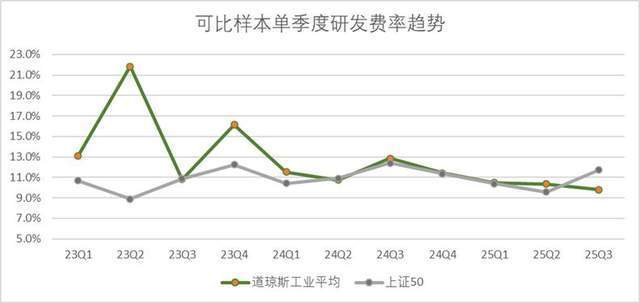
Whether it is mature industries in China or the U.S., before the landing of technological breakthroughs, it seems that they are not willing to increase their bets. After all, they are already the best in their respective industries, their capital strength is relatively strong, and they have a certain moat. It is obviously a better solution to carry out capital expenditures after the technology matures.
(2) The debt structure of the Shanghai 50 is obviously more conservative
In terms of capital and liability structure, the gap between the Dow Jones industrial sample and the Shanghai 50 is relatively large. First of all, there is the difference in financing methods. The overall debt ratio of the Dow Jones Industrial Average reached 68%, while that of the Shanghai 50 sample companies was only 45%.
At the same time, in terms of debt repayment security, the strategy of the Shanghai 50 is obviously more conservative. The overall quick ratio reached 3.17 times, while the average quick ratio of the Dow Jones Industrial Average sample companies was only 1.16 times.
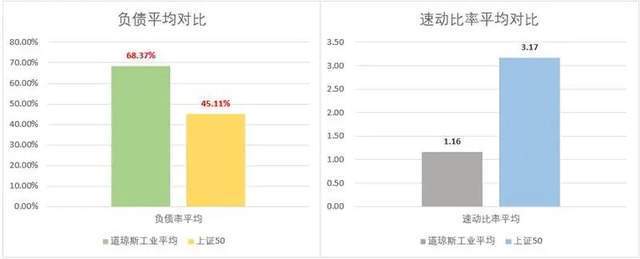
This may be due to the different life cycles of the companies. U.S. companies have taken the lead in entering the mature stage, and they are relatively confident in long-term stable operations to expand profit boundaries through capital leverage. Chinese companies entered the mature cycle later, and companies are more conservative in their capital operations on the debt side, leaving enough safety space. In the future, mature companies in the Shanghai 50 may be able to explore more possibilities of capital gains.
(3) Even in mature markets, the peer competition of the Shanghai 50 is higher than that of the Dow Jones
In addition to the debt level reflecting the "personality" differences between Chinese and U.S. cornerstone companies, there are actually many data that can confirm that although they are all in mature industries, there are still significant differences in the competitive environment of leading companies in China and the U.S.
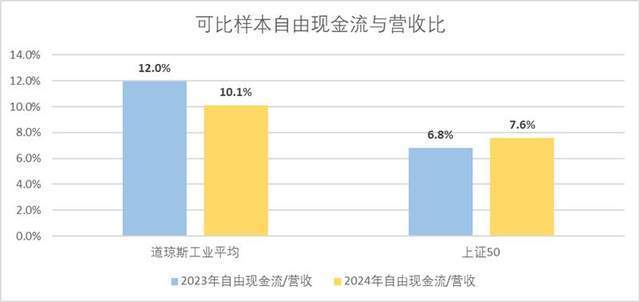
For example, we found that among comparable sample companies, the proportion of free cash flow to revenue of the Dow Jones Industrial is higher, while the free cash flow of the Shanghai 50 is still at a low level.
The main reason is that the companies in the Shanghai 50 are still in the cycle of production expansion or still need to maintain capital expenditure expansion, while the mature companies in the Dow Jones sample have obviously entered the cycle of higher capital returns earlier, with fewer competitors and less need for maintenance capital expenditures.
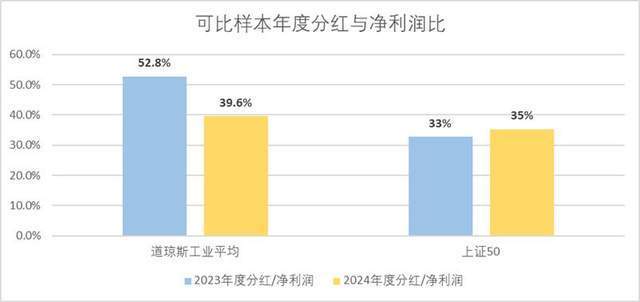
Another example is that at the level of investor returns, although the Shanghai 50 has gathered the companies most willing to pay dividends in the domestic capital market, compared with the mature companies of the Dow Jones, the amplitude of returns to investors is still relatively conservative. For example, the Dow Jones Industrial can maintain an annual dividend accounting for 40%-50% of net profit, while the Shanghai 50 is about 10pct lower.
Of course, this may also be related to the market structure. At present, even in mature industries, the competition intensity of the Chinese market is higher than that of the U.S. market. We have counted the dispersion of the leading TOP1 companies in the GICS sub-industries (Shanghai and Shenzhen A-shares, NYSE and AMEX; dispersion = 1 - the proportion of the total market value of TOP companies in the industry market value).
Among the comparable industries, in the 11 industries excluding cutting-edge semiconductors, the dispersion of the Shanghai 50 is higher than that of the Dow Jones in 7 industries.
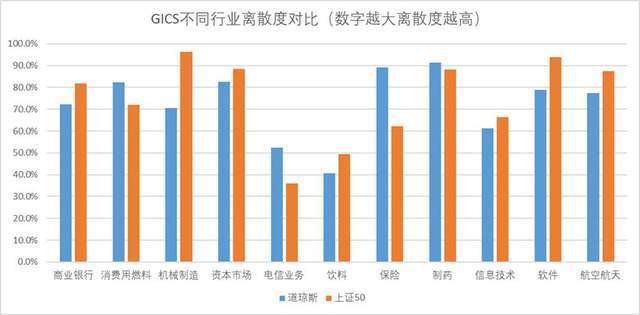
However, from the trend, whether it is the scale of free cash flow or the level of dividends, the two are gradually converging. If the dispersion can be reduced through mergers, reorganizations, and other methods at the capital level in the future, I believe that the Shanghai 50 can also achieve higher capital returns, thereby further improving the valuation level.
05 Conclusion: There Is No Obvious Gap Between Traditional Cornerstone Industries in China and the U.S.
At this point in the article, we summarize the results of the fundamental comparison between the Dow Jones Industrial Average and the Shanghai 50 comparable samples:
·The market size and valuation logic of mature industries are also relatively mature. The differences between the two in terms of valuation level, revenue growth, and gross profit margin level are very small, and the cost structure is also tending to be consistent.
·The first difference is in the level of net profit. The sample companies of the Shanghai 50 benefit from the characteristics of relatively concentrated resources, and the net profit margin is even higher than that of the sample companies of the Dow Jones.
·The second difference is in the capital structure. Even in mature markets, the competition of Chinese companies is higher than that of U.S. companies. Therefore, the sample companies of the Dow Jones have a relatively higher leverage ratio and a stronger willingness to pay dividends, while the Shanghai 50 has a higher safety margin.
In summary, in those seemingly traditional, heavy, and even somewhat "old-fashioned" industries, the gap between Chinese and U.S. companies is much smaller than imagined, and in some dimensions, the performance of Chinese companies has quietly caught up with or even surpassed. At least in the eyes of capital, the value anchor points of traditional industries in China and the U.S. are getting closer. However, this also means that in the high-tech field, the strength of the United States is still amazing, and China's Internet technology cluster has a long way to go.
But differences still exist. Dow Jones companies are better at using financial leverage, pay more attention to shareholder returns, and have more abundant free cash flow, while Shanghai 50 companies appear to be more cautious, with conservative debt and sufficient safety margins.
The core behind this may still be inseparable from the differences in market dispersion, inseparable from the issues of intensified peer competition and anti-involution, which also shows that even in mature markets, there is still room for future capital operations and return improvement of the Shanghai 50.
This article is based on public information and is for information exchange only and does not constitute any investment advice.
The copyright of this article belongs to the original author/organization.
The views expressed herein are solely those of the author and do not reflect the stance of the platform. The content is intended for investment reference purposes only and shall not be considered as investment advice. Please contact us if you have any questions or suggestions regarding the content services provided by the platform.
