


How to position at the end of the volatility period? A volatility strategy that allows zero-cost position building and two-way profit—Short Butterfly Spread (Episode 22)

Have you ever encountered these trading dilemmas:
Expecting significant volatility but find the cost of buying a Straddle too high?
Anticipating a stock breakout but unsure of the direction?
Missed the low entry point and now stuck in a sideways market with no clear strategy?
The Short Butterfly Spread introduced in this article is precisely tailored for these scenarios. It achieves negative cost (cash flow at inception), two-way profitability (profit from both rises and falls), and high flexibility (adjustable by leg removal before expiration).
Short Butterfly Spread - Betting on Small Price Fluctuations
Strategy Composition:
Involves trading three types of options simultaneously:
Sell 1 lower strike (X1) Call, receiving premium (C1)
Sell 1 higher strike (X3) Call, receiving premium (C3)
Buy 2 middle strike (X2) Calls, paying premium 2*C2
Strike relationship: X2 = (X1 + X3)/2
i.e., the strike of the bought options is the average of the two sold options
Initial premium net income = C1 + C3 - 2*C2
Note the trade ratio: Call1(sell) : Call3(sell): Call2(buy) = 1: 1: 2
All options have the same expiration
This strategy can also be built with Puts, with identical logic. The two approaches are very similar in both payoff and risk.
Investment Rationale:
The core is betting on small price fluctuations of the underlying asset before option expiration.
Essentially, it combines bull spread and bear spread strategies:
Sell low strike Call1 + Buy middle strike Call2 = Bear Call Spread
Sell high strike Call3 + Buy middle strike Call2 = Bull Call Spread Thus combined becomes a neutral strategy: indifferent to stock direction, profiting from movement in either direction
Strategy Expiration P&L Diagram and Calculation Formula:
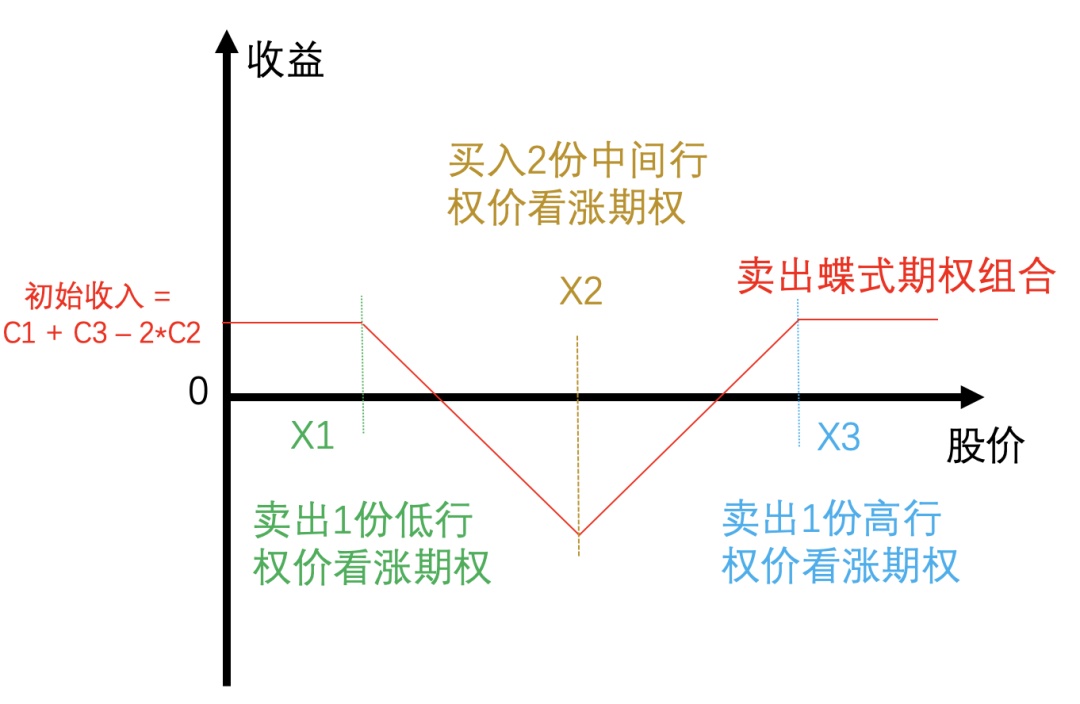
The red line represents the strategy payoff of Short Butterfly Spread
Net credit received = C1 + C3 - 2*C2
Lower breakeven stock price = X1 + net credit per share
Upper breakeven stock price = X3 - net credit per share
Profit when stock price < lower breakeven OR > upper breakeven
Maximum loss occurs when stock price = middle strike X2
Max loss = (X2 - X1)*100 - net credit
Maximum profit achieved when stock price < X1 OR > X3
Max profit = net credit received
Strategy Characteristics
1. Neutral strategy with low reward/risk ratio but high win rate (see case study later).Profitable whether the stock "surges" or "plummets" beyond X1 or X3 - a long volatility play.
2. Deploy when the market is at the end of consolidation, about to choose direction (unknown up/down). That is, when volatility is low and expected to rise subsequently. This makes option prices rise, increasing your spread's profit.
3. High cost efficiency: Selling options offsets buying costs, enabling negative-cost entry.
Beta Practical Application
Disclaimer: The following is for illustrative purposes only, not investment advice. Users should refer to Beta's actual interface.
Assume a stock trades at $315/share. Xiao Li expects a breakout within ~3 weeks but is unsure of direction.
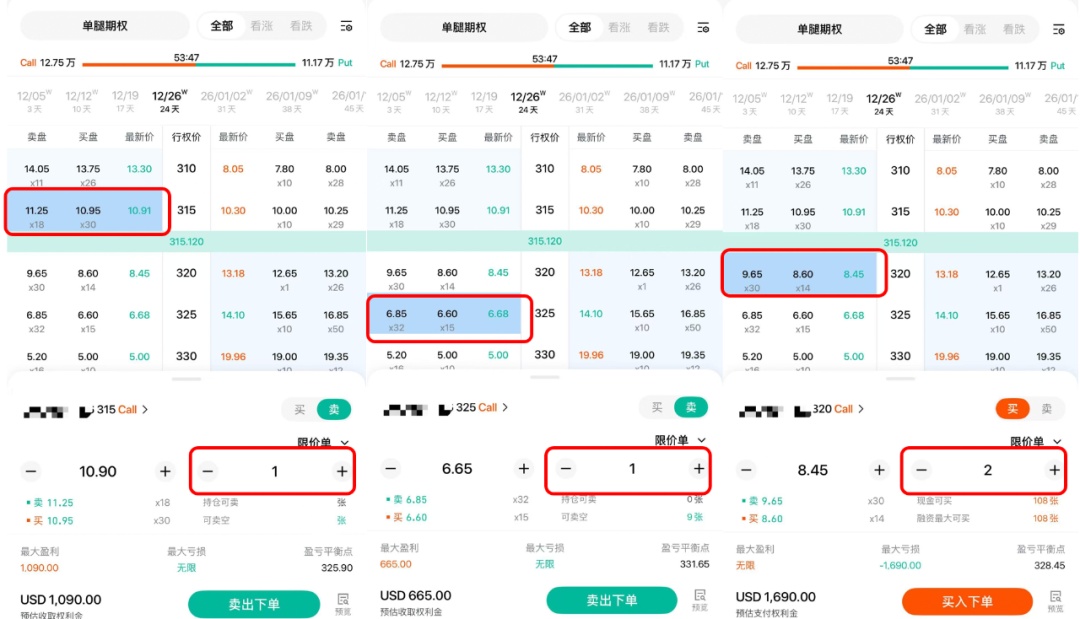
Execution:
Sell 1x 315 strike Call1
Sell 1x 325 strike Call3
Buy 2x 320 strike Call2
Net credit = C1 + C3 - 2*C2 = 1090 + 665 - 2*845 = $65
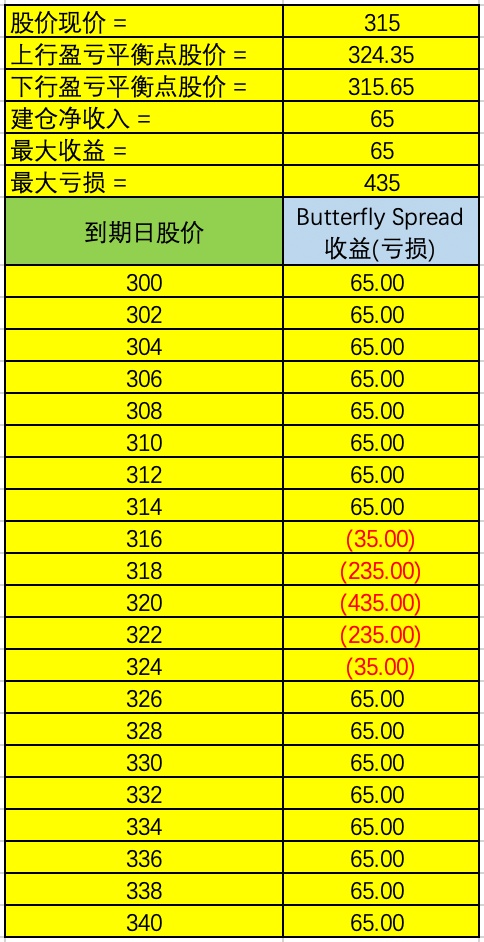
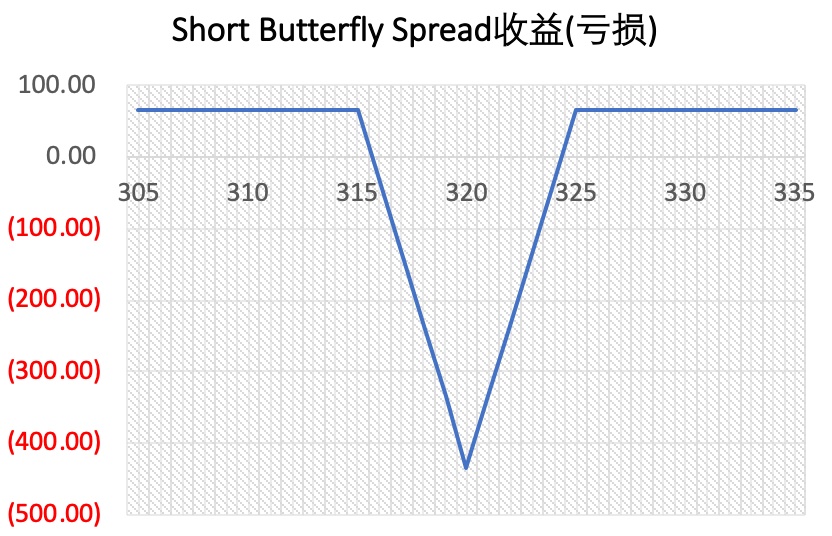
$65 is also the max profit, achieved when price <= 315 or >= 325
Lower breakeven = X1 + net credit/share = 315 + 65/100 = 315.65
Upper breakeven = X3 - net credit/share = 325 - 65/100 = 324.35
Profit when price < 315.65 OR > 324.35 (Note: theoretical, excluding transaction costs)
Max loss occurs if price expires at middle strike 320,
Max loss = (X2 - X1)*100 - net credit = (320 - 315)*100 - 65 = $435
Scenario 1: Price crashes to $250
Sold Call1 & Call3 expire worthless, premium kept = 1090 + 665 = $1755
Bought Call2 also expire worthless, premium paid = 2*845 = $1690
Total profit = 1755 - 1690 = $65 (max profit achieved)
Scenario 2: Price at $316, slightly above lower breakeven 315.65 (small loss)
Sold Call1 P&L = -(316 - 315)*100 + 1090 = $990 (profit)
Bought 2x Call2 & sold 1x Call3 expire worthless, net premium = 665 - 2*845 = -$1025 (loss)
Total P&L = 990 - 1025 = -$35 (loss)
Scenario 3: Price at $320 (max loss at middle strike)
Sold Call1 P&L = -(320 - 315)*100 + 1090 = $590 (profit)
Bought 2x Call2 & sold 1x Call3 expire worthless, net premium = 665 - 2*845 = -$1025 (loss)
Total P&L = 590 - 1025 = -$435 (max loss)
Though the reward/risk ratio appears low (65/435 = 0.15), profit triggers with just ±1.6% price movement beyond strikes, making win rate favorable in proper conditions (end of range, pre-catalyst).
Below charts show strategy payoffs at different prices:
Usage Suggestions (Reference Only)
1. Generally prefer 30-45 DTE options to balance:
Sufficient time for price movement: Too short (<21 days) may not allow volatility to materialize
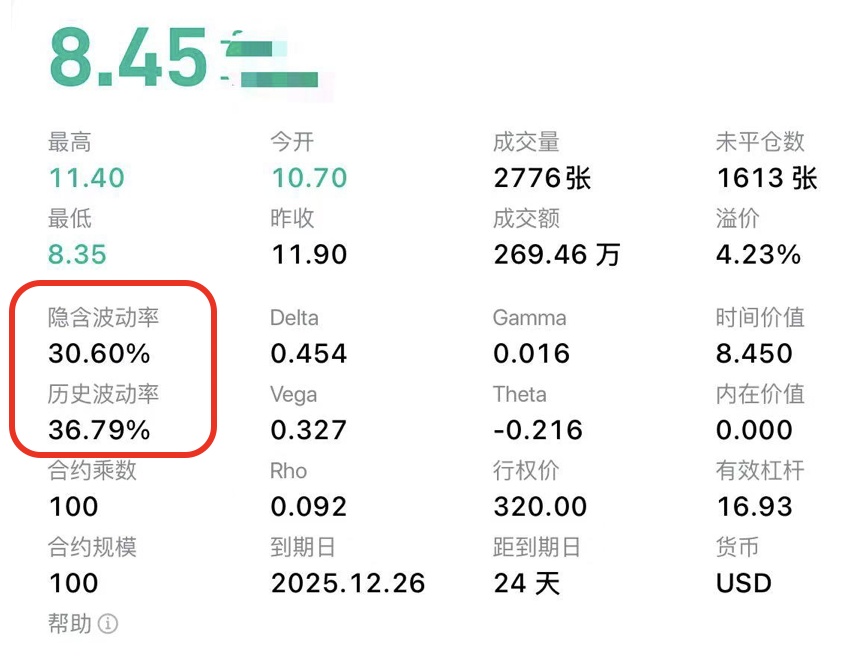
Avoid excessive theta decay: Too long (>60 days) accumulates theta loss, eroding long option value2. Deploy in low IV environment + expected catalyst scenarios like earnings, policy decisions when IV is historically low; set expiration 1-2 weeks post-event to capture IV expansion. Avoid entering too close to event when IV may already be elevated (see chart):
3. Center strike should be near current price (ATM), with 3-5% spacing between short strikes. Prioritize liquid US options to avoid unwinding difficulties. Note assignment risk on short calls (requiring stock purchase if unhedged) - close naked shorts pre-expiration if avoiding exercise. We'll introduce more option strategies later. Follow [Beta Investment Institute] for exclusive tutorials + market insights. Experience options trading via Beta App! For prior content, see "Options Trading Introduction" section below. Risk Disclosure: Options involve high risk of total loss. Investors with adequate experience, objectives, and financial capacity should carefully evaluate suitability.
The copyright of this article belongs to the original author/organization.
The views expressed herein are solely those of the author and do not reflect the stance of the platform. The content is intended for investment reference purposes only and shall not be considered as investment advice. Please contact us if you have any questions or suggestions regarding the content services provided by the platform.
