


GOOGL vs. NVDA: Is the comeback thesis credible?
$Alphabet(GOOGL.US) has been executing its full-stack AI strategy for over a month. The market narrative seemed to flip 'suddenly' as cracks emerged in the OpenAI funding loop. But Google's trajectory is more about patient compounding, where incremental tech upgrades trigger step changes, and, most importantly, a fundamental shift in biz. positioning.
With Anthropic placing another $11bn TPU order and Meta advancing a base-language collaboration with Google, Dolphin Research takes stock. The focus is on what truly changed and why it matters.
1) What are the key shifts in the TPU ecosystem? The drivers are both technical and commercial.
2) How should we map Google’s order flow with Anthropic and Broadcom? The sequencing and revenue attribution differ by model.
3) How much TPU upside is priced into the stock today? We assess the implied expectations vs. backlog and customer ramps.
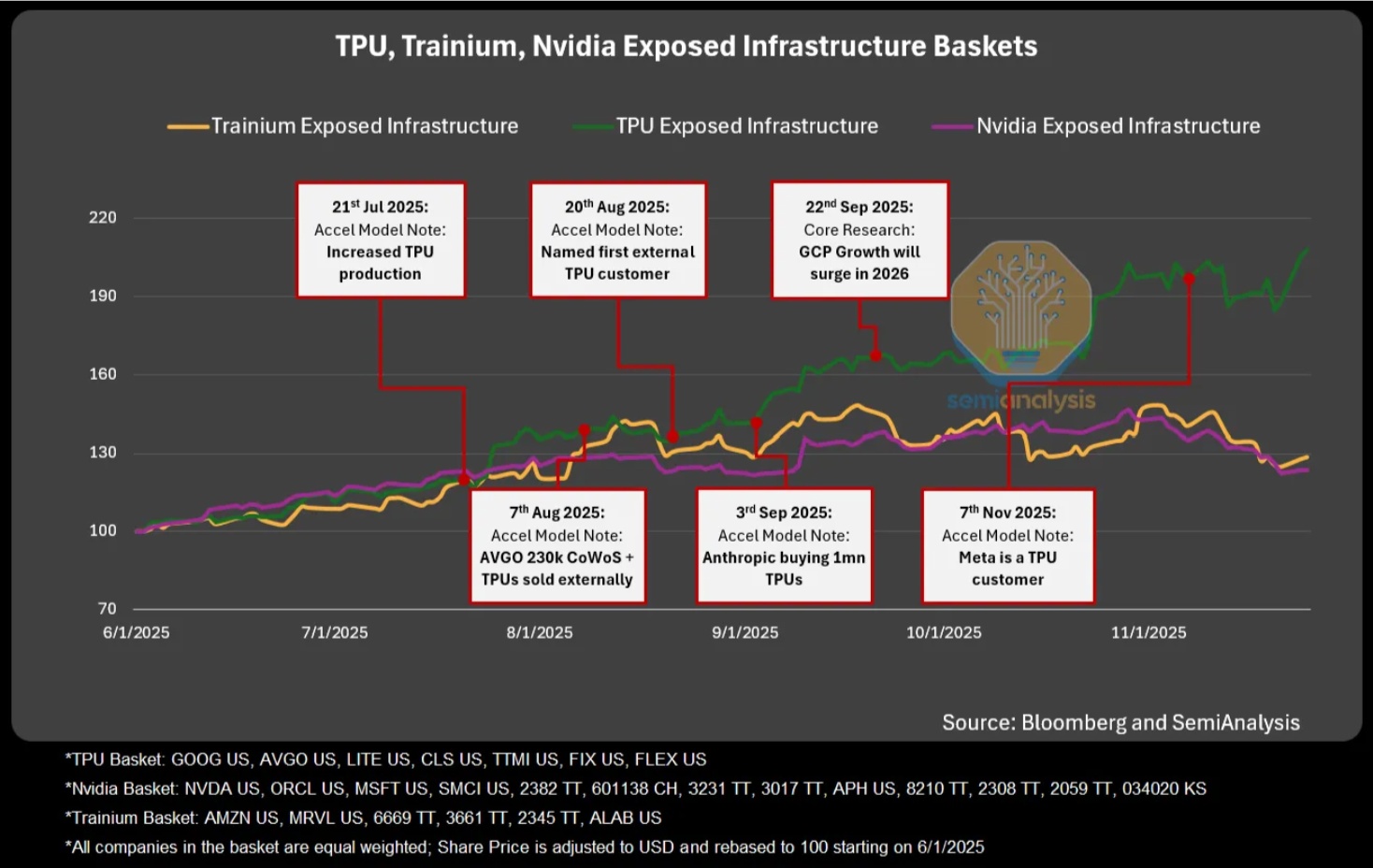
I. Core questions: TPU backlog vs. incremental revenue recognition The timing and mechanics matter for both volume and margin.
1) Did TPU’s tech substitution 'suddenly' break out? If you are not deep in the industry, that is a natural question. Many still recall TPU as less general-purpose, primarily for internal workloads rather than external commercialization.
The inflection is not about the market missing a beat. It stems from a strategic pivot inside Google, shifting TPU from 'internal-first' to 'direct external commercialization', which in turn reset the chip design philosophy.Before the LLM wave, TPU design was conservative relative to NVIDIA’s focus on pushing single-die peak performance.
TPU prioritized perf./$ — trading off absolute single-card peak for lower failure rates, slower wear, less component aging and thermal stress, thereby reducing total system cost. This was rational given its historic role.Internal use also meant different performance targets vs. LLM workloads, especially on compute metrics.
Ad recommendation models did not require extreme throughput, and with no external commercial pressure, there was little need to showcase peak performance. The design fit the job-to-be-done.The chart below contrasts Reco models vs. LLMs: Reco needs are less stringent on compute throughput and network latency.
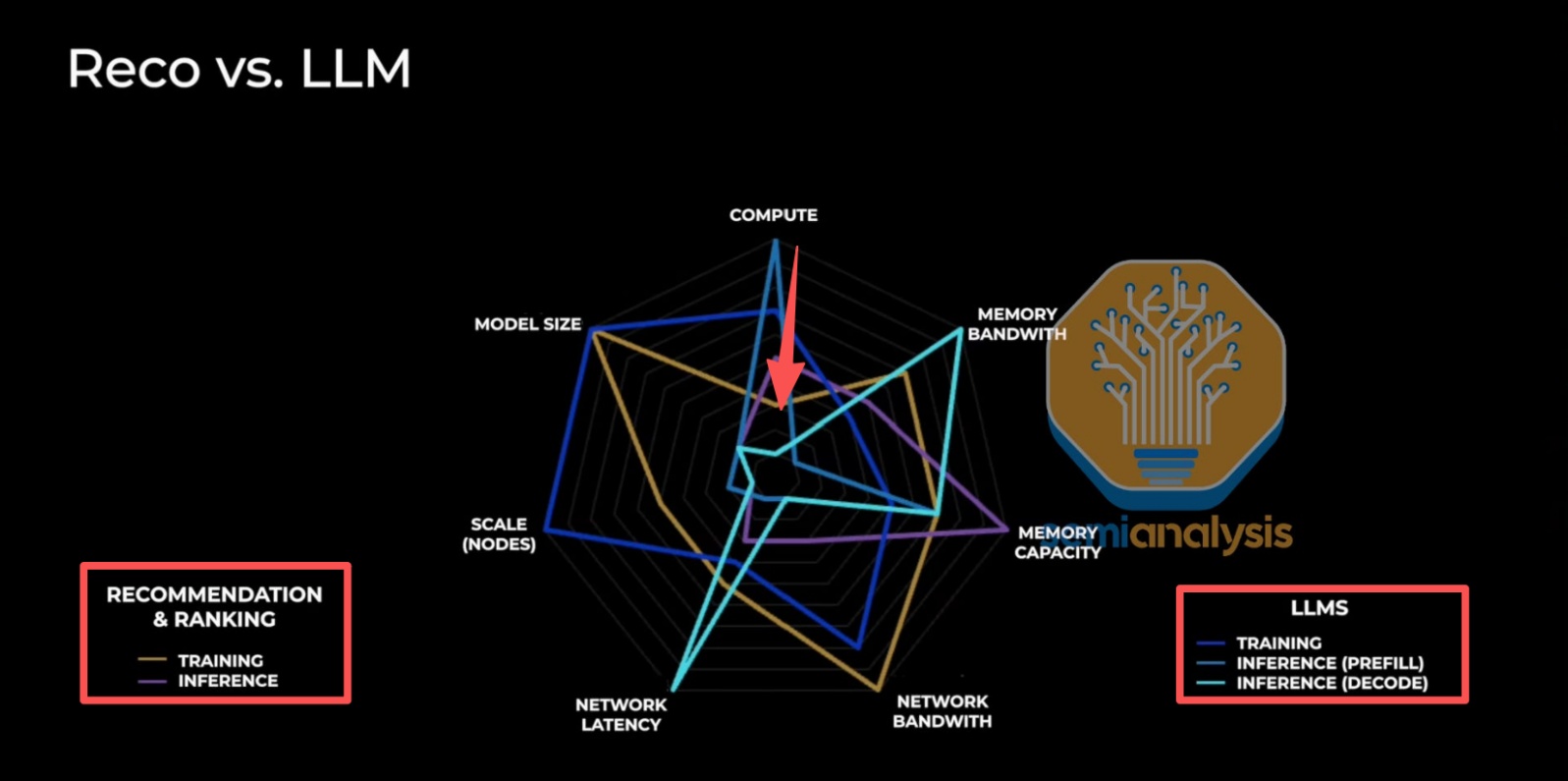
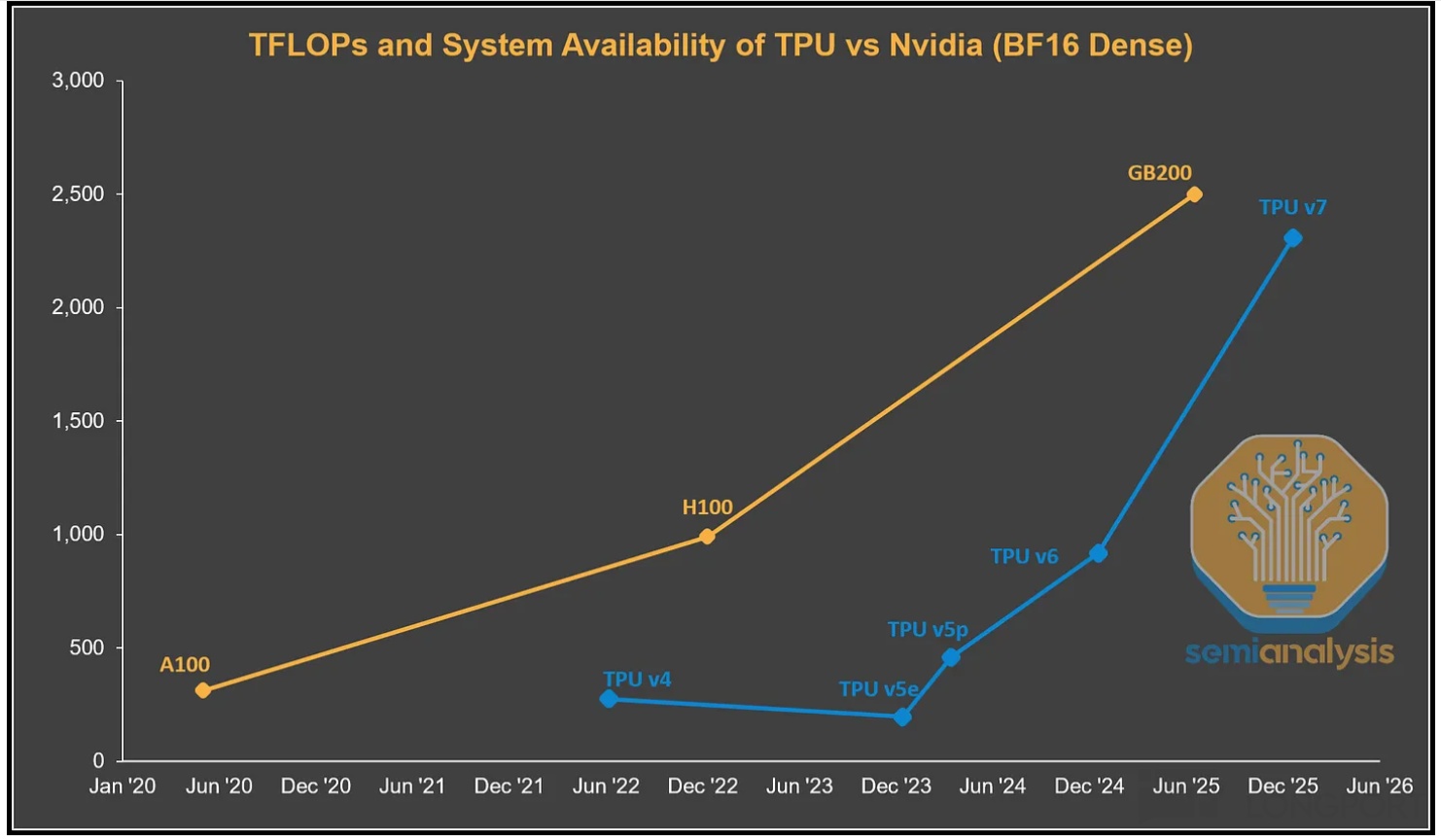
As LLMs arrived, compute requirements surged, forcing a rethink in TPU design. Commercializing TPU directly also opened a path to capture share in a trillion-dollar compute market.Thus, TPU v5 (mid-2024) stepped up single-card performance, followed by major jumps in v6 and v7.
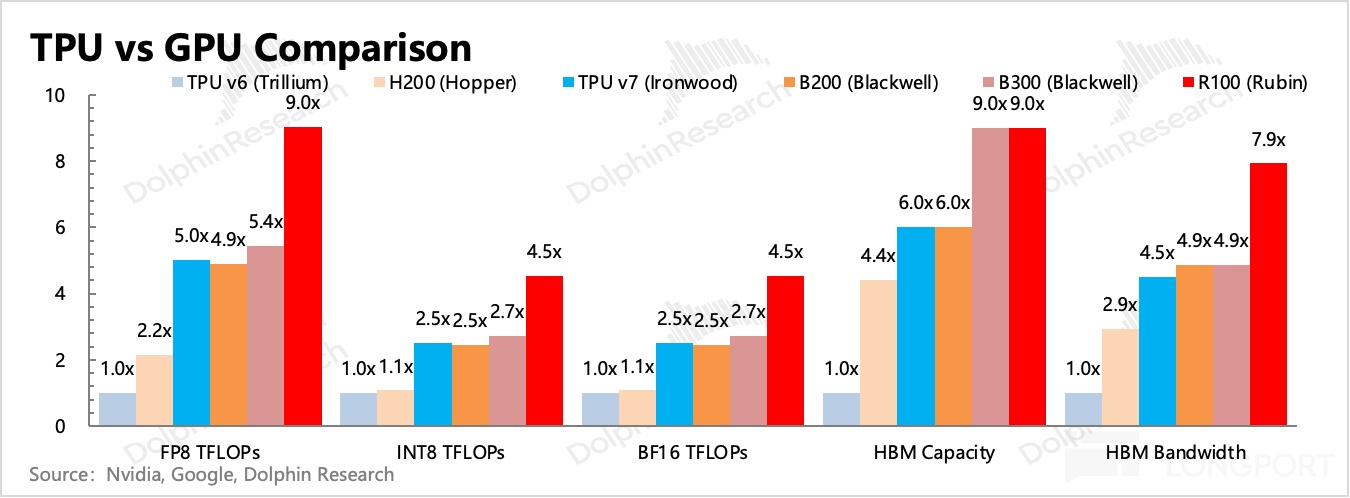
On memory performance — bandwidth and capacity — TPU v7 reached parity with GB200. Single-card perf. still trails GB300 and NVIDIA’s Rubin series by a visible gap.Throughput, however, must be viewed at cluster scale, not just on a single die.
2) Did top-tier customers 'suddenly' place dense orders? The Sept. leak and Oct. confirmation of Anthropic’s 1mn-unit TPU plan put TPU at center stage.Expert checks suggest 3mn units shipped in 2026, implying +66% vs. a low 2025 base.
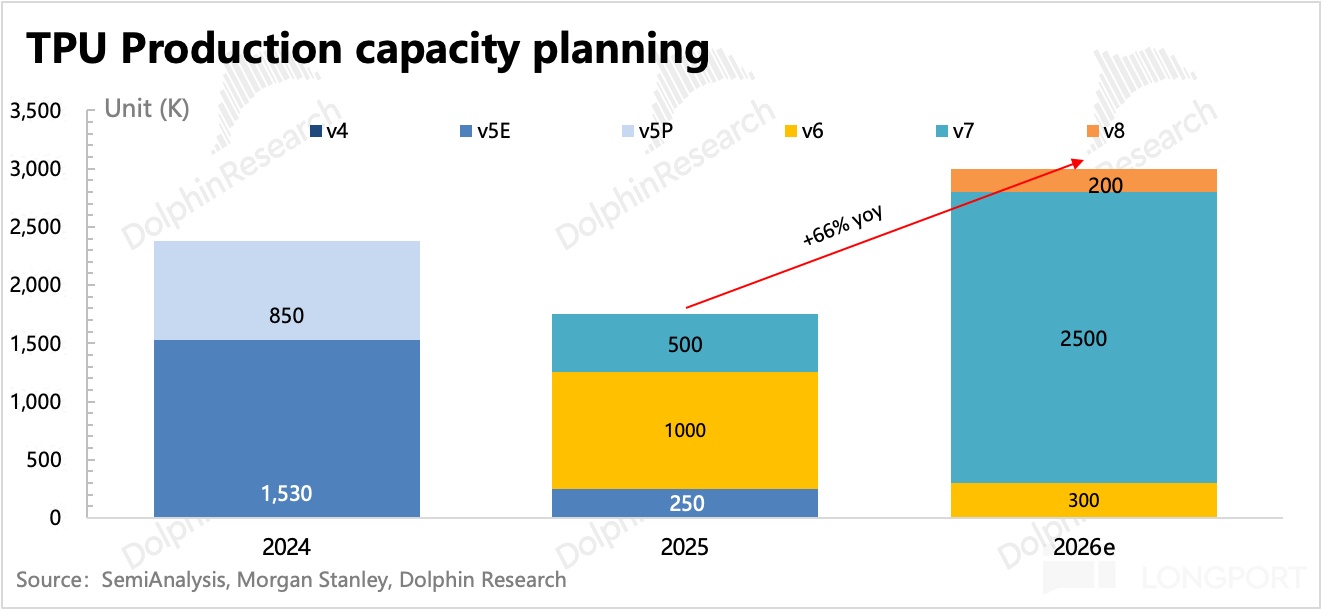
Broadcom’s Q4 print flagged Anthropic’s new $11bn TPU v7 order for delivery by end-2026. At implied ASPs, that is another 400–500k units.If shipments track plan, 2026 TPU shipments should reach at least the 3.5mn-unit range.
The table shows Anthropic’s two orders. Reported talks with Meta and OpenAI lack confirmed detail for now, so we do not ascribe volume there.Visibility should improve as delivery windows lock.

Despite paper parity on substitution, winning flagship customers hinges on three factors: 1) perf./$, 2) advanced packaging capacity allocation, 3) developer ecosystem. These map to effective compute cost, TSMC CoWoS capacity, and the software stack, akin to NVIDIA’s CUDA moat.Execution across all three unlocked the recent step-change.
(1) Win on scale, not as a 'shovel' vendor Raw single-card perf. on TPU v7 may trail NVIDIA B200, and notably lags B300/Rubin. But at 10k-card cluster scale, Google’s proprietary OCS (optical circuit switching) interconnect materially mitigates the exponential efficiency loss typical in large GPU clusters.
Pursuing peak single-card perf. can raise failure rates, wear, aging and thermal stress, depressing effective utilization and lifting maintenance OpEx. Total cost of compute worsens as you scale.Anthropic prioritizes perf./$ — the compute per $ deployed.
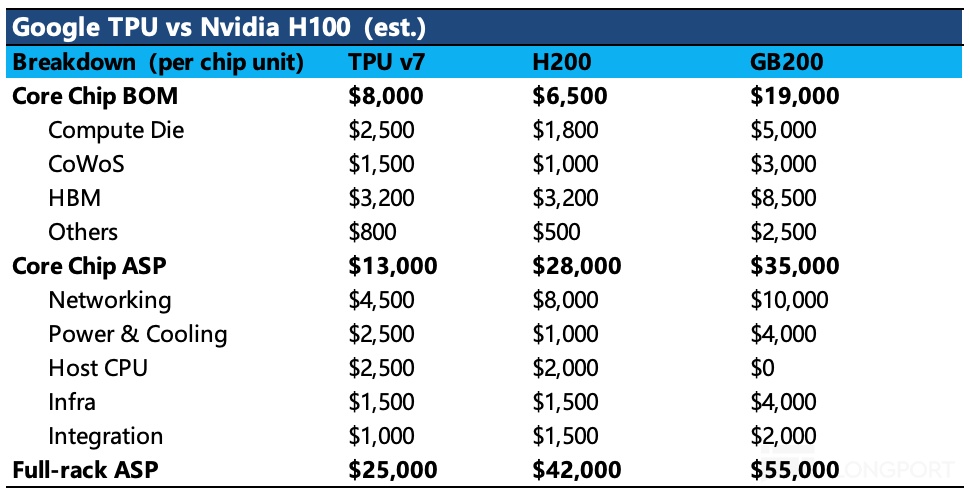
As shown, TPU v7’s unit compute cost (per-chip per-hour all-in, incl. silicon, DC capex, power and labor) is ~44% lower. With one-off hardware and infra capex at 72.7% of total — below GB series’ 77–79% — TPU naturally makes the final shortlist for customers’ compute stacks.That is exactly where procurement decisions are made.
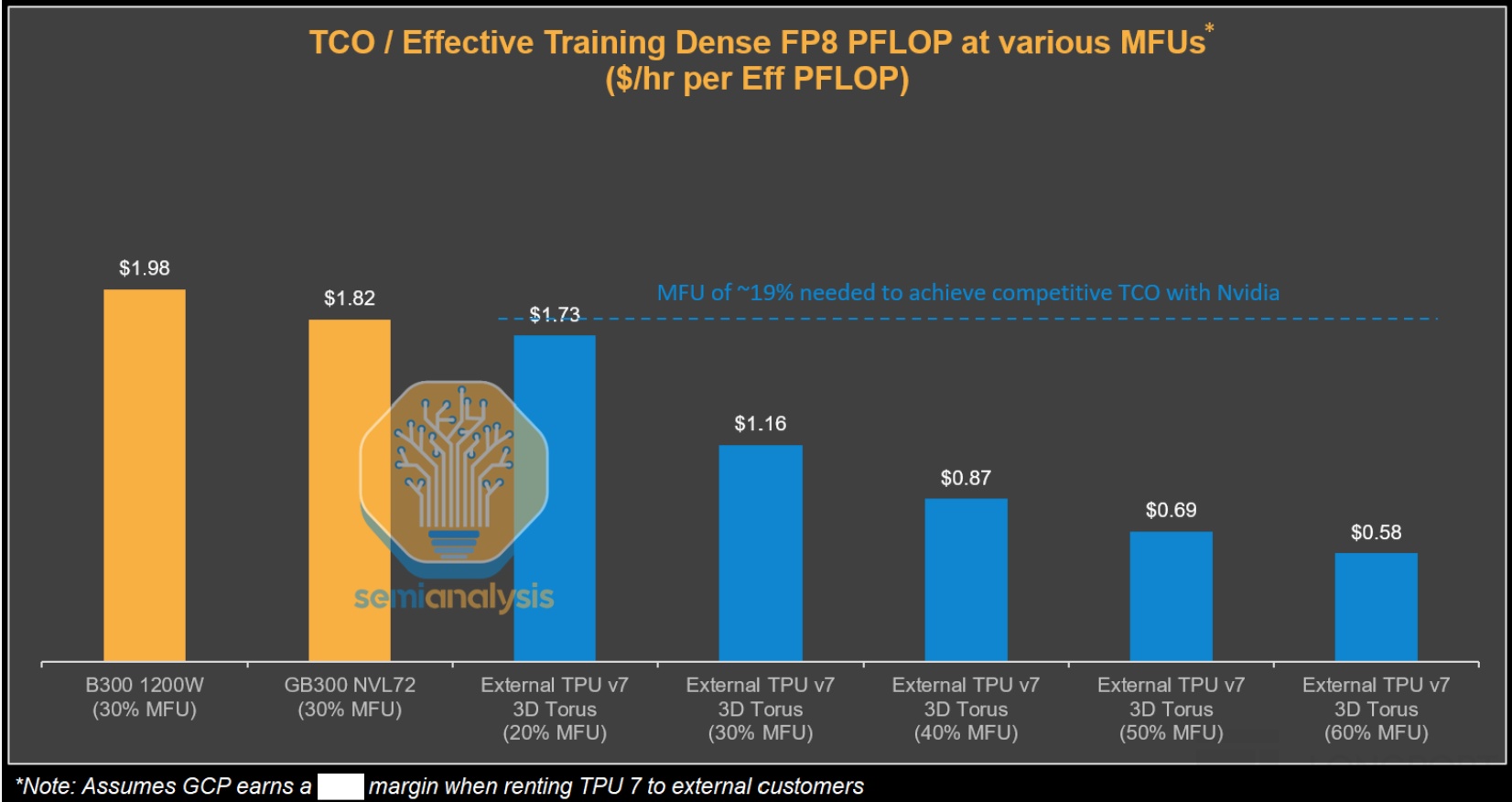
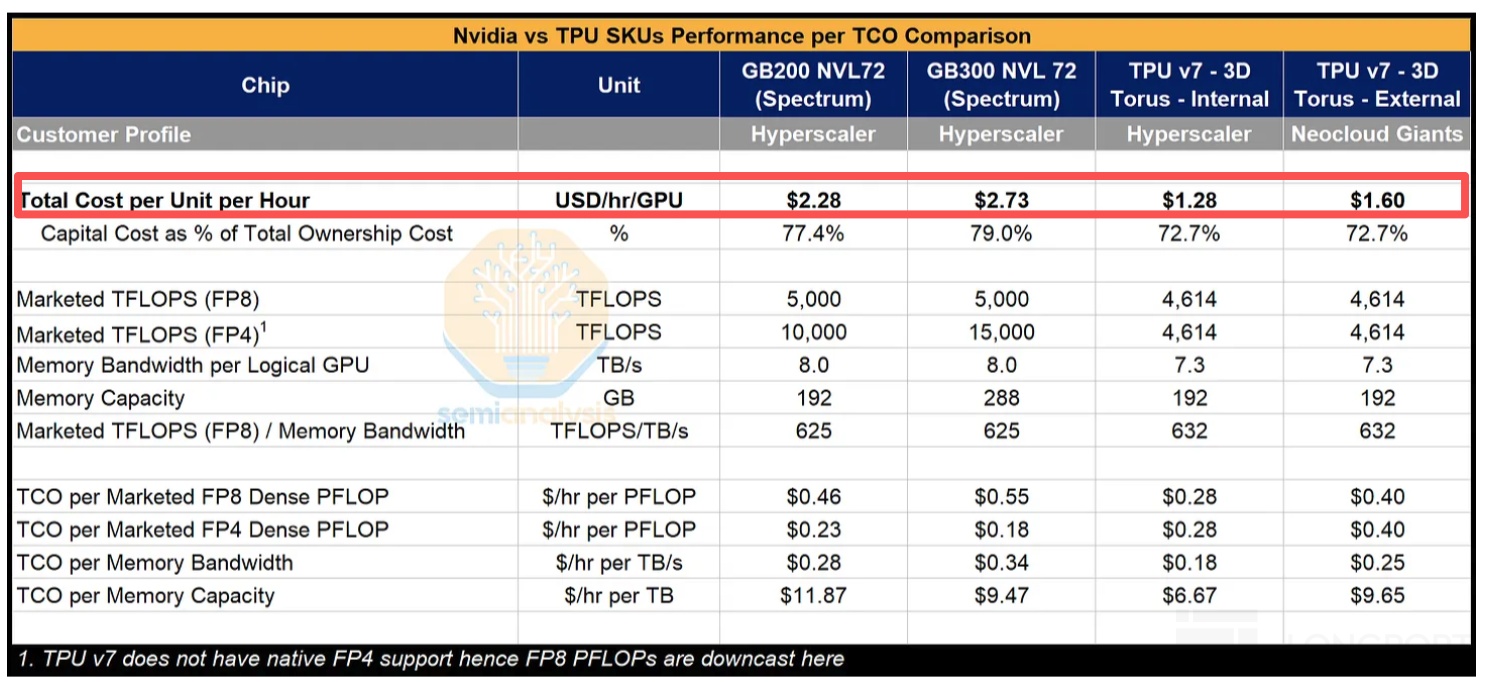
(2) Shift disclosure tactics to lock orders and secure capacity TSMC and NVIDIA have long been tightly aligned, capturing most of the compute supply-chain profit pool in the recent arms race. But that alignment is not unbreakable, especially as the market questions OpenAI’s monetization and the sustainability of order growth under circular financing.From a risk-control perspective, TSMC prioritizes customers with 'deliverable, contracted orders' when allocating capacity.
Google accordingly changed TPU disclosures. To compete with NVIDIA, it must publish roadmaps earlier so customers include TPU in forward capacity planning.Early order capture then helps secure TSMC capacity.
Pre-v7, TPU disclosures were more guarded, treated as an internal 'secret weapon'. TPU v1 deployed in 2015 but was only revealed at Google I/O 2016.Gens 2–6 relaxed disclosures somewhat, typically taking TPU from I/O slides to Cloud GA within a year — i.e., capacity was pre-lined before public launch.
For v7, Google disclosed detailed specs early (Apr-2025) to win orders, even before capacity was locked. By Aug., Broadcom reportedly expanded CoWoS bookings (likely for TPU v7), Anthropic signed in Sept. for racks (public by late Oct.), and its recent $11bn add-on was followed by Broadcom re-securing TSMC capacity for next year.
Broadcom’s delivery windows to Anthropic (mid-2026 and end-2026) imply Google disclosed TPU v7 about 1–2 years ahead of deployment, clearly earlier than prior gens. This cadence shift is deliberate to front-load demand capture.It also signals confidence in the roadmap.
(3) Why is NVIDIA’s software moat showing cracks? Big Tech will not place $10bn+ bets on 'cheap' alone. Software ecosystem readiness is the key unlock for TPU scale commercialization.NVIDIA’s true moat is CUDA, not just single-card perf.
CUDA, the low-level library enabling GPUs to understand C++/Python, has nearly 20 years of accumulated tooling. Engineers built PyTorch atop CUDA; subsequent generations reuse PyTorch modules without writing everything from scratch.To 'disrupt' CUDA, you need tools and talent.
a. Targeted optimization: Compiler 2.0 + native vLLM on TPU TPU’s low-level library is Pallas. Given TPU’s later and internal-first evolution, Pallas was mostly staffed by Google engineers.The PyTorch analog in the TPU world is JAX, with XLA introduced to compile JAX down to TPU runtime.
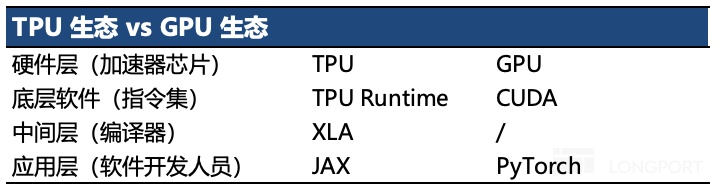
One team versus an ecosystem is a structural disadvantage. Pallas/JAX catching CUDA/PyTorch was hard, making software ecosystem the key bottleneck for TPU commercialization — unless customers already had JAX talent, often ex-Google.Google then launched PyTorch/XLA, enabling PyTorch code to compile and run on TPU.
v1.0 was clunky. The 2.0 release in 2023 improved TPU startup latency, though first-compile overhead remained.The next turn came in H2 2024: vLLM added native TPU support — announced late Jul-2024 for v5e/v6e — and has since improved rapidly.
vLLM is the most widely adopted open-source inference library, originally solving NVIDIA GPU fragmentation, so it was GPU-native. To make vLLM run natively on TPU, Google worked deeply with the vLLM team, rewriting core kernels in Pallas.With JAX + Pallas, vLLM calls TPU’s low-level memory management directly, bypassing PyTorch/XLA overhead.
c. Passive developer seeding: a talent-driven playbook In this AI infra cycle, upstream captured most profits, but prosperity depends on downstream diversity. To secure durable demand, vendor lock-in helps.NVIDIA uses equity — essentially 'chip discount + VC upside'.
Equity tie-ups are not moats; anyone can write checks. Google has long invested in Anthropic, committing $3bn for a 14% stake (non-voting).With Anthropic valued near $200bn, Google has done well regardless of chip bundling.
But again, equity alone is not exclusive. CUDA thrives because of developer scale — talent is the crux.Native vLLM-on-TPU is a clear positive for flagship users, but smooth deployment still needs JAX/XLA-savvy TPU engineers, with Google likely providing dedicated solution teams to top customers.
There is also a 'bonus': as an AI incumbent, Google has exported talent for years. Anthropic’s 1mn-TPU plan was aided by ex-DeepMind TPU experts who had already trained Sonnet and Opus 4.5 on TPU pre-deal.Together, tech iteration plus talent flow can close TPU’s ecosystem gap faster than expected.
II. What is GOOGL worth under the new AI narrative? The full-stack AI trade has played for ~2 months, with GOOGL up ~30%, making it an early-2025 Mag 7 standout.Momentum cooled with broader AI sentiment, but Google’s AI setup still screens constructive.
In this 'halftime' window, we run the math. If TPU steps into the compute spotlight by 2026, how much incremental value accrues to Google? With a ~$4tn mkt. cap, how much TPU is already priced in?
1) How does Google monetize compute? Pre-Q2 this year, Google mainly rented compute via GCP, offering both NVIDIA GPUs and its own TPUs. From Q2, with TPU v7, it formally began large-scale direct sales of TPU racks.
Each model implies different margins and different strategic intent:The mix also dictates how much value flows through Google vs. partners.

(1) GPU compute rental: within GCP. Effectively a reseller of NVIDIA, hence the lowest GPM at ~50%, targeting SME/traditional customers unwilling to rework CUDA-based code for TPU compilers.It captures overflow demand but not the premium.
(2) TPU compute rental: within GCP. As in-house silicon, it removes reseller margin, and the architecture drives a different cost curve. Even pricing at 60–70% of GPU rates, Google can still earn 70–80% GPM on TPU rentals.
(3) TPU rack sales: third-party compute sales, i.e., head-to-head vs. NVIDIA. TPU is not 'plug-and-play' like GPUs; its advantages are ICI and OCS, which require high-speed optical fabric, so the minimum sales unit is a rack with 64 TPUs.Two sales paths define revenue recognition.
Path one: Broadcom sells directly to the customer, and Google charges GDC software stack support fees only.Path two: Google sells directly, recognizes hardware revenue, and books hardware procurement/outsourcing costs to Broadcom, SK, etc.
Given TPU integration needs, current buyers are industry leaders. Anthropic is on the Broadcom-direct model with third-party DC hosting, so Google does not book hardware revenue here.It only charges for TPU stack support (system software, XLA compiler, JAX framework).
This model is front-loaded in R&D and headcount support but low in marginal cost, hence very high GPM for Google.For Anthropic’s ~1mn TPU units (first ~400k + second 400–500k), Google does not touch hardware revenue.
Dolphin Research believes that for customers tightly aligned with NVIDIA, Google may avoid 'shovel money' altogether. NVIDIA and partners give equity-linked internal discounts to top customers, lowering effective GPU prices.
a) NVIDIA invested $100bn into OpenAI, tied to a 10GW compute contract. Ignoring equity upside, that is roughly a ~30% effective discount vs. a $350bn notional.b) Microsoft and NVIDIA invested $5bn and $10bn into Anthropic, tied to a $30bn Azure contract — effectively ~50% off.
In that context, if TPU v7 system pricing included a Google gross-up, it would lose perf./$ vs. H200/B200. It is reasonable that Google skips hardware take-rate to expand the TPU ecosystem — especially the developer base.Monetization then tilts to annual software-stack support and cloud rentals, where Google can price for value.
Over time, if the ecosystem matures, Google can scale direct chip sales. Near to mid term, however, we expect ecosystem-building to dominate, with 'shovel' sales a minority.That trade-off maximizes long-run strategic optionality.
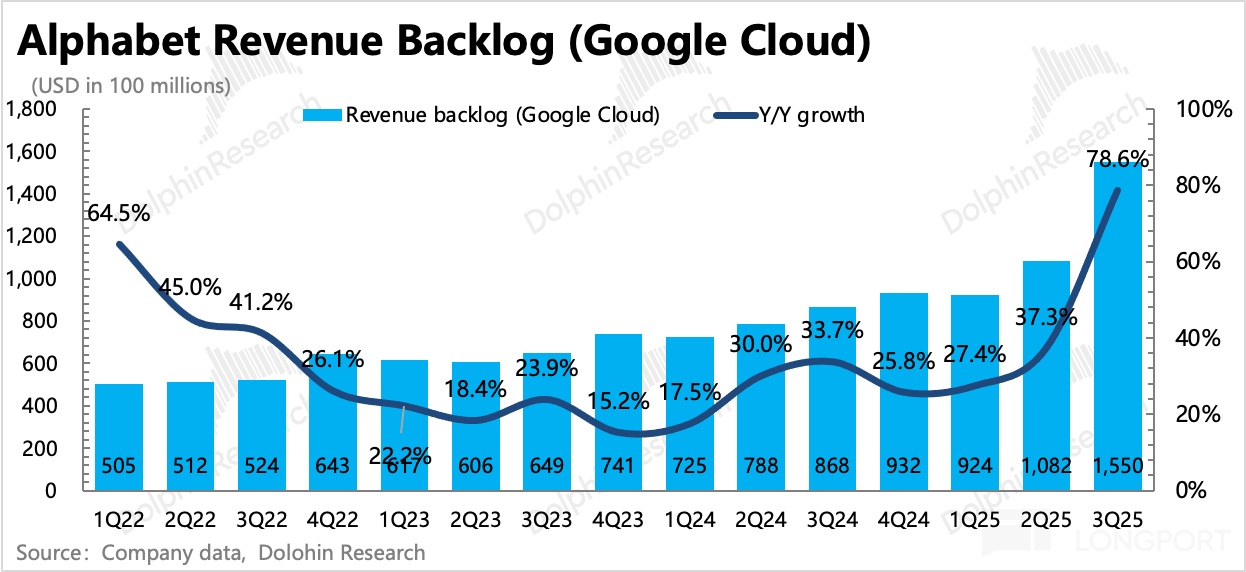
2) How much TPU is embedded in today’s valuation? From revenue backlog, Google Cloud was already seeing AI benefits by Q2 2024 (with revenue flow-through in Q3 2025).At that time, Cloud demand skewed to SMEs and traditional enterprises; beyond steady Workspace growth, AI upside (in the bn range) came mainly from Gemini APIs.
On silicon, Google still followed the market playbook — buying NVIDIA Blackwell (GB200/300) in early 2025. By Q2 2025, with TPU v7 launched and AI adoption rising, Cloud backlog re-accelerated on a high base.Some of that likely reflects incremental TPU v7 rental demand.
Of the $47bn net add in Q3, roughly $42bn should be Anthropic’s compute rental, based on 600k TPUs at $1.6/hour per TPU over 24x7x365 for five years: 600k × $1.6 × 24 × 365 × 5 = ~$42bn.
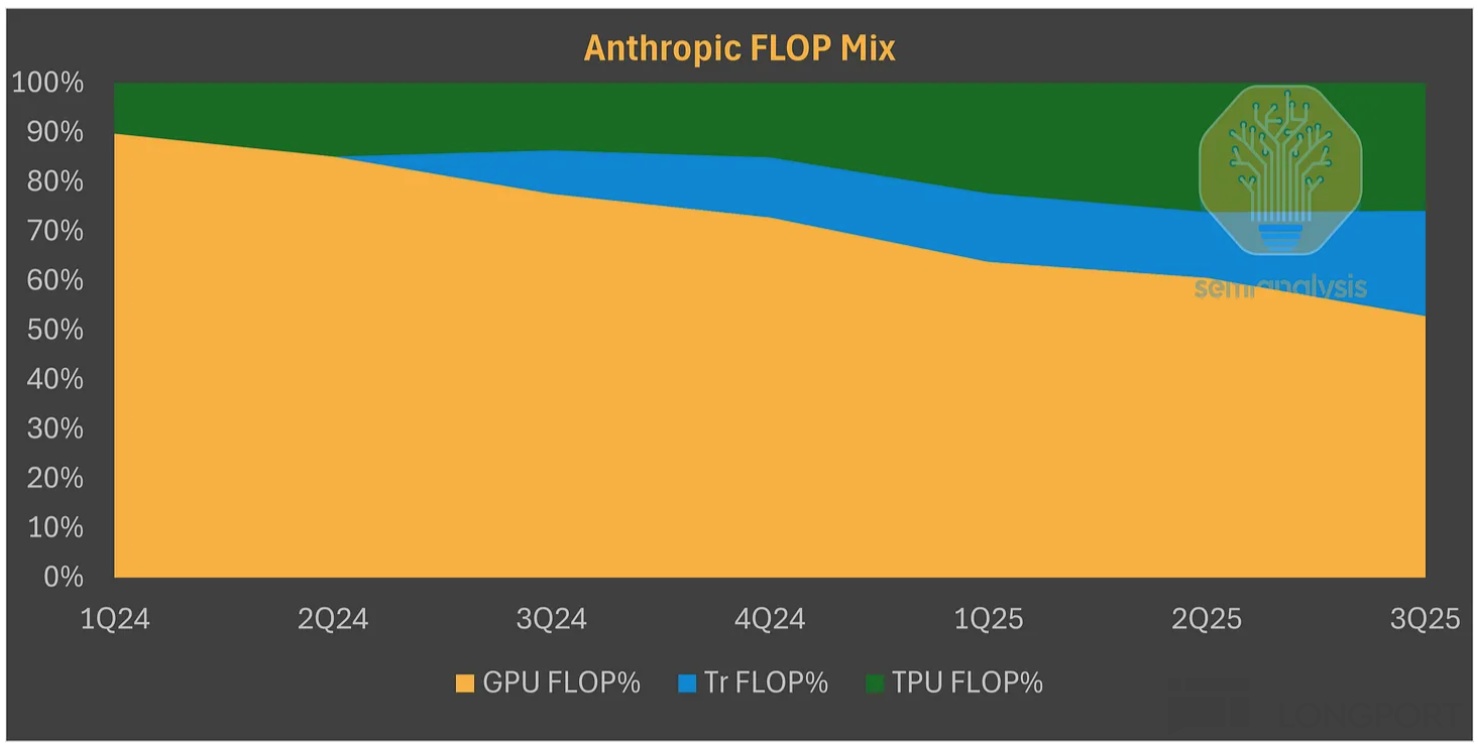
Anthropic has long rented TPU, albeit at lower mix. The $42bn five-year deal implies ~$8.4bn/yr to Google Cloud, ~14% of our 2025E $61.5bn Cloud revenue.That is a meaningful anchor tenant for TPU utilization.
Other TPU rental users include Apple among large caps, and Snap, Salesforce and Midjourney among smaller players. Meta signaled intent in Nov. with a two-step plan:Phase 1 (2026): cloud rental; Phase 2 (2027): direct TPU purchase for self-deployed DCs.
Recent leaks point to joint work on TorchTPU to run Meta’s PyTorch-based code more smoothly on TPU. Street models once had Meta 2026 capex at $100–120bn, with a ~30% pullback in metaverse spend recently.GPU buys were ~1mn units, mostly GB200 with some V100.
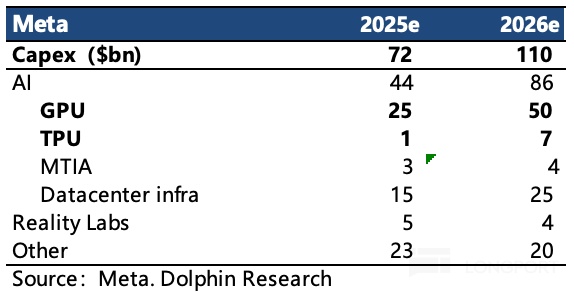
Given Meta’s active TPU talks with Google, Dolphin Research estimates a $7bn TPU contract, with 2026 spend mainly in rentals booked as Opex, and ~$2bn in chip purchases. The remaining ~$50bn goes to Blackwell, potentially yielding ~2GW at discounted pricing, per the chart.
If $2bn in chips are bought directly from Google at ~$25k/unit, that is ~80k units. In 2027, chip purchases could rise to ~500k units, implying $12.5bn in contracts (if Broadcom ships directly, Google would not book hardware revenue).Assuming a 3–5 year, Avg. 5-year life, that is ~$2.5bn/yr in recognized revenue.
This TPU footprint equates to ~0.5GW. If Meta’s total compute target is unchanged, that would displace roughly $17.5bn of GPU revenue on a like-for-like compute basis, given higher NVIDIA pricing.For Google, any TPU delivery path lifts revenue first, profit second, while for NVIDIA the revenue impact is magnified by its premium.
Back to Google: given uncertainty on TorchTPU timing, we treat Meta’s TPU as an upside call option. Our base case only includes Anthropic as the flagship customer.This keeps estimates conservative while preserving upside.
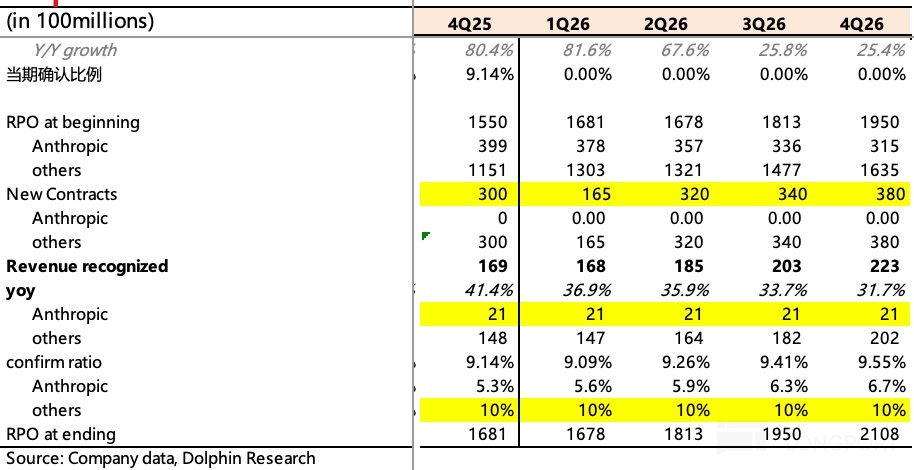
On our assumptions, Google Cloud revenue reaches ~$78.7bn in 2026, +34% YoY, while Google Services grows 10% as guided. At a $3.65tn mkt. cap, stripping Services (OP ~$152bn, 39% OPM, 15x PE) implies ~$1.32tn for Cloud at ~17x EV/Sales.Versus peers, that is not cheap, suggesting TPU rental expectations are largely embedded in the base case.
Further multiple digestion likely requires Meta orders (cloud rental in 2026, or Google direct TPU sales in 2027). Applying 15x EV/Sales would add ~$105bn to 2026 value, or ~3% upside from here.Stronger SMB uptake could also help bridge the gap.
In short, any progress update with Meta could be a near-term catalyst for GOOGL. If the final contract is below the ~$7bn we model, the lift may be modest. With expectations high, also watch downside risk if OpenAI, with ~1bn MAU by 2026, accelerates monetization against Google.
Alternatively, Google could trade near-term margin for broader TPU penetration — deeper discounting or ceding hardware revenue when Broadcom sells direct. That would seed more customers into the TPU stack, with payback via software support and cloud rentals later.This mirrors the 'NVIDIA tax' on GPUs — in essence, competing monopoly rents.
<End>
Dolphin Research coverage on 'Google':
Earnings Season
Oct 30, 2025 Call Trans: We Are the Only Full-Stack AI Cloud Platform
Oct 30, 2025 Earnings First Take: From AI 'Casualty' to AI 'Pacesetter'
Oct 30, 2025 Call Trans: Cloud Megadeals Doubled; Compute Tightness to Persist Into Next Year
Oct 30, 2025 Earnings First Take: No AI Shock; Ads King Still Firmly in Charge
Apr 24, 2025 Call Trans: Too Early to Call Q2
Apr 24, 2025 Earnings First Take: Tariff Overhang Persists; Can the Ads Leader Stay Rock-Solid?
Feb 5, 2025 Call Trans: Cloud Slowed Because We Underinvested — We Will Keep Investing
Feb 5, 2025 Earnings First Take: $75bn AI Capex — Outspending Meta
Hot Topics
Oct 27, 2025: Our Fate Is Not Tied to OpenAI
Deep Dives
Dec 20, 2023: Gemini Can’t Solve the 'Small Demons' — Tough Year Ahead
Jun 14, 2023: Long Read: Is ChatGPT the 'Thanos Snap' for Google?
Feb 21, 2023: US Ads: After TikTok, Will ChatGPT Spark the Next 'Revolution'?
Jul 1, 2022: TikTok Is Teaching the Giants; A Regime Shift for Google and Meta
Feb 17, 2022: Internet Ads Overview — Google: Watching the Storm Gather
Feb 22, 2021: Dolphin Research | Google Deep-Dive: Is the Repair Rally Over?
Nov 23, 2021: Google: Earnings and Stock in Sync — Repair Rally Dominated the Year
Risk Disclosure & Disclaimer: Dolphin Research Disclaimer and General Disclosure
The copyright of this article belongs to the original author/organization.
The views expressed herein are solely those of the author and do not reflect the stance of the platform. The content is intended for investment reference purposes only and shall not be considered as investment advice. Please contact us if you have any questions or suggestions regarding the content services provided by the platform.
