


US TikTok revamp done: what did ByteDance lose vs. gain?
From repeated Congressional hearings to new legislation, TikTok's US biz. has long been trapped in a 'national security' dispute, centered on cross-border data risks and control of its algorithm. These pressures repeatedly sought to force ByteDance to divest TikTok's US operations.
On Dec 18, 2025, TikTok CEO Shou Zi Chew announced agreements with Oracle, Silver Lake and others. By establishing a dual-entity structure for 'commercial ops + data security,' TikTok has provided a phased answer to a years-long cross-border standoff. This 'grand compromise' will have several implications; below are Dolphin Research's initial views for reference.
一、这次重组的主要影响是什么?
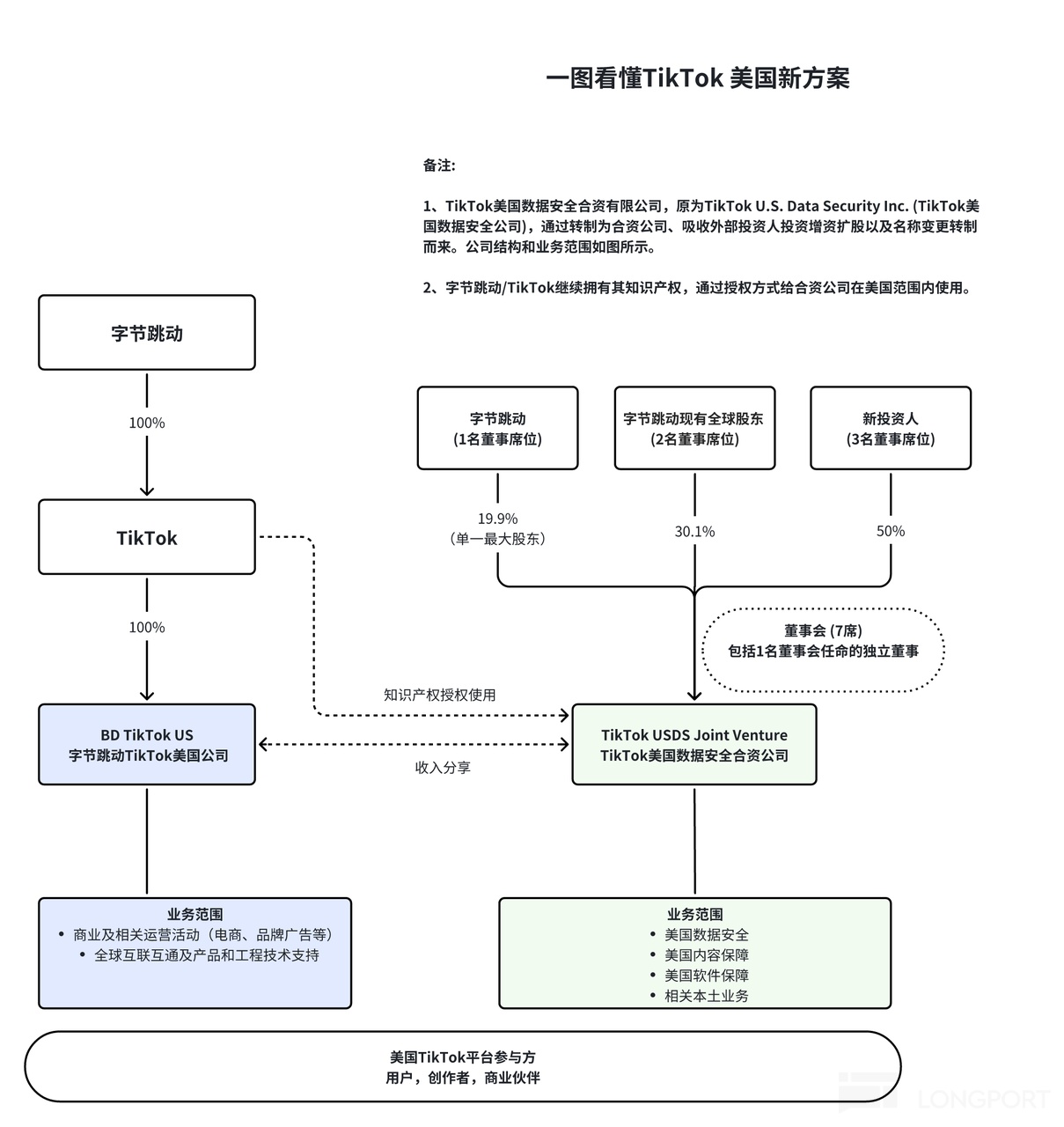
The most significant change is the carve-out of the US data-security unit from the ByteDance-controlled TikTok US entity, followed by the introduction of new US investors — Oracle, Silver Lake Capital and MGX. This restructures who governs data and who monetizes.
The new entity will have a six-member BOD. ByteDance will own 20% and hold one board seat.
With this, the former parent–subsidiary setup becomes a sibling relationship with strict ring-fencing. In the US, platform operations will effectively run through two entities.
a. TikTok's US subsidiary under the global TikTok entity will handle high-margin monetization. This is the commercial shell.
b. A new data-security JV will handle user data, content moderation and other compliance functions, effectively the 'compliance data shell.' Algorithm IP for the US TikTok app remains owned by the global TikTok entity, and the data-security company will pay an IP royalty for algorithm use. The design ensures local data stays local and is used locally.
A strict firewall will separate the two shells. Operations will remain segregated.
At this stage, the core trade-offs are clear. They are as follows:
a. ByteDance, via the global TikTok entity, retains ownership of its core IP — the algorithm.
b. TikTok's US subsidiary is responsible for monetization, allowing ByteDance to preserve the integrity of revenue and profit capture from the US market. Economic interests from US operations remain largely intact.
c. The new JV, through its BOD design, cap table, and scope of duties, addresses US Gov. concerns over national security and user-data protection. It is built to meet the regulatory expectations that have driven the dispute.
In essence, the plan enables technology export while ceding data control across countries with differing philosophies and trust levels. That is the crux of the compromise.
TikTok's costs boil down to two items. They are:
a. Future US revenue, net of IP royalties, will face a revenue share to the new JV. The percentage is not yet clear, and it will be the key to how much commercial value is being sacrificed.
b. Loss of control over US app data — a concession that was effectively inevitable. Without it, the US side would not allow continued operations.
Under the current plan, new shareholders are primarily financial investors or upstream suppliers (Oracle as cloud and data host). As such, the new entity will find it hard to micromanage platform commercialization.
After years of intense bargaining, this is a relatively ideal solution for TikTok. How ideal it proves will hinge on three points: whether algorithm IP rights are durable; how much revenue the platform must share with the new JV; and how much execution friction emerges between the two entities.
二、此次方案对 TikTok 是好结局吗?还有没有隐患?
As above, this is broadly a good outcome. The remaining contest is more likely to be an internal business dynamic between the compliance entity and the operating entity, with country-level willpower risks much reduced.
With the uncertainty easing, headwinds to user growth, time spent, and ad revenue should abate, as advertisers had avoided long-term frameworks due to US outlook risk. TikTok US can get back on track, focus on user acquisition, rebuild advertiser confidence, and accelerate e-commerce monetization.
One open question remains: who leads the US app's front-end ops and user acquisition — the ByteDance monetization entity or the US-controlled data-security entity that holds the data? The announcement does not make the division of duties explicit. If roles are not clarified, this could trigger fresh disagreements.
三、TikTok 的例子多国内企业出海有哪些范例价值?
In short, the resolution of the TikTok dispute implies the following. It offers several takeaways for China-based companies going global:
A. Chinese companies now have the capability to export high-end technologies such as algorithms. The tech stack has matured to support outbound deployment.
B. Even amid de-globalization and differing ideologies, disputes can be resolved through negotiation, creating room for overseas expansion. It need not be a binary, zero-sum choice.
C. For other jurisdictions with similar concerns, this provides, to a degree, a workable template for resolving disputes. It can serve as a reference case.
<End of text>
The copyright of this article belongs to the original author/organization.
The views expressed herein are solely those of the author and do not reflect the stance of the platform. The content is intended for investment reference purposes only and shall not be considered as investment advice. Please contact us if you have any questions or suggestions regarding the content services provided by the platform.
