


The 'Sensory Artery' of Software-Defined Vehicles: How Automotive Ethernet AVB Protocol Reshapes the Interactive Experience and Market Landscape of Cockpit and Autonomous Driving

Global Info Research's latest report, "Global Automotive Ethernet Audio Video Bridging (AVB) Solutions Market Size, Key Players, Key Regions, Product and Application Segmentation Research Report 2026," provides a systematic and comprehensive analysis of the global automotive Ethernet AVB solutions industry. The report covers the overall market size, key regional market trends, operational performance and competitive share of major manufacturers, product segmentation types, and downstream application areas. It not only provides an in-depth analysis of the competitive landscape, revenue, and market share of major automotive Ethernet AVB solution providers worldwide but also highlights the product features, technical specifications, gross margin, and latest developments of various manufacturers (brands). The report's historical data spans from 2021 to 2025 and offers authoritative forecasts for future market trends from 2026 to 2032, providing valuable insights and decision-making references for industry participants.
Overview of the Automotive Ethernet Audio Video Bridging (AVB) Solutions Market
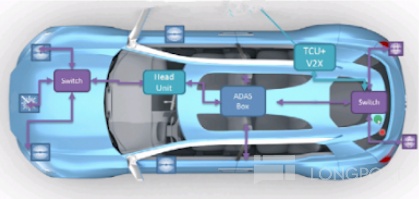
Automotive Ethernet Audio Video Bridging (AVB) solutions refer to a set of standards and technologies designed to provide a reliable high-performance network for transmitting audio and video data within vehicles. AVB leverages Ethernet to achieve seamless and synchronized data transmission, ensuring that multimedia systems (including infotainment, driver assistance, and autonomous driving functions) operate with minimal latency and high fidelity. These solutions enhance the in-vehicle experience by delivering high-quality audio and video streaming, reducing the complexity and weight of traditional wiring harnesses, and meeting the growing demand for advanced connectivity and integration in modern vehicles.
Figure 1: Automotive Ethernet Audio Video Bridging (AVB) Solutions Product Image
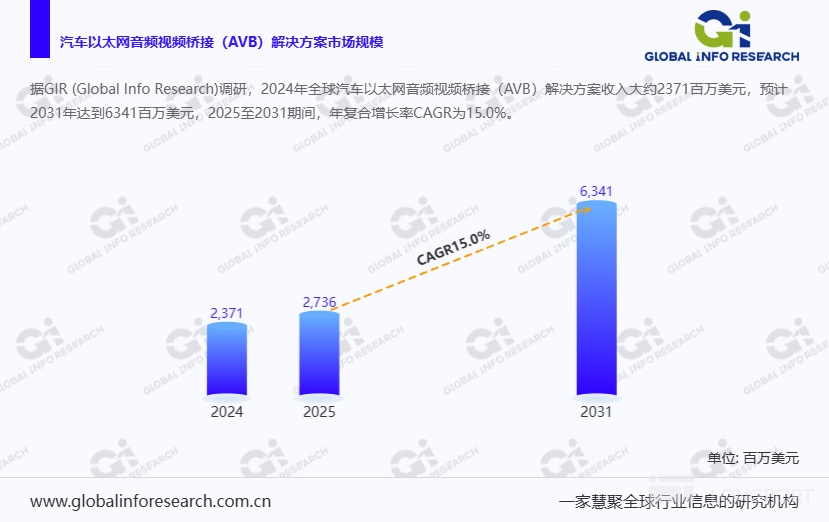
According to GIR (Global Info Research) research, global automotive Ethernet AVB solutions revenue in 2024 was approximately $2.371 billion and is expected to reach $6.341 billion by 2031, with a compound annual growth rate (CAGR) of 15.0% from 2025 to 2031.
Major companies include:
NXP
Microchip
Toshiba
Excelfore
Renesas Electronics
Capgemini Engineering
Vayavya Labs
DornerWorks
Elektrobit
By product type, the market is segmented into:
AVB Hardware
AVB Software
By application, the market is segmented into:
Passenger Vehicles
Commercial Vehicles
Key regions include:
North America
Europe
China
Japan
Southeast Asia
India
1. Market Drivers for Automotive Ethernet AVB Solutions
1. Increased Penetration of Smart Cockpits and ADAS, Surging Demand for High-Bandwidth Transmission: With the acceleration of vehicle intelligence, features such as multi-screen interaction, 3D navigation, and immersive audio in smart cockpits are becoming widespread. The number of high-definition cameras and LiDARs in advanced driver-assistance systems (ADAS) has significantly increased, with a single L4 autonomous vehicle generating up to 4TB of data per hour. Traditional CAN and MOST buses can no longer meet the transmission demands of massive audio and video data. Automotive Ethernet AVB solutions, with their high bandwidth (supporting 100Mbps to 10Gbps transmission rates) and low latency, have become the core communication architecture supporting smart cockpits and ADAS, creating rigid market demand.
2. Transition to Domain-Centralized E/E Architecture, Highlighting Architectural Adaptability: Automakers worldwide are advancing the transition from distributed to domain-centralized and central computing E/E architectures, requiring efficient and unified communication networks for inter-domain coordination. Automotive Ethernet AVB enables parallel transmission of audio/video streams and control signals through precise clock synchronization (IEEE 802.1AS) and stream reservation (IEEE 802.1Qat) technologies, simplifying wiring harness layouts and reducing system complexity. For example, Tesla's Model Y uses a ring Ethernet topology with AVB technology to achieve efficient interconnection between the central computing platform and zone controllers, making it a standard communication solution for next-generation vehicles.
3. Rising Consumer Demand for In-Vehicle Entertainment, Driven by Immersive Audiovisual Needs: As vehicles increasingly become "third living spaces," consumer expectations for in-vehicle entertainment are aligning with consumer electronics standards, with growing demand for high-quality audio, 4K video, and rear-seat entertainment systems. Automotive Ethernet AVB solutions can support 12-channel 3D stereo algorithms, ensuring synchronized multi-channel audio/video data transmission and enabling features like active noise cancellation and surround sound, providing immersive experiences and serving as a key differentiator for automakers.
4. Policy and Standards Driving In-Vehicle Network Upgrades: Major economies are implementing stringent policies to promote vehicle safety and intelligence. The EU's GSR 2024 regulations mandate new vehicles to support data transmission speeds above 10Gbps, forcing upgrades to traditional in-vehicle networks. China's new energy vehicle development plan also emphasizes improving the bandwidth and security of in-vehicle communication networks. As a core technology meeting these requirements, automotive Ethernet AVB is seeing accelerated commercialization and market penetration.
5. Limitations of Traditional In-Vehicle Buses, Creating Substitution Opportunities: Traditional in-vehicle buses have significant drawbacks: CAN buses offer only 0.51Mbps bandwidth, insufficient for HD audio/video data; MOST buses support multimedia but use ring topologies with limited nodes and high costs. Automotive Ethernet AVB solutions outperform in bandwidth, cost, and scalability. While single-port Gigabit Ethernet modules are more expensive than CAN buses, overall cost optimization is achieved through simplified wiring and fewer controllers, driving clear substitution trends and unlocking vast market potential.
2. Future Development Factors for Automotive Ethernet AVB Solutions
1. Evolution Toward TSN, Expanding Real-Time Control Applications: As the foundation for Time-Sensitive Networking (TSN), AVB will continue integrating protocols like IEEE 802.1Qbv (enhanced traffic scheduling) and IEEE 802.1CB (seamless redundancy) to improve transmission determinism and reliability, reducing latency control precision to ±500ns. This will expand AVB from audio/video transmission to autonomous driving control signals, enabling "entertainment + control" integrated networks and unlocking high-end autonomous driving markets.
2. Deep Integration with 5G V2X, Enabling Vehicle-Road-Cloud Collaboration: Future automotive Ethernet AVB will synergize with 5G V2X, achieving end-to-end latency below 30μs through time-slot synchronization for real-time vehicle-to-vehicle, vehicle-to-infrastructure, and vehicle-to-cloud data exchange. For example, AVB can efficiently fuse onboard sensor data with roadside device data to support autonomous driving decisions while enabling cloud-assisted computing for HD map updates and OTA upgrades, reshaping the vehicle-road-cloud communication ecosystem.
3. Low-Power Breakthroughs Aligning with Carbon Neutrality Goals: Under global carbon neutrality initiatives, low power consumption is a key focus for in-vehicle electronics. The industry will prioritize energy-efficient Ethernet controllers, optimizing chip processes (to 16nm nodes) and adopting dynamic power adjustment to reduce per-channel power below 100mW, improving efficiency by over 40% versus current products. This will reduce energy consumption in new energy vehicles, meeting the EU's 2030 target of 50% lower per-vehicle emissions and enhancing market competitiveness.
4. Software-Defined Networking (SDN) Adoption, Enabling Business Model Innovation: SDN will integrate deeply with automotive Ethernet AVB, enabling "hardware pre-installation + software subscription" models. Automakers can flexibly configure network resources via SDN to offer personalized audio/video and security services. The software-as-a-service market is expected to grow rapidly, with SDN penetration in automotive Ethernet exceeding 60% by 2028, creating an $8 billion value-added service market and extending the industry value chain.
5. Accelerated Localization, Boosting Domestic Competitiveness: Chinese firms are accelerating localization of core AVB technologies, with HiSilicon and Yutai Microelectronics making breakthroughs in 2.5Gbps PHY chips, raising domestic market share to 25% in 2024. Continued improvements in protocol stack R&D and system integration will further reduce costs, leveraging China's vast new energy vehicle market to transition from "technology follower" to "technology leader" and expand global market share.
3. Challenges for Automotive Ethernet AVB Solutions
1. Reliance on Imported Core Chips, Slow Localization Progress: Core chips (PHY and switch chips) for automotive Ethernet AVB remain dominated by global giants, with the top five players holding 78% of the 2022 market. Localization rates for key PHY chips are below 15%, with domestic firms lagging in chip processes and wide-temperature adaptability, creating supply chain vulnerabilities.
2. High Costs Limiting Mid-/Low-End Vehicle Penetration: Automotive Ethernet AVB hardware costs are significantly higher than traditional buses, with single-port Gigabit Ethernet modules costing 8-10x more than CAN buses. For price-sensitive mid-/low-end vehicles, high costs deter adoption, currently limiting AVB to premium smart vehicles.
3. Lack of Unified Standards, High Compatibility Validation Costs: The absence of fully unified AVB/TSN standards leads to protocol stack variations across automakers and suppliers, causing cross-vendor compatibility issues. Companies spend 30% of R&D resources on compatibility testing, increasing costs and timelines and hindering scale.
4. Electromagnetic Compatibility Challenges in High-Voltage Environments: Unshielded twisted pair cables in automotive Ethernet AVB are prone to electromagnetic interference in new energy vehicle high-voltage systems, affecting transmission stability. While optimizations like improved wiring and anti-interference chips help, stability under complex conditions remains unproven, posing commercialization barriers.
5. Talent Shortages Constraining R&D Capabilities: Developing automotive Ethernet AVB solutions requires multidisciplinary expertise in automotive electronics, networking, and protocol development. The shortage of such talent limits domestic firms' capabilities in protocol optimization, system integration, and security, slowing innovation and hindering competitiveness in high-end markets.
4. Automotive Ethernet AVB Solutions Industry Chain Analysis
The automotive Ethernet AVB industry chain follows an "upstream core components/software - midstream solution integration - downstream applications/services" structure, with value distribution characterized by "high-margin upstream, stable midstream, and high-value downstream." Upstream core chip segments achieve 35%-50% gross margins, led by PHY and switch chips; midstream integration offers 20%-30% margins, with system integrators commanding premiums; downstream testing/validation and maintenance services exceed 30% margins, including 40%+ for automotive-grade certification.
Upstream: Core components include PHY/switch chips and unshielded twisted pair cables, with PHY processes advancing to 16nm. Global leaders like Broadcom, Marvell, and NXP dominate, while local firms make gradual breakthroughs. Software covers IEEE 802.1AS/Qat protocols, where international players lead in maturity. Testing equipment (e.g., latency testers, EMC systems) relies on imports. Competitiveness hinges on chip performance and protocol stability, with leaders holding technological barriers.
Midstream: A "global giants + local players" duopoly exists. Giants like NXP, TI, and Elektrobit lead the high-end market with full-stack chip-software-integration capabilities, serving Tesla and BMW. Local firms (e.g., Huawei, Desay SV) leverage China's NEV market, focusing on mid-high solutions via local chip partnerships. Key competencies include system integration, protocol optimization, and customization. Over 70% of integrators cluster in Yangtze River Delta and Pearl River Delta regions, forming industrial ecosystems.
Downstream: Smart vehicles are the main application, particularly in smart cockpits (multi-screen, audio) and autonomous driving (ADAS sensor data). Customers include traditional and NEV automakers, with direct OEM supply chains and some Tier-1 indirect channels. Services include certification, testing (e.g., IEEE, EMC), and maintenance. Regionally, East/South China lead domestically, while North America and Europe dominate overseas, with Asia-Pacific growing fastest (55% share by 2025).
Future Trends: The industry will move toward technological collaboration, localized supply chains, and software-driven value. Upstream-midstream partnerships will advance chip localization to reduce risks. Midstream firms will accelerate TSN integration and SDN upgrades for real-time flexibility. Downstream-midstream joint scenario testing will optimize products. Standardization bodies will unify AVB/TSN standards, while M&A consolidates resources. Software services will emerge as a profit driver, shifting value from hardware to "hardware + software + services."
The copyright of this article belongs to the original author/organization.
The views expressed herein are solely those of the author and do not reflect the stance of the platform. The content is intended for investment reference purposes only and shall not be considered as investment advice. Please contact us if you have any questions or suggestions regarding the content services provided by the platform.
