港股研究社
2025.12.25 08:49

Cheng Tai Technology goes to Hong Kong: With Huawei's genes, can intelligent driving equality mature this domestic millimeter-wave radar IPO?

portai
I'm PortAI, I can summarize articles.

When BYD proposed to fully equip and offer intelligent driving for free, its vast supply chain system also came into the spotlight.

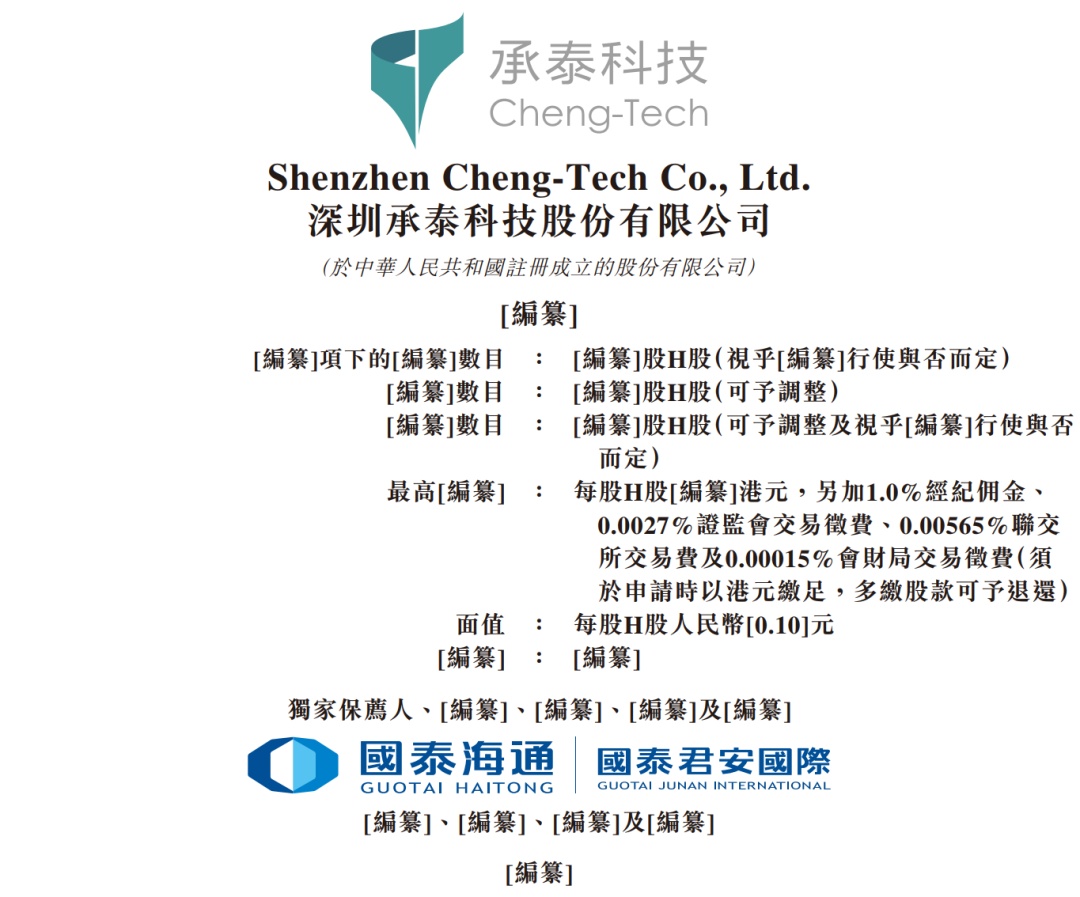
Recently, ChengTai Technology, which submitted a listing application to the Hong Kong Stock Exchange, is the key "perception eye" hidden behind this new energy giant. As a supplier of millimeter-wave radars for BYD, ChengTai Technology has achieved exponential revenue growth over the past three years.

However, while enjoying the dividends of the era, the company also faces the complex reality of technological premiums, profitability, and other multiple challenges.

With Huawei's DNA, revenue surged 5 times in three years

Founded in 2016 by a team of Huawei engineers, ChengTai Technology focuses on the R&D, design, and mass production of automotive millimeter-wave radar products. Data shows that its executive director, board chairman, and general manager Chen Chengwen was once a Huawei technical director and senior product manager; another co-founder and deputy general manager Zhou Ke also worked at Huawei.

Currently, its product line covers intelligent driving needs from L0 to L2+, including core perception components such as forward/rear radars and corner radars, with a total of seven major radar models launched.

The products generally focus on the non-high-end intelligent driving segment with the highest demand, highly aligning with the narrative of "democratizing intelligent driving."

The company's financial data is a direct footnote to the explosive demand for vehicle intelligence and its smooth entry into the market. According to the listing documents, its revenue soared from 57.651 million yuan in 2022 to 350 million yuan in 2024, a more than fivefold increase in two years.

This momentum intensified in the first half of 2025, with half-year revenue reaching 540 million yuan, far exceeding the full-year 2024 figure, representing a year-on-year increase of 464.6%. This growth curve almost resonates with the domestic new energy vehicle market, especially the pace of intelligent configuration adoption by its top clients.

It is disclosed that its products are used in multiple BYD models such as Han, Tang, and Song. The company also claims to have R&D capabilities that match the iteration speed of its clients' products, flexibly meeting customer needs. Behind this, the product R&D team led by the two Huawei-originated co-founders likely contributed significantly.

In fact, ChengTai Technology repeatedly emphasized its "three-ring" business model—high-quality hardware, agile software, and rapid delivery—and full-stack in-house R&D capabilities in its prospectus, highlighting the deep competitive logic it is building.

Its leading market position to some extent confirms the feasibility of its product strategy. According to CIC data, in 2024, it became the largest domestic supplier by shipment volume in China's forward-facing automotive millimeter-wave radar market, ranking third in the overall automotive millimeter-wave radar market by shipment volume, with market shares of 9% and 4.5%, respectively. Clearly, its forward radar products hold a significant advantage among domestic manufacturers in this niche.

At the product level, thanks to its independent R&D capabilities in millimeter-wave radar applications and specially developed hardware and software technologies, its 5th-generation 4D radar and 5.5th-generation 4D high-resolution radar products have become some of the most competitive heavyweight products in the industry. The latter was adopted by Client A and another major Chinese OEM in 2024 for integration into their high-end intelligent driving systems. This year, the product was also equipped in the intelligent driving systems of a leading domestic OEM.

ChengTai Technology has attracted over 20 automotive clients, including several leading Chinese OEMs, and is in talks with several leading European automotive brands.

Amid continuous scaling, ChengTai Technology's profitability has steadily improved, though it has yet to reach a better state. During the reporting period, the company recorded net losses of 79.2 million yuan, 96.6 million yuan, and 21.8 million yuan, respectively; in the first half of 2025, the loss further narrowed to 14.4 million yuan, just one step away from a qualitative profit turnaround.

Entry is just the first step; ChengTai awaits evolution

Choosing to enter the capital market at a time when intelligent driving is becoming standard in mid- to low-priced vehicles, ChengTai Technology's listing also carries certain industrial signaling significance.

Automotive millimeter-wave radars have evolved from auxiliary safety equipment to critical perception modules for intelligent driving. Industry statistics show that in the first half of 2025, domestic millimeter-wave radar installations reached nearly 16.5 million units, rapidly popularizing in vehicles priced between 100,000 and 300,000 yuan.

Market growth is driven by multiple factors, including mandatory safety and intelligent driving metrics catalyzing demand for millimeter-wave radars, improved performance of domestic chips and algorithms, and rising average radar installations under L2+ standards. This phased growth trend strengthens the industrial foundation for ChengTai Technology's listing application and highlights the current growth momentum of this niche industry.

Although key upstream components in the millimeter-wave radar supply chain are still dominated by foreign players, midstream companies' capabilities are significantly improving. Domestic suppliers like ChengTai Technology already possess competitiveness in complete system design, software algorithms, and integration capabilities.

According to institutional forecasts, from 2024 to 2029, the global and Chinese automotive millimeter-wave radar markets will grow at compound annual growth rates of 15.1% and 21.5%, respectively, further accelerating compared to the past five years.

Future technology trends focus on the evolution of 4D millimeter-wave radars toward higher resolution and perception capabilities, the integration of AI and deep algorithms to improve accuracy, and multi-sensor fusion becoming mainstream.

In these evolutionary directions, at least ChengTai Technology has made early investments, and its technological strength and product lineup align with the future path of perception system evolution.

But realistically speaking, from a broader macro perspective, ChengTai Technology is not a company that tells stories with "disruptive technology." Its growth logic leans toward the pragmatic manufacturing approach of the past—embedding itself into China's mainstream intelligent driving path with faster cycles, lower costs, and stronger adaptability, assuming comparable performance.

Even in the longer historical context, ChengTai Technology has only completed the first step—market entry. Currently, the millimeter-wave radar industry itself is undergoing multiple technological transitions. Foreign giants like Continental and Bosch have iterated to sixth-generation products, adopting new technologies such as waveguide antennas to continuously improve performance, reduce size, and lower costs. Meanwhile, automakers and tech giants like BYD and Huawei are increasing in-house R&D investments to form closed-loop ecosystems. ChengTai and its peers face a "midfield battle" with accelerated technological iterations and diversified competition dimensions.

In this environment, whether the Hong Kong stock market is willing to grant long-term premiums to such a company depends on at least two questions: whether the large-scale deployment of 4D millimeter-wave radars will accelerate as expected, and whether ChengTai Technology can complete the next stage of evolution in its client structure and profit model.

From the current industry cycle, the timing of this company's listing is not early. Referring to the listing performance of complementary products to automotive-grade millimeter-wave radars—lidar—the current situation is not the most optimistic. Hesai and Innovusion, which listed in Hong Kong this year, have shown less-than-impressive market capitalization performance, even leaning toward sluggishness.

The copyright of this article belongs to the original author/organization.

The views expressed herein are solely those of the author and do not reflect the stance of the platform. The content is intended for investment reference purposes only and shall not be considered as investment advice. Please contact us if you have any questions or suggestions regarding the content services provided by the platform.