


CoreWeave: Cloud rising star or just a 'workhorse'?
In our prior coverage of the new cloud leader $Coreweave(CRWV.US) Part I, Dolphin Research outlined the cloud biz. model and factor inputs, arguing that long-term model risk remains meaningful.
Low long-term visibility does not preclude mid-term opportunities. In this note we will:
1) assess what gives the company its edge near term and why it leads the current NeoCloud cohort.2) analyze CoreWeave’s capital-heavy, high-leverage model to estimate steady-state margins and the revenue scale needed to justify the current valuation and unlock further upside.
Detailed analysis below:
1) Long-term uncertainty vs. mid-term clarity
CoreWeave’s long-run fate is debatable. Yet as the fastest-growing, largest new cloud, it enjoys high near-term certainty from tight demand and quasi-locked supply. What exactly underpins that certainty today?
1.1. Compute in structural shortage and rapid cycles: new demand, new cloud
The backdrop is a supply-demand mismatch: surging compute demand vs. a gradual supply ramp.
Gartner and IDC expect total data-center compute demand to rise ~1.7x over 2025–2030, with AI compute up ~2.5x. Goldman Sachs estimates avg. DC utilization at ~85% in 2022–early 2024, peaking above 95% during 2025–2028.
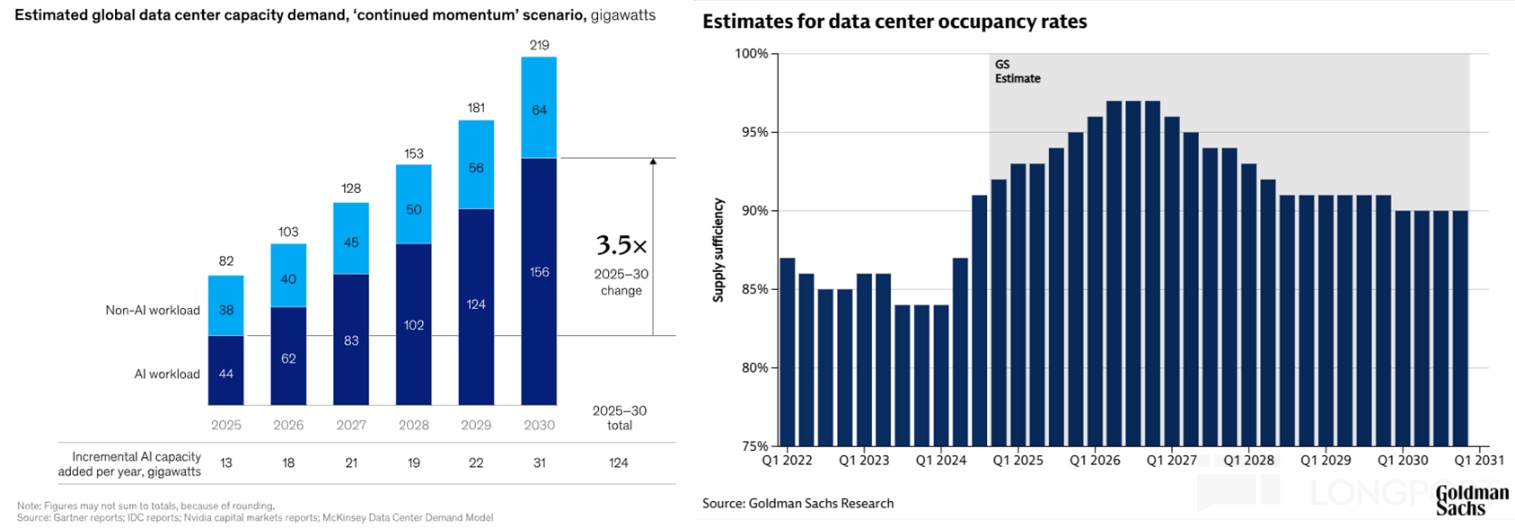
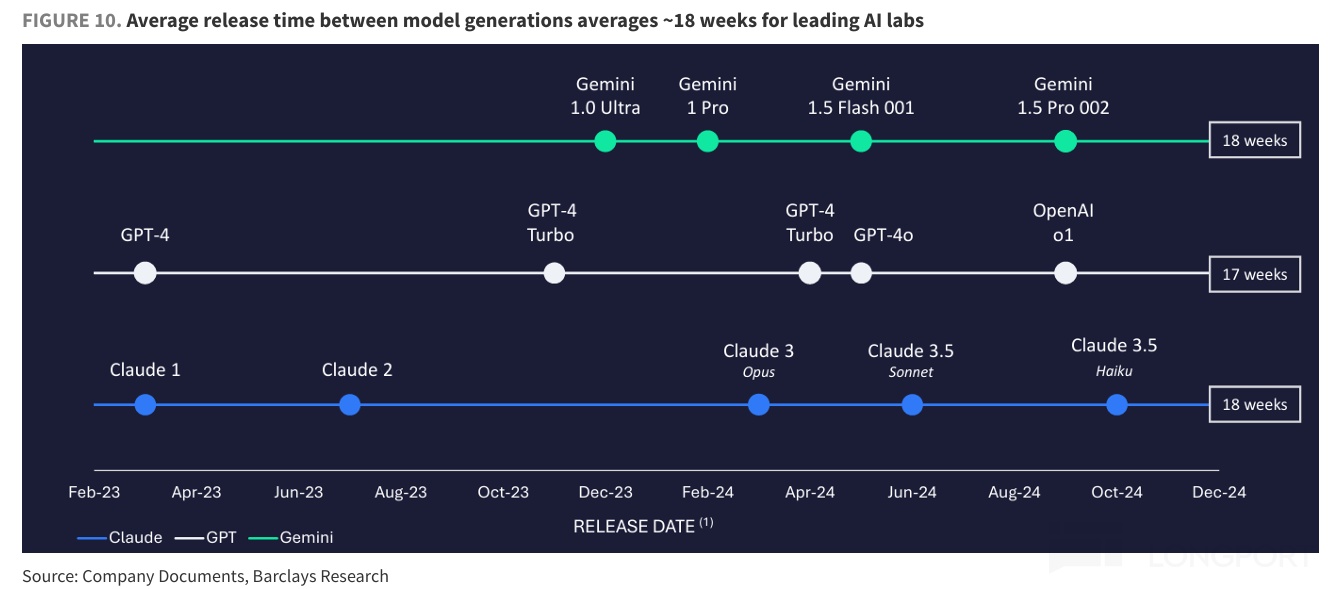
From early 2023 to end-2024, top models like ChatGPT, Gemini, and Claude saw major updates roughly every 18 weeks (4–5 months). Faster model cycles demand not just more compute but also updates to DC hardware and software architectures.
In a world where speed trumps all, hyperscalers with long decision chains and legacy workloads can be slower to react than focused, smaller AI-first providers like CoreWeave.
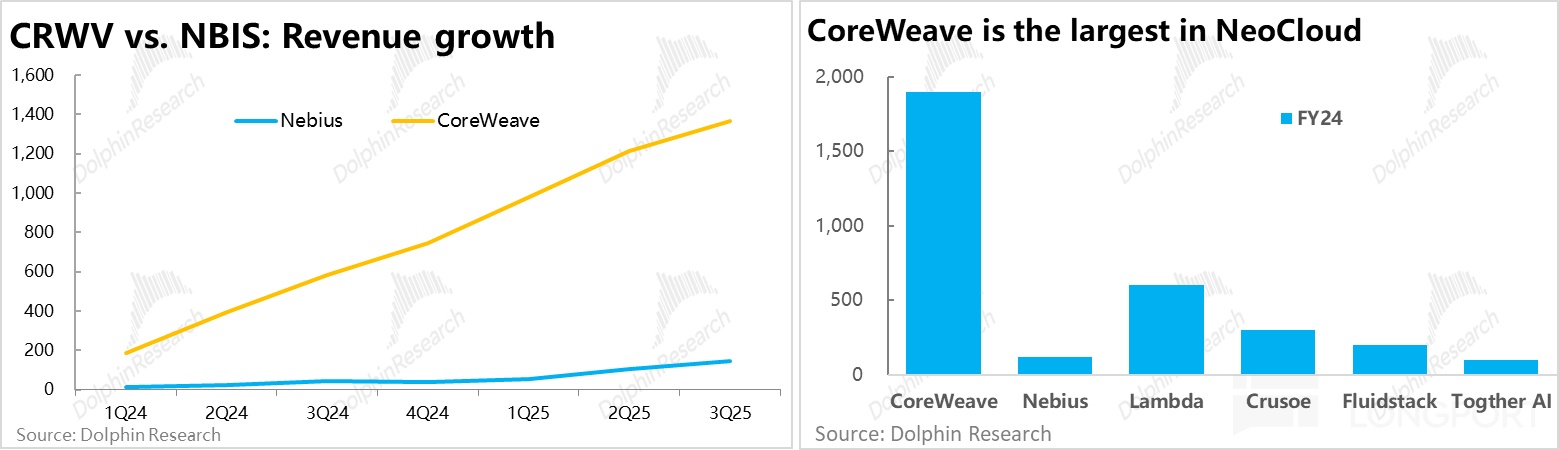
CoreWeave’s engineering efficiency is best-in-class and well-suited to this moment, helped by Nvidia and OpenAI support. As a result, it is the largest and fastest-growing player among Neo-Cloud peers.
The chart shows CoreWeave’s FY24 revenue near $2 bn, far ahead of peers still in the hundreds of millions. In the first three quarters of 2025, its scale is ~9–10x that of Nebius.
1.2. Nvidia’s favored child: why CoreWeave?
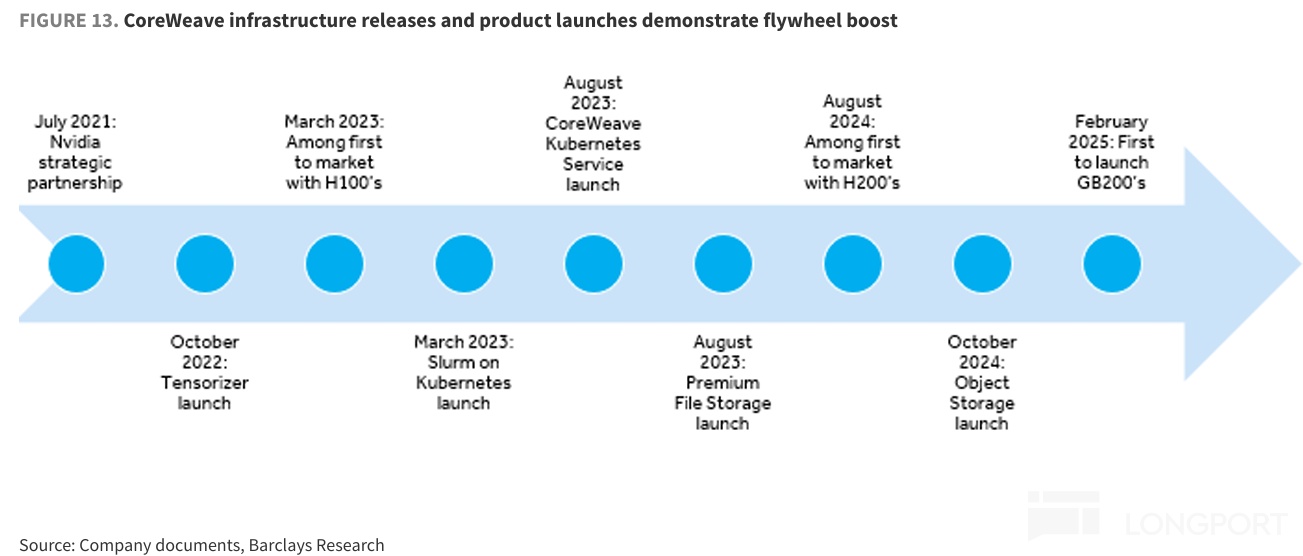
A key, though less visible, edge is its tight relationship with Nvidia. Nvidia owns ~5% of CoreWeave. The stake is small, but the preference matters.
a) In shortage, early access to Nvidia GPUs is a distinct advantage.Since a 2021 strategic agreement, CoreWeave has consistently been among the first to receive top-tier chips at launch, including H100, H200, and GB200. Even MSFT and Meta have rented from CoreWeave when their own access to the newest chips was constrained.
b) In Sept 2025, they updated the agreement: CoreWeave can resell compute initially reserved for Nvidia (original contract value $6.3 bn) to other clients. Any unsold residual will be backstopped by Nvidia’s own rental.
This is not a blanket backstop for all future capacity additions. But it does share part of the risk.
Why does Nvidia prefer CoreWeave, and is it sustainable?
A 5% stake alone does not confer exclusive favor. From Nvidia’s perspective, cloud providers’ push into in-house accelerators creates conflicts with third-party GPU vendors, while Nvidia’s GPUs command a high share of cloud value and remain supply-constrained.It has both the incentive and ability to nurture an aligned partner. As long as that logic holds, continued support for CoreWeave is likely.
1.3. Contracted revenue under take-or-pay drives near-term visibility
While reliance on a few large clients creates long-term concentration risk, it also raises near-term certainty for CoreWeave.
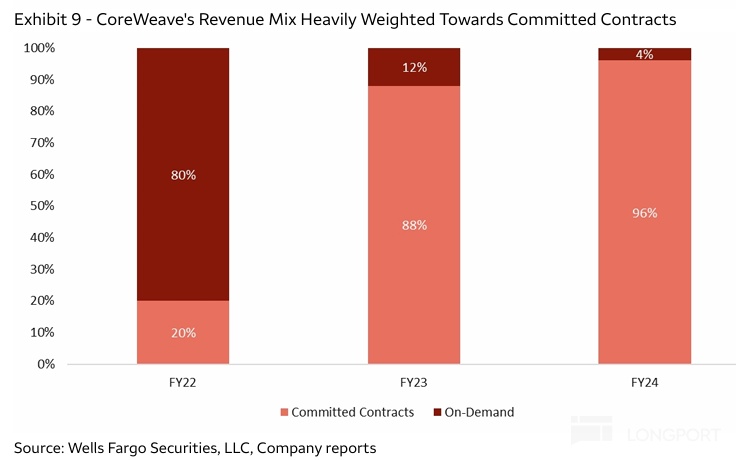
Traditional clouds charge on consumption (compute x time). By contrast, most of CoreWeave’s revenue is take-or-pay: clients pay the full contracted amount regardless of actual usage, which aligns with big customers’ bare-metal model where capacity is exclusive and non-substitutable.
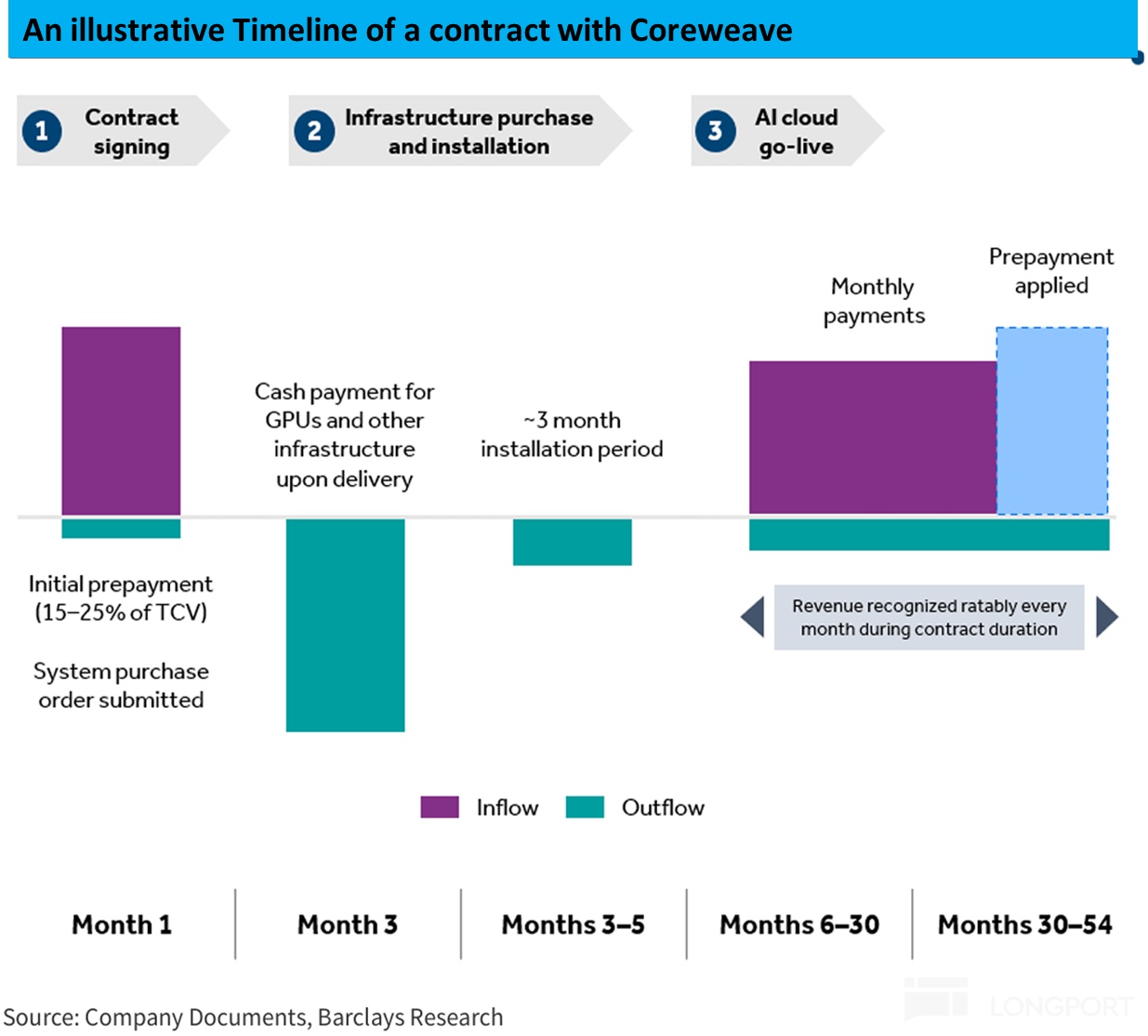
CoreWeave also builds to order, adding capacity only after signing new demand contracts, rather than spec-building DCs. Most contracts require 15%–25% upfront payments, reducing the company’s need to pre-fund capex.
In other words, during the 4–5 year contract term, revenue visibility is high. Over-investment, if any, is largely borne by the anchor clients, while CoreWeave primarily faces residual value risk if customers do not renew post-term.
1.4. A modest edge in power sourcing
Beyond Nvidia alignment, CoreWeave has an edge in power procurement, a key bottleneck in DC buildouts.
Its leadership team largely hails from energy investing, and the company previously ran power-hungry bitcoin mining. By repurposing some of that power, it locked in capacity amid widespread shortages.
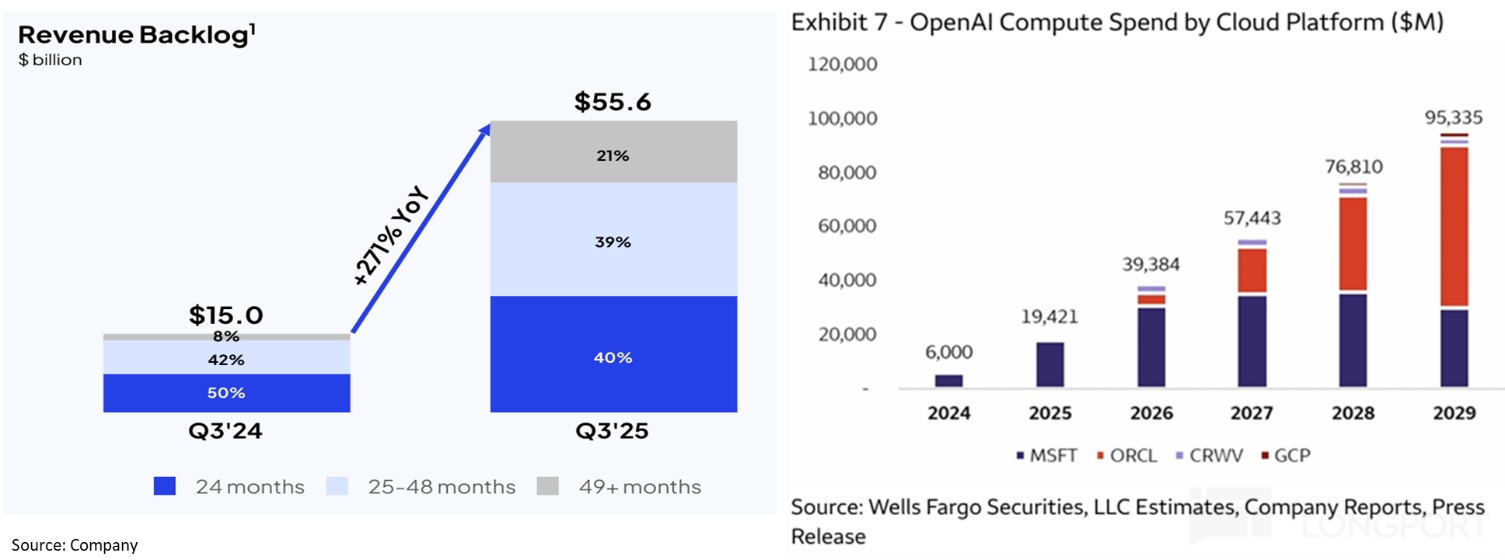
As of Q3 this year, the company had contracted 2.9 GW of power and had 0.59 GW online. This implies it can nearly quadruple compute without new supply, supporting annualized revenue near $27 bn, and adequately covering its ~$55.6 bn backlog.That said, this advantage reflects smaller current scale and legacy relationships. If CoreWeave aims to challenge top hyperscalers, its ability to secure much larger power blocks is less certain over the long run.
1.5. Qualitatively: a non-typical supply-chain play
CoreWeave effectively sits in the supply chain of giants. The long-term uncertainty from dependence and the near-term certainty and rapid growth from sponsorship both stem from that positioning.
History rhymes: Apple’s suppliers and Tesla’s chain have enjoyed periods of hypergrowth and stock returns if they iterate quickly with the ecosystem leaders. But the biggest risk is disintermediation or the end of a lead product cycle, which can be devastating.
Today, CoreWeave is a supplier aligned with Nvidia and OpenAI. Its outcome depends not only on its own execution but materially on whether Nvidia and OpenAI prevail in this AI cycle.
2) Can NeoCloud make money?
Having outlined mid-term advantages, we now address two quantitative questions:
a) what steady-state margin can CoreWeave’s model achieve?b) what revenue scale is needed over time to match the current valuation?
2.1. How is CoreWeave’s cost structure built?
(1) Costs and opex
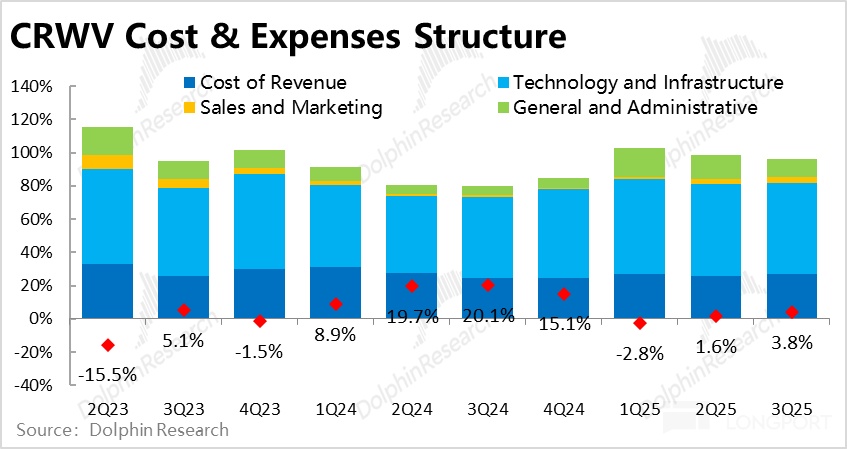
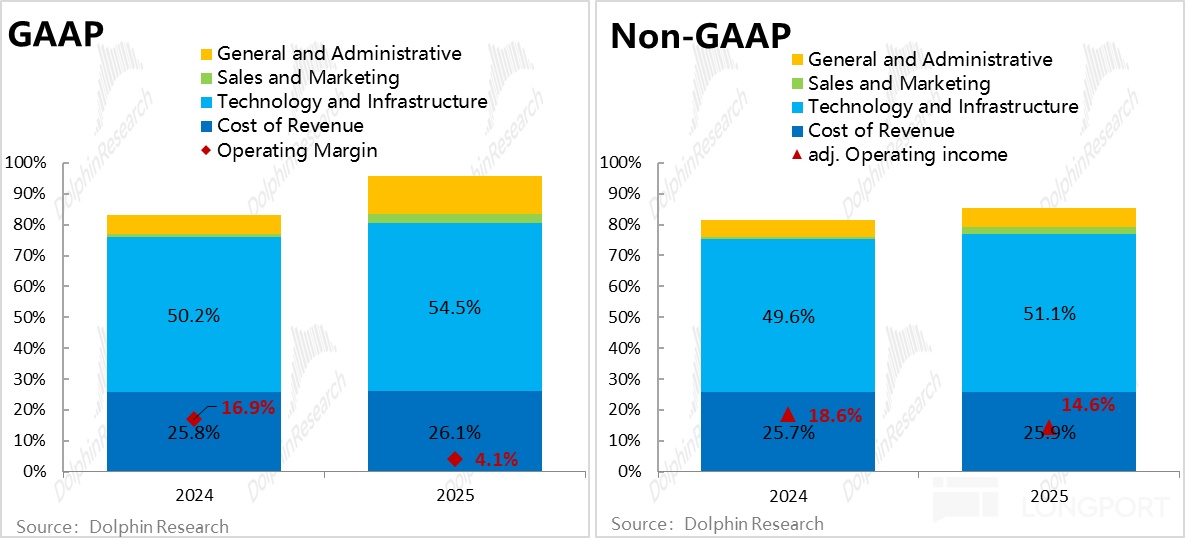
Key observations: GAAP OPM is low and hovered around breakeven in 2025 (-5% to +5%). Non-GAAP OPM is above 15% after excluding SBC, but SBC is a recurring cost and should not be ignored.
Headline GPM fluctuates around ~70%, which looks atypically high for a capital-heavy biz. That is because reported COGS excludes items that peers include; comparable costs are split between COGS and Tech & Infra opex.
G&A and S&M ratios are low. S&M is only ~1%–3% of revenue, consistent with serving a handful of mega-clients and minimal need for marketing or customer acquisition.
(2) Reclassification of costs and opex
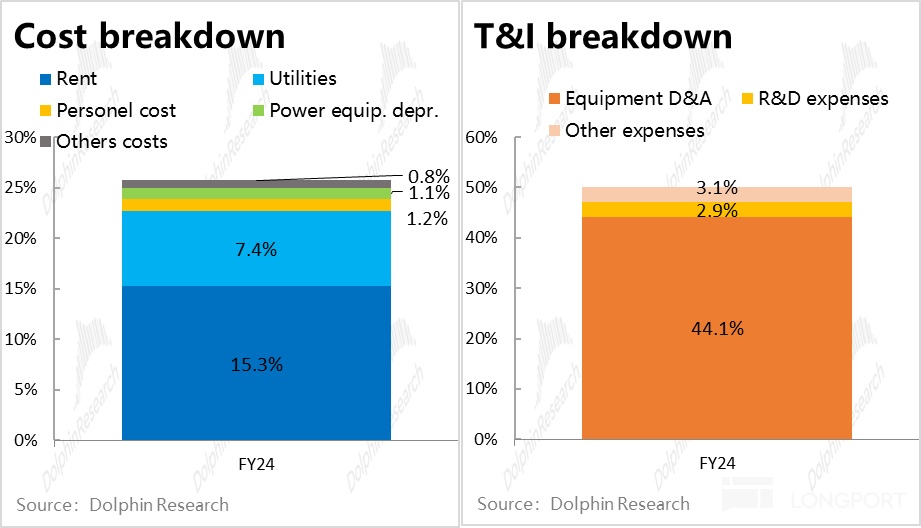
The company defines revenue costs as DC construction and energy-related items. Tech & Infra (T&I) mainly comprises depreciation of hardware and software, plus traditional R&D, software subscriptions, etc.
Breaking this down: depreciation of hardware/software (in T&I) is the single largest item, at ~44% of FY24 revenue. This reflects heavy IT capex and high GPU prices weighing on profitability.
Next are DC rent at ~15% of revenue (most sites are leased, with minimal building depreciation) and energy at ~7% (power, bandwidth, and energy equipment depreciation). On a conventional basis, CoreWeave’s true cost ratio in FY24 is ~75% (COGS plus T&I ex-R&D), while S&M + R&D + G&A together run ~10%–11%.
In 2025, the picture is similar: ex-SBC, cost ratio is broadly flat vs. 2024, and T&I is up only ~1–2ppt.
2.2. What is the steady-state margin?
At today’s model and scale, GAAP operating profit is roughly zero, before interest and taxes. Key questions are:
a) as the business scales and evolves, to what level can OPM improve and stabilize?b) during the first contract cycle with a mega-client, can cumulative cash inflows fully cover front-loaded capex?
(1) How does CoreWeave earn at scale?
To estimate steady-state margin and identify key drivers, Dolphin Research built a detailed bottom-up model (DM us if interested). We split the horizon into two phases: the first is the exclusive service period under take-or-pay, and the second assumes non-renewal, requiring remarketing of used hardware.
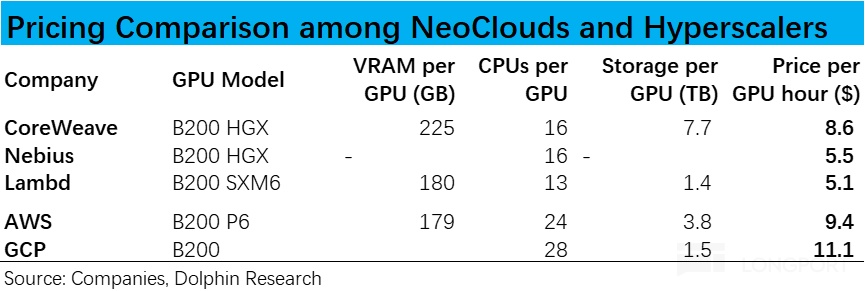
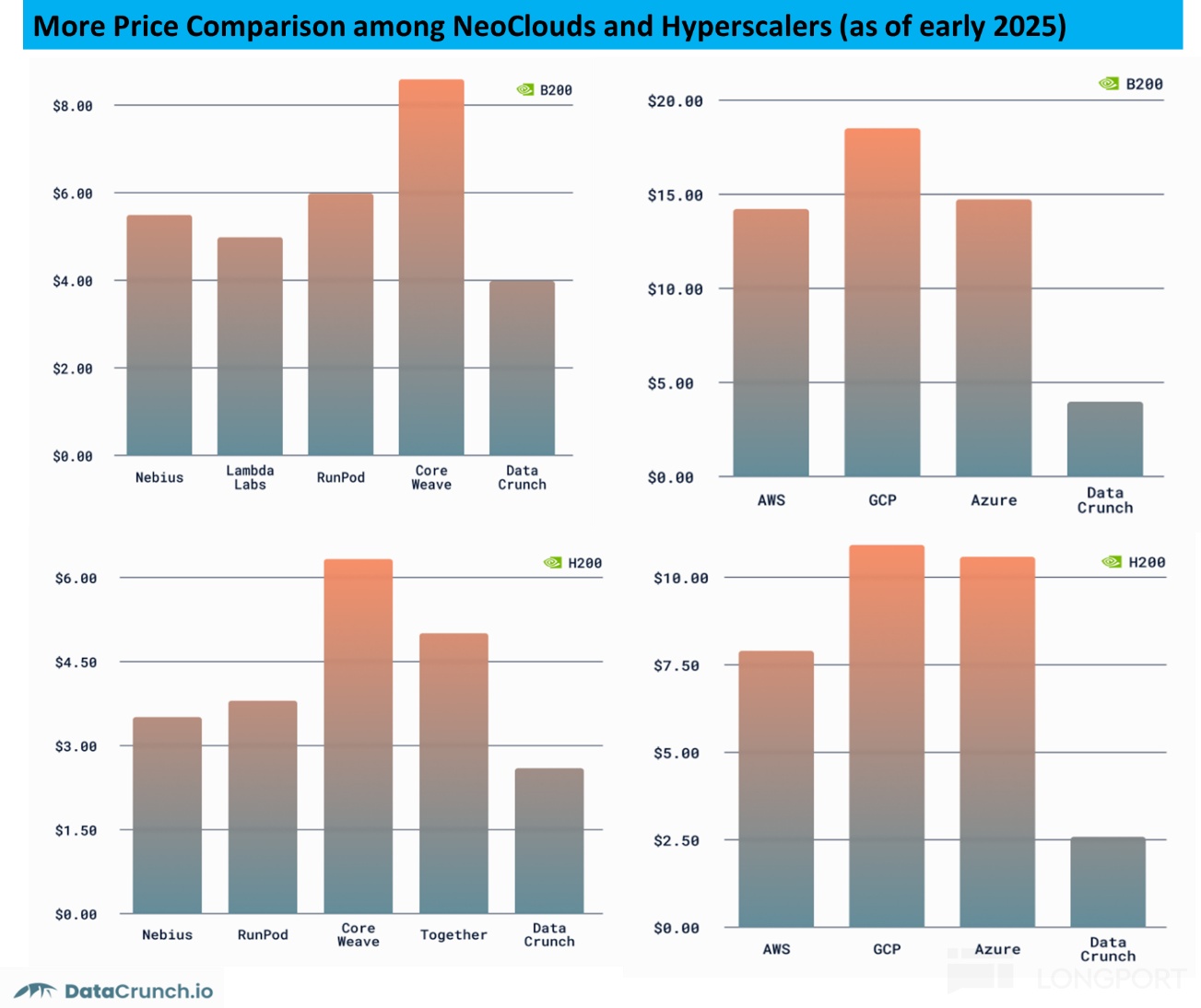
a) Pricing: for a single B200 GPU, hyperscalers charge ~$9–$11/h, above new clouds at ~$5–$8/h. With similar operating costs, new clouds earn lower margins due to weaker soft power like tech depth, stability, and trust.
Among new clouds, CoreWeave’s list price is the highest, underscoring its leadership. In practice, mega-clients get discounts, and the prevailing view is that the average realized price during the term is around $2.5 per GPU per hour.
The lifecycle swing factor is post-term price erosion. Our base case assumes the price drops to ~$1.5/GPU/hour in the first year after expiry and then declines gradually, broadly in line with where a 2020-vintage H100 prices today.
b) Utilization: under take-or-pay, utilization is effectively 100% during the initial 5-year term. Afterward, remarketing older hardware implies lower take-up; we assume 75% initially and trending down.
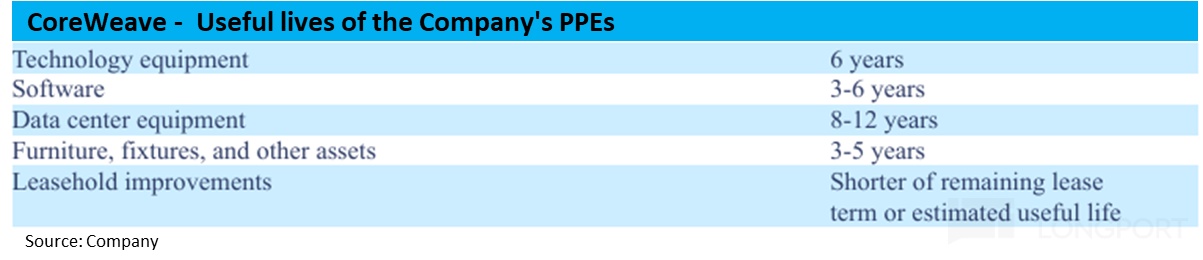
c) Capex and depreciation: IT gear is depreciated over 6 years. As depreciation is the largest cost, how many years the asset can keep generating revenue after full depreciation materially impacts lifecycle economics.
Another key driver is total upfront capex per GPU including ancillaries. If GPU and related gear get cheaper, margins can step up. A Blackwell GPU lists around $40k; our base assumes total upfront of 1.5x GPU price.
d) Other costs: variable energy costs track actual usage and hence utilization, while DC rent and other items are relatively fixed. There is limited room for cuts here.
e) Opex: traditional opex ratios are modest, at ~10%–20% in 2024–2025, with fluctuations mainly from SBC.
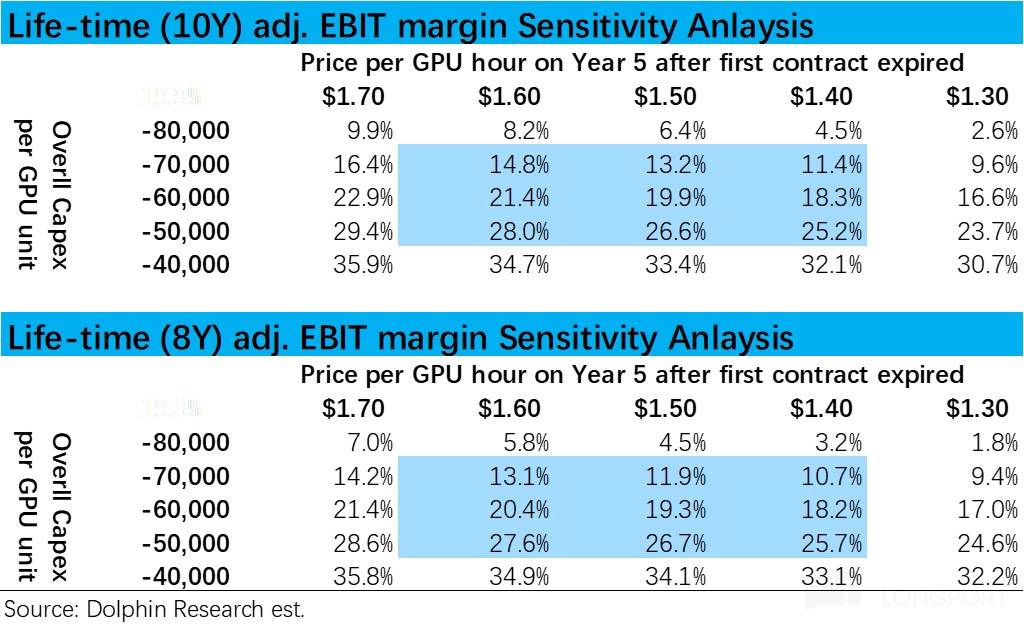
Under base assumptions, the lifecycle adj. EBIT margin per Blackwell GPU over 8–10 years is ~19%–20% (ex-SBC). If hardware is scrapped after just 6 years, the economics do not pencil.
This becomes our baseline for company-level steady-state margin. Sensitivity to post-term pricing and upfront capex yields a ~10%–28% adj. EBIT range.
2.3. High leverage is another drag
With 6-year depreciation and a ~75% cost ratio, revenue is quickly absorbed by capex needs. The company therefore leans on debt to fund growth, effectively reinvesting each quarter’s revenue and then some into new capex.
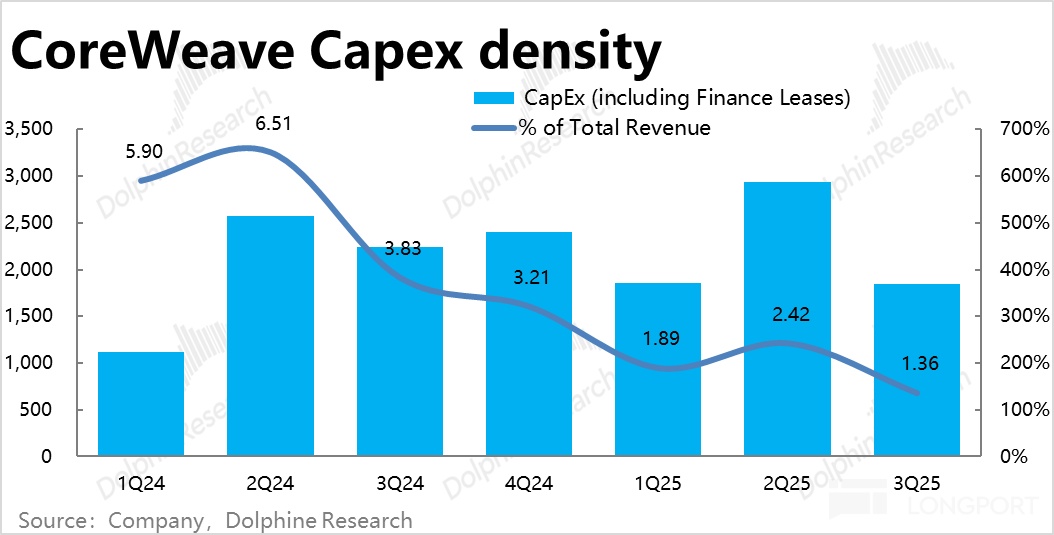
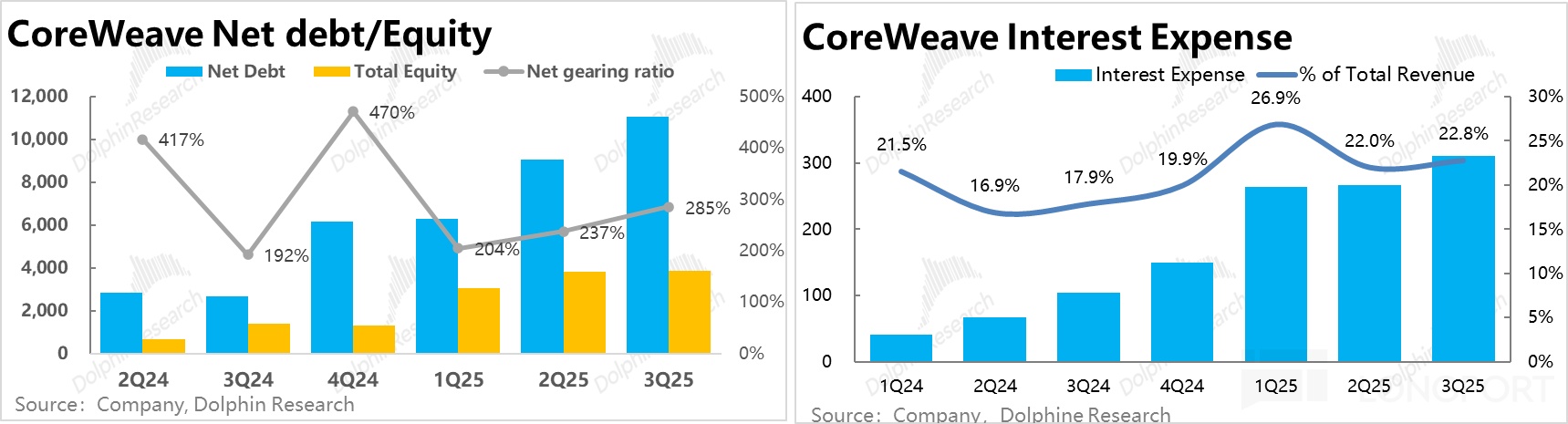
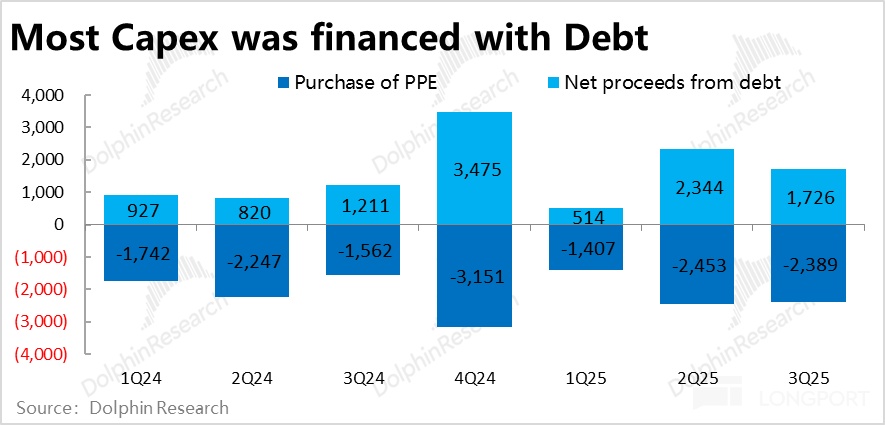
Three angles highlight this reliance: net debt has been ~2–4x shareholder equity over the past two years, pointing to debt over equity funding. Cash flows show capex outflows roughly matching new debt draws each quarter.
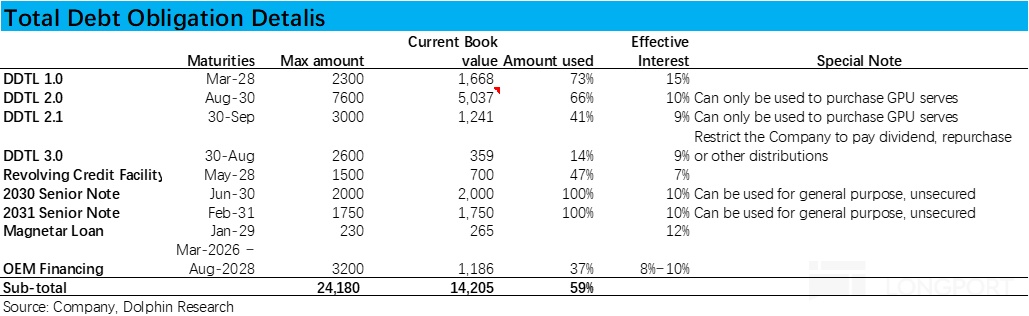
And interest expense has run near ~20% of revenue for the past two years. In Q3 2025 specifics: maturities are mostly 3–6 years, broadly aligning with contract tenors, and effective rates hover around ~10%.Compared with hyperscalers and even UST funding costs, these are plainly high for a smaller company.
This leverage enables rapid scale without large equity raises. But it also means modest operating margins are further eroded by interest, raising insolvency risk if growth or renewals disappoint.
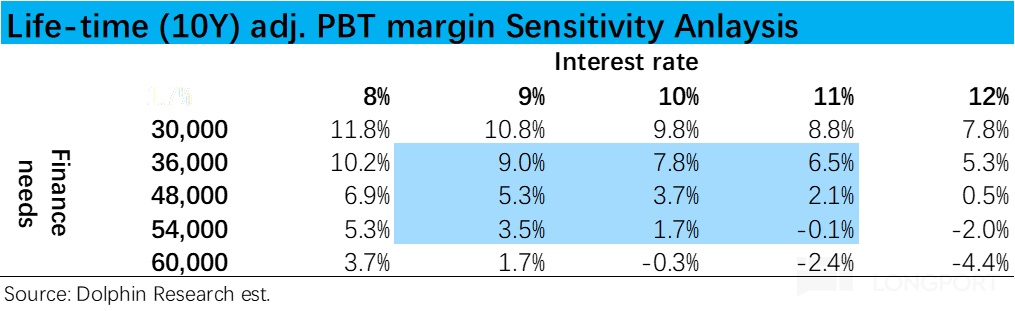
Incorporating leverage into the unit economics: base case assumes 90% of capex funded by debt at 10% interest, 5-year term, bullet principal at maturity.
On that basis, avg. pretax margin over a 10-year lifecycle is only ~1.7%, and breakeven is not achieved over 8 years. Sensitivity across 50%–100% debt funding and varying rates implies a ~0%–9% pretax range over 10 years.
Relative to ~20% adj. EBIT on $60,000 total capex, interest drag is ~11%–20%.
3) Valuation math: is CoreWeave investable?
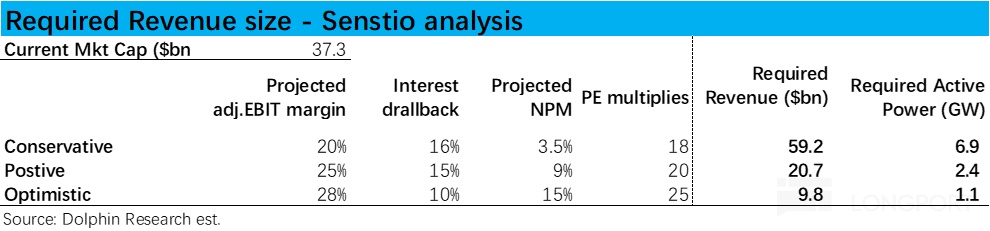
The remaining task is to triangulate mid-to-long-term revenue scale. Our approach is to back into required steady-state revenue from the current market cap under various steady-state margin scenarios, then test feasibility.
We derive the following revenue requirements under three cases:
a) Base-conservative: the company remains a supplier tied to Nvidia and OpenAI, fails to diversify away from mega-clients, and makes limited progress in software and higher value-added services. Pricing power stays weak and margins are low.Using an 18x steady-state PE given the mediocre model, required steady-state revenue is around $59 bn.
b) Moderately positive: assume better customer mix, stronger soft power, improved pricing, lower hardware costs/depreciation, and/or more efficient fixed costs. With ~9% net margin, required revenue is around $20 bn.
c) Bullish: on top of the above, assume lower debt funding or lower funding costs, trimming interest burden. With ~15% net margin, required revenue is roughly ~$10 bn.
Can these revenue bars be met? Starting with the most optimistic case:
a) Bull case: can revenue reach $10 bn+? As of Q3 2025, ~$55.6 bn total backlog has ~79% due over the next four years, implying about $11 bn per year already contracted. On existing commitments alone, the target is met; any new awards should lift equity value, making current levels an attractive entry.
b) Moderately positive: this requires ~$20 bn revenue, roughly a doubling from the annualized run-rate implied by current contracts. Consensus expects that by 2027.
Dolphin Research sees a decent chance. OpenAI’s cloud spend is projected at ~$57–95 bn during 2027–2029. If CoreWeave captures ~20%–35% of that, it would be enough, with other customers as additional upside.
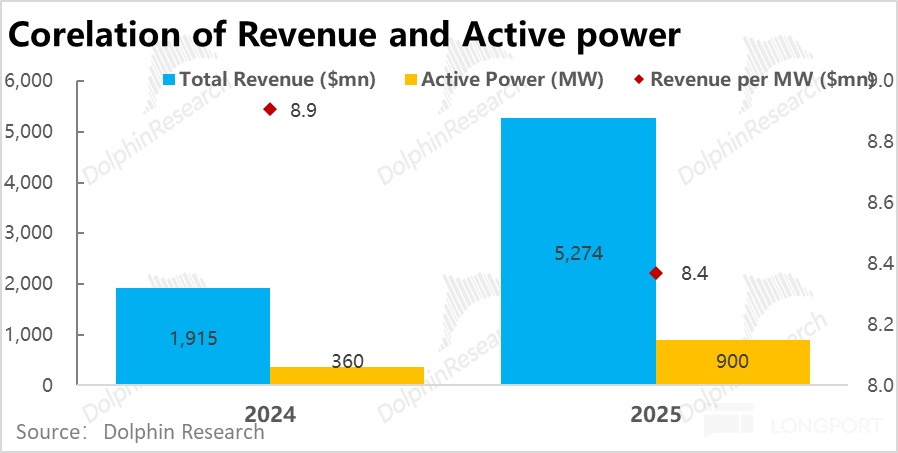
On supply, recent history suggests ~${8.5} mn annual revenue per 1 MW of deployed compute. That implies ~$20 bn revenue equates to ~2.4 GW online, below the 2.9 GW of contracted power, so power is not a bottleneck.
In this case, watch for management disclosures of new orders sufficient to support a $20 bn annualized revenue base before considering entry, assuming the stock has not already priced it in.
c) Conservative: the ~$59 bn revenue and ~6.9 GW compute required look unlikely unless CoreWeave becomes OpenAI’s top capacity provider or a key supplier to other giants like Google or Meta.
Given Google’s in-house cloud and its push to reduce reliance on Nvidia GPUs, it seems unlikely to rely on CoreWeave as a primary compute supplier for now (Google is currently leasing CoreWeave DC space).
If this is the case, the stock has little investment value at present.
For now, Dolphin Research views the moderately positive case as the base scenario. If there are credible signals that annualized revenue can exceed $20 bn, and the stock has not rerated materially beforehand, we would consider an entry.
It is still prudent to keep a margin of safety. The conservative case, where long-term net margins stay in the low single digits and value is near-destroyed, cannot be ruled out.
Dolphin Research prior work on [CoreWeave]
2025.12.16 CoreWeave: Nvidia’s favored child, or lasting franchise?
<End of text>
Risk disclosure and disclaimer: Dolphin Research Disclaimer and General Disclosure
The copyright of this article belongs to the original author/organization.
The views expressed herein are solely those of the author and do not reflect the stance of the platform. The content is intended for investment reference purposes only and shall not be considered as investment advice. Please contact us if you have any questions or suggestions regarding the content services provided by the platform.
