


HOOD: What's Left After the Frenzy?
Quadrupled in nine months, then halved in four. From 2025 into 2026, few 'wild rides' top retail broker Robinhood$Robinhood(HOOD.US). Volatility has been relentless.
After Longbridge U.S. session close on Feb 10, 2026, the 'retail king' posted Q4 2025 results as scheduled. But the print was a fresh hit just as a rebound seemed underway.
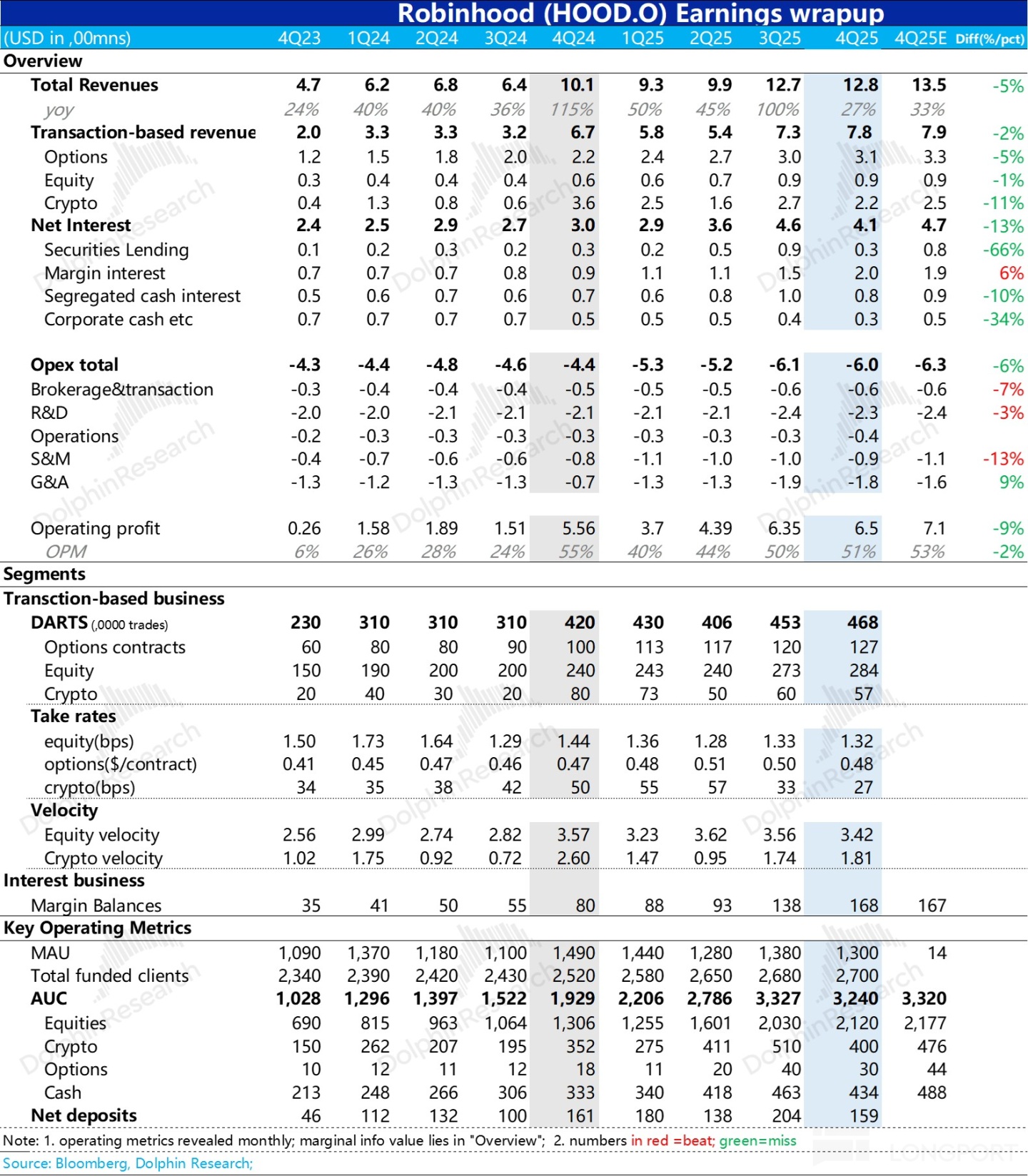
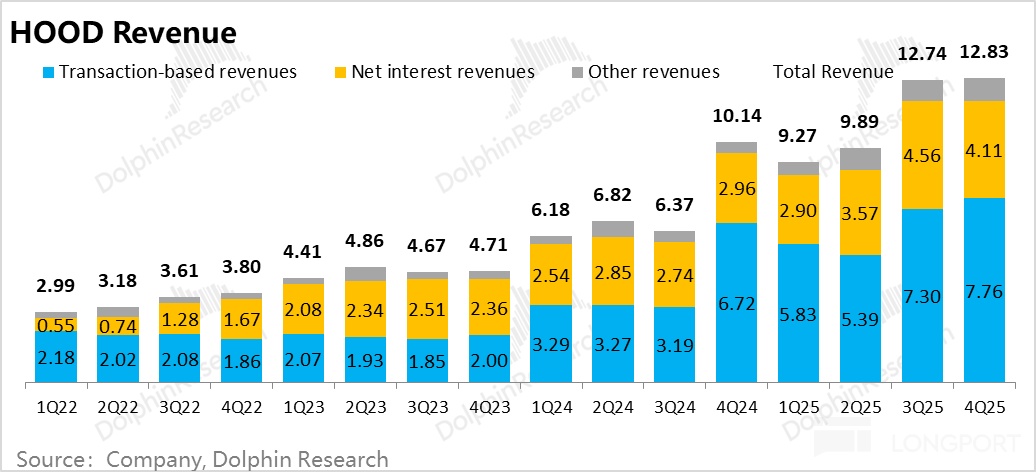
1. Total revenue: $1.28bn, +27% YoY, flat QoQ. Consensus was $1.35bn, so revenue undershot by ~5% despite fully transparent operating metrics.
Operating profit was $650mn, below the $710mn Street view. Same root cause: revenue missed.
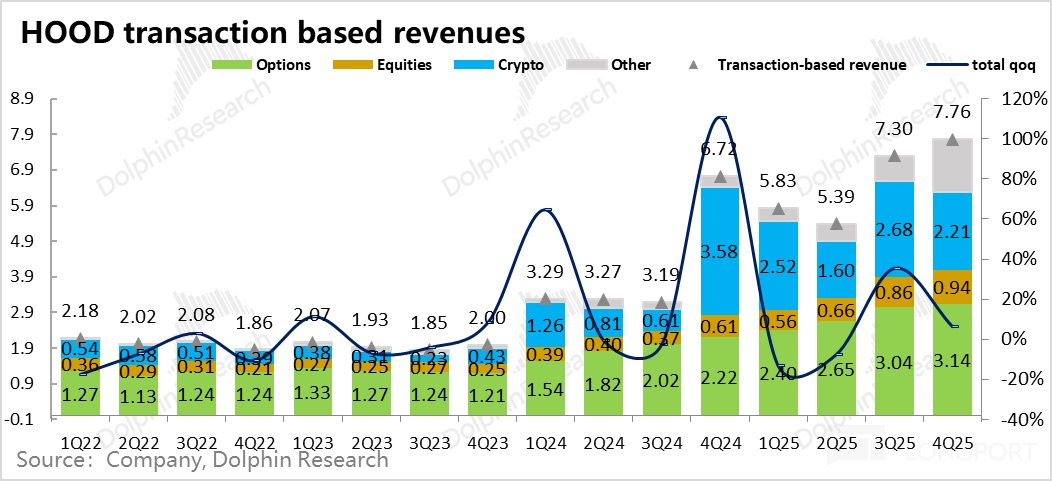
2. Transaction revenue: $780mn, barely in line. Options, equities, and crypto volumes were known; the delta came from monetization: the crypto revenue capture rate slipped 3bps QoQ to 60bps.
This is the first dip in crypto capture since shifting to smart order routing. It signals the monetization tailwind in crypto is nearing its end.
3. Net interest-like revenue: $410mn, below the $470mn consensus. The main drag was securities lending: with liquidity tightening in Q4 after a Q3 retail frenzy, borrow became easy and spreads collapsed.
With the U.S. gov. shutdown, liquidity fell off a cliff, and HOOD's lending revenue shrank over 60% QoQ to under $30mn. That badly missed the linear extrapolation of ~$80mn.
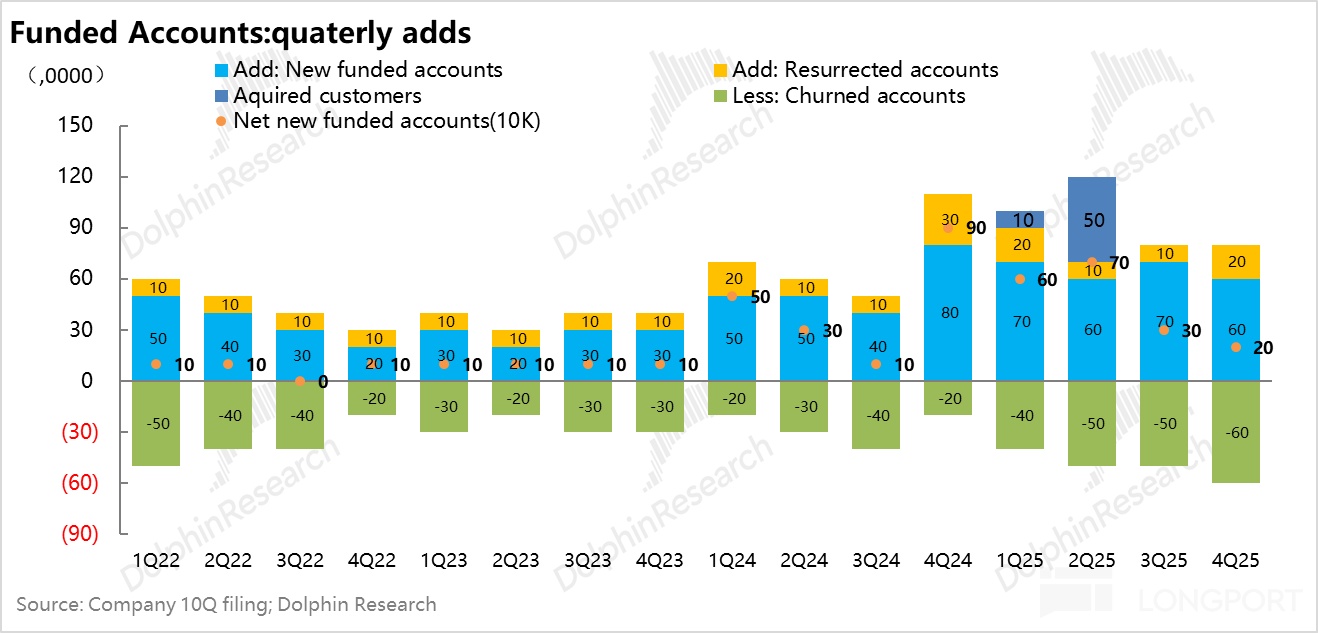
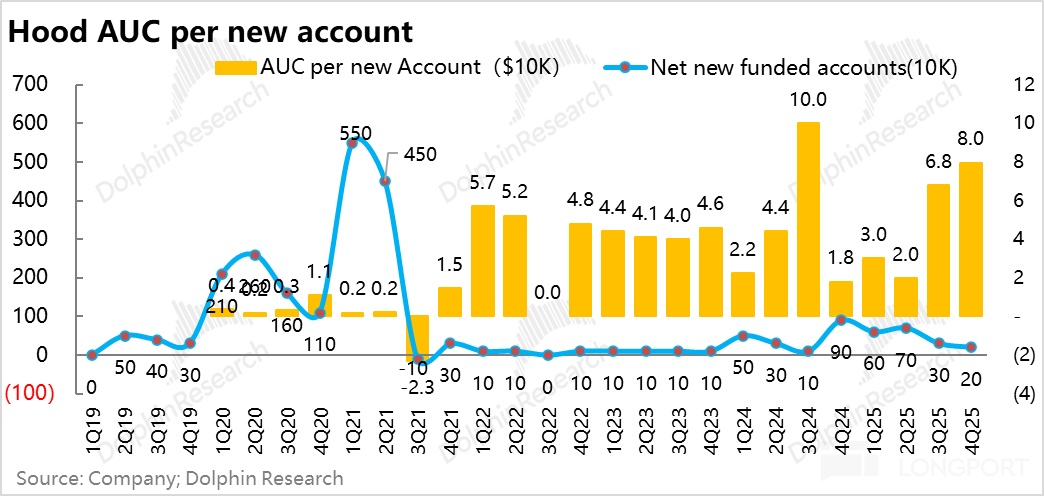
4. User growth intact: Funded accounts added 200k in Q4. Acquisition cost rose modestly to $217 per customer on weaker markets, still manageable.
Avg. first-time deposit per new user has climbed to roughly $70–80k. That is a clear broadening beyond the prior few-thousand to $10–20k cohort.
5. 2026 key guide: Revenue is market-dependent and not forecastable. Mgmt focused on 2026 opex: Adj. expenses guided to $2.6–2.725bn; at the midpoint $2.6625bn, implying ~18% YoY growth.
With 80–90% of costs largely fixed, this is unsurprising. Profit elasticity in 2026 will hinge on the revenue line.
6. Results snapshot:
Dolphin Research view:
As noted last quarter, HOOD’s 4x run into Oct 2025 reflected four concurrent cycles: product innovation, M&A expansion, crypto monetization upshift, and a liquidity-fueled bull market. Those factors resonated together.
The precondition for sustaining a premium multiple was: a) structurally low monetization across the asset ecosystem with room to keep releasing, and b) an ongoing U.S. bull market. These were crucial.
But after Oct 2025, the gov. shutdown tightened liquidity. The first casualties were crypto beta and retail-fueled 'hot' names on HOOD, while crypto monetization’s upcycle also tapered.
These declines drove crypto revenue down 20% QoQ and securities lending down over 60% QoQ. The hit was direct and material.
By Feb 2026, with Kevin Warsh, a 'QT-leaning' nominee, tapped for Fed Chair, liquidity darlings and high-multiple assets were de-rated sharply. Robinhood was not spared.
The stock has fallen back to $70–80. The multiple continues to compress, with 2025 PE now ~35x.
On a 2026 run-rate scenario of $1.4bn revenue per quarter ($5.6bn annualized) and opex guidance, implied post-tax OP is around $3.4bn. At 30x 2026 PE, market cap could still top $100bn.
Jan operating data show a rebound in stock and options trading, and even crypto appears to be bottoming. If crypto does not leg lower, risks look more contained.
For a safety margin, assume $3.0bn post-tax profit in 2026 (i.e., 2026 revenue barely above Q4 2025 annualized, though in practice growth should continue). With a 20x long-term EPS growth multiple, that implies ~$60bn market cap, or sub-$70 per share.
Overall, after two years of restructuring, product innovation and appeal to younger users have returned, making HOOD a quality asset. The prior surge was exuberance from four cycles in sync; the subsequent 50% drawdown reflects overextended multiples beyond fundamentals being rapidly squeezed as liquidity expectations tightened.
As valuation normalizes and sentiment skews too negative, an asset re-entering an innovation cycle can present long-term buy-and-hold opportunities near the margin of safety. Timing and discipline matter.
Detailed analysis follows: More below.
The company discloses monthly data on acquisition, client funds, trading volumes, margin balances, and securities lending, so the print hinges on capture rates, yield on interest-bearing assets, and cost discipline. Those are the swing factors.
I) Trading: Is the monetization upcycle near its end?
For users, HOOD is known for zero commissions and low fees; for investors, the earnings lever is effectively raising users' 'fees'. This translates into a higher revenue capture rate on trading flows, now centered on crypto.
The front-end driver of higher capture is the business model upgrade. It moved from PFOF-like rebates that raised best-execution concerns to explicit tiered pricing based on 30-day rolling volumes.
The back-end is smart order routing. It slices large orders to avoid liquidity distortions at a single venue, improving price discovery and execution quality.
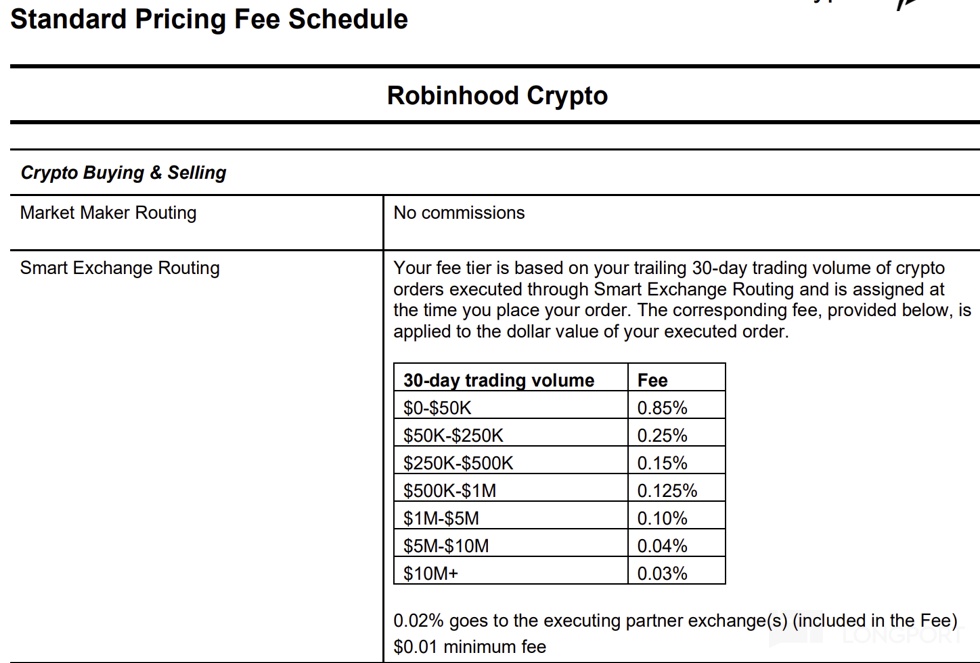
This pricing currently applies mostly to crypto, with HOOD increasing smart routing penetration vs. pure PFOF. Technically, it can extend from crypto into equities, where capture is also still low.
1) Crypto monetization is rising, but below hopes
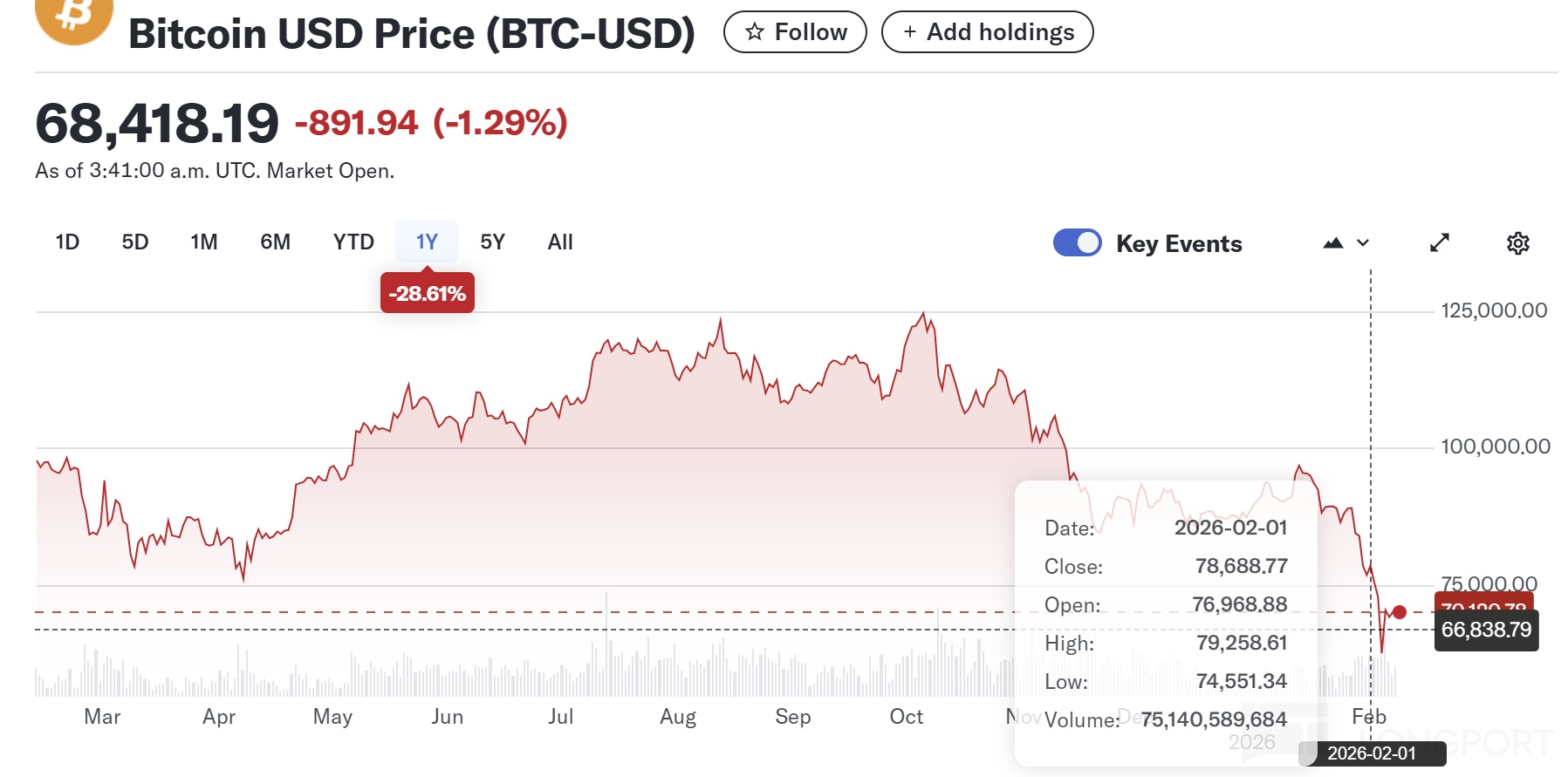
Based on disclosures, HOOD App’s crypto capture was ~60bps in Q4, down 3bps QoQ. There remains a wide gap vs. Coinbase’s ~150bps theoretical ceiling.
From H2 2024 to end-2025, HOOD’s crypto capture climbed from ~35bps to ~60bps. Street now sees a peak near ~70bps, suggesting the uplift is close to tapped out.
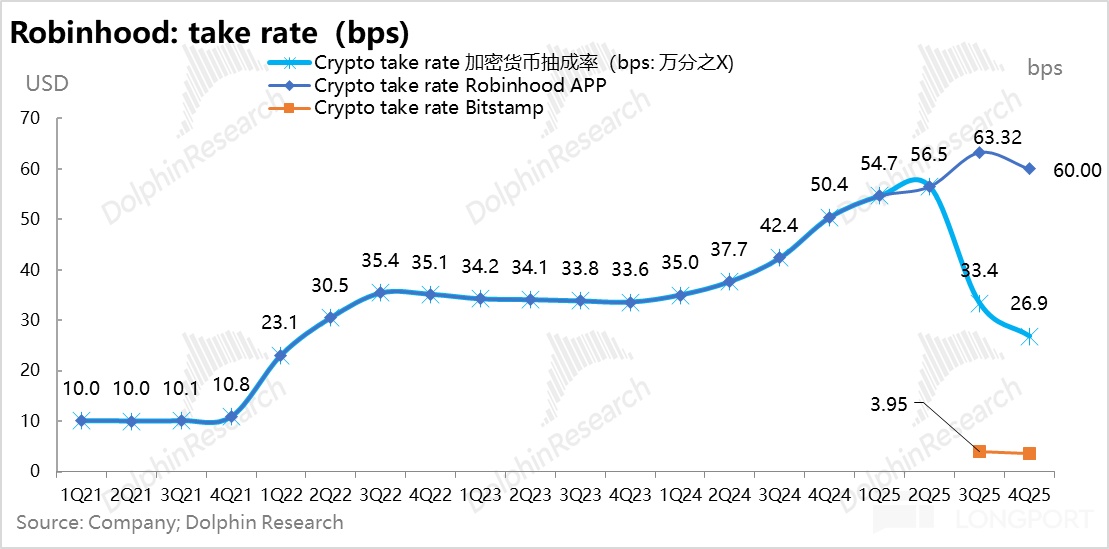
Also, Bitstamp, consolidated in Q3, did $48.5bn of Q4 volume (90% institutional, 10% retail) vs. HOOD App’s $34.0bn. Given the institutional mix, Bitstamp capture was just 3.52bps, generating only $17mn and dragging consolidated crypto capture to 27bps.
This is not a problem. The Bitstamp deal is about Intl expansion, licensing, and vertical integration into clearing/settlement, not about boosting capture.
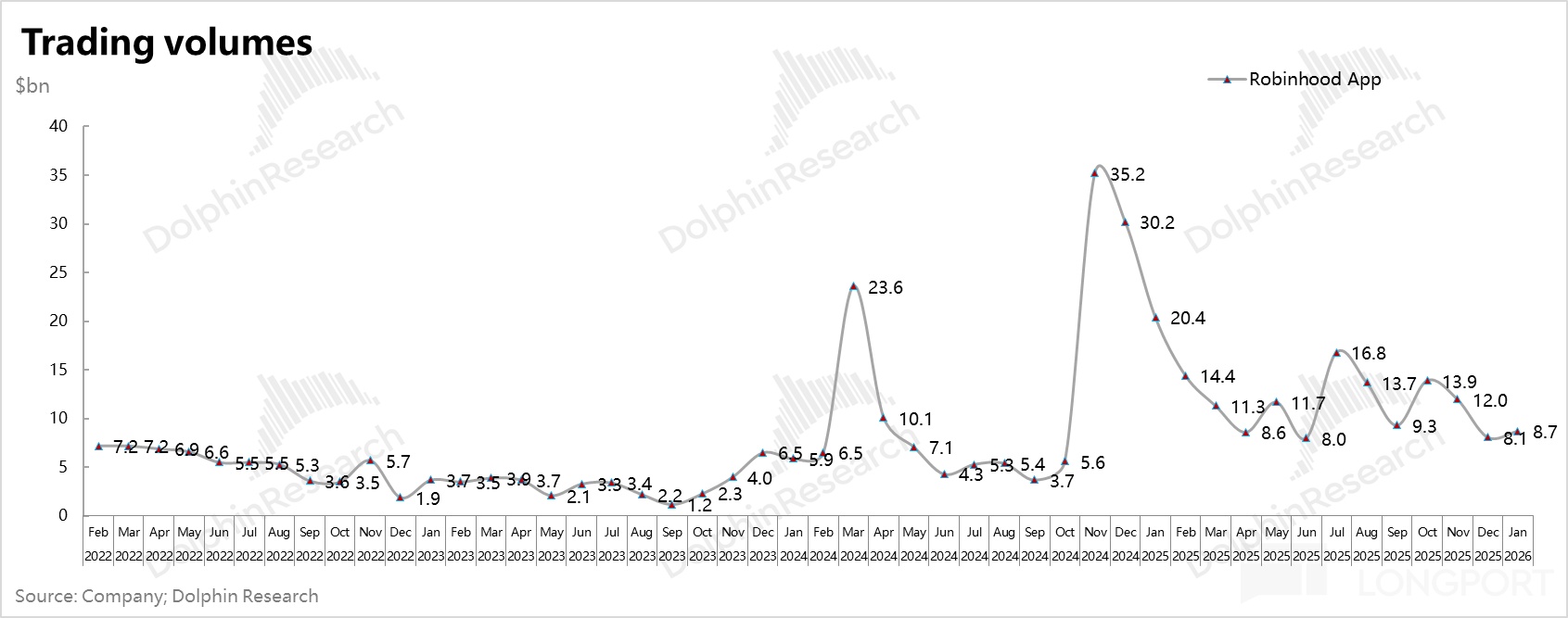
On flows, industry Q4 crypto volumes fell 9% QoQ; HOOD App was down 14%. Retail platforms show higher beta up and down.
Despite the Warsh shock and a sharp crypto drawdown, U.S. Treasury signals against rapid balance-sheet runoff have helped crypto and other liquidity-sensitive assets stabilize. They have started to rebound.
To date, this looks more like a positioning washout after overly crowded, levered bets on a Fed nominee. Ahead of the 2026 election, the risk of true QT-driven declines appears much smaller.
2) Options and equities steady
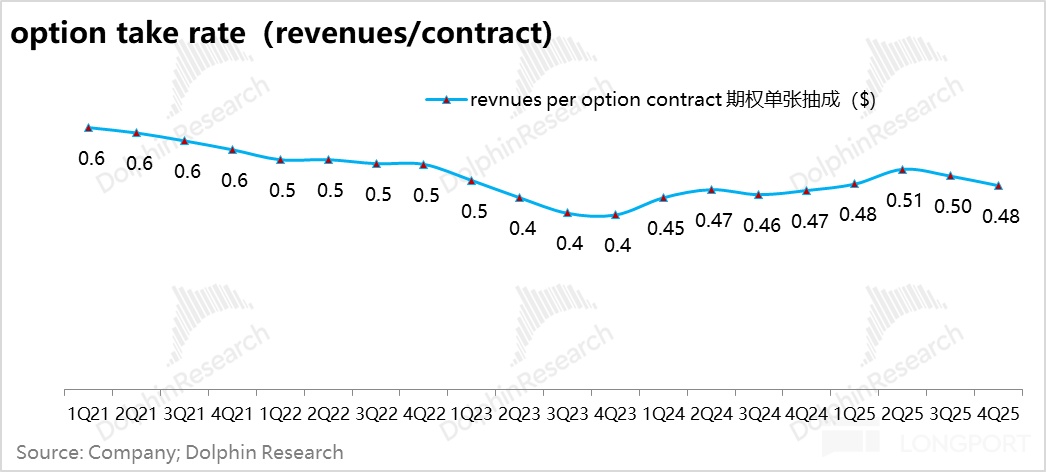
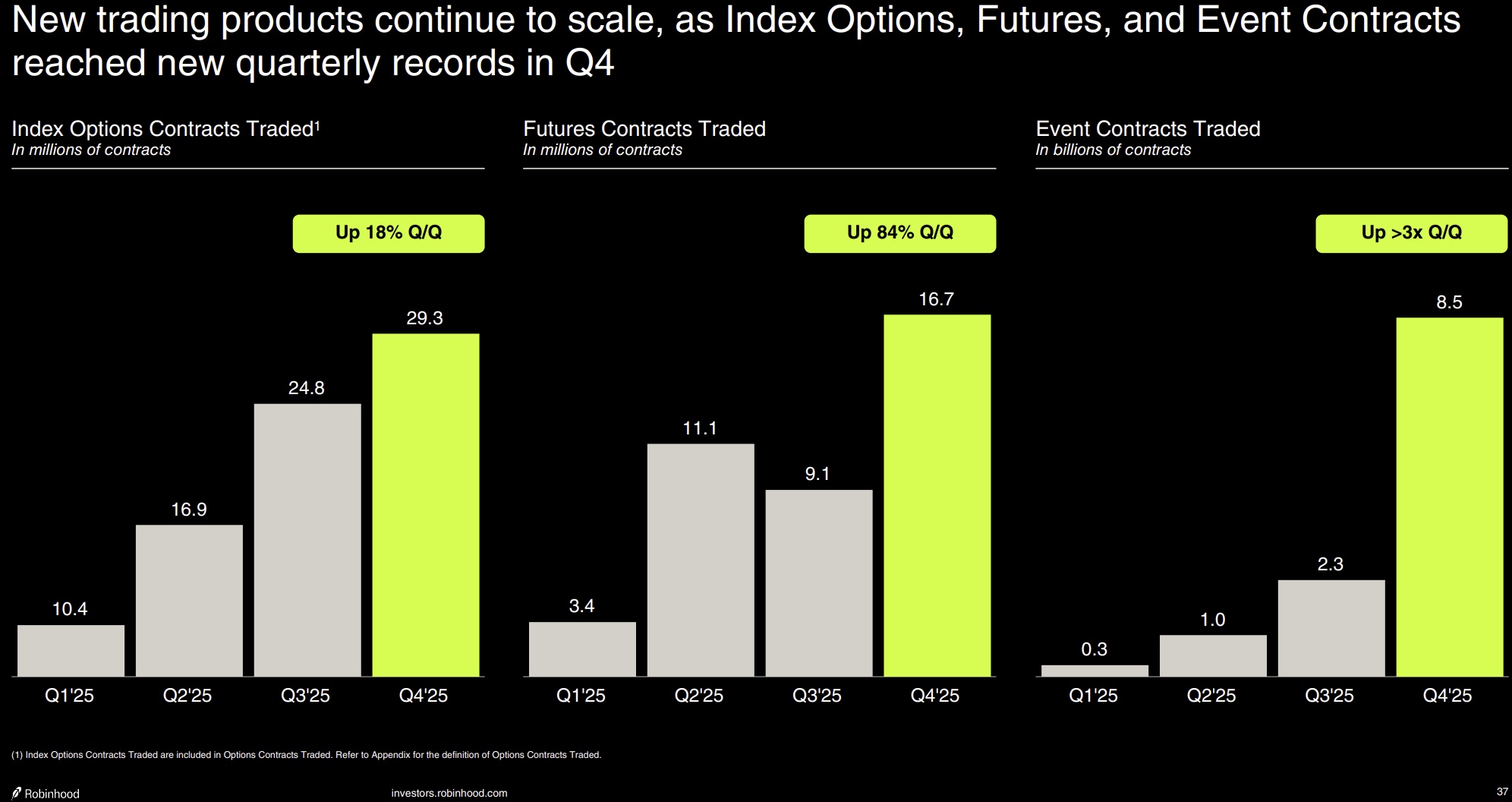
Options: Contracts hit a record QoQ, driven by new products like index options. Q4 options revenue was $314mn, +3% QoQ.
Revenue per contract was $0.48 vs. $0.50 in Q3. Slight slippage, but broadly stable.
3) Equities: modest monetization improvement
Q4 equities volume rose 10% QoQ, beating the market’s ~5% QoQ. Capture, still mainly PFOF, held at 1.32bps, driving $94mn revenue and underscoring low equity monetization.
Total transaction revenue reached $780mn in Q4, up from $730mn in Q3. The QoQ lift mainly came from 'other' at $150mn (predictions, withdrawals, futures, etc.), which doubled QoQ.
The standout was event prediction, effectively betting. It grew from under $30mn in Q3 to over $100mn in Q4, an eye-popping ramp.
II) Interest-related: securities lending reset
Interest businesses include securities lending, margin lending, and segregated cash. Securities lending is market-sentiment sensitive; segregated cash tracks rates.
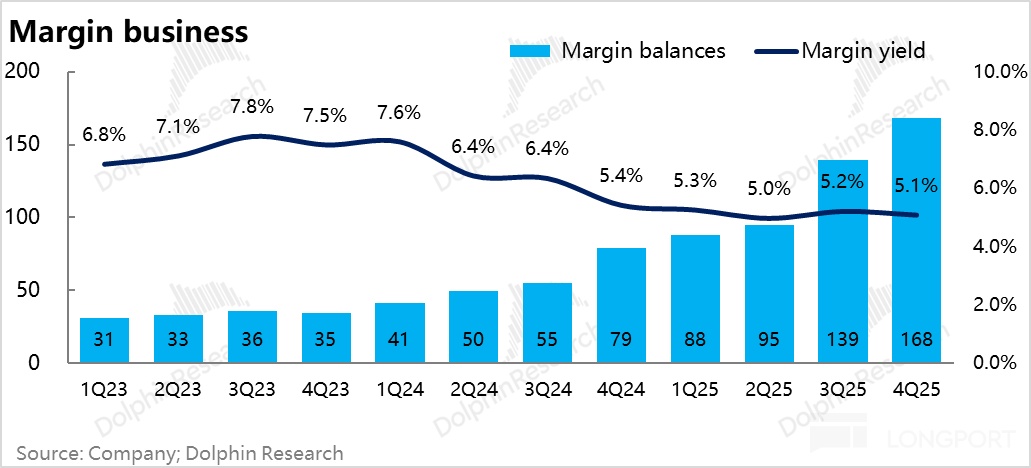
a. Margin lending: $200mn in Q4, +28% QoQ, remained strong. Growth is balance-driven, a balance-sheet business funded by sizable equity/capital, augmented by converts around the IPO.
Yield even dipped slightly to 5.1% in Q4, holding up well. The real driver was balances, up from $13.9bn to $16.8bn, sustaining high growth.
b. Securities lending: $26mn in Q4, down from $87mn
When clients borrow stock, they post cash collateral held as segregated cash at HOOD. The platform earns: a) interest on that segregated cash, and b) additional spread income based on borrow scarcity.
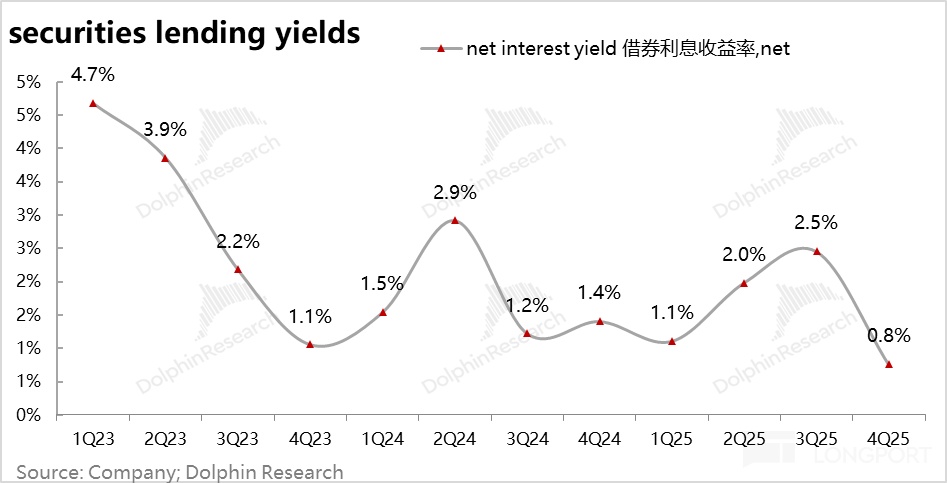
The latter is reported as securities lending revenue and depends on specialness/shortage; the former sits in segregated cash interest and tracks rates. Both moved against HOOD in Q4 for lending.
Dolphin’s math shows a Q4 lending yield of just 0.8%, a steep drop. As small-cap speculation faded, borrow became abundant, collapsing yields toward historical lows.
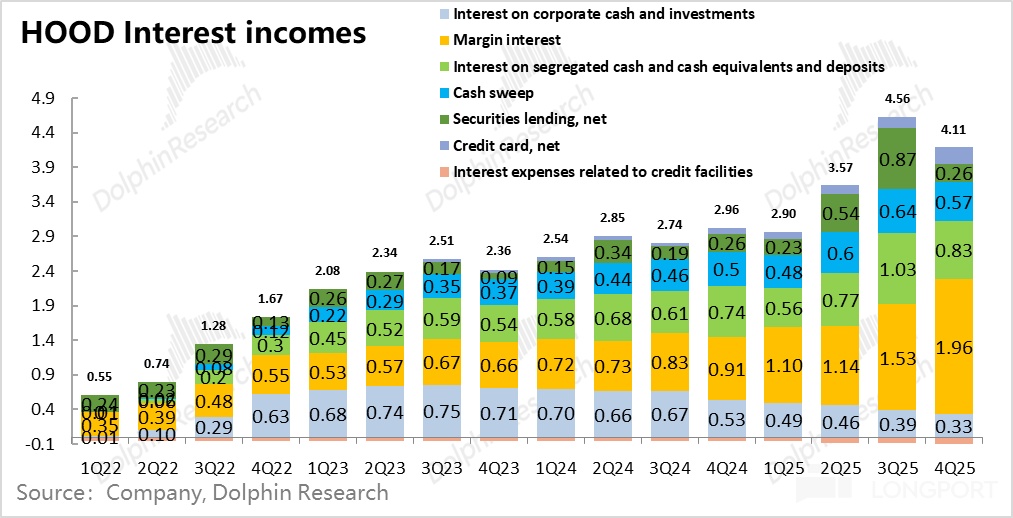
c. Segregated cash interest: $83mn in Q4, the second-largest interest line.
All interest lines plus cash sweep (bank products via HOOD) and interest on corporate cash totaled ~ $410mn, down ~10% QoQ, mainly on lending underperformance. That was the primary drag vs. expectations.
Transaction and interest revenues make up ~90% of HOOD revenue: +27% YoY, ~0% QoQ. Given the known upside in predictions, flat total revenue implies the shortfall was largely lending.
III) Costs remain disciplined
Mgmt does not guide revenue, but the long-term framework is faster revenue growth vs. opex, with ~90% of costs fixed, enabling operating leverage and rising margins. That remains intact.
In Q4, with revenue flat QoQ, opex was also flat. R&D, the largest bucket, held steady and G&A did not step up.
Operating profit was $650mn (OPM 51%), or $760mn and 60% margin if you add back SBC. That reflects meaningful leverage.
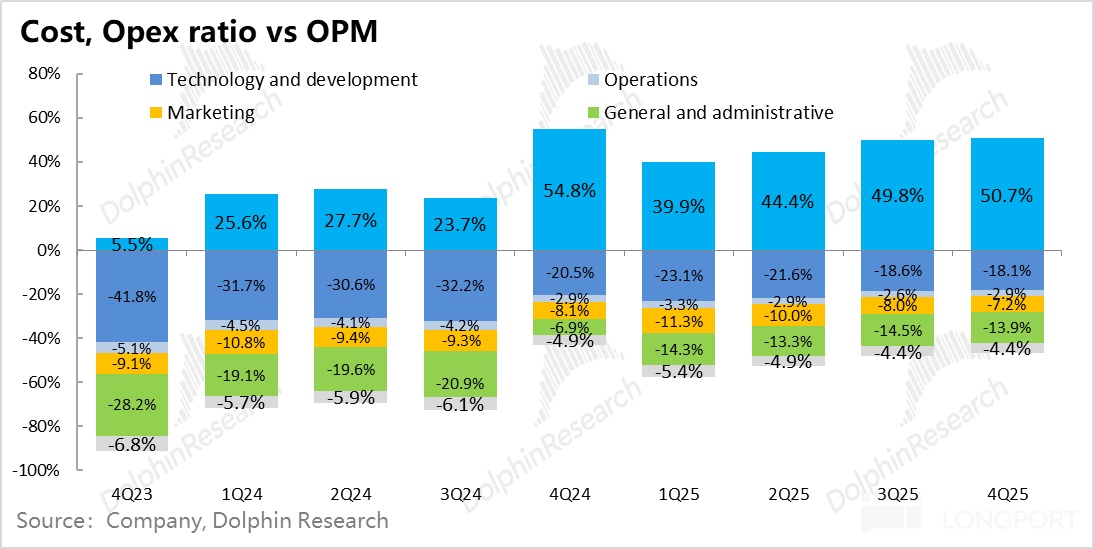
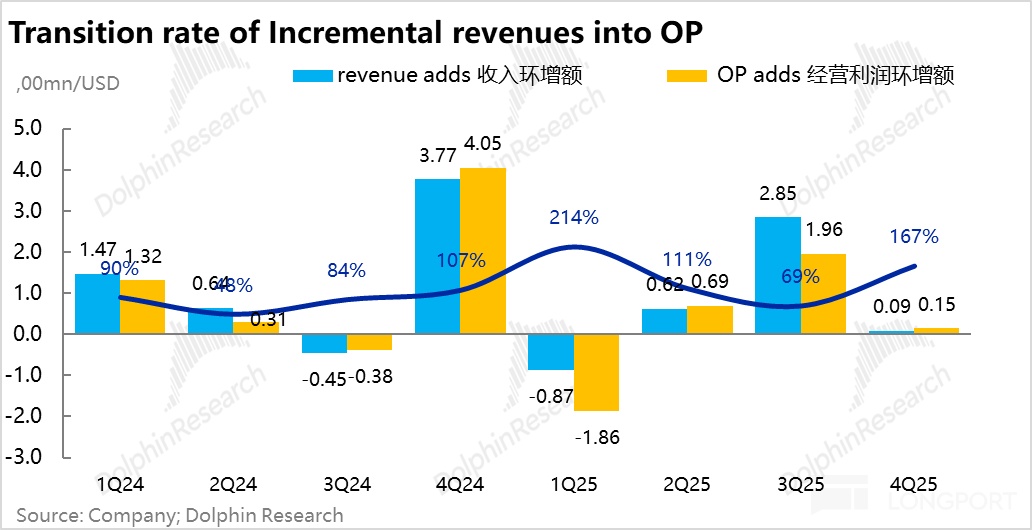
Bottom line, with largely fixed costs, incremental revenue converts heavily to profit. As the top line scales, margins should keep expanding.
IV) User growth steady
Funded accounts net-added 200k in Q4. CAC was $217 per user; given weaker markets, that is broadly stable.
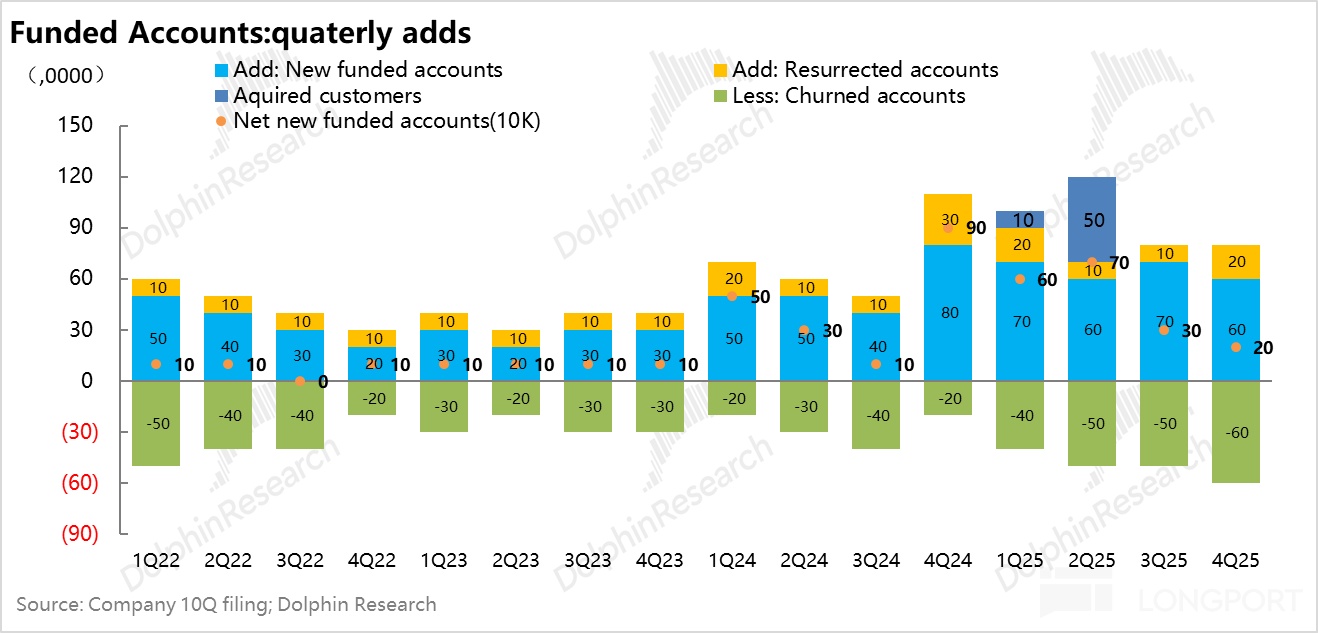
Avg. AUM per new user rose to ~$80k, indicating penetration into more traditional 'old money' segments. That is a notable shift in mix.
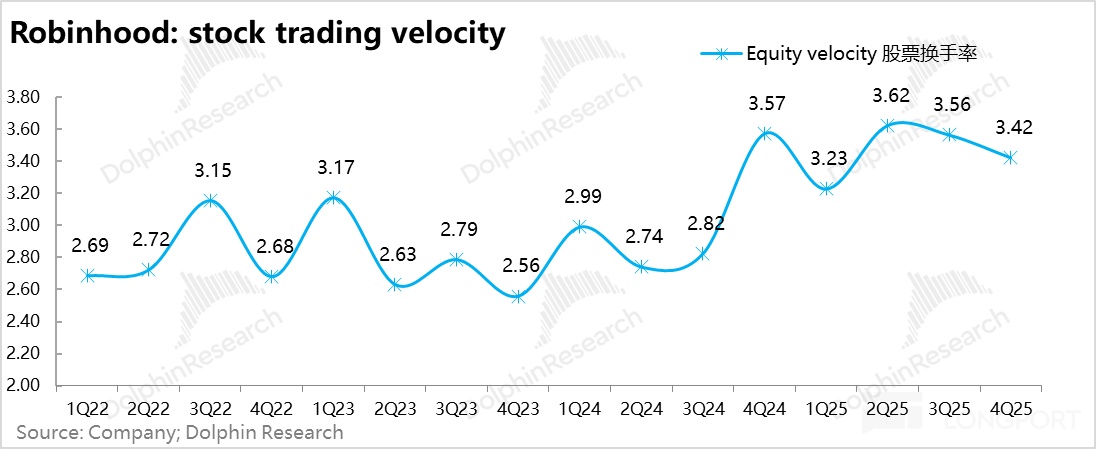
Client turnover (equity volume / avg. equity AUM) was 3.42x in the quarter. It eased only slightly, showing healthy velocity.
<End here>
Dolphin Research past pieces:
‘Robinhood: A 4x in a Year — Is the U.S. Retail King Really That Strong?’
‘Robinhood: Tokenized Equities Have a Long Runway — Is the Retail King Unstoppable?’
‘Robinhood: Trump’s Boost Brings the Retail King Back’
‘Robinhood: Born Rebellious, Bound to Become Mainstream?’
‘The Retail ‘Boxer’ Robinhood: Can One Trick Win Everywhere?’
Risk disclosure and statement:Dolphin Research Disclaimer and General Disclosures
The copyright of this article belongs to the original author/organization.
The views expressed herein are solely those of the author and do not reflect the stance of the platform. The content is intended for investment reference purposes only and shall not be considered as investment advice. Please contact us if you have any questions or suggestions regarding the content services provided by the platform.
